Poverty Inc.

Last week my husband and I attended a showing of the movie, Poverty, Inc. which also included a panel discussion afterwards.  The movie was educational, inspirational, and thought-providing.  It also was convicting.  The main premise is that the way we (wealthy, "developed", western world, whichever word you choose) have "dealt" with poverty and those who are struggling is not sustainable, nor healthy.  In some respects those who are trying to help are really hurting and keeping people in poverty.  The title Poverty, Inc. suggests that there is a huge business in the multitude of NGOs (non-government organizations) and in the system we have created, all in the name of helping.  

One of the biggest hurdles is that those who help never ask the ones who they are helping what they want.  How do they (the impoverished) see themselves and what would be the best plan to get out of the situation?  For many, many years the people who are to be helped were never themselves factored into the equation.  They were just told to do certain things in a certain way or they were given things without any idea of how to get those items on one's own all in the name of "aid".  It was a very paternalistic approach which on so many levels doesn't work.  Not only does the poverty perpetuate but the self-esteem of the one who is being helped is chipped away. 

It got me thinking.  The crux of this larger global problem is no different than helping a family member or a person in one's community, or coaching a client;  each individual has the right to self-determination.  Each person knows what they want to achieve or has some inkling that needs to be unearthed.  Of course, some might not have the tools in their toolbox to do so, but that would be part of the overall plan- discovering what is needed to learn in order to achieve the goals.  And a plan includes steps to achieving goals.  Many times even if if the person has determined that they need such and such, if there is not an overall reason for getting those needed things, it is not a plan.  

Most people are compassionate, generous and have big hearts.  We want to help others. We may in the name of love try helping by providing "aid"; money, food, help, etc. but if the one who needs assistance doesn't ask for it or hasn't determined what he/she wants, the assistance won't be sustainable.  As it was pointed out in the movie, sometimes the seemingly generous logical task, i.e. donating used clothes to countries in Africa, unintentionally causes harm- cotton growers and textile manufacturers in Kenya have gone defunct.  People say why should I buy clothing when I can get if free?  And so an entire industry and livelihood is gone.  

The new buzz word is partnership.  Those projects that work the best are those that the nationals have determined would be best for themselves and their community.  They shared a beautiful antidote of a company in Haiti that is using the local community to make beads and necklaces that are being sold to various stores in the United States.  They use  low-tech technology to produce the beads and have sold enough to continue employing people.  From starting with just one or two employees, currently they are up to a couple hundred. This provides the adults in this community to have a wage and  to care for their children.  There was a story of a woman who had turned up to the orphanage to hand over her child for whom she couldn't care. (Apparently this is a big problem- parents are "sacrificing" one of their children to an orphanage, knowing that the child will be educated, cared for with food and medicine and may have an opportunity to live a better life with another family. The child has parents but they are at a loss of what to do since there are minimal jobs.)  Someone asked her, if you could work would you keep your child?  Of course was the reply.  The bead group took her in, she learned to make beads and she set small goals for herself.  i.e. If I make so many necklaces in the next couple of months, I can buy a small 2 room house where I can live with my children.  Powerful. And it wasn't some complicated economical formula.  It all started because someone asked her what did she want. 

I think that there is a lesson for all of us.  What do you want and how do you see yourself going about doing that?  What is the overall plan?  No matter what our income, we all can feel at times that others are determining our lives and that we have no say in the matter.  We need to stop and ask of ourselves and those whom we are helping- what do you really want?  How do we want to go about achieving it?  We are called to give dignity to everyone and many times that starts with a simple dialogue of listening to their needs.  The antithesis for Poverty, Inc. comes down to the golden rule:  do unto others as you would want done unto you. 

A Daughter's Tribute

In a week we will have a memorial service for my mom.  I wrote the following in the wee hours of the first night after learning of her death. The thoughts are random and certainly reflect my state of grief. I share with you so that you too might think of your loved ones.  Whether they are alive or not, it is good to reflect on the qualities of those we love.  I would encourage you to write out that reflection and what that person means (meant) to you.  If you are fortunate to have your loved one still alive, I would encourage you to send him/her a note telling them.  We never know what tomorrow will bring.

Mom and I at our beloved beach

Mom and I at our beloved beach

I am awakened in the early hours of Easter.  I cannot sleep.  This afternoon I received the call that my mother had died. I know that I am still in shock. Yet I know that the best way for me to honor and remember her is through words. 

My mom loved words.  She loved a well turned phrase. She loved books.  She was a veracious reader.  In the years she and my dad lived at a retirement center, she was an active part in the community library, reading every book that was purchased or donated to the facility before she placed on the shelf.  One of my earliest childhood memories is of her reading the Children's Illustrated Bible to me at bedtime. I can still hear her voice telling the story of Jesus' birth, David and Goliath or Joseph and his brothers.

Mom loved Jesus.  She loved stories and words that told of Him and His love for mankind.  Words were her way to impart God's love to others.  She was the queen of sending a note of encouragement or a card or remembrance for a birthday or anniversary.

Mom loved music especially hymns.  She played the piano from an early age and her maternal grandfather, a Presbyterian minister, would have her play hymns.  "Keep up girlie," he would say to her if he felt she was dragging the hymn tempo on a hymn that he thought (and it seemed that he thought most) should move along.

She had a way of making the music speak to the tenure of the worship service.  That music was to be used as another expression of God's love.  Whether in church through her role as organist/choir director or through her teaching as an elementary music education, she would explain to the congregation or audience the meaning of the words and how they connected to one's life or situation. Long before it was part of the educational curriculum she would tie the songs, folksongs to whatever the children were learning in the classroom.  She imparted the idea of looking at things broadly- get the bigger picture and interconnectedness of life.

 She believed without a shadow of doubt that Christ was the son of God and that He came to earth with the sole purpose to rescue us and bring us back into community with God.  He was sent to bridge the gap of separation with God.  Our original sin, when we disobeyed God, placed us with a chasm between being in absolute communion with God.  Christ came to be the sacrificial one, to once and for all bridge the gap so that we might have eternal community with God.  

I believe without a shadow of doubt that she is with her God and Savior.  She is also in the community of the saints who went before her.  She has reunited with her mom, dad, aunts, uncles, dear friends and her grandfather.

My mom was passionate about life and about certain things.  Whatever she became involved with, she did so with gusto.  When my one sister and her family were missionaries in Africa, my mom sent them regular care packages.  They were not for their personal use, but because mom had heard that the clinic where my sister worked did not have any linens, she would send boxes upon boxes of sheets that she found on sale or at estate sales. She could've filled a container ship with the amount of boxes she sent. 

There is a hole and ache in my heart that I do not have her here physically with me.  I knew this day would come but no one is really prepared for it.  I do believe that I too will see her one day when the temporal world in which I live is replaced for the eternal one with God.  For now I can only wish that I impart and encourage others like she did through my words.

I was blessed to have such a loving mom.  She was not a famous, wealthy or powerful person but she was influential on her family and in her small circle of friends.  She will be missed. 

Time Spent

I can't say that things are settled or "back to normal" in our household following the death of my mom.  We are still reeling with the reality of her not being with us.  But we are trying to figure it out.

I am having difficulty getting my schedule together.  Initially in the first few days we were in emergency mode; things scheduled or planned had to be postponed.  The focus was on my dad and what needed to be done.  Part of that scheduling was dictated by how my dad felt- did he need one of us to stay over, spend the day with him, etc?  He is still very raw with his grief but he is wanting to have some space and time alone which we want to give him.

I try to contact or see him every day.  But looking forward I am noticing that I have a week coming up where I won't be able to see him for about five days and I am feeling anxious about it.  How can I rearrange things to be there?   How did these things creep in when I was trying to have an open schedule? 

I think part of it happened because I don't have a set time on the calendar for my visits with my dad.  I know that eventually we will but for now we are still in the "this is new territory for us" and "we shall see how each day goes" mode.  When my mom was alive, I would see the folks at least every other week for scheduled outings.  We would also check in with one another every three days or so. 

It reminds me that if we don't schedule regular time with one another, it does not happen.  Oh sure, we can have the spontaneous, "Hey, what are you doing for lunch today?"  gathering but generally we don't.  They say nature abhors a vacuum.  I think in our modern culture, schedules abhor a blank space. We will spend our time in a variety of unproductive ways that don't accomplish our overall plans if we are not diligent and intentional about how we spend out time. 

I have noticed that if things are not purposely planned, we end up with a "full schedule" of activities that just appear. If we want to spend time with someone it is generally with any "leftover" time.  It is almost if we think if I have time after I do such and such, then I will visit.  Truthfully, when does that really happen? 

I have also noticed that many approach our time with God the same way.  Only when we have time "left over" we might pray or read the Bible.  Lately I have changed my daily schedule in that reading the Bible and praying is the first thing that I do upon waking.  Once I do that, it seems as if the rest of my day falls into place.  It is doing the first thing, the important thing- first.

Going forward with my dad, I know that once we have a set schedule, ie. visits every Monday, then I can fill in the rest of my time with the activities and obligations that I need and want to do.  When I intentionally have a regular plan with our visits, the rest will fall into place.  Plus I will have the added benefit of knowing that I did the important thing first. 

What about you?  Do you find your time being spent in ways which aren't productive?  Do you find that you can never schedule time to see and visit the people with whom you want?  Have you ever spent your time first scheduling the important items and then filling in with other activities?  How did that go?   Does your time get spent without your input or do you spend your time wisely?  How is your time spent? 


Blessed

"Blessed are those who mourn for they shall be comforted."  

These are words spoken by Jesus in a section called the Beatitudes. I always thought that it seemed a strange thing for Jesus to say. Most people that I know who mourn or are in mourning don't feel too blessed.

Yet  beatitude means supreme blessedness.  As I am still in the process of mourning the loss of my mother I cannot say that I feel supremely blessed but I do see glimmers of blessed-ness every day.

I see the blessedness of re-connection with family with whom I haven't spoken in a long time.  It might be because of the heightened emotion of grief yet I feel the familial ties and the instant connection when we speak.  There is no pretense nor apologies needed for not connecting sooner.  It is just a comfortable connection of love.

I see the blessedness in the strengthening bonds of friendship.  So many people have offered to help and have cared for our family's immediate needs. It is through the intensity of life and death that binds us closer to one another. We see those who are there for our family through the difficult times. 

I see the blessedness in the ability to view life with an eternal perspective.  Nothing like a death to pull me up short to realize what is truly important in life overall and in my own life specifically.  I think that is one of the reasons that funerals make me cry.  Of course, I am thinking of the person who is gone but there is also the thinking of my own life- what have I done in it, who have I influenced, if any and will God be pleased?   I think for many a funeral is a time of personal reassessment. 

I see the blessedness in the way I view other people. Death's perspective causes me to feel a generosity and grace towards others.   We never know when it will be our last moment.  I want to live so that when I am gone, there are no regrets. Things might be left undone but nothing is left in anger, rudeness or any other negative behavior.   

What about you?  Have you ever had to grieve?  Are you still grieving?  What did you learn about yourself through that process?  What comforted you?  Do you (did you) ever feel blessed by it?  

When Time Stops

Funny how things change.  In a blink of an eye the Bible writes.  One day, we are thinking and planning our day and then something happens.  The phone call. The missed turn. The chance encounter.  

Almost two weeks ago, on a Wednesday morning I had prayed, "use me Lord in whatever, whenever, wherever way you can."  Little would I know that when I prayed that prayer, everything that has transpired since would be a testimony to God, His provision of strength and the witness of so much care and support that friends and community can provide.

From a single phone call that my mom was going to the emergency room our family has been propelled into a whirlwind. From the ER, my mom had an overnight hospitalization. She was released home with a treatment plan for an acute illness. She was home for two days when she died suddenly.  

Shocking to all of us as she was "indestructible" as one cousin said to me.  She had ailments related to aging but overall she was always a vibrant, energetic, active woman.  Sad as we all are, we know that she did not suffer, her passing was painless, she had the love of her life, my dad and her husband of 63 years,  right next to her and she is in Heaven. 

It does feel as if time has stopped.  We are all going through the motions of planning the memorial service, contacting out of town family and friends as well as having to work through the aftermath "to do" list (contacting Social Security, pension, etc.)   I have lost track of the days.  Some days it seems as if the day is spread out so long before me and I don't know what to do next.  But once we get working on things, it seems as if there is not enough time in the day.  Even though the change in our daily lives happened so quickly, we are developing a new routine. These early weeks almost seem to be a freeze frame for acute grief and regrouping.  I do think that this "time stoppage" is a protective mechanism for us. It allows us to concentrate on the immediate.  We do recognize that it is not going to be the permanent. I know that after the service and all the to-do things are accomplished, there will be another"normal" for us. Then time will restart. 

I am also amazed at how much God has provided an inner strength and calmness to do what needs to be done.  So many little things that have happened have demonstrated how, even in the midst of our loss, God cares for each of us.  I am more and more convinced that life consists of these little events;  that one's life is really a series of small dramas and actions that are interwoven into a larger composition.  I find great comfort in knowing that the One who has designed the larger composition cares about each of the little elements that go into it.  

I am grateful that I did pray that prayer that Wednesday morning.  Of course, I was not expecting a death. Yet I do feel that because I was open to be used in whatever way I needed to be, God was/is able to work with me.  I like this new state of openness.  It does take a lot of stress off my plate.  I don't have to be in control, God is.  

How about you?  Have you ever had the feeling that time stopped due to an unexpected action?  How did you handle it?  When did time restart?  In what ways did/can you see God at work?  Have you ever prayed to be used by God?  What happened?  

Welfare Challenge

This week I decided that my husband and I would try the welfare food challenge (see post Up For A Challenge? February 25, 2016).  Our challenge was to eat $57 (allotted $4/person/day) of food for the week.  This was our grocery list: ground beef (1 pound);  1 dozen eggs; 2 lbs bags of whole grain pasta; butternut squash; potatoes; onion; celery; strawberries; grapefruit; apples; grapes; red peppers; grape tomatoes; black olives; yogurt; oatmeal; milk; cream; homemade bread; frozen green beans; peas; tea; coffee (using a gift bag); spaghetti sauce; mayo; butter; olive oil.

Our menus consisted of breakfast:  yogurt + fruit or stovetop old-fashioned oatmeal or poached eggs, toast, grapefruit.  lunch: egg salad sandwiches, any dinner leftovers + grapes or apples  dinner: homemade butternut squash soup; spaghetti with meat sauce; pasta with sautéed vegetables (using up any vegetables from the fridge).  Some of the staples we already had in the pantry- olive oil, mayo, butter, etc.  Actually, I had most of the food already in the fridge- was using up what we had in a different way-  I ball parked the cost of the different foods to try and keep under the $ amount. 

Of course as we conduct this challenge I am aware that we have a safety net.  There is food in our pantry, money in the bank and time to plan our meals.  Many of those on welfare have none of those extras.   I also know how to cook especially making things from scratch. 

This week we also had a few unexpected and un-budgeted expenses.  One such occurred while I I was doing my spring cleaning, I broke a glass shade in our kitchen.  I can replace it but not everyone has the money for the "extras". Those who are on a tight welfare budget most likely would have to make choices between eating, household repairs, medical expenses, car repairs, etc.  Even though  food was the only part of the challenge, the extra expenses this week made me mindful of how tight some budgets may be. 

It is difficult to eat healthy meals with a limited budget.  This time of year we don't have the advantage of farmers' markets or growing our own food. Even if it was harvest season, it takes time and money (purchasing the equipment) to can or freeze food for the future. One can see why some of the working poor have unhealthy eating habits.  In order to stretch the budget, sometimes people choose the calorie dense, nutritionally poor choice. 

I am glad that we tried the challenge.  I would like to practice it again.  It provides a tangible reminder of those less fortunate around us.  It also is good to assess our eating habits, bills and grocery lists. 

Interestingly that this week I came across an article about The Food Project organization. What a great organization- they combine youth, food and community.  "Since 1991, The Food Project has built a national model of engaging young people in personal and social change through sustainable agriculture."  Young people from a variety of backgrounds come together to learn about sustainable agriculture and the practicalities of farming, harvesting, and selling their produce. Part of the food grown is given to food pantries. The program, through the education of agriculture, is bringing people together while giving them information and skills to practice a healthy, simple, relatively inexpensive lifestyle. The program, through the education of agriculture, serves and builds a greater community.  What better way to get to know others, especially those who are different from ourselves, through the working together to provide and share basic resources with one another. 


Great Decisions

The mission of the Foreign Policy Association today, as it has been throughout its 97-year history, is to serve as a catalyst for developing awareness, understanding, and informed opinion on U.S. foreign policy and global issues.

The mission of the Foreign Policy Association today, as it has been throughout its 97-year history, is to serve as a catalyst for developing awareness, understanding, and informed opinion on U.S. foreign policy and global issues.

 I have been attending a group, Great Decisions, that reads and discusses foreign policy. Our curriculum is written and provided by the Foreign Policy Administration.  It has been an enlightening and interesting group. (If you are interested in sponsoring or finding a group in your area, Click here. Even if you don't join a group the site has wonderful articles and current reference materials.)

This  semester contains 8 sessions about current affairs, mostly those things taking place in the Middle East and Asia.  We've discussed or will discuss the Middle East alliance, Islamic State, The Kurds, Migration, The Koreas, United Nations, Climate Change and Cuba.  

In all these topics that we discuss there are many issues. They all have complexities and nuances that require Solomon's wisdom. But it seems to me that underlying many of the issues is that a group of people- doesn't matter their nationality or race- feel unrecognized and obscure.  They are feeling that they do not belong, that no one is listening and that there is no recourse except for violence towards those whom they consider  "lesser" than themselves.

I am reminded that most people desire a sense of belonging, a sense of knowing and being known by others and a sense of purpose. For the heavy conflicts in the East, how do you get them to stop long enough to be known?  How do you have them treat each other with decency and respect?  How can they recognize and listen to one another without feeling that they have compromised themselves? 

It is not just " another country's" problem.  Our country may not be in a physical civil war with guns and ammo, but we have the same tensions between those who feel unaccepted and unrecognized and those who are not listening.  It seems as if these same issues rise up whether one lives in the Middle East, Korea or downtown Baltimore. 

What about you?  Do you feel disenfranchised by your government, unrecognized by your religion, unknown by your neighbors, unaccepted by your family?  Or if you are honest, is there anything in your own behavior that might be causing others to feel that same way? 

I love the name of this 97 year-old series- Great Decisions.  I keep thinking that it should be called, Great Discussions because the topics do evoke wonderful discourse but great decisions is more appropriate. I think that everyone needs to make some type of decision- will I just let things happen around me or will I, in whatever small way, participate?    This class has been a first step in starting to grasp what goes on in the world.  The more I learn about others and our "differences", the more I learn at the core of all of our being is just the same;  we all want to be known, to have purpose and to have a sense of belonging. 

My prayer is that each of the groups we study will find that.  To some degree the fighting, the loathing, the bickering will not end until those desires are met.  I can only pray that each person might experience it personally, with the thought that our longing of belonging and purpose is our internal pull to be drawn closer to our Creator, whether we want to recognize that or not.   I think that is the great decision. 

What Is On Your Kitchen Counter?

A couple of years ago I was attending a professional conference.  One of the speakers was Dr. Brian Wansink the director and researcher at Cornell University Food and Brand Lab.  He and his colleagues study the behavioral science of eating behavior, behavior economics and behavior change.  His research is fascinating and once explained, makes sense. Click here to read about their exciting discoveries.

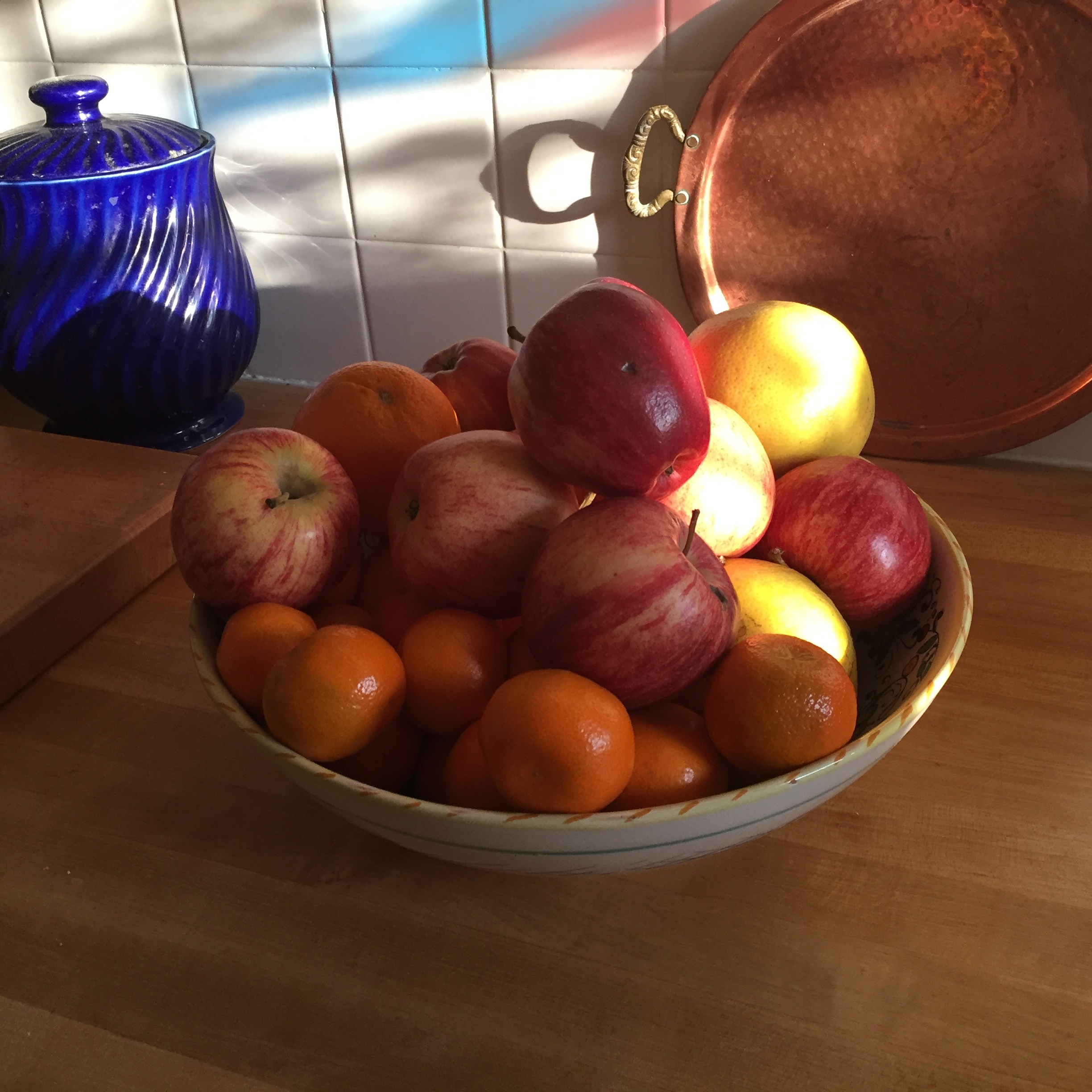
The "ideal' setting on our kitchen counter. 

The "ideal' setting on our kitchen counter. 

One thing they discovered is that the people who kept a  bowl of fruit on their kitchen counter were likely to be eight  pounds lighter than their neighbors.  Not to say that the bowl was warding off the poundage or that it was a talisman for ideal weight.  The bowl of fruit was a reminder to eat a healthy choice.  They also suggest that snacks should be kept on a low shelf (out of line of vision, out of mind) in the pantry.  “It’s your basic See-Food Diet – you eat what you see”, says Dr. Wansink.

To me it is a reminder of how mindless we (or at least I am) are in eating.  Seems as if there is any bowl of anything on the counter I will eat it.  Of course, eating from the bowl is better than eating from the bag or box but it is mindless nonetheless.  I do find that many times I reach for a snack when I really am just thirsty.  Dr. Wansink's mantra is to make the healthy choice the easy choice.  He suggests when choosing the healthy choice to make it Convenient, Attractive and Normal.  (CAN)

How is your kitchen?  Do you make the healthy choice the easy choice?  For you, your family, your friends?  What small step can you do to make over your eating habits?  Check out the Cornell website  for simple ways to change your eating habits. 

Do the Hard Thing First

Over the weekend we went bicycling around town.  My husband wanted to show me and our home-for-spring-break son a new bicycle path.  It was a lot of fun and as always, we get to see our city in a different light when riding on the back of a bike.

The twenty mile trip was a large loop- heading south from our home, then turning west, heading north and then east back to home.  When we traverse east and west we have to navigate a fairly large hill. There is no way round.   The only choice is which way round: either a very long, fairly gradual uphill climb or a shorter, steeper version.  The guys opted for the shorter, steeper version and did very well climbing it.  I climbed it too but not on the bicycle.  My bike and I had a nice walk  up the hill.

We have done a similar route in the past, but it doesn't include traversing this large hill.  When we do the flatter version, about 2 miles from our home I am ready to return.  I am tired and have had it.  Today, when we came to the same area where I usually am fatigued I thought this is no problem.  After traversing those other hills, this is a piece of cake.   I had done the hard cycling already and so when I came to an area that was difficult but not as difficult as what I had just done,  I was prepared and could do it.

In time management circles they always suggest that one does the hard task, the task that you keep putting off, first. Yesterday I definitely saw why that is.

  1. You get it out of the way.  When you know something is inevitable I find the anticipation is worse than the actuality.
  2. It makes everything that comes afterward so much easier. It puts things in perspective; everything after the hard task seems like a piece of cake even if in the past that "piece of cake" experience was once the hard thing.
  3. You experience  such a relief. There is a collective sigh that one can move on to something else. 

What about you?  Do you have to accomplish something difficult that you keep delaying?  Is it something for work or is it personal?  Is it weighing on your mind?  Why not try and scratch that activity off your to-do list by tackling it first thing in the morning?  Commit to getting the hard thing done first and you may experience a lightness of being the rest of the day.  What do you have to lose?


Wired

One of my favorite actors is Ewan McGregor.  I enjoy some of his body of work but I really enjoy his interviews on various talk shows.  He just seems to have a joie de vive and a generous spirit. He embodies the adage, "do what you love and love what you do". He takes such delight in his environment, what he is doing, and the people whom he meets. 

I heard him once discuss his experience on giving up smoking.  He was a heavy smoker and finally had enough.  He said that he spent so much time looking for his smoking accoutrements-lighter, cigarettes, ashtray-every time he sat down that he just  couldn't  sit down. He had to make sure that he had all his "stuff" and he would fiddle with all those things.  He couldn't leave the house without checking and rechecking that he had all his smoking paraphernalia. There was so much activity just to keep the habit going.  Now that he is not smoking he says that he is at peace. He has a sense of tranquility.  When he sits down now, he can just sit and enjoy the experience. 

Collection of known usable wires that keep us "connected".  In addition, there is a box somewhere that contains cords and wires to those electronic devices which have gone to the great beyond. 

Collection of known usable wires that keep us "connected".  In addition, there is a box somewhere that contains cords and wires to those electronic devices which have gone to the great beyond. 

I feel that way with all the cords and wires to keep us electronically connected. Every time we go on a trip we have added to our checklist litany, 'Do you have your chargers- for the phone, the laptop, all your devices?"   

One summer we were packing up from our stay at our rented vacation cottage.  For reasons that take too long to explain, my one son had put all his electronic cords, mouth retainer and other (expensive)  sundries into a plastic grocery bag.  The four of us in the family were doing our respective "getting ready to leave" jobs: final vacuum through, packing the back of the car, loading the bikes onto the roof rack and collecting the trash which was in a plastic grocery bag like the one my son used as his "luggage". You can only guess what happened.  We did not discover the switch until we were ten hours away, dropping off this son at his college apartment. The restful and peaceful feeling of our two week vacation was immediately shattered with the seemingly innocent inquiry, "Mom, where did you put the white plastic grocery bag?"

Somedays I wish I could quit the habit of the electronic devices and the need (seemingly)  to be connected all the time.   Somedays it seems as if the cost of the devices- keeping track of their whereabouts, keeping them charged, updating the information, figuring out how to use them properly- far outweighs any benefit.  Somedays the red circle or ding of a reminder that I have a text message, a notification or an email is anxiety producing.  I can feel my heart rate increase. The red is too reminiscent of the red marker from school. "What did I miss?,  Did I do something wrong? Have I broken something?"

When I get anxious I know that I need to take an electronic fast.  I need to take a deep breath and realize that I am not going to get an "F" for failing to respond to a message or alert immediately.  I need to set the electronics aside so that peace and tranquility can reign in my heart. 

I have an acquaintance who makes a point of taking an electronic sabbath one day a week or at least a good part of one day. She and her husband have agreed not to look at emails, turn on the computer or respond to text messages.  Admirable.  To be honest, I think I might have a tough time not being electronically connected for a whole day.  Although the times when I couldn't be connected to an electronic device for whatever reason (current location has no service, attending a workshop or meetings, on a trip), I have felt such lightness of being, kind of like a snow day.  I always feel rejuvenated and ready to come back to the "electronic age".  

What about you?  Are you too wired?  Do you get frustrated with all the cords, wires and connections of which you need to keep track? How do you handle it?  Physically and emotionally? Have you ever not been connected?  What was the reason?  How did you feel when you finally "reconnected"?   Have you ever taken an electronics fast?

Aren't we fortunate to be living in an age where we can choose how we use the tools that improve our lives?  I just need to remember that the electronic devices are to be used and not to let them use me.  I need  to choose peace and tranquility.   I need to choose not to be "wired". 

Leap Year

There seems to be flowers for other holidays, so I purchased a small bouquet for my desk.  What is recommended  for Leap Year?

There seems to be flowers for other holidays, so I purchased a small bouquet for my desk.  What is recommended  for Leap Year?

Happy Leap Year! When I was a kid it seemed as if leap year was one of those notations on the calendar that was recognized and was talked about, not as anything special but rather an interesting footnote, kind of like Lincoln's Birthday.  The biggest concern was "What would you do if you had a birthday on leap year?  When did you celebrate?  More importantly, when did you get presents?"

Leap year was designed to keep the calendar year synchronized with the astronomical or seasonal year. Since seasons and astronomical events don't repeat in whole number days, in order to keep whole days in a calendar, an extra day is inserted every four years to keep things on track.  According to Wikipedia, "The same type of problem happens in the relationship between the day and the number of seconds in the day: If you divide the larger measure of time by the smaller, you do not get a whole number. Instead, the result is an unending decimal".  To prevent the calendar drift of half days, leap year was invented.  The "leap" comes from the fact that while a fixed date in the Gregorian calendar advances one day a week from one year to the next, in the following year of a leap year, the fixed date "leaps" over a day of the week.  For example, February 1 , 2013 fell on a Friday. The next year, 2014 it fell on a Saturday, then in 2015 it fell on a Sunday. In 2016 it fell on a Monday. Because 2016 is a "leap year"  February 1, 2017  will "leap" over Tuesday and will fall on Wednesday. 

The idea of leaping got me thinking.  What types of idioms  (or expressions) do you know which have leap in them? Here are some that I found:

"leap at a chance",  "leaps and bounds", "leap into someone's mind", "leap to conclusions", "leap at someone or something", "leap for joy", "leap forward", "leap out (of something)", "leap over", "look before you leap", "leap in the dark".

The one that I love is "leap of faith".  Two of the definitions of leap are to "propel one forward" and "to enter eagerly into an activity".  The idea that I am eagerly willing to enter into the activity that requires me to have some faith and that will propel me forward is encouraging and exciting. 

By nature I am not a risk taker.  I am a plodder and planner.  I have enough trouble leaping from rock to rock when traversing a small stream on a hike let alone leaping out on faith into a vast unknown of all the "biggies" in life- job opportunities, where to live, moving, marriage decisions, financial responsibilities of college and retirement.  Yet because they are the "biggies" I came to the conclusion long ago that there was nothing I could do to control them.  I had to have faith in something/someone bigger than myself and to believe that God's plan for me was much better than the limited one that I could foresee.  

As it is leap year, I am reminded of the times when big circumstances required me to make a leap of faith. Many times it was hard, kind of walking out onto a ledge and not seeing what is ahead or underneath you.  But I can honestly say that when I completely trusted God, I was never disappointed.  When I listened to His leading, my feet were on solid ground. 

But I am wondering if I am making the small, daily  leaps of faith?  Am I trusting God with the smaller things in my life as I trust him with the biggies?  If not, why not?  Certainly his track record is excellent.  Can I make that leap of faith that today, I am being propelled forward into an eagerly awaited activity?  Am I looking at my day with the expectation of faith- that what I am being called to do today, could be as mundane as walking the dogs, excites me because of the possibilities that await me?  Am I open to possibilities? 

 Do I trust God enough that whatever and wherever He calls me, He is faithful to provide me with what I need for the journey?   

What about you?  Have you ever had to make a leap of faith?  How did it work out?  

One thing I have noticed with my physical, rock leaping "skill" on hikes- the more I do it, the more sure-footed I become. I have noticed that the more I make those spiritual leaps of faith, the more eager I become to see what awaits me and what is on the other side.

Up For a Challenge?

Yesterday I had the privilege to hear author Barbara Morrison speak about her memoir: Innocent:  Confessions of a Welfare Mother.  It was eye-opening and inspirational.  Ms. Morrison had a college education and prior work experience, yet due to a series of circumstances she found herself at twenty-four, divorced, abandoned by her husband, disowned by her parents,  pregnant, with an eighteen month old and no job prospects.  She couldn't cover the cost of childcare, food, rent, clothing, transportation and so was forced to make the "choiceless" choice- receive welfare. She talked about the challenges welfare recipients face and the misunderstanding of the system.

Yes, her situation was extremely difficult and in her talk she alluded to it.  I am sure that there were many dark days and nights for her.  Yet I was struck by her matter of fact explanations, her generosity of spirit towards those who did her harm and her focus on the positive of her experience. She discovered and experienced a true community in the poor neighborhood with the other welfare mothers where she lived.  She was surprised to discover such kindness that if one didn't have enough food stamps to make it to the end of the month, someone in the community would share.  If a person in the community had a job interview, all the members would help provide decent "interview" clothing as no one had a complete ensemble.  If one was sick, someone in the community would watch her children until she got better. 

There is a sense that she doesn't take her current life situation for granted.  As she states, so many people are living from paycheck to paycheck.  All it takes is an accident, health issue or job layoff and they too would have to make the "choiceless" choice of becoming a welfare recipient.  She is grateful that every April 15th she has the privilege to pay taxes knowing that she can share her good fortune with others.  Sure the system might have its flaws but overall we are fortunate to live in a country where the systems relatively work. 

She was a product of the welfare system and the reason for the safety net.  Some people just need a little help to get going.  From the good fortune of legislature timing and kindness of others, she was able to receive a grant that enabled her to learn a new skill and get a job with upward mobility.  

She speaks about the stereotypes and judgements we all make of each other. "Lazy welfare mothers, hard hearted social workers, uncaring parents."  Her story once again underscores our need need to put ourselves in others' shoes for a while to see what their lives are like before we make snap comments.  

One way we can practice empathy is to take the food stamp challenge.  Can you live for one week on the same daily monetary allotment for food that a welfare recipient receives?  (approximately $4 per person per day)  In our household there are two of us- $8 a day x 7 days = $56 for the week for groceries.  If you use any food that is already in your household, subtract that amount from your daily amount. 

Click here to read more about the challenge.  

What is your feeling about the welfare system?  Have you ever experienced a "handout"?  How did that make you feel?  Have you ever had to live paycheck to paycheck?  Would you consider trying the food stamp challenge?  If you try it, please comment.