WE ARE All .... HERE

This past week I spent the day in New York with our one son. We had a fun day poking around in consignment shops, bookstores and areas in the city where we hadn't spent much time before. Walking down one of the streets there was a large sign affixed to a church wall.  It read "We are Orlando." 

The sign made me think of a story I had recently read about Master Sgt. Roddie Edmonds. Master Sgt. Edmonds was a non-commissioned officer in the US Army during WWII.   He and his men were in the Battle of the Bulge and were taken prisoners.  At one of the Stalags, the prisoners were told that the Jewish POWs were to fall out to be counted.  When the time came, all 1,275  prisoners stood together in formation.  As the highest ranking officer in the camp, Master Sgt. Edmonds was the one in front.  The commandant was furious. He came over to Edmonds and yelled at him, "You can't all be Jews."  Edmonds looked at him and said, "We are all Jews here."  The commandant took his gun, pointed at Edmonds' head and demanded that Edmonds tell him who were the Jews or he would shoot Edmonds.  Edmonds replied, "According to the Geneva Convention, we are only required to give our name, rank and serial number.  If you shoot me, you will have to shoot all of us and when we win this war, you will be tried for war crimes." (Read more about his story)

His son knew his father had a harrowing war experience but never knew the entire story.  It was only after his dad's death, going through old diaries that he started putting the pieces together. He discovered his dad's name referenced in a New York Times article about Richard Nixon trying to buy an apartment in New York after he had resigned and left office.  The article spoke of Lester Tanner, a lifelong Democrat who in hearing about Nixon's predicament, sold him his Manhattan townhouse.  Even though Mr. Tanner did not share Nixon's political beliefs, Tanner believed that a person should not be blackballed like that.  

Mr. Tanner had served in the Army with Master Sgt. Edmonds and had witnessed Edmonds' bravery. Because of it, Mr. Tanner said that he decided that for the rest of his life he would always do the right thing. 

In the wake of the horrible tragedies of Baton Rouge, Orlando, Nice, Dallas (the list seems to go on and on) I wonder if we can remember that we are all humans here. By the grace of God go all of us. At any one moment, a certain group can be singled out. Isn't that what those who are intent on doing harm want to do? Cull the group? Pick on the most vulnerable?  Force each other to turn on one another? 

We need to stand shoulder to shoulder against the forces of evil, prejudice, and hate.  We need to decide to do the right thing and not allow this divisiveness to wedge and split our society.  We need to be wiling to speak out when injustice occurs. We need to be willing to work together with those with whom we disagree. We need to be willing to listen to one another. We need to have the courage to say to those who are intent on harm, this is the wrong way to go about getting your point across. We need to have the mindset of Master Sgt, Edmonds that we are all one here. 

I have never been in a life or death situation where my beliefs have been called into question.  I pray that if I ever did I would do the right thing.  But every day I do have the choice whether I will treat the person who doesn't look, speak or think like I do, with respect, dignity and love. 

What about you?  What choices do you have to make? 

"The only thing necessary for the triumph of evil is for good men to do nothing". ~Edmund Burke
 

Nipping the Buds

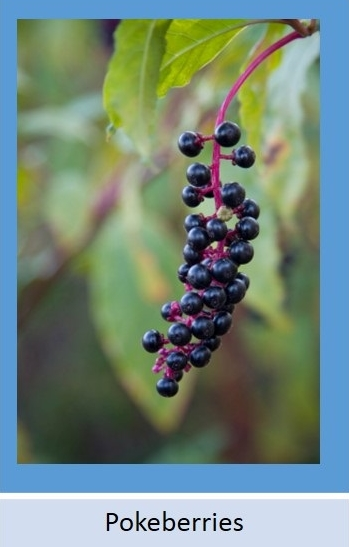
Pokeberries.  Seems as if I have a cash crop of the plant this year.  Every where I turn in the garden I see the little seedlings poking their heads up.  I cannot even tell you the number of small plants I have pulled thus far. 

The sad thing is I know that I haven't gotten nearly all of them.  Before I know it, the plant will be so developed that it will have a tap root that makes it almost impossible to pull.  Once established if I try to pull a plant out,  I have to wade into the garden, squat down directly over the plant, place both hands, one over top of the other near the base of the root and pull with all my might.  Generally it results with me rocking and then falling backwards on my bottom with a broken off base and the root in terra firma.   I can't even disturb the dirt. 

If I pull the pokeberries when the leaves are small, I can lean into the garden and over the plant. I don't even have to be that close.  Sometimes if I spot a plant in the back of the garden I will have to lean in so far that I am balancing on one leg while keeping the other outstretched behind me (imagine a very clumsy ballerina dressed in mud stained khakis, bleached splattered t-shirt and green wellies) In using one hand, I will grab hold of the plant from the top and gently pull.  The plant plus roots comes cleanly and smoothly out of the ground. Voila.  One less pokeberry. 

But I have to be diligent in looking for these weeds.  I can spend hours weeding in one particular spot almost 100% guaranteed that I have pulled all the weeds and wouldn't you know, I blink and there are a bunch of pokeberries hiding behind my perennials. They are prolific. 

Pokeberries remind me of bad habits: those little annoyances that at first don't seem too bad but before you know it, they are firmly entrenched into your lifestyle.   In fact, they might even be camouflaged as not so bad habits. Yet, once they take root in your life they are a bear to eliminate. The bad habits seems to spread to others and they pop up every where you look.   

 Each year I vow to be more diligent in eliminating these weeds.  I don't like using any chemical sprays as I believe there are more long term effects to nature so I rely on hand weeding.  This year I think I am on top of it but I know come August I will see the pocked marked purple cluster of berries somewhere in the garden.  But, I also have fewer than last year. 

What about you?  Do you have any bad habits have developed into problems? What could you have done to prevent it?  Or could you?  Is it a matter of saying no to something or saying yes to something else?  Are you procrastinating doing something?  What happens the longer you let it go?  Does it develop into a bigger problem?  Does it go away? 

Of course to the birds the pokeberries are just fine. As analogies go, some "bad" habits might not be bad in another context.  It might take some reflection to see if there are any habits that are creeping in and preventing you from achieving your goals: to honestly reflect if they are bad or is there something unexpectedly good about them.  If you determine that they are hindering you, you might want to think about strategies to nip it in the bud. Pull out those pokeberries when they are easy rather than hard. 


Tennis Lessons

Do you ever have a reoccurring discussion in your head?  You know, the one that plays on repeat- "You are not good enough; You'll never achieve thus and such; You should've done this; You screwed up on that; How come you can't do...?"

Turns out, we are not alone.  Serena Williams the 2016 women's Wimbledon champion has had similar thoughts.  She had a couple of years where she was in the top rankings but just couldn't get a Grand Slam win.  During this time Williams states, "I had to start looking at positives, not focusing on that one loss per tournament which really isn't bad,,, Once I started focusing more on the positives, I realized that I'm pretty good."  

Huh?  She says that she is pretty good?  I would say she's more than that with her winning 22 major tennis titles.  But still she has/had her own demons.

From her losses at the Australian and French Opens, she said that she "learned that you can't win everything, even though I try really hard.  I do the best that I can.  I still am not going to be perfect." 

Life seems to be made up more of our failures rather than our successes.  Or at least that is how we think and that is how we think others, think.   In actuality we probably have just as many successes as losses, albeit small ones, but successes nonetheless.  We are "pretty good" when we just do the best that we can. 

There are times when our negative thoughts loop over and over in our brains.  It paralyzes us from moving forward. We can get so caught up with our failure to achieve perfection, that we miss the accomplishments that occur while striving for excellence. In our own way, we become like Serena and her quest for a Grand Slam tournament, almost achieving our goals but not quite. 

What to do about it?   A couple of days before I read the article describing Serena Williams' new mind set, I was thinking about my own situation and my slump of not moving forward.  I thought that I need to practice some type of strategy to stop this negative cycle of thinking. I remembered reading a tip:  For every negative thought, state three positives.  Don't even let the negative thoughts take hold in one's mind.  Try to banish them with three positives right away. 

What about you?  Do you ever play the negative thoughts record?  How do you stop?  Can you stop?  Do you not even start?  What in your life is "pretty good"?  Write those down for future positive comments. If you haven't achieved a big goal, what smaller ones have you done?   Is it getting out of bed this morning?  Depending upon your situation that can be pretty good. You might not have won any "titles", but have you gotten close? 

If for nothing else, can you see your negative situation as a teachable example for someone else? Sometimes our failures are the inspiration and encouragement that someone else needs. 


Universal Precautions

Once again as a nation we are reeling from the destruction from guns and the misconstrued notion of what it means to agree to disagree.  We all talk about stopping the insanity yet we seem to be powerless to do anything about it.  I think deep down we want someone else to fix our social ills when really each one of us needs to take responsibility for the problem of hatred, violence and de-humanization of those whom we deem "different" from us. Whether we like it or not, we are called into community with each other.  We need each other for our own survival and certainly for the survival of our nation. 

Sometimes I wonder if some of our problem lies with the words that we choose to describe ourselves: black, white, hispanic, LGBT, liberal, conservative.  Sometimes I wonder if in our quest to be equal and diverse we have only focused on the diverse, which can lead (and has led) to division. Sometimes I wonder if perhaps the simplest solutions might be the most complex to achieve. 

When I was in nursing school, the AIDS epidemic was just beginning.  There wasn't much information on how to treat and care for those with AIDS.  However, it was known that the pathogen was blood borne and so there needed to be precautions in place for the caregivers. 

I remember many a discussion with fellow students about the disease, the known transmission, and the care and treatment of those with HIV and AIDS.  I do remember a very heated and lively discussion with one student who was very opinionated about his feelings towards the lifestyle of people with AIDS. Underlying his strong comments was a vein of fear and misunderstanding. 

At that point there was a difference in treating and handling AIDS patients than with "regular" patients.   For example, one didn't need to wear gloves for drawing blood with "regular" patients but did for those with AIDS.  Eventually It was determined that all patients should be treated in the same manner, that hospital and medical personnel would wear protective equipment (gloves, face shield, etc.) for any procedure that was at risk for exposure to bodily fluids.  No longer would assumptions be made.  No longer would anyone else be able to tell the difference among patients by the way the staff were treating them.  From the idea of universal- everyone the same- precautions it is now called standard precautions.  No longer is there any thought based on the type of patient about how one handles personal protective equipment.  It is just done for all. Standard. 

I wonder if we can begin to end this fear and hatred of diverse people by stop drawing attention to our divisions and instead looking at our similarities.   Can we look at people as people- universal and not as red or blue or black or white?   Can we see that all people want respect, recognition and a sense of purpose? Can we be open to law enforcement and government recognizing that there might be a better way for them to do their jobs? Can we finally admit that we cannot fix the problem through violence? Can we go beyond our prejudices, our assumptions and our fears?  Can we see others as sons, daughters, mothers, fathers, aunts, uncles, friends- people who are loved and who love in return?  Can we just see people, no labels or demographic descriptions, as a matter of course?  Can it be done for all?   Standard.

All lives matter- no matter the color, creed, religion or profession. 


The Greatest

Michael Phelps.   The greatest swimmer that ever was.  (To mangle a quote from one of my favorite movies, The Natural)  The most decorated Olympic athlete ever. (18 gold medals and 22 total)   A man with so much: so much potential and so much waste.  Tragic. 

There was an interesting article in Sunday's  New York Times Sports section about Michael Phelps.  He is on a comeback journey. 

In April when my husband and I went to Washington D.C. we also visited the Portrait Gallery.  It has great artwork but is not nearly as crowded as the National Galleries.  Plus it is in the old patent office building which my husband likes. 

There was an exhibit on portraits of various famous individuals- some from entertainment, some from politics, others from sport. For each subject they gave a brief explanation about the person, his/her accomplishments and life.  For Michael Phelps, all the swimming accomplishments were overshadowed by his poor decisions resulting in DUI arrests.  To have all his athletic accomplishments and then to be reduced to one's poor decisions is tragic. 

As his coach told him, " Michael, you have all the money that anybody your age could ever want or need; you have a profound influence in the world; you have free time- and you're the most miserable person I know." 

Part of The New York Times article is describing his comeback and how is on a path to wholeness.  I truly hope that is the case. 

His situation is similar to so many others.  Sure, everything about him is larger than life than most- most people will never achieve the world recognition or fame or wealth, yet the human condition is still the same: we all desire a sense of purpose and a sense that there is something bigger than ourselves and our accomplishments.  As Augustine of Hippo says, “Thou hast made us for thyself, O Lord, and our heart is restless until it finds its rest in thee.” 

In finding God we find a life bigger than ourselves.  We discover that life is not all about us, not all about our accomplishments and not all about our things.  We find that by humbling ourselves and by serving our fellow humankind we can accomplish far greater things than being the greatest that ever was. 

What about you?  You might not be in Michael Phelps league, but you might feel that you are on a track to destruction. Or that you don't need anyone else's help or support.  Or that you have everything that you could possibly want or desire yet you still feel empty. Do you have a sense of purpose with what you are doing and how you are living your life?   Do you feel that your life is tragic?   If so, have you ever considered looking beyond yourself?  I would suggest that you look to the One who was, is and will always be the greatest- period.  


Radical Ramblings

In our town there is an weekly alternative newspaper.  Most weeks the articles and subject matter are a little avant garde, even for me.   This past week though there were some thought provoking articles all on the subject of walking, and specifically walking as a mode of transportation in a city. 

In some ways, it still gets me that we look at walking as if we have a choice.  Isn't that how are bodies are made- to move and to move in the form of walking?  Of course we could roll on the ground to where we need to go or we could crawl on our hands and knees but that is not a desirable mode of transport.

One of the articles in the newspaper was written by a self proclaimed radical pedestrian. Whether he truly believes what he wrote or just trying to provoke, he does have some interesting points. When you are traveling at car-speed, sitting and driving in a car, you don't notice your surroundings. "At car-speed, building simply seem 'dilapidated' and people 'loitering' or 'hanging around'."  When you are walking you get to see the surroundings.  You decide to speak or not to speak with another person out on the street.  You have the opportunity to interact with those surroundings and to elevate the inhabitants from "loiterers" to "people with stories, backgrounds, loves and sorrows".  

We saw the difference of car speed vs. bike or walk speed when we travelled through the city on our bikes a couple of weeks ago.  There were some areas that we went through that, if we had traveled by car, would have been seen as a blight in our city.  We would have been anxious to get through that neighborhood and never give it another thought.  Instead, because we were slowly traveling at bike-speed, we were able to have some conversations with the residents.  They were not long, nor deep interactions but they were interactions nonetheless.  The residents asked about our fund raiser and where we had ridden.  As a society, each time we have these little discourses, we strengthen the ties that bind us together.  Each interaction draws  us a little bit closer in community.   

The writer of the newspaper article wonders how much cars have kept our city segregated.  He writes about the frustration of people talking diversity and intersectionality yet no one wants to get out of their cars and interact. "Facebook stokes fears so that people don't want to walk in certain neighborhoods."  The irony is that if people did get out into the streets, the safer the neighborhood would be. 

He also wonders if automobiles have subsidized the suburbs at the expense of the cities.  He feels that if all roads were toll roads in order to reflect the true cost of the automobile- pollution, parking, construction and congestion-  people would think again about walking.  Interesting.  Would that make people think twice about driving?   He poses some radical thoughts. 

I wonder, why does everything have to be extreme in America?  Why can't we embrace and choose a middle road? Why can't we decide that for certain activities we will walk and not use a car?  Especially for those of us that live in a more congested area.  Does it have to come down to government regulation for us to function in the way in which we were designed?  Why can't we decide when we walk and when we use a car?  Yes, a car is certainly very convenient.  (I can tell you that after walking home from the store with heavy grocery bags digging into the palm of my hands and my shoulders.)  And yes, some people do not have the luxury of a car.  (I guess the definition of a car being a luxury or necessity is also another debate.)   

I know for me that walking and bike riding for errands are a conscious choice over just jumping into the car.  I have to think about my schedule, how much time do I have, the weather, the distance, etc. It is not my default mode of thinking (yet) though it is getting there.  I realize that by not making it my first choice, I might be losing out- missing community, interactions and exercise.  

What about you?  Have you ever thought about using another means of transport other than a car to get from here to there?  What is your city or town like?  Do you think that the car has segregated it?  

This week, is there any time or opportunity for you to walk or bike ride instead of using the car for a specific errand?   For instance, getting milk at the convenience store, dropping your kids off at a friend's house or meeting a friend for coffee?  Are you up for some radical ramblings?  

What Are You Intending To Do Today?

When I introduced my then boyfriend (now husband) to my family, my brother asked John in no uncertain terms- "What are your intentions towards my sister?"  Partly he was joking but partly because he truly wanted to know. 

I like the word intention- a determination to act in a certain way and intentionality-the fact of being deliberate.  

Have you ever thought about your intentions?  I like the image of deliberately doing something. The simple definitions for intend are-to plan or have something in mind. It connotes a decision on one's part that only that individual can make. It is the beginning of the process to achieving something.  The Olympic athletes are intentional about their workouts. The practices don't just happen willy-nilly.  Successful people, whether we are talking "worldly" or "spiritual" success, are intentional about their lifestyle- what they do, with whom they interact, where they spend their time. 

"The road to hell is paved with good intentions", is a quote attributed to Samuel Johnson.  (There is debate whether or not it is truly his or perhaps Saint Bernard of Clairvaux). The point of the proverb is this- while it is good to have intentions, there needs to be another step in achieving those goals.  Or to quote another saying- "just do it".   Many of us say we want to do such and such or that we decide this is how we will act, speak, behave, plan, etc. but many times we never proceed with the next step of doing the actual work to achieve it.  We then end up living in the hell of disappointment with ourselves.  "Why can't I get anything done?", we lament. 

Intentionality takes the thought process to another level.  Sure we can formulate a plan or goal in our mind.  I think of intentionality as the grit and deep down determination that we are going to do it.   It is an inner resolve.  It is if in our mind's eye when we are intentionally going to do something we become like Scarlet O'Hara at the intermission portion of Gone With The Wind:  "As God is my witness, I will never go hungry again." 

I was thinking about this word this morning as I was wondering about my own intentions?  Not only what do I want to achieve this summer, but am I intentionally doing things, controlling my schedule, choosing activities and work that pushes me along the path of my purpose and plans? 

What can I intentionally do today that would move me along my purpose?

One thing about which I need to be intentional is working in community- reaching out to friends, family and neighbors.  As I have mentioned before I am basically shy and introverted (Some of you might be surprised by my declaration. Yes, I can certainly meet and greet people and do enjoy people but left to my own devices I am more the observer than the participant)  I need to reach out to others in a way that is fitting for my personality (one on one, notes of encouragement, etc.)

I will be intentional:

  1. Sending encouraging emails or notes to those whose names have been on my heart
  2. Looking for ways to speak to my neighbors more than the precursory wave
  3. Treating my writing as a full time job

What about you?  What are your intentions?  First name them.  But then next, how will you go about doing them? What intentional actions can you do?  Are there any resolutions in your life that you will, "As God is your witness, never or always do..."  What can you do each day to remind yourself of your resolve and intentions?   What are you intending to do today?


What Are You Learning?

I have noticed that in interviews of celebrities or accomplished people, the interviewer will ask, "what are you reading?"  Or, sometimes they will ask, "what are you planning on doing next?" 

I think an important question is to wonder, "what are you learning?"  Are you learning something, anything? It might be book knowledge or life knowledge. It might be something seemingly small but significant to you.  Or, it might be a long-time-coming achievement.  Whatever the learning process and goal is, it is important to reflect on what you may have learned because I think it speaks to wanting to be open, vulnerable and ready to receive information.  

Sometimes we don't actively seek learning it just happens.  It is only on stepping back can we see the journey and the strides we have or have not made. 

These last two months have been such a blur to me. In some ways there hasn't been any time for reflection yet in other ways I feel that all I have been doing is spinning ideas, memories and thoughts in my head: I have had the once in a lifetime loss of a mother, the continuation of a creative venture, the yearly organization process of a volunteer endeavor and a new (to me) competitive tennis team.  

Things I have learned or are learning thus far: 

  1. To speak with a lower pitch, slower speed and single thought regardless if the one listening is hard of hearing.
  2. Concentrate fully at the task at hand, aka keep my eye on the ball, especially in a competitive tennis match.
  3. Compartmentalize the things that need to be done.  One thing at a time and fully engage in that one thing. 
  4. Decide on what is important and forget about the rest.
  5. Sleep is overrated (too much time for memories) and under performed (back to the too much thinking).
  6. Daily Bible reading is essential.
  7. Continual prayer throughout the day is much needed.
  8. Iced coffee is a great after lunch treat and pick me up.
  9. Losing a mother is one way to lose weight but not recommended.
  10. Even though one can be a ready-made crier with any emotional issue, through preparation and the power of prayer, one can get through a memorial service and reception.
  11. Good friends are the ones who check in with you even after all the condolences have been said.

What about you?  What has been going on in your life lately?  What lessons have you been (or are) learning?  Any of those lessons becoming long-term habits or values?  What would you like to learn?  How can your lesson be a help or encouragement to another?