
Abbondanza!
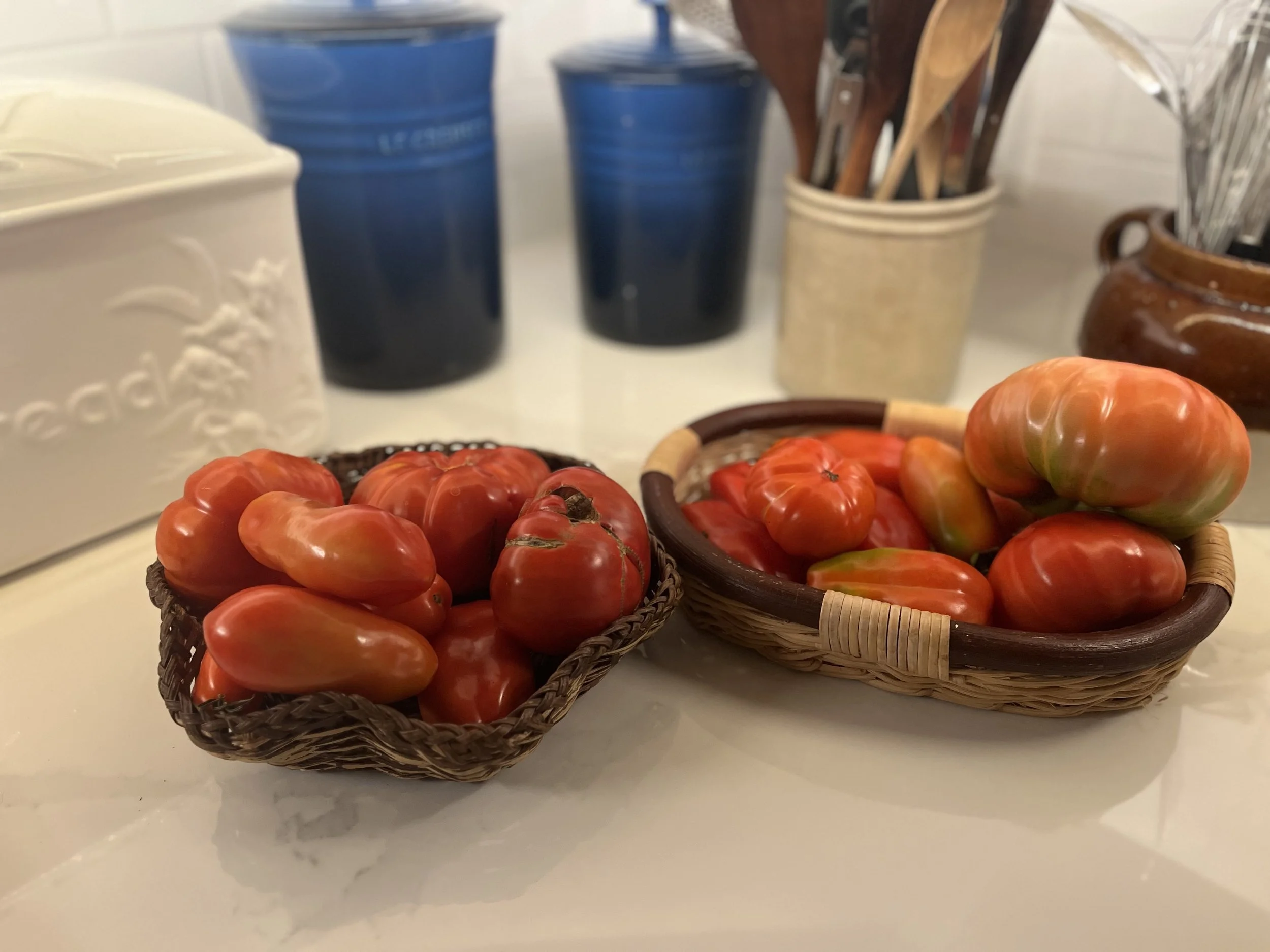
Just a smattering of tomatoes off our vines. A lot for just two people.
It has taken a while but our vegetable garden is coming in. For the longest time I thought the tomatoes were not going to develop let alone ripen for us this season.
But, low and behold, the vines are full with green and ripening gems. Really too much for two people to eat.
As I was picking the tomatoes and placing the extra in a box for our son, it occurred to me that so much of nature is incredibly plentiful, especially in the correct environment.
The extravagance of nature’s bounty reminds me of the extravagant generosity of God. After all, God designed nature so why wouldn’t God design our world, modeled after God’s own generous nature? Creatives will tell you that a piece of their nature, soul or personality is tucked into their creation whether that is a song, written word, visual art, drama, comedy, or food. Even in the “sciences”, the creative’s influence, thoughts, or ideas comes through a mathematical equation, theorem, or hypothesis. So too is God’s nature tucked into God’s creation.
I think of my flowers spilling over everywhere. Even when I pick them, they come back two-fold. The plants just keep giving and giving.
Many years while living in our former home, I had so many hydrangea blossoms, I kept giving them away. The more I cut and gave away, the more they bloomed.
God’s economy of generosity seems to work with everything: the more we give away, the more we receive. It works with physical items, like the plants. It works with emotions, like love. And it works with spiritual concepts like listening, being present and building community. When we are generous with all that we have and all that we are, we receive so much more in return.
We were wired to be generous. Our brains, hormones and nervous system were designed for generosity through caregiving, which strengthens our survival as a group. Various studies have shown that those who volunteer- giving of their time- live longer, have better health outcomes and, in general, thrive. Even young children can be generous- who hasn’t received a smooshed cookie or sandwich from a toddler willing to share?
Of course, we have seen and experienced those who do not share. Many times it can be from the same sharing person. That same toddler who shares her favorite food can turn around and snatch a toy saying, “mine”. Many adults do the same thing- only their toys or property are a little bit bigger and more expensive. I believe it is due to fear of scarcity. If I give this (whatever this might be) away or share it, I won’t have it for the future. We saw that with the ugly side of the pandemic- the individuals who hoarded hand cleaner, toilet paper and other essential items.
Yet, for every story of those who do not share, who are scared of scarcity, who hold on to everything they have and say, “mine”, there are the stories that inspire us to be better. The stories of those who sacrificed so that others might live. The family who shares their paltry meal with a stranger. The churches who remain open as a sanctuary for those who are oppressed. The volunteers in the aftermath of the attacks on 9/11. As Michael Bloomberg wrote about the 9/11 memorial in NYC, “In the weeks after 9/11, countless people stepped forward to help others. Their actions strengthened communities and inspired a legacy that continues today.”
If one isn’t prone to generosity, how does one cultivate it? Many times, being generous is through our time: in being present to listen. That action is a sacrifice to our “busyness”. If we build wiggle room in our lives, we won’t feel so pressured that we are sacrificing precious time that we do not have. We can afford to spend the time with one another.
We cultivate generosity when we realize that all that we have is really not ours. As they say, we can’t take it with us. Everything we have is a gift. When we start to see the world around us as presents, we realize how generous God is. We don’t need to fear scarcity, since God is the source of all. We can share because it was never ours in the first place.
What about you? How is your garden, if you have one? Exploding with veggies? Have you ever experienced the generosity of God? What was the experience? How did that make you feel?
The more I experience God’s generosity, the more grateful I am. Grateful for the gifts I’ve received which in turn, encourages me to give to others. That’s the thing about gratitude- gratitude begets sharing, whether that is time, talent or treasure. It is like those flowers or those tomatoes. Abbondanza!
Enough

Enough. Sufficient. Adequate.
What is enough? For you? For your family? For society?
Ever since our water situation (see June 7, 2023 post) when there wasn’t enough (or any) water coming into our home, I’ve been thinking about resources and what constitutes “enough”. What would be sufficient or adequate for the quality and quantity of resources or items in my life? What is enough?
It also begs the question- what would/should I do with those resources or items that are plenty? Share with others? Many of the world wars have been fought over one country’s desire to have more than enough than its neighbors- more resources, more people under rule, more revenue, and just plainly, more power.
The thing is- there is always enough when one shares. It is part of God’s economics. Plenty of Proverbs in the Old Testament call for the Hebrews to be generous and share: One person gives freely, yet gains even more; another withholds unduly, but comes to poverty. A generous person will prosper; whoever refreshes others will be refreshed. (Proverbs 11:24-25.) I think of Abram giving his nephew Lot “first dibs” in choosing land for their respective, growing households.
But it is more than allowing someone to pick the choicest morsel. It’s the miracle of loaves and fishes. The bounty of nature. The unexplainable economics of tithing.
I am always amazed at the quantity of seeds/flowers/fruit/vegetables that a single plant can produce. While plants are designed to produce a lot in order that the species survives, some plants provide much more than that. Their abundance is not necessarily for their own survival but for those insects/birds/animals surrounding them. And then there are those plants that provide just beauty. I think of the abundance of my hydrangeas at our previous home. Some years, the blooms were prolific. Heavenly. The thing that I learned, it was best to cut them and enjoy the blooms. That way, I could prune/shape the bushes as I enjoyed the flowers and be guaranteed that I wouldn’t inadvertently cut the next year’s set blooms (which can happen if I tried pruning in the spring before the season began). Of course, the hydrangeas being so prolific, I had to share them with others. There was no room in the house otherwise.
A gardening task that is necessary for perennial plants to grow and thrive is to divide them every three to five years. Dividing is a natural sharing. It underscores the health benefits for sharing in general: physical/mental/emotional health as well as community building. The dividends can be placed in other parts of the garden or given to others. The remaining plant has room to grow deeper roots, allows more sunlight and air into the plant and in general will allow it to become even healthier.
If you had any doubt about sharing and/or plants producing enough- look to zucchini. Is there any other plant that keeps on growing and giving like the zucchini? What to do when you the gardener has enough? Give to neighbors, friends, colleagues, etc. (There is an old adage that you cannot out give God but I think the zucchini plant could give Him a run for His money. Or perhaps zucchini is a divine plant?)
When I was a teenager there was a gentleman in our church who shared a home movie about a relative who tried a tithing experiment in the 1940’s: The relative planted wheat and gave a tenth of the yield to the church and then replanted the remaining 90%. He continued this practice for six years, resting on the seventh. He started with 1 cubic inch of wheat kernels- about 360 kernels that were planted in a four by eight feet area. The final crop, six years later, grew in an area of over 2,000 acres. The amount of yield he received with the planted 90% exceeded the expectation of what the amount should’ve yielded. (Click here to see the 1944 Life Magazine article about the tithing experiment.)
It seems to me that the underlying question of enough and sharing is all about control and fear. Think about little kids who have trouble sharing. “Mine” they say. They do not want to relinquish their ____ (fill in the blank- toy, food, blanket, etc.) Or they do not want a portion of what they have to be shared (half a cookie, piece of candy, etc.) Some of the rationale is the fear that the item will not be returned, or that it will get lost or broken. Or what is left will not be enough to satisfy them. If they hold on to item and not share it, they can control what happens to it.
There is really no difference with adults. Can you let go of something and trust that all will be well? That what you have left will be enough? Or that what is shared will be returned, perhaps even in unimaginable ways? Or just be satisfied with what you have? No more? No less?
And we have trouble sharing not just physical items, but what about the intangible- sharing information, ideas, or guidance. Helping the colleague which may give them the leg up for the promotion? Allowing another to take “credit” for your idea? Does the recognition matter as long as the activity/solution/idea comes to fruition? Fear that someone will “get ahead” of us? That we will be left with “nothing”?
What about you? Do you have enough? More than enough? Of what types of items? Tangible? Intangible? How are you with sharing?
I love the idea that King Solomon writes in Proverbs that he (or she) who refreshes others will be refreshed. To be refreshed- I pray that would be enough for me.