
Happy New Year

You’ve probably heard of “Christmas in July” but how about “New Year’s in July”?
I heard an interesting interview on the Canadian Broadcast Company radio. A professor from one of the universities was talking about just that- celebrating New Year’s in July. July 1st is Canada Day and the professor being interviewed suggested that July 1 is a good day to restart any resolutions or goals. His point was that most people have New Year’s resolutions but January 1st puts too much pressure on people. He notes that January 1st is too close to the holidays-one is usually exhausted, there may be financial pressure from overspending, the weather isn’t conducive to being outside and working on any physical goals, and in general, goals started at the beginning of the year usually do not last more than a week or two. Plus, there is an addition of guilt- either feeling one has to have a goal or guilt when stopping the goal.
Anecdotally that is probably true. While there are those individuals who are extremely goal oriented and might succeed in their goals, for the rest of us, not so much.
I’ve been thinking about projects and items I want to accomplish this summer and this year. I have mentioned this before about my lists. Theses lists are ones that I transfer from week to week, month to month and sadly, even year to year.
I’ve been thinking about why I put off some of these items. Especially when I do care about accomplishing them. For if I get a chance to work on even a part of the list, I feel so much better. So why don’t I, as they say in the Nike world, just do it. I have friends and family who are in a similar situation: things that they want to do or accomplish but just cannot seem to get it done.
The goal management people would say: break it down into doable chunks; make it realistic; set a timeline; even give yourself a break occasionally. And I will try that. I’ll even have a “schedule” to implement my small goals.
But then something else comes up and those goals go out the window.
The thing is, I am disciplined. Just like my family and friends are and, I suspect, are you. We accomplish tasks (while they may not be written goals) like regularly fixing meals, caring for our daily personal hygiene, tending to our homes, our families, or showing up to work.
What about you? Are you a disciplined person? Do you have goals for yourself? Have you achieved them? What stands in your way?
According to Forbes online: “Goals are sophisticated procrastination disguised as productivity and progress. You spend time creating the perfect objective, starting the work, then hoping motivation carries you through. It rarely does. According to the University of Scranton, 92% of people fail to achieve their New Year's goals. The better approach is creating systems. Daily actions tied to identity over outcomes.” (Jodie Cook, Why 92% of People Fail to Achieve Their Goals. forbes.com. June 27, 2025)
The Forbes article makes me think of the book, Atomic Habits- tiny habits that build on one another and over time, can make big changes. Yet still, even doing that, I still can’t seem to “just do it” on certain goals.
So I’ve been thinking about the different reasons that thwart my accomplishments specifically. Perhaps these are universal to all? I am wondering if the bottom line to these reasons might be fear?
1) “Savior” complex. I do try to put others’ needs before mine but it seems as if every time I embark on one of my goals- inevitably something- another person’s situation pulls me away. Most often it is a legitimate need that needs addressing. Do I do this because of some deep “savior” complex or reverse pride of appearing to be humble and servant-like? Or am I afraid others won’t like or love me if I do not help with the need?
2) Fear of accomplishment. What would happen if I actually completed those goals? There are a couple of goals that I don’t even begin because I am afraid that I could fail in my attempt to achieve them. But what would happen if I succeeded? Recently I watched the documentary on Netflix about Martin Short. He would say that his career was made up of 98% failure. He just kept going.
3) Letting go. Some goals require letting go. Exchanging what is known for the unknown. What would be the worst scenario of that goal. Worried that which you gave away would one day be needed? But when that time came would you still be the same person who would want the old situation, relationship or item? The thing is, the unknown may be even better than the known.
4) Physical change. Aging? Medical changes? Health improvements? Do I have to adapt to a new “normal”? There is always the chance of being hurt or uncomfortable before a positive occurs.
I found this interesting TED talk: https://www.youtube.com/watch?v=5J6jAC6XxAI (A word of caution- In the first couple of minutes of the talk, the speaker mentions his attempt to take his life when he was a young man. That is not the point of the talk, but rather it was a wake-up call for him.)The speaker draws upon lessons from Stoicism. His goal plan is actually a three-page “fear” plan. Starting with the worst case scenario, he helps you figure out that which you can control and that which you can’t.
Page 1: He starts with asking, “What if I ….?” Under three columns you will make a list:
Column 1: What are the worst things that can happen if I take this next step/action or accomplish this goal? List 10-20 items.
Column 2 : What can I do to prevent or decrease this from happening? Next to each item in column 1, write a corresponding prevention or decrease action.
Column 3: If this happens (column 1 item) what repair can I do or whom can I ask for help? List those corresponding things. As he points out, most likely you are not the first person in the world to have whatever situation or item you listed occur. There are others who have experience and possible advice.
Page 2: What benefits will occur if I complete or even attempt this goal of “What if I ….?”
Page 3: (Which I thought was a very interesting exercise) What will this cost me if I do not do this plan? If I stay with the status quo? Think about emotionally, physically, financially, etc.
Write the answer out in terms of staying in the “status quo” mode for 6 months, 12 months, and 3 years. What is the cost?
As I struggle with this, I cannot help but think of the Apostle Paul and his words, “I do not understand what I do. For what I want to do I do not do, but what I hate I do.” (Romans 7:15 NIV). Me too. I hate writing the same goals year after year. It is time for a change in the approach.
I think as I round the midway of 2026, I will write out my “fear” plan. Perhaps I can tackle the real motivation behind what I do and not do. My prayer for you and myself is that we might accomplish the goals and activities for 2026 that are in our hearts and minds. Happy New Year.
A Prayer for the New Year

As we live into the new year of 2024, my prayer for you is this:
May you have peace in your heart. Peace regarding your health, finances, relationships, work and future.
May you have joy in your heart. Joy in each moment regardless of the circumstances.
May you experience hope in your heart. Hope that all shall be well, and all shall be well, and all manner of thing shall be well.
May you know Love- the Love that knows no end. The Love that loves you as you are. Today. This moment in whatever state you find yourself. And loves you too much for you to stay that way. The Love that is continually calling you to come home and belong to Him.
May you know and experience the peace, joy, hope and love of God. My prayer for you this 2024 is that during this year, this day, perhaps in this very moment, you experience God’s best for you. Amen.
Happy Accident

When our family gets together we have odd discussions. Although, the more I live, the more I realize that every family has odd discussions in their own way. It’s a slight different variation of Tolstoy’s idea of happy and unhappy families, yet the point is that the way families interact are sometimes similar.
Over the holidays we were all enjoying a delicious cheesecake made by our son. As we ate, we started wondering-what exactly is cream cheese? Which then led to a discussion of how does one make any type of cheese? Which generated a discussion of rennet and what the heck was that? [Rennet: curdled milk from the stomach of an unweaned cow. It contains multiple enzymes which aid in the process of curdling the casein (main protein) in milk.]
As we all remarked and wondered- how did this first happen? Who “discovered” the process and more perplexing- who was brave enough to eat it? Perhaps many, many years ago in slaughtering a young cow, it was noticed that part of its stomach (there are four stomachs and this “rennet” is found in the third chamber) had a “curdled” type of milk? Or did some of the contents accidentally drop into a bucket of milk and then it was noticed that the consistency changed? Was it just by accident that the curdling and rennet were discovered? Certainly that discovery has changed the way people eat.
So many processes, inventions or ideas that were happy “accidents”: fluky things that happened which totally changed an outcome. Or what was originally planned was not the final outcome. New ideas developing from planned ideas not going quite as planned. It reminds me to not hold too tightly my plans, ideas or schedules.
A new year always brings about a demarcation: time to think of what went on in the past year and what ideas or plans for the future one. New Year’s is a time to reflect on those things: what to discard or to keep and what ideas or thoughts to investigate in the coming year. Many people like the one word idea of “resolutions”: one word to describe either how they will behave, think or react in the new year. The cream cheese makes me think of two words: happy accident.
I am reminded that if we look for it, we can discover new possibilities. I know that it is so easy for me to be so focused on what I have planned and ensuring that things go according to plan that I can miss seeing the beauty of something new and different.
Certainly with this ongoing house remodeling I have been a witness to many a happy accident. Much of the project has not gone according to plan. But, when all is said and done (and we hope that will occur before next new year!) what will be accomplished is more (and better) than we originally planned. I am always reminded of a dear friend who said many times the projects that she was involved in would have some type of snafu. But, the remodeled-change-in plans was almost always better than what was imagined.
What about you? Have you ever stumbled upon something that was better than originally planned? Or you discovered something completely unintentionally?
So for this coming year, I am re-thinking the planning mode in my new year’s goal. Trying to be a little less anxious over controlling outcomes and more present and aware of each day as it unfolds. Whatever will happen, will happen and to let it be.
For who knows what happy accident is just around the corner?
A New Year
Out with the old, in with the new….
You may have heard this common expression for the new year. In our consumer economy, I think we are all pretty good with the “in with the new”. But how are you with the “out with the old”? Do you hold on to things, ideas, habits, philosophies, relationships?

Over the holidays my son and I were working on a jigsaw puzzle. As a friend once commented about puzzles- they are a good way to just talk about anything while you are lightly engaged in a project. As we were trying to figure out some tough distinguishable areas of sky pieces my son remarked, sometimes it takes a different perspective to figure out what goes together. He had just gotten up to get something to drink and when he sat down, he had started working on a different section. When he returned to the sky section he was able to fit in many pieces.
For this New Year’s Day, why not look upon this year with a different perspective? Instead of all new: new ideas, things, philosophies, relationships, we review the “old”? We evaluate what we have- is it necessary, helpful, supportive, useful, beautiful- and decide if it is it serving our current needs?
Are there things that you might want to evaluate before you blindly turn the page for the new year? Why not plan on evaluating those things during the month of January before embarking on a new idea, or purchasing a new item, or starting a whole new exercise regime.
The current psychology regarding changing and creating new habits is to create a new one before eliminating an old one. The thought is that once a new habit is established it is easier to drop the old. But for many, it is hard to even begin a new one because the old one gets in the way.
I wonder if even before any new steps, we take a good hard look at the old habit or things, or ideas/relationships/philosophies. We take the time to go through the old. We look at the old with fresh eyes and ask ourselves some questions: Why do we still have it? Is it too costly to continue- physically, socially, emotionally, spiritually? Is there anything about the old habit- physically, socially, emotionally, spiritually that is still good, useful and helpful? What would happen if I gave it away, sold it, discontinued using it? Would I miss the old if it were gone? Am I ready for the “new”?
Sure, it is nice to have everything new and to feel everything is fresh. There is nothing freer than to feel that January 1st has given us a new chapter in life -full of new opportunities and possibilities. But as anyone who has ever moved, most likely you end up bringing your old junk to the new home. New location, same stuff. Nothing really has changed except you might not know where the coffee mugs are located. Yet in the case of moving, when we really go through each box and not just hastily pack, we sometimes discover long lost meaningful items. Items that can be resurrected and used in our new location if only in a new and different way.
What about you? Do you have a New Year’s routine? Start something new? What about the old? Still around? Want it to be? What can you do this January to evaluate the old? How can you view your life differently this January? Need to see your relationships through the eyes of your friends? Need to “shop” your closet/house- finding long forgotten items and clothes that might be new again for you? Need to see what you are already doing in your exercise routine that can be augmented? Need to have a reflective time with God to determine your next steps with Him?
Maybe a new expression should be: evaluate the old before you embrace the new…
Running With Sherman

Running With Sherman is a book by Christopher McDougall. I first heard the story on the radio. For a little holiday inspiration and COVID uplifting, I thought of his story and sharing it with you:
Click here for the radio broadcast that explains more about Sherman’s story.
I love this story on so many levels: the animal/human connection, the human/human connection and the human/spiritual connection. I love the ideas that are embodied in the story as explained by the characteristics that make up all of us: independence-let Sherman lead and have him think the way going forward (or running) was his idea but also to find something that he, Chris also enjoyed doing; purpose- Sherman needed a purpose to get moving and the neighbor needed a purpose in his life; community- the neighbor’s purpose was running with Sherman and Sherman needed the purpose of running every day and in community with the other barnyard critters and his human friends; and perseverance and patience- Chris’s tenacity to not give up on Sherman, to hold on and to keep sticking with Sherman and the neighbor.
Once again the story reminds me how all creatures need to have purpose in their lives. Of course animals and plants in the natural world seem to know their purpose. They procreate, make a joyful noise, and grow in order to keep the species alive. We will never know if these creatures have feelings or further thoughts although animals of higher order- chimps, do have thought processes.
One could put certain Jack Russells in that category. Our two little scamps were always thinking of ways to improve their lot with food or through comfort. Our female would sit in front of her brother and bark to try and get him out of the bed or chair where he was sitting because she wanted to sit there. He would turn his head and not pay any attention to her. She would then go to the back door to be let outside. Once outside she would give her “there is a creature out here” bark. Upon hearing the call, Marley would jump down from his perch and charge outside, ready to bark and help with the intruder. While he was otherwise occupied she would quietly come back up the deck and ask to be let in. Once in, she would settle herself down in the place Marley had just left. She did it many times and he never caught on.
As we wrap up 2020 ( Do I hear a collective “thank goodness”?), I wonder if you have felt like I have at times this year, “what happened to our connection?” Things seem to be horrible with no end in sight. What is the use of our existence? Will this ever end?
I love the story of Sherman and the subsequent good turns that developed. His story provides hope in a bleak landscape. For a long time it appeared that Sherman’s future was quite bleak. He was hindered from doing what he was supposed to do through no fault of his own. Certainly there is an element of neglect in his original condition but it wasn’t due to anything he had done. I am sure that in his donkey brain he might have wondered if this was ever going to end. He became depressed and despondent.
When you think about it, it is not that much different from our own pandemic predicament. We have been hindered from moving and going about our normal business due to circumstances beyond our control. (I wouldn’t go so far as to say it was due to anyone’s neglect though.) Many of us have become despondent and depressed thinking that we will never get out of this cycle.
Yet in looking at the long game of life- we will get out of this predicament. For some of us it will come in the form of someone giving us a second, (or third, or fourth…) chance. For others of us it might be through the ministrations of another, someone who is experienced in knowing how to tend to the problems that cripple us. Just like Sherman needed someone who knew how to tend to his hoofs. For others of us, we need to persevere and hang on. Like Chris and his sticking to it-ness with Sherman. We may need to open our eyes to the needs of others around us and to reach out in faith- not knowing how the connection will turn out. In some ways, it wasn’t that much of a stretch in Chris’s connection with Sherman. Chris already liked running. He was a long-distanced runner. He was able to combine his passion with his openness to try something new and in the process, found a new calling.
What about you? Have you ever found yourself down a different path than intended? Was it one that produced any lessons? Have you ever “rescued” a critter? Who rescued whom?
As 2020 comes to a close and 2021 is just a page-turn away, hang in there. Have hope. A new day is dawning. This year, instead of resolutions or plans, how about just being. Being present to what the day brings. Being engaged with one another- however that might look like. Being aware of the world around us, the creatures and people God places within our path. Being willing to explore our likes and passions, and in sharing them with others, perhaps find purpose.
One Word.
One. Word. Perhaps you have friends or acquaintances who speak about the one word they have committed to for a course of a year. Every year, I seem to hear from others about their word for the year. For them, they commit to one word that reflects what they want to achieve. It is the word that reminds them of what they want to embrace as a lifestyle improvement or purpose. I have written about the one word phenomenon in the past. It all stems from a book and philosophy which helps you figure out what your one word would be. (One Word That Will Change Your Life by Dan Britton, Jimmy Page, Jon Gordon)
I have been thinking about that philosophy lately as well as the idea of new year’s resolutions (which never seem to come to fruition, hence the one word, supposedly a more doable and achievable goal.)
I am reminiscence of a friend, who after a divorce was given the advice that for the first, post divorce year, say “yes” to everything he was offered. The idea is to get out of one’s comfort zone and “live a little”. I have heard of people who have a “yes” day (rather than committing to a whole year). For twenty-four hours they have to say “yes” to anything asked of them. This philosophy may do well for those who find themselves stuck in a rut. If the idea of a whole year or day is terrifying and too uncontrolled, maybe a “yes” afternoon is the way to shake things up.
Conversely, if you are the type of person who has trouble with saying “no” to any request, perhaps you can try a “say no” day or year or afternoon. Plan to say no to opportunities with the thought and idea of freeing up your schedule so that you may “say yes” to something that you want to do or try.
If you are the impulsive type- saying and doing whatever comes across your plate- without thinking through the consequences, you might want to have a “say maybe” day or year or afternoon. Some folks never cogitate over requests or plans. Give yourself some time before you jump into something. You could try a “sleep on it” or “wait twenty-four hours” as part of your “say maybe”.
Yes. No. Maybe. All one word answers that could change the trajectory of your year. As answers, they may not help you achieve lifelong goals, but they might. Isn’t the idea of new year’s resolutions or one word for the year, an exercise to help one make use of one’s time and try something new in the coming year?
Whatever you decide to do for 2020 (resolutions, one word, say “yes”, “no”, “maybe”) -
Happy New Year. It is a new year. Full of opportunities and blessings.
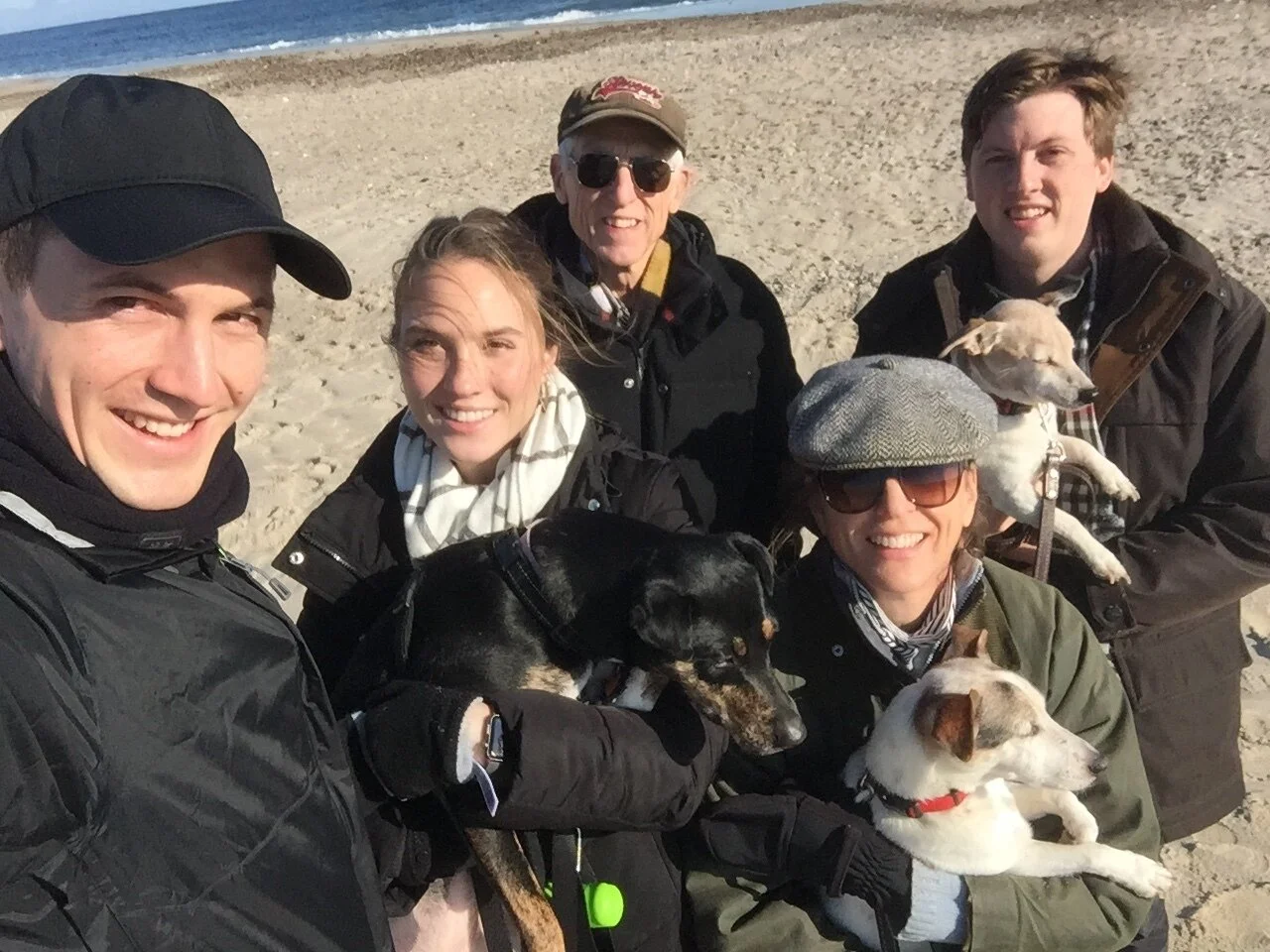
Happy New Year from my family to yours. The gang is all here on our beloved beach. Well, all except the cat who was home. Sleeping.
Wishful Thinking
This year, we spent a lovely New Year's Eve with dear friends: the food delectable and the conversation engaging. After midnight our host suggested that we share our thoughts from 2015 and our plans for 2016. We were tasked to answer three questions: For what are you most grateful from 2015? What do you wish for yourself in 2016? What do you wish for others in 2016?
It was interesting to hear the replies. In some ways, we know each other pretty well so the answers were not surprising, yet everyone had specific personal items reflecting their individuality. The thing that struck me was that the question of wishes for ourselves and others was not mutually exclusive or at least not by the answers of our friends.
What we desire most for ourselves is what would help others. Not that we are such self-less people. Rather, I think that it speaks to the paradox of in losing our lives, (or death to our selfish selves), we find life (authentic living).
It really is a balance. I know some people who err on the side of doing so much for so many that they have lost their lives. They are burnt out and have become shells of a person. But with examination of their choices, it appears that they are not completely selfless. Their constant helping has become a pride thing. It is not about helping others but more about adding another notch in the "isn't he so busy and selfless, I don't know how he does it" belt.
For those who err on the side of self-absorption there is no room to help others. These are the people who are really a bore. I just finished reading an Alexander McCall Smith book. In it he portrays a quite accurate, character study of a self-absorbed person. This character was so enamored with his looks and behavior. While he did provide a good foil and laugh, as can be expected, he was not the protagonist nor was he likable.
When we are asked about what is one thing for ourselves in the new year, I would hope it is with self growth and development in mind. We do so, not for the sole purpose of our own adulation. Our growth should aide us in our role for others and what we feel called to do.
In some ways it is like the old song, "let there be peace on earth, and let it begin with me." How we respond in life should encourage others to respond likewise. Our personal goals should align with our hopes and dreams for others. Any change in the world needs to start with change and improvement in ourselves.
How would you answer those questions? For what are you grateful for 2015? What would you like for yourself in 2016? What would you like for others in 2016?