
Balancing Act
Together, yet alone.
That could be the slogan to sum up our current existence and interactions in society. We are, in some sense, more together than ever- technology can bring people together from far flung places in our planet. We can connect on any day of the week and at any time of day, yet the feeling of belonging and community is disappearing. Because of technology, one would think that in this period in history we would be the most social civilization ever but that doesn’t seem to be the case.
In the latest The Atlantic Magazine, the cover article “The Anti-Social Century” speaks about the change to the way we interact with one another. There are many reasons but technology seems to be one area that has changed how we interact: The automobile created distant suburban homes, the home television became the evening entertainment and the smart phone became the conduit for solo social interactions.
We are not inclined to join groups or organizations that would give us a sense of belonging. Over the last twenty years, professional organizations, service clubs, social clubs and religious organizations have been declining in membership. Even the percentage of 12th graders going out with their friends two or more times a week has dramatically declined from @ 80% in the 1980s to below 50% in 2020. There is a dramatic sharp decline around the time of the introduction to smart phones.
According to psychiatry.org, in a 2024 poll by the American Psychiatry Association (APA), 30% of respondents say that they feel lonely at least once a week and 10% feel lonely every day. Loneliness is described as “feeling like you do not have meaning or close relationships or a sense of belonging.” According to that poll, when Americans feel lonely, 50% will use a form of distraction like TV, podcasts or social media.
“Clearly we believe technology can be used to connect with others,” said APA CEO and Medical Director Saul Levin, M.D., M.P.A. “In some cases, it seems to be helping us reach people who become part of our inner circles or to communicate with those who already are. However, distracting yourself when you’re feeling lonely with social media might be a double-edged sword: while it can connect, it can also lead to feelings of missing out, and we need to make sure we remain conscious of its effects on our mood. In this tech-heavy world, we should not forget the value of in-person interaction.”
It seems as if our loneliness doesn’t have anything to do with solitude and silence or even “togetherness”. Many times we feel like we do not belong when we are in the middle of much “noise”- in the form of instagram posts, youtube videos, podcasts, or streaming services.

We have all seen those pictures of a social gathering, say around a diner table, and everyone seems to have their head down, engaged in something that is on their phone.
The fact that people are on their screens doesn’t necessarily mean they are alone. Many might be in a group, but no one is interacting- just scrolling, texting or watching individually. While social media has brought people together- reunions of old friends, long lost relatives, individuals with similar health conditions, political leanings, etc. it has mostly been a place where we are together (tethered by technology) but really alone (individual watches and engages).
We have an interesting relationship with solitude. We seem to attribute alone with loneliness but it doesn’t necessarily mean the same. One can be alone but not lonely and one can be in a crowd and very lonely, almost as if the crowd amplifies the feeling of loneliness. Ironically, it is in our alone times that we can process and prepare for our time together. Of course we have those people who are extremely introverted while others are extremely extroverted and then there is the spectrum in between, which is most of us. We need socialization for our psychological, mental, emotional, spiritual and even physical health. And we also need solitude for those same reasons.
The following chart looks at the benefits of solitude vs community. As humans, we need both. It appears that there are almost equal benefits to solitude and community. The yin and yang of existence.
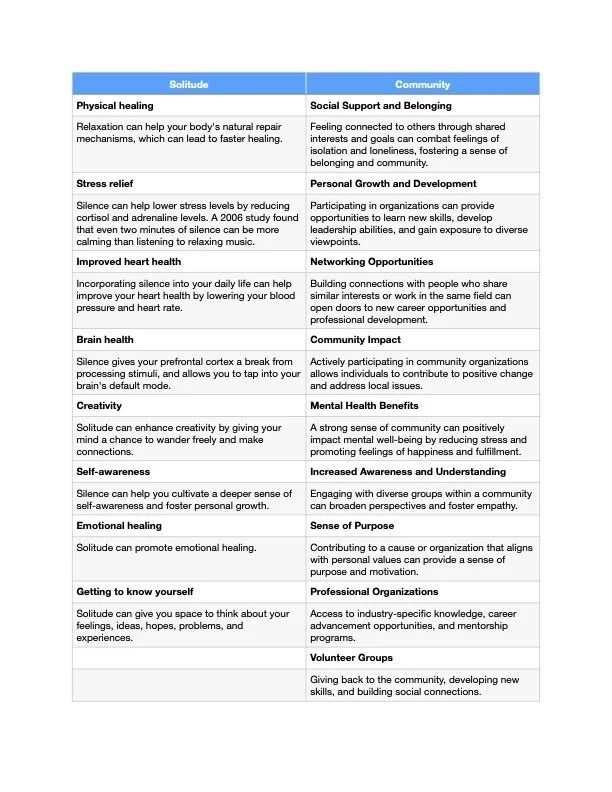
I have been more and more interested in what they call Rule of Life. When we last went to Canada we visited a Benedictine Abbey and purchased a book in their gift shop about the Benedictine way of life. There are five practices: prayer, work, study, hospitality, renewal. While monastic life lends itself to more contemplation and solitude, there is a pattern to their days. A balance of solitude and community.
As a Christ follower, I turn to Jesus and how He handled the two seemingly oppositions of solitude and community. There are plenty of stories that Jesus loved a gathering- socializing over food and fellowship but that He also practiced solitude- the need to get away by Himself and engage with God.
Jesus modeled how one can and should be balancing our lives. We need to take time for that renewal through our time alone with God in order to engage in community- to have margin in our lives so that we do not get burned out in either situations- to not to feel lonely and to not feel overwhelmed and overstressed.
But as it is discussed in The Atlantic article, we have to do more than just be together via technology. We need to be face-to-face with our loved ones and family. But we also need to be face-to-face with our neighbors and those people who are familiar to us but not necessarily intimate friends or family. It is in the villages of our lives that we learn empathy, patience, productive disagreements and compromise.
In thinking about the way I spend my days, I realize that I need to put into balance the practice of solitude vs. engaging with others. I need to model my days after Jesus.
A while back I posted about the book, Listening Below the Noise. (August 21, 2024) I must confess that I have yet to practice a day of silence/solitude. I am looking forward to trying it but have yet to plan a day on my calendar. Sadly, I have to schedule it first before it becomes a regular practice.
Due to geographic locations, health, or timing, it is wonderful to have the technology to connect with friends and family. For example, I am grateful for technology to be able to share my thoughts via this blog. Yet, I find myself drawn in to a practice of spending more time with technology than perhaps with real people- checking my phone, looking up meaningless “facts” online (not for any type of knowledge or benefit). While I need solitude, I also need (sometimes have to force myself) into physical community- going out of comfort zone to engage with my neighbors or joining a group. I am learning to engage, listen and enjoy those who live around me.
What about you? How do you balance the two? Do you? How are you with solitude? Being quiet, alone and with your own thoughts? Or do you have to have something in the background? Do you have to look at your phone? How often in a day? Do you interact with others? Face-to-face? Do you belong to any organizations? Do you feel a sense of belonging?
While it is scary to read how fast society is changing, I try to remember that our basic human nature hasn’t changed. We can be together and alone. It is a matter of choice and, as humans, we can control that choice.
Connection and Community Part 2- Technology

We’ve come a long way baby… Or have we?
Community and connection. If we are made to have community, why then do we have difficulty in achieving it and what causes us to dis-connect with others?
In architecture they say “form follows function” but I almost think the opposite is true when it comes to designing a society: function follows form. How we build the structures in our society determines how we function in that society. The structure of modern society has been built around technology and technological advances. Consequently those technology structures determines how we function individually and collectively.
I am always fascinated with the question about innovation and change- does this new idea, technology, gadget enhance society or detract from it? Are new fangled things just creating change for change sake or do they serve a real purpose? What are the benefits and risks to society?
It seems we embrace the idea of something new sometimes before we think about the repercussions. And, it is not only thinking about the effect the new technology may have on what we currently experience but also the impact on the future.

Years ago I heard someone speak about the idea of transportation. For a time, train travel was king. There were railroads dotted across the country. Unfortunately, the various railroad companies didn’t think in terms of connection - just the possibility of their own travel line. The tracks were privately owned by different companies and so it was hard to connect from one station to the next. In Baltimore there were at least four different railroad stations across town, each associated with a different railroad company. There were no connecting tracks from one station to another. So if you came to town from a small town in Eastern Pennsylvania with the hope to travel by train to Ohio and beyond, you took the Maryland Pennsylvania RR (MaPa) to its station and then would have to take a horse drawn cab to the Baltimore Ohio station across town.
If the railroad innovators had thought about the goal of transportation, they would’ve focused on the idea of connection both in their current situation (connecting all rail lines) and connecting modes of transportation as the future unfolded. When air travel became prevalent the trains didn’t get involved and didn’t plan to expand the rail lines to the air fields. Wouldn’t it be nice now to travel to the airport without having to rely on congested highways? Trains can move more people much faster than the snarl ups and parking lot waits of the individual cars on the highways of today. It is a hassle to fly (forget about the TSA requirements) and part of it is the trouble in actually getting to the airport.
Technology can do that if we are not careful: the thing that is meant to make our lives easier and bring us together can make life harder and push us further apart. The telephone was made to bring us together. “Reach out and touch someone” the ads promised. Connecting by phone, hearing the actual voice of a loved one, distant relative or complete stranger living across the country or world is still amazing. Yet, the phone can keep a distance between speakers. You don’t get to see the eyes and the expressions on one’s face as the speaker talks. Consequently words can be spoken via the telephone that would never be said face to face. Many a household has heard the slam of a telephone in mid conversation as the listener became upset or enraged over the comment from the one on the other end of the line.
The future generation of the phone, the internet and all that it entails, has also brought the world together and apart. The technology of writing the words via email, twitter or Instagram can be even worse than what is actually said in a phone conversation. We are witnessing the outcome of vitriol towards one another- it tears at the fabric of community and civilization. And, all that can be accomplished via the internet can be done solo. Not only can we alienate others by our words, we can be physically alienated as we say them. That which was designed to bring us together has in fact, drawn us apart.
In pondering the question if technology makes us more lonely, I have come across conflicting ideas and studies. No surprise that some of the studies were sponsored by tech companies and therefore felt that technology/social media are good in bringing people together. And so technology can be. Many people have connected through finding lost friends or relatives via social media. People with common interests or concerns can find like minded individuals and discover that they are not the only one who thinks a certain way or has had a unique experience. I have met many wonderful, interesting and courageous people through this blog, which would not have occurred even twenty years ago.
I also saw studies looking at technology- Facebook and the like- and how being tied to social media and our computers affects individuals and their feelings of connection. The Atlantic magazine has a classic 2012 article about Facebook and loneliness. In it they noted that, “within this world of instant and absolute communication, unbounded by limits of time or space, we suffer from unprecedented alienation. We have never been more detached from one another, or lonelier.” They begin the article around the death of Yvette Vickers, a once B-movie actress who ended up dying alone in her home and was not found until @ six months after the fact by a neighbor. In finding the remains of Ms. Vickers, the neighbor also found the computer still on. Apparently, Ms. Vickers had no one in her life- no actual community or connection. She died as she was trying to reach out electronically to anyone who would listen.
With technology, it seems to be prudent to explore the idea of what tech is doing and not doing for us as a society. I am not advocating throwing the baby out with the bath water but perhaps we need a careful reasoning and thought process of what are the gains and losses with any new technology. Of course, there will always be cumulative problems or unforeseen/unpredicted outcomes but that shouldn’t negate the fact that we should think things through.
It makes me think of the Amish viewpoint of evaluating new technology. While I don’t agree with the lifestyle per se, I do like the idea that that we can (and should) pick what and how we choose to interact as part of being a modern society. I have heard that one of the reasons some of the Amish sects choose not to own or drive cars is that they feel that the automobile impacts the family and the way the community engages with one another. Certainly the solo driver going to work, stores, play, school, etc. bears out those fears.
There is an interesting project underway looking into using old and new technology in the shipping business: How can combining wind power and current boats be used in a way to reduce fuel consumption. By applying the modern sailing techniques (as learned through America’s Cup challenges) and more efficient engines, different companies from various countries (US, Japan, Denmark, Norway) are hoping to reduce fuel consumption on the large container ships by twenty percent or so. Click here to read the article.
What about you? Do you think about our fast pace technology and what it may or may not be doing to society? Have you seen technology impact your community or your connections with one another? Positively? Negatively?
Next week we will talk about ways to counter the negative effects of technology. Things we can do so that we can be in control and choose the best part of technology and maintain our sense of community and connection.