
What is It?

Do you have any idea what the object is in the above picture? Perhaps you have seen those “tests”: “Can you recognize everyday objects close-up?” They are always fun to try. Those objects (literally) remind me that much of our understanding is all about perspective- how limited we are in our knowledge and understanding of the world around us and in the why’s and how come’s of our lives.
I like the following quote: God will either give us what we ask or give us what we would have asked if we knew everything he knows”. Tim Keller (from his book on prayer)
Again, it is a reminder that I know nothing about the big picture of life. Thank goodness I do not know. There have been times in my life when I asked for a specific thing for either myself or for others: housing; jobs; health; relationships; peace. Sometimes the prayers were answered in the way that “I thought” they should and other times they were answered not at all how I was expecting. Some times the answers were better than expected and others, I must admit, were gravely disappointing.
The thing is, having more years behind me then ahead, I know now that many times those disappointing answers were short-lived. Sometimes I had the blessing of seeing the answers unfold- starting out a disappointment but when seen in its entirety, with other lives entwined, I can say that the prayers were answered in the best way.
The first Sunday in January (the 7th), my nephew gave a good sermon (imho) https://asburytulsa.org/media/sermons/ addressing the idea of God working things out for good for those who love Him and are called according to His purposes. He used the illustration of Joseph- the favored son who was betrayed by his brothers, sold into slavery, thought dead by his father, wrongfully accused of sexual harassment and rape, and imprisoned only to eventually become highly regarded by Pharaoh. He became second in charge of all of Egypt and under his excellent administrative skills, saved the Egyptians and surrounding countries (even those brothers who betrayed him) from a horrible famine.
The question the story asks - are we willing to trust the omniscient God with the situation of our lives and the lives of those around us? Can we believe that He is working things out for our good even if we perceive that things are horrible, or, like the many years Joseph endured, that things are actually bad/difficult for us.
There are so many stories of people whose difficult situations were blessings in disguise. I always think of Corrie ten Boom, the great Christian evangelist (not that she ever planned to be one) who having been imprisoned in a concentration camp during WWII for hiding Jews in her family home in Netherlands, was grateful for fleas in the camp. Because she and the prisoners were infested with fleas, the guards didn’t do the regular checks (for fear that they too would become infested). It allowed Corrie and her sister Betsy to have Bible studies and meetings with the women in their barracks without reprisal.
Starting out this year, I most definitely need this reminder- that things will be okay both individually and societally. While I am concerned about certain things for myself and family, I am also alarmed about our country and the world stage. When things seem insurmountable and without any resolution, how in the world can God work things together for good?
I think it comes down to trust- do we trust that the God of the universe is faithful? Hasn’t God been faithful to us, individually and as humans, in the past? Certainly we all have our moments of doubt. Even the psalmist David complained at times, “Are his promises at an end for all times?” (Psalm 77: 8) In other words, he wonders- where are You, God and what have you done for me lately?”
But if I look in context of the whole- for both myself as an individual and for humankind- and remember God’s goodness I see that He has worked things together for good. The psalmist almost immediately after going through his diatribe of “where are you God”, recognizes God’s goodness and faithfulness. “You are the god who works wonders.” (Psalm 77: 14)
What about you? How are you viewing your life? Your situation? Can you see it in context of others around you? Or is your situation so difficult that it looms large?
The story of Joseph should encourage us. It is a story of good eventually winning over evil on both the individual and global level. As Joseph tells his brothers “You intended to harm me, but God intended it for good to accomplish what is now being done, the saving of many lives.” (Genesis 50:20)
Sometimes we just need a little perspective- a little pulling back of the lens- in order to see the bigger picture of God’s goodness.

Guess what the picture at the top of the blog, represented? The seeds of a pepper.
Artistic Adjustments

John Constable, Wivenhoe Park, Essex, 1816. National Gallery of Art, Washington, DC
This past week I joined my son for a day trip to the National Gallery of Art in Washington, DC. I love going to the art museum. Art is a subject about which I know very little and I am always interested in learning more. To me, there is something elevating in seeing a beautiful work of art: I think it is seeing the creative God at work through the creative human.
There are certain paintings that I enjoy viewing. They always make me smile and feel good. I love the paintings of Constable- how he captures the outdoors especially the sky and the clouds. Even though this painting was done in 1816 in England, I have seen cloud formations like these over two hundred years later here in the Mid-Atlantic.
I have seen this painting many times, but I did not know that this was not his “original”. He had painted the scene of this home, commissioned by the homeowners, General and Mrs. Rebow. However, when it was almost completed,Mrs. Rebow wanted additions to the canvas. Constable added about three inches of canvas to both sides. He “covered the seams” on the left hand side, by painting a cow in the foreground and on the right side by adding the fishing boat.
What I love about this story- even a fine artist like Constable had to make adjustments. He had spent a good amount of time already sketching, drawing and painting the scene. Yet how true for us, whether in small ways or large, whether we are almost done or not, we have to adjust to changes through nature, society, others’ decisions, or our own shortcomings. Sometimes we have to adjust because of our own health, or misjudgments. Other times we change due to obligation or responsibilities. Sometimes it is totally out of our control and we just have to adjust.
The thing about Constable’s new painting, the changes he had to make, elevated the canvas from a very good painting to a masterpiece. By adding the additional scenes, he had to also make adjustments to the perspective. The “new” canvas shows an entire panoramic scene that we would have seen with our visible eye if we were standing next to him- the canvas includes the entire view. If the same scene had been taken by a camera, it would be somewhat distorted due to the limitations of the camera’s panoramic view. He fiddled with perspective so that we, the viewer wouldn’t have to.
What about you? Have you ever had to make adjustments to a project? Were was it in the process? At the beginning? Middle? End? Have you ever had to make an adjustment to an attitude or thought process? By doing so, did you make it easier for another?
I wonder if Constable minded having to make the adjustments? The following is from the National Gallery of Art’s book on British Paintings:
The commission, which was executed in August and September 1816, is described by Constable in a series of letters to his fiancée, Maria Bicknell. "I am going to paint two small landscapes for the General, views one in the park of the house & a beautifull wood and peice [sic] of water, and another scene in a wood with a beautifull little fishing house," he wrote on 21 August. "They wish me to take my own time about them—but he will pay me for them when I please, as he tells me he understands from old Driffeild that we may soon want a little ready money. "
The next letter, written on 30 August, explains why he had to extend the canvas by over three inches on either side: "I am going on very well with my pictures . . . the park is the most forward. The great difficulty has been to get so much in as they wanted to make them acquainted with the scene. On my left is a grotto with some elms, at the head of a peice [sic] of water—in the centre is the house over a beautifull wood and very far to the right is a deer house, which it was necessary to add, so that my view comprehended too many [distances]. But to day I have got over the difficulty, and begin to like it myself. I think however I shall make a larger picture from what I am now about. .. . I live in the park and Mrs. Rebow says I am very unsociable." He reported on 19 September: "I have compleated [sic] my view of the Park for General Rebow." Constable received a payment of one hundred guineas for this picture.”
Did he have an inkling at the time that this canvas would someday grace the walls of a museum? The painting and his story reminds me that if I have to make changes, there is always the possibility that the adjustments just might transform what I am doing, thinking or saying from something ordinary to something wonderful.

Probably what he was initially thinking before Mrs. Rebow asked for the additional changes.
Day 26: Words and Pictures: Floating

This past week, my nephew wrote and preached about a concept of top-down versus bottom-up thinking. The premise is that as humans in general and Americans in particular we view our lives as top-down. We have an ideal of perfection and anything short of that is substandard which causes us to be discontent, unhappy and dissatisfied with what we have. We feel entitled to the perfect ideal and shortchanged if that doesn’t occur. Contrary, if we are grateful and thankful for whatever we have, we are more likely to be appreciative, content and joyful in our lifestyle.
I think he is on to something. It is not that we shouldn’t have goals and targets but that we should start in a place of appreciation of our lives, of our circumstances, and of our material possessions. There are so many blessings that we do not even give consideration: trash pick up; water from the tap; light when we flip a switch, etc. One thing this pandemic has done for many is to open our eyes to a whole new world of workers: the faceless person behind the convenient store counter or the never-before-given- eye-contact grocery store checker or re-stocker. People and work for whom and for which we should be grateful.
It makes me think of the annual world happiness report- a “survey of the state of global happiness that ranks 156 countries by how happy their citizens perceive themselves to be.” The Nordic countries seem to be in the top tier every year. I have heard it said that one of the reasons they are so happy is that they have low expectations. While the actually report doesn’t say that expressly, they did report under the Nordic exception that research has “consistently shown that social comparisons matter for well-being…This is corroborated by findings according to which status anxiety, defined as the fear of failing to conform to the ideals of success laid down by society, tends to be lower in Nordic countries compared to most other countries measured.” It seems as if our Nordic counterparts aren’t too worried about failing to hit the perfectionism mark. “In assessing how good their lives are, humans often compare their own lives to the lives of those around them. This makes people’s subjective perception of their position in society more predictive of well-being than objective measures such as income.” The report goes on to explain, “ seems possible that keeping up with the Joneses doesn’t carry as much weight in Nordic countries as in the US and many other countries.”
Isn’t that a bottoms-up type thinking? If I am focused and grateful on what I have, I won’t be concerned with what someone else has and I won’t be setting a unrealistic standard and goal for myself.
It is the old adage of the half-empty or half-full glass. Those with the half-empty would say that they need to do everything possible to have a full glass. After all, isn’t that the standard? There isn’t much rest- mentally or physically until that measurement happens.
The half-full would see that the glass has a fair amount of water in it already and while making plans to fill it up, would be stopping to have a sip, to enjoy the refreshing liquid along the way.
Have you ever noticed that if the gas tank is on the 1/2 to full side of the gauge, it seems to take a long time for it to move downward? But if the indicator is between the 1/2 to empty side, it seems to go very quickly regardless if the same amount of miles are driven? I am sure that the miles per gallon is the same on either side of the half way point but my perception doesn’t share that. If we view life with an attitude of appreciation and positivity, we are more likely to “enjoy the ride”.
There are times however, when all the positivity just cannot carry us. The thing about the half-empty and half-full glass of water is that sometimes, we don’t even want to think about the water level. Life is too difficult or depressing or disturbing to worry about contemplating our viewpoint from either bottom or top. We don’t even know which way is up or down. We feel that we are floundering. We are beyond worry and anxiety and certainly are no where near a place of contentment or happiness.
When that happens, what do you do? Have you found that you feel like you are floundering while experiencing this pandemic?
I recently texted with a friend about that foundering feeling. We all get it. Whether it is from a point of overwhelming stress, anxiety, grief or dramatic life change, it still can feeI the same- trying to keep one’s head above the waves, treading water as fast as one can, yet still getting knocked in the nose and mouth with a snoot full of brine. When those times happen to me, I imagine myself floating. That is the thing with treading water- if you feel tired and need a little reprieve, you can always turn onto your back and float. Of course, floating isn’t a sustainable action- it won’t get you anywhere but it can offer some respite from kicking and windmilling below the water surface. Even if we are trying to reset our viewpoint from top to bottom, floating is the time for renewing our minds.
What about you? Do you need to float for a little while? Give yourself permission to do so. And then, when feeling refreshed, come back to viewing your life situation from a bottoms-up perspective- looking at what blessings you have in your life- big or small and enjoying them as you go along.

Recently discovered photo of me at our beloved Cape Cod. While I am not floating per se, I am taking a respite. As only a three-year-old (I think that was my age?) can do.
W@TW: Perspectives
In starting this post, I realized that I have written about perspective a bunch of times. I also realized that I need to hear it one more time. Perhaps you do too? It is always interesting that if I look and am observant, God puts in my path examples of what I am currently experiencing and new ways to view my life.
On a recent dog walk, I strolled* through the campus of a local university. The students had not yet returned from break and it was interesting to see the changes of new buildings and walkways on campus. There also appeared new outside art installations. I came across the following:
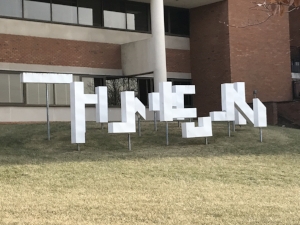


Viewing the installation from the side, it looked like random white blocks on sticks. But standing in front of the artwork, you could see the name of the school spelled out. I had to take a picture of it as the reminder for me at that moment was just as revealing as the blocks aligning into something recognizable.
Lately, I feel that I am viewing life as random white blocks on sticks: nothing seems to make sense, nothing is ordered and nothing is clear. It feels like I have been sucked into a vortex that doesn't allow me to see anything but the swirling chaos around me. I know that what I see is not the entire truth and the reality of my life. It just is hard to step out of that sucking tunnel.
But, step out I must. I know that I must make the effort to move my location and change my perspective. If not, I will become washed out, useless and bitter about my situation. "How come my white blocks don't spell anything?" I'll be stuck in my disjointed views and never see the way life can actually be.
I need to keep perspective by looking at the situation and my life in a different way:
- Perhaps I need to remove myself from where I am standing? Literally. I need to get out and take a walk or visit a new location.
- I might need to remove myself from a relationship or activity that holds me to a certain perspective. It might be a position that is expected from all the parties involved, or it is a position that has become comfortable and therefore provides no challenges and produces inertia.
- Or I need to help someone else see his/her white blocks aligned. Through that process, I might see a connection to my own situation and thereby help me to get my own blocks aligned.
What about you? Do you ever feel that you are stuck at looking at your life from one direction? How do you get out of that rut? Do you think you even need to get out of a rut? Is there anything wrong with ruts or one perspective?
Yesterday afternoon, I got out from my normal routine. I had a leisurely lunch with a friend who provided me with a new perspective on my situation. What was new and refreshing about this get together, was that neither one of us was rushed to a next thing. We were able to dive a little deeper with our discussions and let the conversation twist and turn through a wide variety of topics. I came home refreshed, encouraged and renewed. She helped me align those random blocks into seeing some words.
When you look at your life, do you see white blocks on sticks or do you see a word?
*(Lately our two have been awful in the lack-of-wanting-to-walk department. Must be because it is cold. They absolutely loath their jackets and many times our walks become more of a "drag" than a walk.)
When Shadows Fall
Yesterday I noticed a movement on the floor; a large black entity was creeping closer and closer to me. As it moved it seemed to spread out and get larger. If I didn't know any better, I would've been worried that some big black cloud was going to obliterate me. From where I was sitting I couldn't see exactly what was causing the strange darkness.
Turns out it was a shadow of a spider. Sunlight was streaming through the back door and a spider was building a web across the door frame. As it moved across, it would block a stream of sunlight causing a shadow. If it moved across that beam of light, the shadow got bigger and bigger.
From my perspective the shadow/dark spot/spider seemed huge but on closer inspection it was quite small.
It made me think.
How many times do problems or situations in our lives seem huge. They seem to creep up on us from no where, getting closer and closer and bigger and bigger. Before we know it, the problem obliterates everything else. We can't see clearly. We can't move. We just huddle in fear in a corner.
But is the problem really that big? Was it magnified by our perspective?
Once I changed my point of view- moved directly in front of the door- I was able to see things how they really were. I could see what was the cause of the shadow and why it looked so large and ominous.
When we let things become bigger than they really are, we become powerless and fearful- that which we think is huge will overtake us. Like the classic past time of making shadow pictures: holding our hands in certain positions in front of a light which can produce a different image than the original.

Norman Rockwell
I know that some problems in life are huge. They are constantly pursuing us in the hopes to disarm and destroy us. The problems can be physical, financial, social, spiritual, or emotional. We feel that we are going along in life only to constantly be looking over our shoulder for the next attack.
But I know in my own life, I have made situations worse by not checking out the source of the problem. It might be a health issue that I have refused to acknowledge or even get more information via testing because I have already determined that what I must have is terrible. Or, I may write someone off because I felt that what she said or did was offensive to me.
In all these situations I have seen and allowed something to grow larger in my mind when in actuality the original problem or situation was quite small. I just see the enlarged shadow. I don't recognize the person creating it. I allow my perspective of only seeing the shadow, paralyze me. If I would see my doctor, or get to know the person better, or plan to explore the source of the problem, I might discover that it is just a manipulation of hands or a very small bug.
What about you? Do you ever feel that something is creeping up on you? Something larger, scarier with the potential for trouble? What is the real situation? Do you need to talk to someone who can give you perspective? Someone who can say, turn off the light- it is causing the shadows. Someone who can show their hands and demonstrate how the shadow/problem was made. Someone who can make the shadows fall...away.
La Dolce Vita

Overlooking the eternal city. The dome is St. Peter's Basilica.
One of the reasons I love to travel is that it gives you a better perspective on life. Sometimes it reminds you that there is no place like home. Other times, it shows you a different way to live than might improve your home life. Most of the time it allows you space to view life with a point of view that you normally don't get. A trip can inspire, encourage and enlighten you.
On our recent trip I was bombarded with so many thoughts and ideas. Mostly I observed how the "natives" lived and interacted. Watching them gave me pause to reflect on my life and to think about human existence and what it means to live on this planet.
One thing that struck me was how unhurried most of the people seemed to be. Yes, they were coming and going on mass transit but there didn't seem to be the frenetic pace that I witness in my neck of the woods. I realize that I was on vacation (and perhaps they were too) so I wasn't going at a frenetic pace (but close enough with our task master son who had organized the trip and kept us on schedule) but the whole tone of the subway, streets and venues was one of unhurried enjoyment. The only time that I felt somewhat frenetic was at the Vatican and being part of the tourist laden blob that was posing as a queue winding (more like pushing) its way through multiple cramped door ways and rooms on the way to the Sistine Chapel.
Here are five thoughts that I gleaned while overseas:
- Embrace the past while living in present. Both apartments where we stayed were built over a hundred years ago. The facades and interiors had that old world charm. Yet the decor and amenities were sleek and modern.
- Limit/reduce the amount of time with electronics. We certainly saw people on their smart phones both walking around and while they sat at a restaurant. And I am sure people spend time on the internet in private. But we didn't see the majority of people doing that. It seemed as if the majority of life happens in community; people were engaging and socializing with one another in the parks, outdoor bistros or beer gardens. The rooms and apartments where people live are not that large so they are forced to find larger spaces.
- Know what you don't know. Nothing convinces me more that I am a dumb little oyster than by traveling and speaking to foreigners who seem to speak English without trouble. They also seem to be well versed in their politics, our politics, various places in the world and all sorts of different subject matter. I feel like a sponge trying to soak it all in. I certainly have topics I want to pursue and research now that I am home.
- People are people wherever they are. As much as some people seem more sophisticated or polished, at the end of the day, we are pretty much the same with the same concerns, the same gripes and the same joys. At all times during our travels- whether mass transit or airplanes, the overheard conversations among family and friends, wealthy or poor, blue or white collar, western or eastern european, all sounded the same.
- History does repeat itself. As we read the information plaques in the Roman Forum, Colosseum, Da Vinci museum of Florence, Albertina Museum of Vienna I was struck on how much about human nature has not changed. There is still jealousy (Da Vinci was extremely jealous of Michelangelo), fear (many of the Roman laws were enacted to keep order since there was a large slave population) skepticism and scapegoating (you can see Galileo's finger in the Galileo Museum in Florence). All of the same emotions as people are trying to make sense of their place in the world.
It seems as if it always comes down to balance. Balancing work, play and study in ways that bring enjoyment of life. Learning to take each day as it comes and to be mindful and fully engaged in whatever we are doing at that moment. La Dolce Vita.

La Dolce Vita- "The Sweet Life". Our apartment overlooked this street.
Gardening Perspectives

The garden last year.
This weekend was beautiful in the Mid-Atlantic. Hopefully it was just as nice in your neck of the woods.
Yesterday, I had a small window of opportunity to work outside in our gardens. I don't know why it is, but getting some dirt under my fingernails feels good to my soul. It appears our neighbors must feel the same way because they were out in full force, digging, planting, mowing and mulching.
We have some newly-moved-in neighbors to the south of us and had our first seasonal chat over the back fence about gardening plans and projects. As new owners of a home that has been neglected for over ten years it was interesting to hear their plans. Already in just an afternoon they had put in some serpentine shaped herbaceous beds lined with stones along the corners of the square back yard. I commented how much better the yard looked. "Oh thanks but we have a long way to go."
Later as I was working on my yard I thought about our little chat. When I glanced over I could see how much improved their yard was becoming over the way it was. Before there were weed infested spots with patches of hard dirt, overhanging dead limbs from balding evergreen trees and a space under the deck filled with rotting wood, half- decomposed dry leaves and rusted old gardening tools. Now they have a clean blank "canvas" under the deck, a lovely sitting area surrounding a fire pit and trimmed trees.
I know that when I am in the middle of a gardening project all I can see is the task at hand; elimination of weeds, division of out of control hostas, tidying up stone gardening paths, etc. It also seems to be the time when I notice other projects that I cannot get to; scraping and painting the exterior of our screened porch, sorting and eliminating gathered gardening material and never to completed projects e.g. reusing the wood from an arbor for part of a potting bench.
Yet if I am truly honest it is not a bad as I think. As much as I think that I have so much to do and things are not "finished", I have had neighbors and passers-by comment about our inviting back yard. For them they see the overall effect of shrubs, plants and sitting spaces. They don't see the weeds popping up between the patio stones.
I think that sometimes we need the perspective of looking at a situation from another's point of view. For instance we might feel that we are not handling a difficult situation well, yet someone else seeing what we are going through might notice our quiet strength. By looking at a situation through the lens of another, we might be able to be encouraged by his/her handling of a similar situation. In this world of "sandwich generation" I have seen how some of my friends have handled moving an elderly parent and I am able to glean encouragement and practical help from their experience.
Other times we are too close to a situation to have perspective. We need to give distance to the problem. I noticed that too yesterday as I was upstairs getting ready to come out to work on the yard. While there, I glanced down on the back yard from one of the upstairs windows. The gardens looked quite different from that view. As I looked down I thought, "I need to move the garden statue over a couple of feet behind the pond. If I move the crepe myrtle bush I can open up some space over there..." That birds-eye view helped me correct some issues that were bugging me but I couldn't quite figure out before.
What about you? Are you going through a situation that needs perspective? Can you step back and give yourself some distance to the problem? Can you talk to others (friend, family or neighbor) and find out what they think? Can you gain some gardening perspective?
Give Yourself The Finger
Last week I attended a lecture given by an educational designer for a program in the city. This program uses Outward Bound and its curriculum to bridge gaps between the youth in the city and the city's police officers. The underlying goal of the day-long program is helping each person understand that others might have a different perspective from oneself.

To emphasis this point, the speaker had us do this exercise:
- Take you right hand, make a fist and extend your pointer finger
- Holding your hand in front of your chest, move your hand with your finger pointed upwards in a counter-clockwise circular motion
- Continue circling your finger counter-clockwise as you raise your hand above your head.
- Look up and see what direction your finger is moving now
Just goes to show you that one's perspective is not absolute.
Another goal of this program is a chance for people on "opposite sides" to get to know each other on a level playing field. The kids and the officers interact in a neutral place- a YMCA or public park. They are not identified by specific clothing or uniform. Both parties have to disarm. They spend the day doing team tasks, talking about stereotypes, sharing a meal together and begin viewing each other in different ways.
When we can put a name and face to someone on "the other side", we begin to see a different perspective. We begin to understand a little bit about what the other is going through. The speaker gave an example from one of the conversation tables where both parties shared openly how they felt about the other. The kids were saying that an officer is intimidating because of his gun. One officer responded that he feels intimated by the kids because, "we rarely see just one of you. There are generally twelve of you traveling around. My gun would only stop one of you at a time."
What about you? How's your perspective? Have you ever had it change? What prompted that? Are there people in your life that you view through a certain lens? Do you need to see life from their vantage point? Do you need a different perspective in your life? Do you feel stuck in your outlook? Do you need to move (literally or figuratively) to see things in a broader range?
When I feel that I am stuck in viewing a situation, I remember "the finger"- the movement of my counter-clockwise hand which appears to be clockwise once I change my vantage point.
Choices
What choices have you made today?
Get up with the alarm or hit the snooze button? Shave or go with a little stubble? Boxers or briefs? Skirt or pants? Eggs or oatmeal? Tell your boss his project idea isn't going to work or smile and start planning? Visit that family member or decide to stay home? Ride the train or drive? Ask the cute co-worker for coffee or remain silent? Say yes to the job offer across the country or look for something closer to home? Go to church or sleep in?
Every day in every way we have choices. Some are major. Some are minor. Most are lifestyle preferences on how we feel on a particular day. Major or minor, what we choose says something about us and our values.
I was thinking about choices and attitudes recently. The other day I was riding my bicycle to do some errands. It was so much easier to go to the store and the shopping mall on my bike rather than contend with the long holiday traffic lines. But I had a practical reason for riding as we are down to one car and that particular car was "in the shop". I needed some sort of transportation and the bicycle was it.
Our one car lifestyle is a lifestyle choice. We are choosing to reduce our carbon footprint. We are choosing to take time and research our next car options so that we can purchase a car that matches our needs. We are choosing to save up our money so we can buy our next car without a loan. We are choosing to see if we can live in a place where there is (limited) public transportation and "bike paths". When I view the decision for one car as our choice I am much better in my attitude.
Many years ago we were down to one car. We were seeing how long we could go without purchasing another much needed second car. It took a lot of coordination of schedules, "I need the car on Wednesday. You need it Thursday night." etc. At that time, the choice for the one car was necessitated by a total car accident of our previous car and not one that we had readily chosen.
How I internally complained about our situation! As I would be walking along, pushing our two young boys in the stroller, struggling under grocery bags, every passing car seemed to mock me. "Why don't you have a car? We have a car- ha, ha, ha."
But I am so grateful for that experience. Our two boys developed into wonderful walkers. When they were quite small I remember taking them to Washington DC with a friend and her two "slightly older than ours" children. Our guys just kept plugging along, never flagging while the friend's children had a little bit of a struggle. Also, the experience has made all of us more aware of others' transportation plights, the development of cities and what we as citizens can choose to do.
So as I was pedaling along the other day, I realized that I had none of the animosity and annoyance in our current one car choice as I did with the previous time. For me it was because I have chosen to live like this. I have the pleasure of exercising and doing an errand. I have the opportunity to explore areas of our town that I cannot traverse in the car. I have the satisfaction in knowing that I am living my beliefs.
What a difference a shift in attitude and perspective make. Because I made the choice and it wasn't decided for me, I feel that I have options. The end result is the same- one car- yet my attitude is totally different as I pass motorists. No longer do I feel that they are mocking me. I feel confident with the ease in which I travel and with the fun that I am experiencing.
What about you? What choices have you made? Are making? Are some of your choices thrust upon you or can you decide for yourself? In dealing with other people, do you make the choices for them or do you allow them to do so? What are you having to decide that could be handled differently with an attitude and perspective choice?
Why Give Thanks?

"The First Thanksgiving" (1915), by Jean Louis Gerome Ferris (American painter, 1863-1930).
Do you ever wonder why we have Thanksgiving? Sure, we have all learned about the Pilgrims and their first feast in Plymouth. We have read about George Washington's issuing a proclamation that November 26, 1789 would be a day of national thanksgiving for the role of providence in creating the United States. We know that Abraham Lincoln's declaration of an annual federal celebration the fourth Thursday in November is what prompts our yearly migration to home and hearth.
No, I am talking about why as humans we feel the need to have any type of thanksgiving celebration at all. Almost all cultures going back many millennium have the need to have some type of yearly festival. Whether it was to appease the gods or to share in extra harvest abundance, why did we feel the need to give thanks?
I think it is because on some basic biological level we as humans know that there is something larger than ourselves at work in the world. Deep down we know that there is more than just our small existence and that we intrinsically look to something else for the bounty and situations in which we find ourselves.
I think in trying to understand why we give thinks, we should look at whom we thank- the earth, the stars, the moon, a human-made deity, a specific religious person?
I am in the C.S. Lewis camp that although differing religions have many similar values- truth, goodness, kindness, etc., Christianity is the only religion that can point to its founder as alive and living among us. Not to go into apologetics but there is historic evidence that the prophet Jesus was seen walking, eating, talking after his crucification. He is the true living God.
I think that it is that pull to God and Jesus that subconsciously draws us to gather and give thanks. Whether we consciously recognize it or not, we cannot rely on ourselves for all that we have received, nor can we be the ones in charge of our lives. Similar to Blaise Pascal's quote which in the vernacular has been quoted as "there is a God-shaped vacuum inside all of us." Below are the actual words from his book, Pensees, published in 1670:
“What else does this craving, and this helplessness, proclaim but that there was once in man a true happiness, of which all that now remains is the empty print and trace? This he tries in vain to fill with everything around him, seeking in things that are not there the help he cannot find in those that are, though none can help, since this infinite abyss can be filled only with an infinite and immutable object; in other words by God himself” - Blaise Pascal, Pensées VII(425)
Sure we have the pull of the obligatory family Thanksgiving gathering, but it goes beyond that: the practice of thanksgiving is good for our souls.
- We recognize that the blessings we have are not all from our own doing.
- We recognize that others also receive blessings not from their own doing.
- We can recognize that our experiences are not so bad when hearing about others' situations.
- We recognize that difficult and bad situations may have some positive aspects and that time can smooth out rough patches.
- We are humbled by that knowledge and perspective of our lives.
- We can then be open, compassionate and vulnerable to others and grateful for what we do and do not have.
- We recognize that there are some things that bear no explanation- it is only through the grace of God we are in the place where we are.
- We can then experience the authentic and abundant life of a grateful and thankful heart.
What about you? Why do you give thanks? Have you ever done a yearly inventory of your life? What is important to you? What do you believe? What are the positive and negative things in your life? Are there situations or experiences in your life that have no explanation? Is it an abyss that can only be filled with God? How about the people you know and love? Why do they give thanks? For what are you and they grateful? Does that ever connect you?
Why give thanks? It is an opportunity to be connected to others, to ourselves and to God.