
Do With What You've Got
https://www.youtube.com/watch?v=zkbxGvsNWfY.
While I was attending to my garden, the above song played in my Spotify list. I had never heard it before but was stopped in my gardening project to really listen to the words. “It’s what you do with what you’ve got,” that got me. My dad used to say, it is not how much money one makes but what you do with it that matters. I don’t know if my dad was always thinking about being as altruistic and generous as the rest of the song implies but it gave me a remembrance smile.
It is such a timely message during these turbulent times.
For it seems as if a typical reaction to when things are difficult is to shelter in- like a turtle- draw yourself into your little shell of a home and hope the predator goes away. Or, another typical reaction is to blame others for one’s predicament. Which can either cause resentment, bitterness or victimhood.
What I like about this song is the reminder that our lives are all about sharing and caring for one another. And, it doesn’t matter the circumstances of one’s birth: into what family you’ve been born, what socio-economic class, or what physical, social or even spiritual gifts you’ve been given. What matters is what you do with what you have.
Similar to Jesus teaching about one’s talents. It is important to grow and develop those talents. It is important to grow and share what one has.
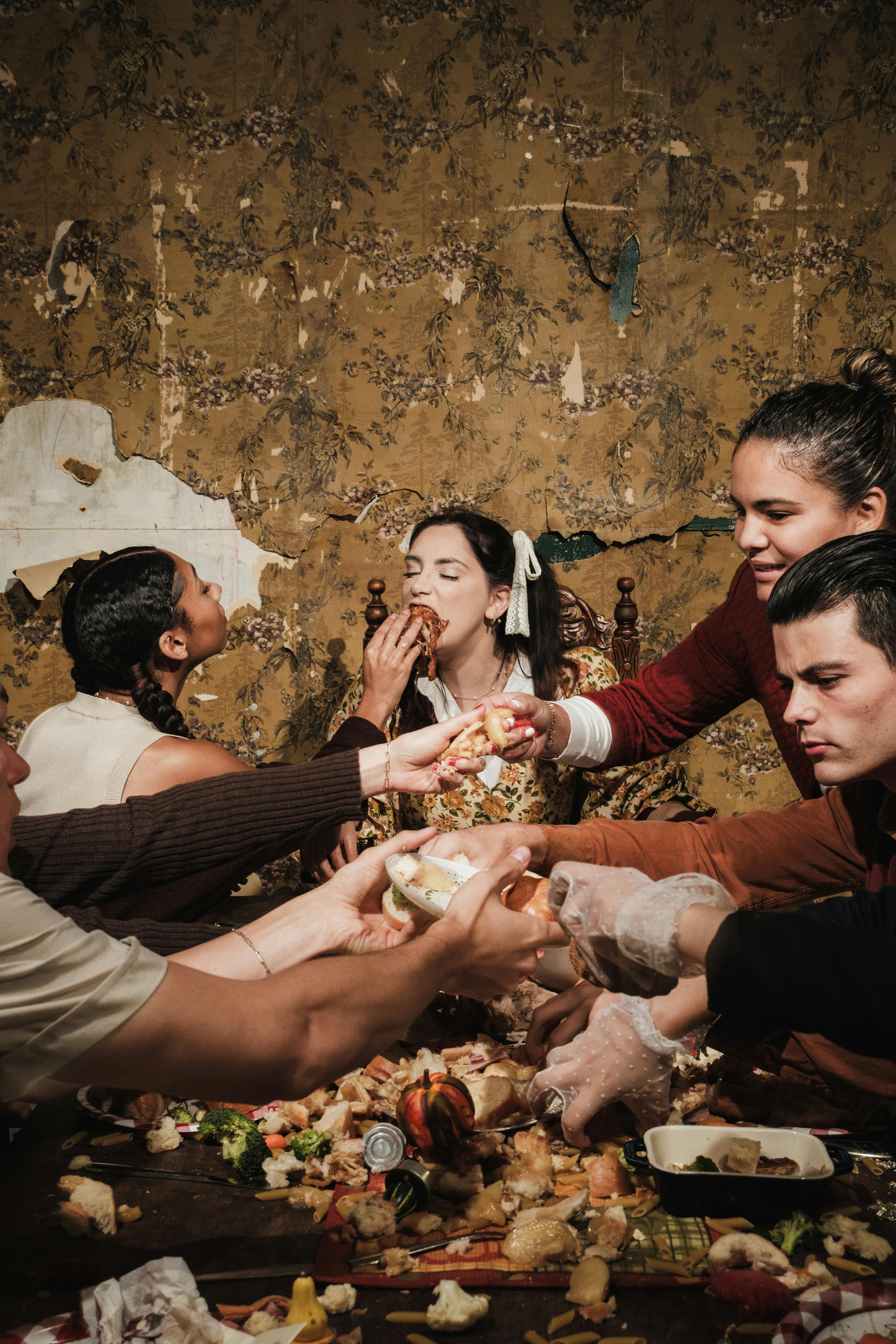
Recently I heard an illustration about heaven and hell. In both places a banquet is occurring. In hell, all the individuals are shackled on their arms. As such, they cannot feed themselves and the atmosphere is one of deprivation. In heaven, the individuals are also all shackled on their arms yet there is an atmosphere of joy and celebration. The difference- in hell each is trying to reach one’s own mouth with food and it cannot be done. In heaven, each is feeding each other and so everyone gets fed.
There is an interesting organization: The Human Generosity Project. According to its website: “The Human Generosity Project is the first large-scale transdisciplinary research project to investigate the interrelationship between biological and cultural influences on human generosity. We use multiple methodologies to understand the nature and evolution of human generosity including fieldwork, laboratory experiments and computational modeling.” (humangenerosity.org). Through this project and information, the researchers are trying to understand and apply human generosity to resource management and disaster recovery.
What about you? Do you make due with what you have? Do you share? Do you use/share your talents, circumstance, time or treasure for others?
It's not just what you're born with
It′s what you choose to bear
It′s not how big your share is
But how much you can share
And it's not the fights you dreamed of
But those you really fought
It′s not what you've been given
It′s what you do with what you've got
More and more I am praying for a generous heart and spirit. Not just with time, talent and treasure but also with my attitude towards others. Especially towards those I might not have (seemingly) anything in common or with whom I do not agree.
"...Nor Any Drop to Drink."

Thus is the sentence ending of the line “Water, water everywhere…” from The Rime of the Ancient Mariner by Samuel Taylor Coleridge.
For a week, such was our lives. We had to have our water turned off due to a leak in our main pipes which required a water main line change. Of course, the leak would occur right before the Memorial Day weekend and the water company had a typical bureaucratic response. While it was most inconvenient, our neighbors were extremely kind to let us use their outdoor spigots to water our newly installed flower garden and fill containers so we could flush toilets.
It was interesting my thought process during this “home drought.” I was saying to one of the neighbors, “Well. This is a first world problem.” Then I stopped and thought. “No. Actually this is a third world problem that many people live with all the time.” I thought of those who never had running water, those who have lost water due to drought and war torn places, and those refugees who are struggling to find food and water. The rationing water made me think of the time I spent visiting my sister in Africa. She had limited electricity (rationed throughout the day) as well as limited running water. I remember filtering our kitchen water and learning to take cold showers.
I was also reading The Nightingale, by Kristin Hannah (highly recommend). Set in Occupied France during WWII, The Nightingale tells the story of two sisters as they navigate the war. The account of the deprivation/starvation/rationing of the people was fascinating, made all the more real since we were rationing our water.
In some ways it is amazing how quickly I forget basic survival skills. It just takes some planning and thinking. I can survive without water flowing from the tap. I just have to fill buckets and think of what water I will need through out the day. Of course, the beauty of consistently running water is that you do not have to think about it. And that can make us too compliant and wasteful.
For instance, how long does it take for running hot water to get hot? According to This Old House, if you ran your shower for 10 seconds you could collect between 1 1/3 and 1 2/3 gallons of water or 8-10 gallons per minute. All that water down the drain while you wait. (Of course, being on the public water system, the waste water is recycled to some extent.) But having had to lug gallon jugs of water from our neighbor to do the washing up in the kitchen, the number of gallons per minute, even for a quick shower seems obscene.
(In the past I have used pitchers or old milk bottles to collect the water as it warm and then use that water to water my plants. Reading about the number of gallons per minute, I am rethinking my plan and how best to collect and “save” all that water.)
As the pipe was being replaced I spoke with the water inspector. One of the things that I did not know was that our water flows due to gravitational force. To me that is unbelievable. How can we (or any of the other 60,000 town residents) get any water pressure at all. But we do.
While earlier civilizations in Egypt and India had aqueducts, it was the Romans who perfected the system: using gravitational force- through building pipes, tunnels, canals, bridges and the natural structure of the land. And that type of system (with some moderations, no lead pipes) is still being used today. What an engineering marvel.
I think of all the other type of “modern” conveniences that I take for granted: electricity, transportation, communication, refrigeration, heating, cooling- many inventions that came during the industrial and post industrial age. I very rarely give any of those services/utilities a thought. And perhaps it is a good thing that I do not spend too much time worrying about the day-to-day existence.
Yet this water situation has me thinking about other resources that I use/abuse. Do I turn off the lights when I leave a room? Have things delivered when I could wait and pick up a grouping of items during an one-errand trip? While we generally have at least one meatless meal a week, I am committed to regularly plan for meatless meals. I also intend on using my bicycle for local errands (fortunately there are two grocery stores nearby). I also want to find out more information about helping global communities obtaining drinkable water. Here is a start: Click here.
What about you? Have any water or electricity issues? What happened? Did you appreciate the service when it came back on? For how long?
I know that there are the skeptics who say that doing a little change in our behavior is a “drop in the bucket”. Yet, I firmly believe that if everyone did a little thing, it would add up to big change, because little things matter. You can find plenty of examples in the natural world: microscopic organisms (phytoplankton and the like) feeding the entire ocean food chain; millions of insects supporting the animal food chain as well as our agricultural system; 10^27 (billions of billions of billions) atoms making up one human body. If any of these organisms are depleted, lacking or harmed, the larger system suffers.
The older I get, the more I'm conscious of ways very small things can make a change in the world. Tiny little things, but the world is made up of tiny matters, isn't it? ~ Sandra Cisneros
Great things are done by a series of small things brought together. ~ Vincent Van Gogh