
It Is Well
Recently I was asked to give a devotional for a group of women. They were exploring the idea of wellness in body, mind and spirit and wanted to use the old hymn, “It is Well with My Soul” as the theme for the day. It made me think, how does one say “it is well with my soul” when life doesn’t necessarily provide an environment conducive to that? For many of us, things are so far from being well in our soul. We are anxious, upset, hurt, broken, or troubled. There is no peace. Or as I say to my husband, some days “there is no joy in Mudville.”
There are certain mysteries of life. One is how, through God we can say that we have the peace that passes all understanding. I think that when we realize that we are fearfully and wonderfully made and that God loves us (and likes us) unconditionally, we can begin to put life into perspective. When we realize that we have eternal life with God, our temporal life on earth doesn’t require as much angst.
Certainly that doesn’t mean that we become anesthetized to the tragedies and difficulties of life. Far from it. But I think when we recognize Who is in control, that He is the one who created all, we can then adjust our attitude and thinking and take a longer view of what is and is not important.
The writer of the hymn “It is Well with My Soul” seemed to understand that. He was no stranger to tragedy.

Horatio and Anna Spafford
Horatio Spafford was a prominent lawyer and business man in Chicago during the mid to late 1800’s. In 1871, he and his wife Anna were living with their four young daughters in Lake View, Chicago when the Chicago fire occurred. Even though Horatio lost money in a property investment deal due to the fire, they were grateful to have survived with their home intact. For the next two years they helped others in the recovery of the city.
In the winter of 1873, the family decided to take a respite and go to Europe with friends. At the last minute, Horatio was detained on business with the plan on meeting the family as soon as he could. Anna and their four daughters set sail on the Ville du Havre. Four days into their journey, the steamship was struck by another boat in the middle of the night. Within twelve minutes the steamship sank. Only 27 of the approximate 300 passengers survived. Anna was one having been found unconscious floating on a piece of debris. Tragically all four of their daughters drowned.
When Anna arrived ashore she sent a telegram to Horatio, “Saved alone. What shall I do?” Anna was bereft but she had a strong conviction that she was saved for a purpose.
Horatio set sail on the next ship. When they boat came to the approximate location and latitude that the Ville du Havre sank, the Captain called Horatio to the deck. After standing on that deck, he penned the words to the hymn.
The Spaffords returned home and in time had two more children, Bertha and little Horatio. Sadly, little Horatio died of Scarlet Fever when he was three years old. After the birth of their last child (Grace), the Spaffords with some friends decided to move to Jerusalem. Over time, the small group become known as the “American Colony”.
Just as they had done in Chicago, they befriended their neighbors in need regardless of ethnicity, race or religion. During WWI, the colony nursed wounded soldiers on both sides of the conflict. When needs arose with orphaned children, the Spafford Children’s Hospital came into being, which is still running today.
From one family’s tragedy arose help and good work for others.
I find it incredible that a family who lost 5 of their 7 children could still have empathy for others and that they would and could reach out to others. I think I would’ve just shut down. It seems to me that in order to be empathetic there must’ve been some peace in their lives. Some reconciliation of their new reality.
What gave them peace? How did they accept the situation that befell their family? (or did they?) By their actions and lifestyle, they continually reached out to others. Was it realizing that there is a bigger plan of life than just what affects them? Whether they felt it or not, they demonstrated obedience, purpose and trust. They felt God calling them to a new venture and so they went.
There are conflicting accounts of the Spafford’s true reasons for moving to Jerusalem yet I don’t find the differing opinions taint my regard of the story. If we examine ourselves, we would admit that each of us is inconsistent in our behavior and thoughts. Our reasons for doing something can be quite complex. Whatever reason they had for moving to Jerusalem and whatever interpretation of their behavior, one cannot argue that they gave back to the community regardless of their circumstances.
I think Anna’s feeling of a purpose helped her. In reading Bertha Spafford’s account of the family’s life, she describes her mother as taking to heart the advice from Evangelist Dwight L. Moody to get involved helping others. Anna did just that even though she grieved for her children her entire life. Bertha mentions in her book, Our Jerusalem, that her mother was quite affected from the drowning of the girls- Anna could never touch corduroy as that was the material of the sleeve of her one daughter as Anna grasped in the dark sea to grab her.
I think purpose helps keep us afloat. My limited life experience has shown that purpose brings depth and understanding to our lives. It gives meaning to situations that on the surface may seem meaningless.
A prayer at Anna’s funeral seems to sum up what the family realized in their hearts: “Life is eternal and love is immortal; And death is only a horizon; And a horizon is nothing; Save the limit of our sight.”
I hope and pray that if I ever have such a life experience as the Spaffords, that I can say “It is well with my soul.” I pray that I can look beyond the immediate and see purpose. I pray that I can trust in Him who suffered and died so that I wouldn’t have eternal death, but life.
What about you? Is it well with your soul?
Lyrics:
When peace, like a river, attendeth my way, When sorrows like sea billows roll; Whatever my lot, Thou hast taught me to say, It is well, it is well with my soul.
Refrain: It is well with my soul, It is well, it is well with my soul.
Though Satan should buffet, though trials should come, Let this blest assurance control, That Christ hath regarded my helpless estate, And hath shed His own blood for my soul.
My sin—oh, the bliss of this glorious thought!— My sin, not in part but the whole, Is nailed to the cross, and I bear it no more, Praise the Lord, praise the Lord, O my soul!
For me, be it Christ, be it Christ hence to live: If Jordan above me shall roll, No pang shall be mine, for in death as in life Thou wilt whisper Thy peace to my soul.
But, Lord, ’tis for Thee, for Thy coming we wait, The sky, not the grave, is our goal; Oh, trump of the angel! Oh, voice of the Lord! Blessed hope, blessed rest of my soul!
And Lord, haste the day when the faith shall be sight, The clouds be rolled back as a scroll; The trump shall resound, and the Lord shall descend, Even so, it is well with my soul.
Click here to hear a beautiful rendition of “It is Well with My Soul” narrated by Hugh Bonneville.
Getting Along

Spoken by the man who lived his words. Without communication how can any relationship form, maintain and thrive?
Our church leadership group is reading a book, The Good and Beautiful Community, by James Bryan Smith. It is a book that brings together the ideas of spiritual formation and community engagement. It is thought-provoking as well as practical.
We recently discussed one of the chapters: “The Christ-Centered Community; Loving those we disagree with. What struck me was the emphasis on getting along, something that is in short supply lately. When we really stop and think about it, most times we disagree with others on non-essential issues: ideas or actions that in the long haul won’t matter. Similarly to the big Christmas argument that no one in the family quite remembers the topic. Relationships become tense and possibly broken as each side harbors hurt, wounded pride and misunderstanding. When we really get to the heart of an issue we find that we generally agree on essential fundamentals. Not all the time, of course. And recently there seems to be more and more disagreement on even the essentials of human existence.
In the application section, the author reminds us of the 18th-century Methodist leader John Wesley’s advice on loving those with whom we disagree:
Treat them as companions.
Do not think of speak evil of them.
Pray for them.
Encourage them to do good.
Collaborate with them in ministry.
Granted, this is written for Christ-followers in getting along with other Christ-followers, but I think that it has universal appeal. I think that these truths apply across the board. Just because someone doesn’t have your same beliefs doesn’t mean that you cannot pray for them (or think about putting your shoes in theirs for a while). While one might not call their work, “ministry”, you can still work with others in whatever job/service they do.
Makes me wonder- what would happen if our President and Congressional members prayed for each other? Treated one another as companions? Encouraged one another? Did not speak evil of each other?And, shall we even dare say, collaborated together?
Closer to home, what about the people with whom I disagree? Some times I am so annoyed with others that I do not want to think or pray for them and I definitely do not want to encourage or collaborate with them. Although I definitely want to speak evil of them- to all who will listen! Not a very good approach to building community.
Are you currently not getting along with someone or a group of someones? Are there any of the five suggestions you can try? I am thinking of one woman in particular who drives me crazy. Perhaps I need to stop thinking (and speaking) “evil”. (Evil might be too strong a word. But I do have the tendency to speak those subtle sarcastic remarks which are not encouraging nor uplifting.)
I did hear some wise advice once: find something positive to begin and end each conversation. If only certain twits (Is that the name for people who use Twitter?) would start that practice, imagine how much our political scene would change.
What about you? How do you handle disagreements? With your family, friends or co-workers? Do you ignore them? Provoke them? Love them?
Today, how can you get along with others or help someone else get along?
3-Legged Stool sitting

Full disclosure: This is not the stool my son made. I have his in our outside shed. Because all our summer equipment is in the shed, I couldn’t reach the stool to get it out for a picture. Perhaps I need to de-clutter….
Have you ever tried to sit on a three-legged stool? Our son once made a stool in art class. It was difficult to get the legs just right- enough of an angle to support the seat yet at the same time have the legs the correct length to keep the seat even. Placing anything on it, much less sitting on it was quite tricky.
I’ve been thinking about stools and balance lately. It seems that it is quite tricky to keep our lives in balance; we might get one part of our lives “in order” but as soon as we try sitting, we find that another portion is too short or too long and that we are unbalanced. It is then that we find ourselves being thrown from our position. Too much or too little is not a good thing.
Not only are there sometimes problems with the supports with the stool, but it also depends on what is placed on it. If there is something heavy or wiggly, the stool might not be supportive. They say that in days of old, bakers used to sit on stools as they tended to the bread. The stools purposely had one leg shorter than the other so that the baker had to be constantly adjusting his position in order to stay upright. If he fell asleep, he would fall off the stool and be woken up.
The three legs of the stool represent us: body, mind and spirit. When one aspect of our lives is underdeveloped, or short, we can experience an unbalance, tipping, falling over kind of situation. Our life can have so many heavy or wiggly situations. Without proper support, we cannot continue holding them up and are at danger of falling apart.
As we continue into the new year, here are some ideas to ponder. You might find that you need only to “shore up” one of the legs in preparation for whatever life situations may happen:
Body:
Are you getting proper rest? Are you eating/drinking in moderation? Are you moving (not necessarily exercise) your body?
Do you need to find out more information? Whether that is through “professionals” like doctors, counselors? Have you had a general check-up with your dentist? Eye doctor?
How is your physical environment? Do you need to de-clutter? Do you have financial peace?
Do you have enough energy to do the things you need to do? Carrying for your family members? Getting through the day?
Mind:
When was the last time you learned something new? Have you ever shared your knowledge (of anything) with others?
Are you curious? Have you ever done anything that takes you out of your comfort zone?
What is your attitude about life? Are you grateful? Joyful? Bitter?
Spirit:
What is your anxiety level? I have found that my anxiety is directly proportional to my desire for control. When I surrender my control of situations, my anxiety level dramatically decreases.
Do you have a spiritual practice? Would you like to develop something new? Bible reading? Prayer? Fasting? Service for others? Solitude? Meditation?
Is there something that is constantly weighing on your mind? Do you need to speak to a spiritual advisor? Counselor? Pastor?
Do you have a mentor? Or are you a mentor of someone else?
One constant in life, is that it is constantly changing. Sometimes we find that we are being thrown off our stools. But just like the baker, it gives us an opportunity to wake up and make some adjustments. Many times it doesn’t have to be big, life-changing behavior. Sometimes it is a subtle, small new habit or attitude. But those small adjustments are what is needed at the time in order to thrive.
What about you? How is your stool sitting?
Stumbling in the Dark

Even a single match provides enough light to see in the darkness…
The other morning I was up early to drive a friend to the airport. I did not want to wake up my husband so I did not turn on any lights in the bedroom. As I was groping for my hairbrush I tried to visualize where things were placed on my dresser. When I reached for where I thought my brush was, I realized I was positioned incorrectly. It was off-putting to have my brain think I was one place and to find out that I wasn’t in the correct perspective and alignment.
It made me think of how most times in life we are (or perhaps I should say- I am) stumbling in the dark. We haven’t a clue on what is around us and we grab at things that we did not intend to touch. We can inadvertently grab something that may be harmful to us or to others. All because we do not want to put on a light and have some sort of illumination.
I think if we are really honest, some days we do not want to illuminate the truth of a situation and we hide within the shadows of ignorance and misunderstanding. We think that we have absolved ourselves of any responsibility because we did not “turn on the light”. We allow ourselves to be victims of a shadowy, unhealthy and potentially dangerous environment.
As I was pondering this analogy of light, it occurred to me: 1) even though our eyes may adjust to darkness, we need a light to quickly and efficiently find what we need. 2) short of that light, we need to be aligned in the right perspective so that when we feel our way round, we know what we are touching. 3) when we finally have proper light, we realize how far off-base we have been in our perspectives and in the reality of what the situation or area looks like. It is only in comparison with the proper light do we finally realize how enclosed in darkness we really are.
We need to be brave. While it can be considered bravery to enter dark spaces and try to navigate in that space, it is even more courageous to be willing to flip on a switch or light a match and shed light into the dark corners of our minds, our problems and our culture. It is willing to come face to face with whatever is lurking in the dark. Most often there are just shadows which are just figments that have no real substance.
When I need to be brave, I need to remind myself, “What is truth? What is Light?” and to hold on to that information. I need to embrace and seek the Light through others and through daily soaking of His Word: the Hebrew and Greek wisdom that illuminates God’s love for us through the stories and promises of and to His people.
What about you? Are you afraid of the dark? Have you ever stumbled in the dark? What kind of light do you like? Ambient? Bright florescent? Are there dark places in your home? Your life? Have you ever cast a light into that space? What did the light reveal? Have you ever tried to “function” without the light on in your home? What could you do and not do? When light finally revealed what you did, how close were you to functioning as if there were light? What helped you maintain (if you did) perspective?
For me to maintain perspective even in dark times, I need the alignment and light from the Light of the World. We are living in dark times: both in our culture and in the season of the year. Light provides warmth, growth, and clarity. Light illuminates the Truth.
There is a Light that shines in the darkness. One that guides us and keeps us from harm. Now, more than ever, we need that Light- as individuals, as a nation and as world beings.
Words?

Sometimes when I have too many projects going on in my head, I have difficulty in communicating what I want to say to others. I will start a conversation and either pause grasping for a word or jump from one train of thought to another. My son will look at me, raise an eyebrow and say, “Words?” (He is twisting the conversations that we, as parents used to have with him and his brother when they had an altercation with one another- Use your words (rather than fists) we would admonish.) What he is trying to do is get me to slow down and use the right word to describe or convey instruction.
Do you find yourself at the start of each year with a whole host of plans? Things you want to do and want to change? Do you also find yourself at the middle of the year, or even one month into the year, frustrated that nothing has happened?
For 2019 I would encourage you to use your words or more specifically to think of one word- one word to describe your intention, focus or meaning for your life this year. One word that will help you change to become the person you want to become. There is a book, (which I haven’t read yet but has been recommended by others) that describes the process- My One Word by Mike Ashcraft and Rachel Olsen. (For more information, click here)
From the My One Word website:
Step 1: DETERMINE THE KIND OF PERSON YOU WANT TO BECOME
The first step is to simply take some time and decide what kind of person you want to be at the end of this year. This goes beyond simply being healthier and wealthier, but it must drive deep into your soul. What about the condition of your heart? What about the person that God Himself has created you to be?
Step 2: IDENTIFY THE CHARACTERISTICS OF THAT PERSON
Get a picture of that person and then simply identify their major characteristics. Is that person gentle? Is that person generous? What are the qualities of the person you want to become?
Step 3: PICK A WORD
Once you have a list of the characteristics, simply pick a word. There might be fifteen things that you want to change, but you must resist the temptation to promise you will do them all. Instead, simply commit to ONE WORD.
This will provide you with a lens to see the changes you need to make as well as a way to determine whether or not change is actually happening. Understand that this process is hard, but staying focused on your word will help you to struggle in the right direction so that you can actually see God working in your life.
Different folks that I know have chosen the following words over the years: joy, love, peace, early, submission, present, resist. There is no right or wrong word, just one that resonates with you. My word for the 2019 is focus. While I am a pretty disciplined person, I have a tendency to put others’ needs in front of my own, so much so that I avoid doing what God has called me to do, all in the name of helping others. For what seems like good work really is not so great: I hide behind this “selfless” act and never rise up to the challenge that God has for me. So for this year, I intend to focus on what God is calling me to do- concentrate on my writing.
What about you? What is your word for the year? Rather than have a list of resolutions, why not concentrate on applying one word to your daily life?
Many blessings for 2019. Thank you for joining me on this journey and in reading this blog. I hope to have many exciting new writing projects to share with you in 2019. If you feel that any of my words are worthwhile, please share these posts with others.
Christmas (Be) Longings

Are you longing? Longing for a lost dream? A lost situation or experience? A new situation? Relaxing time? Peace of mind?
It seems as if the holidays are times of longing- Longing for family and friends, for good times, for laughter and smiles, for happiness and joy. We even long for the busyness of the season to be over. How many times have I said or have been told, “Let’s get together in the New Year when things settle down.” “I’ll do that in January when I have more time.” We long for peace, quiet and a more settled lifestyle.
It seems as if the national collective is longing to live in a Hallmark movie.
On a deeper level I think that we are longing to belong. To be known. To be loved. Unconditionally.
All those Hallmark movies can be boiled down to love. Coming home. Understanding. “To be or not to be”, says the Bard. We want to be-long.
Christmas is the time of longing- a time when all of humanity, past, present and future, long for something. The ancient Hebrew people group were longing for the Redeemer to appear. Our modern Eastern and Western worlds are longing for a time when all is right with the world. Nations want peace and prosperity. All of which will only happen when we, the world, are right with God.
Christmas is the time to remember when God came to earth to save us from ourselves. He came so that we would believe that we are known and loved. Unconditionally. By Him. That God who is Love dwelt among us and knows what it is to be-long in our frail humanity. He entered into our human condition not because He had to but because He longs for us and for relationship. He loves us. He is reaching out to each one of us so that we can come home to Him. Forever.
Better than a Hallmark movie.
What about you? Is this a season of be-longing? Have you ever thought about why we celebrate Christmas? Have you ever thought about the longings of your heart and who/what might satisfy them?
“There is a God shaped vacuum in the heart of every man which cannot be filled by any created thing, but only by God, the Creator, made known through Jesus.”
Party-Goers

Are you the life of a party? The kind of person that the party doesn’t start until you arrive and it will end when you leave?
Or are you one of the crowd? You come, you eat and you may speak with one person, preferably someone other than the one who transported you in the car.
Personally I think the “Good time Charlie’s” are in the minority. They are only prevalent in movies and country songs. Although, I do have a fair number of acquaintances who are really good at small talk. They can spend just enough time with a person to spread bon sentiment and can delicately extricate themselves from the conversation without slighting the other person.
However, I think the majority of us find parties to be difficult: either the extroverted ones are disappointed because they don’t get a chance to speak to everyone and the introverted ones find the entire small talk socialization to be exhausting.
Last week I heard some good advice (thank you, Carla Hall) about how to try and socialize a little bit more at parties.
If you find yourself struggling to talk to people, try this: Say to yourself that you will try and speak to everyone in the room who is wearing a red sweater. Or blue pants. Or…. pick something. It gives you a purpose for your conversation (although you might be the only one who knows what the “it” is). In your head, you might limit your time with each person knowing that you want to speak to all those “who wear glasses”.
It might not be that effective but it may help you move beyond your comfort zone at a party.
I know that I am not the most comfortable with small talk. I find that I am too curious about others’ lives, spent too much time with a new acquaintance and have a tendency to remember the smallest details of people. It can be off-putting. Also, I have not learned the skill to gracefully exit a conversation. I find it so awkward when speaking with a person, another one comes up (whom I might not know) and he/she really wants to speak with the same person. I will try to ask if anyone wants more to drink and leave that way but generally the two start in with the talking that I don’t want to interrupt nor do I want to rudely leave. Awkward.
One time, my husband and I were staying at a bed and breakfast. In the evenings they offered wine and cheese before dinner. We went down to the common room and found ourselves talking to some of the other guests. One couple in particular was quite chatty and very interesting. I kept thinking of more questions, not to fill in the time per se but to hear more about their story. At one point in the conversation the husband stopped. Looked at me and said, “Are you a reporter or something?” Gosh, I guess I had asked too many questions.
In one of the childhood books my son enjoyed, the author based his character on his growing up in New England in the 1930’s. One of the lessons his mom imparted on him was the art of conversation. In conversation, one should answer a question and then ask one. Similarly to catching and throwing a ball.
In his story, the author recounted the story of the school nurse going around and asking each of the children if they had had a bowel movement recently. (Being a former school nurse, I can tell you that times have changed!) When the nurse came to the author, he remembered his mother’s words of tossing the conversation back and forth. After the nurse asked her question, the boy answered and then said, “And you?”
While that specific type of conversation tossing is not recommended at holiday get-togethers, here are some conversation starters. (Some of these I would probably not use unless I were with people I knew and wanted to ask something more engaging or I wanted to have a deeper dinner party conversation.) Hopefully these can get you thinking of some questions to get the ball rolling:
What’s the most interesting thing you’ve read lately?
What’s a fact about you that’s not on the internet?
Do you listen to any podcasts? Which ones?
If you were in charge of the playlist, which song would you play next?
What’s the best gift you’ve ever gotten?
What’s your favorite part about living in [city]? Least favorite?
Great [shoes/haircut/shirt]! Where’d you get it?
I’m trying to plan my next trip -- have you traveled anywhere interesting lately?
What are the top three things on your bucket list?
If you could ask for a miracle, what would it be?
Where do you see yourself in five years?
What is the biggest risk you’ve ever taken?
What would your ideal life look like?
If someone gave you an envelope with your death date inside of it, would you open it?
When have you been the most happy?
Do you know anyone who is living their life to the fullest?
What is your idea of the perfect day?
Who has been the most influential person in your life and why?
What book had a big influence on you?
Do you think your priorities have changed since you were younger?
What is the most memorable lesson you learned from your parents?
What does success mean to you?
What is the most difficult thing you’ve ever done?
What scares you most about your future?
What keeps you up at night?
How long can you go without checking your phone?
Have you ever really kept a New Year’s resolution?
What bad habits do you wish you could stop?
Do you have a morning ritual?
Can you tell when someone is lying?
Do you prefer polaroid or digital cameras?
If someone offered to tell you your future, would you accept it?
Who’s your biggest hero?
Have you ever stolen anything?
If you were to remove one social media app from your phone, which would it be and why?
If you could have tea with a fictional character, who would that be?
What is your most embarrassing moment?
If you were on death row, what would your last meal be?
If you could sit down with your 13-year old self, what would you say?
If you could only pack one thing for a trip (besides clothing) what would it be?
What makes you really angry?
What is your spirit animal?
What would be the title of your memoire?
What’s your guilty pleasure?
What would your theme song be if you had your own show?
What bores you?
What would you do if you were home alone and the power went out?
What’s the weirdest dream you’ve ever had?
If your plane was going down, who would you would call?
What would your rock band group be called?
What about you? Are you dreading holiday get-togethers or are you relishing the time with others? Hopefully this season you may get to know someone a little bit better and at least feel that you “conquered” the party.
Breathtaking Beauty of Life

This comes from Maria Shriver’s Sunday Paper. You can subscribe to her weekly email: www.mariashriver.com
Do you ever have themes in your life? Days or weeks when the same topic seems to be brought up in a variety of settings? It is as if the cosmos is telling you- “This is important. Listen.”
It appears that I have had a theme this last week.
The above quote was tucked at the bottom of Maria Shriver’s Sunday Paper article from this past Sunday. I really liked it as it captures the essence of life: “heartbreaking, soul-healing, amazing, awful, ordinary”. It captures all that I have felt about life especially the extra- ordinariness of the ordinary.
This past week, my women’s Bible study looked at Psalm 90, a psalm of Moses. Moses reminds us of our limitations as humans, namely that we are like fleeting grass and that, in modern day parlance, we cannot “take it with us”. He reminds us of our sinful nature and therefore our shortened lives. Yet, the psalm also speaks to God’s infinite presence and His holiness and righteousness. It is in remembering our proper place that we can live lives that have joy, peace and authenticity. The psalmist reminds us to number our days and to make the best use of our time. It is in looking at death that we can come to grips with life.
Also, this past week was a national day of mourning. It was a time for the national collective to reflect on a president as well as a time to reflect on ourselves. After all, for what funeral doesn’t cause introspection? Many different news commentators spoke of how hearing about the life of President George H.W. Bush made them think about how they lived their own lives. It was a chance to reflect on the time each one of us has left on this earth.
And then closer to home, this past week our church had our annual service of hope and loss. It is a special service to reflect on our losses, whether the loss of a loved one, a dream, our health, etc. and to embrace the hope that comes with Immanuel. It is a collective time for remembering our loved ones- those present and past and it is a time to recount our lives and how we are numbering our days.
All this “death” has me thinking about life. At our service of hope and loss I witnessed first hand the breathtaking beauty of heartbreak and soul-healing. I saw those whom I know have gone through devastating losses to enter into a place of giving to others. Not that they have forgotten those losses, but because they have witnessed the hope of a future with the everlasting God, they are willing to enter into new horizons.
Life is messy. Nothing brings that home more than the fact that God came to earth through the messiness of being one of us- starting as a helpless, messy, needy baby. God was with us (Immanuel) through the experience of Jesus’ life here on earth. Jesus experienced all that we do except sin. When I acknowledge these facts- Jesus was here on earth. He experienced all that I have and will experience. He lived with purpose and with “numbered days”- I have hope for my future. I have hope that I can number my days and accomplish that which God has called me to do. God’s work of my hands means living an authentic life. One in which I honor Him by integrity, love of God/family/friends/neighbor, loyalty, honesty, being servant minded.
“Let Your work appear to Your servants, And Your glory to their children. And let the beauty of the LORD our God be upon us, And establish the work of our hands for us.”
What about you? Any life themes? What is the cosmos trying to tell you? Have you ever thought about death? How do you live your life? With an eye on your epitaph? What would people say about you at your funeral?
Is your life breathtakingly beautiful?
Weary Souls

Sick. And. Tired.
Have you ever felt the weight of each of those words? Sometimes we say it blurred together- “sickandtired”- as if it is just a common detail like a brown eyed girl. Other times, each word and its weariness weighs on us and we feel immobilized.
I have felt that immobilization numerous times, especially when I experienced caregiver burnout. The thought of one more step, one more answered phone call, one more request for help would set me right over the edge. The weight of those words could cause me to cry a river wherever I found myself. I was a weary soul.
Last week I felt the same overwhelming weariness as I was preparing for a weekly responsibility. I felt so sick and tired of the same old, same old. “How come I get stuck doing this?”, I grumbled to myself. I dragged myself to my meeting.
However once I got there I saw the eager and innocent faces of the people who were counting on me and I was stirred by compassion. “How can I grumble when these folks have so much need?”
It is not that I was being such a selfless individual. (I am far from that.) It was that God stirred compassion in my soul.
I was reminded of the time when Jesus “withdrew from there in a boat to a desolate place by himself. But when the crowds heard it, they followed him on foot from the towns. When he went ashore he saw a great crowd, and he had compassion on them and healed their sick.” Jesus was trying to get away for a time but the crowd had followed him. The day became long and as this was a desolate place there were no places to “grab dinner”. Jesus miraculously supplied the food for the five thousand plus crowd, all with the blessing of five loaves and two fish. (Matthew 14: 13-21)
While there are other interpretations and devotionals about the feeding of the five thousand, what I like about this story is the hope that it provides and the relate-ability of Jesus. Jesus, in his humanity (Son of God/Son of Man) was weary. The story right before this one tells of the beheading of John the Baptist. Surely Jesus must’ve been sad and distressed about that- John was his cousin and precursor to Jesus’ ministry. I am sure that the human side of Jesus needed to get away.
“Can’t I go anywhere? Even when I pick a desolate place, they follow me.” Jesus doesn’t complain and say that, but I certainly would have. I wonder as He looked upon the needs of the crowds if He had a conversation with His father, “provide me with the strength I need for this task.”
In this story, God does provide. He provides strength and energy for the weary human-side of Jesus and He provides sustenance to the mass of humanity gathered.
It is so hard to have balance: balance between caring for ourselves and serving others. But it is so important to master that balance. For if we don’t we will suffer burnout- physically and mentally. Also others will experience burnout through the backlash of our bitterness.
Conversely, if we care for ourselves, we can care for others. The miracle of the bread and fish provided care for the crowd but it also provided resources for Jesus to meet those needs of the needy.
Are you bone weary? Sick. And. Tired? Do you find yourself day in, day out caring for a loved one or stuck in a place of service that you do not see any relief? Are you trying to manage it all by yourself?
Hang in there. Find someone to share your struggles- whether a listening ear or a tending hand. If you have the means, think about hiring someone to help for a short period of time. Take a break from volunteering. Say no to solicitations. You can always say that you are taking a sabbatical and ask that they reach out to you in six months.
Take time to meditate on the sayings of Jesus. What I love about the Matthew passage is the image of the yoke. I heard during a sermon once (thanks Sis) about the making of a yoke. It was made of wood and was tailored made for the specific oxen who was to wear it. The yoke would be planed, sanded and fitted exactly for that animal.
God knows each one of us intimately. He knows when we are weary and when we need rest.
1 Peter 5: 7: “Casting all your anxieties on Him, because He cares for you.”
Galatians 6: 2: “Bear one another’s burdens…”
Matthew 11: 29, 30: “Take my yoke upon you, and learn from me, for I am gentle and lowly in heart, and you will find rest for your souls. For my yoke is easy and my burden is light.”
Obedience
I have been thinking about obedience lately. It is one of those words like prudence and chastity that is not used much. You never hear it in wedding vows and very rarely hear it being told to children. Perhaps that is not such a bad thing but I think we may be missing an important structure in our society.
Being obedient was brought home to me the other weekend when my husband and I took our dogs to the vets for a nail trim. I was inside waiting to settle up the bill while my husband took our two scallawags outside. As he waited along the side of the building, a dog that was boarding took off from behind the vets and started running down the street with the poor vet tech chasing behind. My husband secured our dogs and went to help the tech. The dog, a young terrier mix was extremely scared but also out for a frolic along a busy intersection and road. Our vet is located on a fairly busy country road with side roads of new developments mixed with farm land. The dog ran down many of the lanes and into the fields. She then would circle back to the main road and criss cross into traffic. Try as we might, she would not come to us.
At one point I was able to “corner” her in a portion of a field that was fenced on two sides. I crouched low, kept still and called her. She finally stopped bolting and lay down about a hand’s length beyond my grasp. As I tried to hook her up to the leash, she slipped out of my grip. She bolted, then stopped, looked at me and sprinted off into some deep woods.
My husband and I helped the vet staff for about two hours stopping neighbors to tell them about the little dog. The staff continued to call and look for her far into the twilight and night. The next day we got a call from them to say that the dog continued to criss-cross over the road and wouldn’t come to them. Tragically she was hit by a car. The vets tried to save her but to no avail.
Obedience.
With our independent streaks, we are not comfortable with someone telling us what to do. We want to control our own destiny and our own way. Unfortunately we deceive ourselves if we think that we are in control: life has too many variables for us to be in charge. All we can control is our reaction to what comes down our path.
Obedience comes when we realize that someone has a better handle on what is happening: more experience, education, or understanding. It would be wise to heed their advice, listen to their commands and do what they suggest. In the case of the little terrier, had she listened to our calls, she would have been safe. She represents not only time lost for her and those spent looking for her but also a life lost.
The whole idea of listening and obedience had me thinking. In obeying are we really giving up independence? Or are we choosing to be wise by listening to others with greater wisdom? The Hebrew writer says “to obey is greater than sacrifice.” There is the expression blind obedience but I think there is blind sacrifice. Either option seems to imply that one doesn’t have a choice in the matter. One responds almost by rote. Yet I think that there are choices in both options. We can choose to obey. We can choose what and how much we sacrifice.
Whether obedience is blind or fully understood, it also requires trust in the one whom we obey. It requires that we recognize why we should and could trust that person.
In the case of obedience to God- how can we not trust Him? God is love. Pure and thoroughly. He desires the best for us because He made us. It is inconceivable that He would harm us in any way just like it is inconceivable that we would’ve harmed that little terrier.
I think of the many times I did not (and still do not at times) listen to what is good for me. I strike out on my own and don’t come back to the safety of God’s path. If only I would learn that being obedient is not an act of weakness. It is an act of being smart. I could then get over myself and my thinking that I know best. I could embrace what I, at first glance, feel is “someone telling me what to do.” I could then move on to doing the things that God is calling me to do; willingly and obediently.
What about you? How are you with obedience? Do you bristle at someone’s attempt of guiding or helping you? Do you feel like someone is trying to squash your independence? Do you welcome the guidance? Have you ever obeyed and later realized that through obedience you avoided a catastrophe? Do you truly, deep down know that God loves you and wants the best for you?
What do you choose? To obey or not to obey?
Happy Thanksgiving

Another year. Another Thanksgiving. Another gathering with family and friends to share a meal, to spend time together and to think about our lives. For many it is around the table that gratitude is expressed. Today is a great opportunity to reflect on where we have been and where we are going. Today is a good day to pause and think about how we view the blessings in our lives.
At a recent dinner one of our friends was sharing a story about a grandfather and his seven-year-old granddaughter. For some reason as the child’s grandfather was pouring the child some water he decided to test the “is the glass half-full or half-empty” theory on her. After the grandfather asked, the child pondered for moment and then said, “Depends on whether you are the one pouring the water or waiting to drink it.”
What a profound answer.
I know that I have to continually reframe my thinking to see life as “half-full”. Generally I am a half-full person but if I am tired, hungry or anxious I will start seeing life through a “half-empty, unfair, why am I the only one…” whining lens. Totally ridiculous and totally untrue. It is at those times that I need to step back, recharge and regroup in order to see the entire picture- all the blessings that I have undeservedly received.
When it comes to the water in the glass, the volume of liquid is the same whether it is half-full or half-empty. To use the commonly over-used expression, “it is what it is.” I cannot change the amount. What I have before me is just that- nothing more, nothing less.
What I like about the granddaughter’s response is a new take on the age old question. In the past, the question has been asked with the intention of what the viewer, as a third-person narrative, thinks. The question does not really ask if the glass is yours or not. It is a passive question. This new spin on the question has us ask with a first-person narrative- if we are the ones who are involved, how do we view the glass? What is our active participation with the glass? What is our attitude if we are providing the water? What is our attitude if we know that water is coming?
I know that when I am in a position to “pour out” blessings to others, I am more likely to be in a positive and helpful mood. I want to be able to provide blessing, assistance, or aide to others. “Pouring out” blessing almost always has me seeing the provision as half-full. And not only that specific provision, but other things as well. When I am feeling that I can bless others, I start to see the many blessings others have been poured out for me. It is in the act of my blessing that I begin to see blessing all around me.
When I am active as one waiting for the glass to be poured, I have an expectation that needs will be met. I am waiting for whatever comes into the glass. I don’t think of being short-changed (by half-empty or half-full) but grateful for what is in the glass. My thirst will be quenched. I can be grateful for the blessings because they are for me. They are not in comparison of what others have received.
On this day of Thanksgiving, what, “it is what it is” in your life? What are the things that are in your glass? Life? Health? Shelter? Money? Family? Friends? God? Material possessions? Job? Career? Respect in your community? Influence? Honor? Integrity? Love? Relationships?
On this day of Thanksgiving, what are the blessings in your life- whether they are ones you have “poured” out to others or that you are waiting to receive?
Early Morning Dialogues

The other day I was reminded of an elementary school classmate who refused to eat in front of anyone. She had quite a phobia in the lunch room. She was obsessed and absolutely sure that everyone was watching her eat. If any of you recall your lunchroom days, her thoughts were absolutely NOT true: there was so much scurrying around at lunch- finding the table, jostling sitting positions among friends, buying milk, opening the milk carton, gulping the food down in two minutes, cleaning the area so that the lunch lady would dismiss you outside for the rare ten minutes of freedom- that one had enough trouble eating one’s own lunch much less watching someone eat hers.
I think of it now and wonder what was her problem? Did she have a diagnosed psychological issue, does she still suffer from this or was it some childhood idea that eventually she outgrew? I also remember that her mother fussed over her sooo much whenever there was an opportunity for parents to visit and help out in the school. Perhaps that contributed to it?
I have been thinking a lot about what we perceive others are thinking of us and how we respond.
Do you ever wake up in the middle of the night, reliving a past conversation? You find yourself performing a middle-of-the-night revision: the stammering replies become sitcom-worthy quips, the questions turn into insightful inquiries and the rebuttals transform into argument-changing succinct points.
In the dark quiet hours of early morning I will either replay a past situation or create a future one all based on an assumption of my limited knowledge. I can create a whole imagined dialogue and even find myself annoyed and angry as if things happened when in actuality they have not.
For the last six months I have been engaged in this night time ritual as I have been enmeshed in some personnel issues at a local non-profit. I can get all keyed up when in actuality all that I have imagined has not happened nor will it.
This was brought home to me last week. There was a new twist to our employment sage and I once again found myself waking up in the middle of the night preparing a mental list of all things that I had to say at the following morning meeting. When the meeting occurred and the different parties spoke, I realized that all my preparation was for naught. I had worried and fussed over nothing. For what was spoken was so different than I imagined. What I thought I knew was the farthest from the truth. It was not that I had wrong information, rather it was that I had taken what I knew and then expanded it to a whole different unrealistic level.
I had the epiphany that I should never think that I know what someone will say, do or even think. I certainly do not need to be worked up thinking that the other person is thinking of me. That is probably the crux of the situation: I worry, fuss and overthink conversations, not to be prepared for future conversations, but because I am, at my core, self-centered. But the reality is no one is thinking of me and my reaction. Very rarely do others think of us- either the good or the bad. So when we are worried that folks are not thinking good thoughts about us, it is most likely untrue.
Don Miguel Ruiz in his book, The Four Agreements, reminds us in two of his philosophical statements: don’t take anything personally and don’t make assumptions. It is not about you. What others say and do is really about them. In thinking of how others will respond, I forget that there is a whole other side to the equation- did the person get a good night’s sleep, did they have great news from the doctor, did they get a raise or were they up all night, is their kid sick, did they lose their job? The way someone responds to another is largely dependent upon the factors in their own life.
The other activity that I know I am prone to do is to make assumptions. My middle-of-the-night scenarios are mostly made up of those. Mr. Ruiz cautions us to not do this:
“We have the tendency to make assumptions about everything. The problem with making assumptions is that we believe they are the truth. We could swear they are real. We make assumptions about what others are doing or thinking—we take it personally—then we blame them and react by sending emotional poison with our word. That is why when we make assumptions, we’re asking for problems. We make an assumption, we misunderstand, we take it personally, and we end up creating a whole big drama for nothing.”
Gosh what freedom when I realized this. I can just concentrate on doing what I can do. I can just try and be as true to my word and true to the interpretation of the events but not to worry what others think, say or feel. If I want to know a specific answer or response to a situation I need to just ask. Find out directly what is going on. What a relief and lifted burden.
What about you? Do you participate in the rewind of past conversations? Do you have mental engagements and dialogues in your head? Have any of them been true?
I am sure that I will revert back to my middle-of-the-night “writing” sessions, but I am trying not to. I am enjoying this lighter mental load. Maybe I will finally get a good night’s sleep. (But I don’t want to make any assumptions!)

The Air We Breathe

I heard a news program on the radio last week that talked about the cycle of earthly things: rain, air, rocks. Things that have been present for thousand upon thousand years are still here in some form or another. For example, many stones washed upon the seashore have come from glacial boulders. Over time they have been churned up by the ocean and deposited on the shoreline. But the original form has been here for ions nonetheless.
The very air that Einstein, Michelangelo, Rembrandt, Jefferson, Alexander the Great, (fill in any past figure from history) breathed is the same air that we do. The very air that Christ breathed is the same air that we do. To me that is astounding.
Makes me wonder if that fact alone would make me behave better?
Certainly we see the “Kate or Meghan effect” in the buying habits of their adoring public. According to British news, the Meghan effect results in brands she wears enjoying a thirty-five percent increase of desirability. The psychology is that if one purchases and wears the same thing, there is an affinity, a rapport, a vicarious feeling, a connection to the other.
I read an article where the author wore Meghan inspired clothes for a week. She didn’t have an epiphany but she did say that she was inspired to wear nicer, more presentable clothing and planned to do so in the future.
While it seems superficial, there is indication that people do behave differently depending upon their dress.
The idea of breathing in the same air that Christ breathed is one that makes me wonder- is there some type of effect to that? Will I become more compassionate? Loving?
Certainly the air quality has nothing to do with my level of compassion, understanding or love but being mindful of Christ “in me” certainly does. As I breathe in His air, do I take in His words, His guidance, His plans for my life? Do I breathe out His love, His compassion, His care for the world?
What about you? Have you ever thought of your place in the world in relationship to those who have gone before? To walk in the places those whom we admired walked? To hear the same rustling of the wind among the trees? To breathe the same air? Reminds me of old hymn:
Breathe on me, Breath of God,
Fill me with life anew,
That I may love what Thou dost love,
And do what Thou wouldst do.
Breathe on me, Breath of God,
Until my heart is pure,
Until with Thee I will one will,
To do and to endure.
Breathe on me, Breath of God,
Till I am wholly Thine,
Until this earthly part of me
Glows with Thy fire divine.
Breathe on me, Breath of God,
So shall I never die,
But live with Thee the perfect life
Of Thine eternity.
~Edwin Hatch
Agents of Grace

www.letterstotheexiles.com
Last weekend my husband and I went away with another couple for a mountain retreat. We had a wonderful time- ate delicious food, did a little Scotch tasting and the best of all- engaged in deep and meaningful conversation.
While we really do not need any “starter” conversations with this couple, we did bring along a video- Letters to the Exiles, which has 7 short videos with discussion questions to ponder. The videos are so thought provoking. Partly because it has a quirky vibe to the filming: there are all sorts of gems and nuggets of hidden treasures and meanings, almost a grown-up version of “I spy”. But mostly because the content has us thinking about our faith and our purpose in the world in a different way.
One of the segments that spoke to me was about justice in the world: justice is hospitality. Justice is all about how we treat one another. “We don’t give dignity to the other person, we see the dignity inside them.” That set me back on my heels. Even though I try and not portray it, I know that when I see someone less fortunate than myself (and I realize that even using that term “less fortunate than myself” exemplifies the issue) I am thinking, “poor such and such.” My reaction may not be through eyes of compassion but through eyes of comparison: they are less than me- whether the comparison is emotional, physical, or spiritual. Yet for me to be a part of justice in the world, I need to see each and every person with the dignity he deserves because we all are made in God’s image.
When I do so, I see the frailty, humanity, and the potential. I also recognize the log in my own eye. It is when I remove it that I begin to see people as God sees them. I am moved towards compassion and understanding and away from comparison and pride.
I wonder if we truly grasped that concept, where would the hatred and misunderstanding go?
After the Pittsburgh shooting this weekend, I heard someone talk about people coming together to push back those deviants to the basements and their lonely lives. I certainly understand the sentiment. However, I think that would only keep the hatred bubbling up. Jesus called us to pray for those who persecute us and I believe that it is only through God’s power that we can. Anything short of prayer is just simmering hatred.
I am looking forward to watching the movie “The Best of Enemies” when it is released next year. Watch the trailer here. The movie tells “the true story of the unlikely relationship between Ann Atwater, an outspoken civil rights activist, and C.P. Ellis, a local Ku Klux Klan leader. During the racially charged summer of 1971, Atwater and Ellis come together to co-chair a community summit on the desegregation of schools in Durham, N.C.” What is somewhat alluded to in the trailer is the faith of the woman. I am sure that the change in Ellis was due to the many prayers that Atwater and her fellow congregants lifted. His heart change is nothing less than a miracle.
What about you? Have you seen any videos or read any books that have been thought provoking for you? What was your reaction to the shootings of this past week? As I write this, there are too many recent shootings to mention in addition to the PA one. That fact alone should cause us to pause and take a long look at where we are headed as a society.
In the Letters to the Exiles, it reminds us that, as followers of Christ we might live in this world but we are not of it. We are to be agents of God’s grace in a broken world. A daunting task in today’s society but necessary if we are to survive one another.
What is Art?
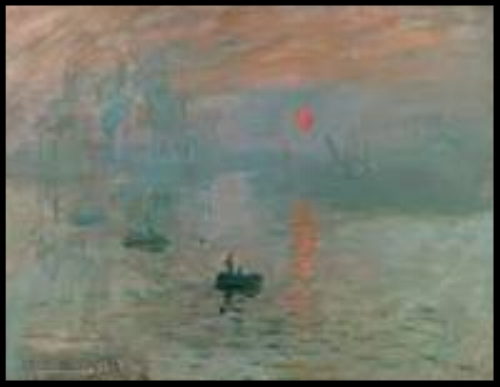
Sunrise is a painting by Claude Monet first shown at what would become known as the "Exhibition of the Impressionists" in Paris in April, 1874.
What is art seems to be a question that resurfaces every time there is some new “development” in the art world- new technique, unusual objects, even artists. Is it art to reject conventional ways of painting and only put on canvas your immediate impressions? (Impressionists, 1863) Is it art to hang a urinal on the wall? (Marcel Duchamp, 1917) Is it art if an animal creates it? (Koko the Gorilla, 2014) Is it art if a computer generates it? (GAN, 2018)

Portrait of Edmond Belamy, 2018, created by GAN (Generative Adversarial Network), which will be offered at Christie’s in October. Image © Obvious.
This week Christie’s Auction House will auction a “portrait” created/generated by GAN (Generative Adversarial Network) . It was not created by any human mind but rather through an algebraic formula. On the Christie’s website, one of the scientists behind the experiment states, “‘The algorithm is composed of two parts,’ says Caselles-Dupré. ‘On one side is the Generator, on the other the Discriminator. We fed the system with a data set of 15,000 portraits painted between the 14th century to the 20th. The Generator makes a new image based on the set, then the Discriminator tries to spot the difference between a human-made image and one created by the Generator. The aim is to fool the Discriminator into thinking that the new images are real-life portraits. Then we have a result.’
Is art what is created or is there more behind the creation? A need to express a feeling or an emotion? Does it have to have original thought? Is it art only if it creates a response from the viewer? Is it art if no one sees the work? Is it art if it is created by aesthetic principles and by form? Or can art express something conceptual?
I think art is another opportunity for us to be co-creators with God. Not that we are God but we have the opportunity to bring to fruition an original idea. Regardless of the genre, the artist has “breathed life” into his/her work.
Just like God created us for community, I also think art is intwined with the viewer. For art to be impactful and to have lasting purpose, it needs to be shared in community: it needs the viewer (others) to respond to it. While there is a need in artists to create regardless of the response (not for others’ viewing or financial gain) ultimately we create to share new ideas, concepts, emotions in a communal sense. Art provides a way for us to explore, to understand and to explain our world.
It seems to me what is lacking in the machine generated image is the need to create and express oneself. Of course, the question could be asked, was Koko expressing herself when she painted the bird or was she performing a task? The computer and the algorithm were performing a task. The equipment didn’t have the need to create, it was responding to a programmer.
I just wonder if there can be any original art from AI (artificial intelligence). It seems to me the originality and the creativity of a piece of art is the pull or the reason for the response from the viewer. It is the originality and the creativity that produces the strand that connects the artwork to the viewer.

Koko not only painted but also titled her works. This one is “Bird” based on the bluebird that would sit by her window.
What do you think? What do you consider art? Something that is aesthetically pleasing to your eye? Or the representation of a concept or idea? Do you think that we need art in this world? Does art need to be viewed in order to be considered art? Do you think artificial intelligence can produce a work of art?
While I think the “portrait” is interesting, I do think that only humans can conceive and produce a creative work. For me, there is something “alive” in paintings by humans: the creative you speaks to the creative me. What a blessing to be able to see, think and discuss the creative arts.
Genius

Wile E. Coyote….Genius.
During Sunday’s Weekend Edition on NPR, I heard an inspiring story of one of this year’s MacArthur “Genius” grants recipients- Vijay Gupta. The “genius” grants are awarded to individuals who show "extraordinary originality and dedication in their creative pursuits and a marked capacity for self-direction" According to the Foundation's website, "the fellowship is not a reward for past accomplishment, but rather an investment in a person's originality, insight, and potential".
Mr. Gupta is a violinist for the Los Angeles Philharmonic whose life's work has been to make music accessible to all. Very early in his career he saw the destitution in LA’s Skid Row. He was amazed that individuals with all sorts of troubles- mental illness, chronic homelessness-were within walking distance to one of the world’s greatest concert halls. After meeting a gentleman who due to mental illness dropped out of Julliard and became chronically homeless, Mr. Gupta formed Street Symphony, a group that plays in jails, shelters and clinics.
What I loved about the story were the quotes of Mr. Gupta and his philosophy of doing what he is doing:
"We all have a story and every person deserves access to tell that story. When we listen to someone's story with reverence and respect, their life matters. Their neighborhood matters. Their histories matter," he says. For him music can “…open the pathways to beginning those conversations and to pay attention to the fragility and pain and vulnerability that exists with every single one of us, “
His story once again reminds me of a couple of things:
1) We really do not know someone’s story until they tell us. We cannot make pre-judgements about the people we see or meet. In this case, the gentleman Mr. Gupta met had been living in Skid Row for almost twenty years. Turns out, the fellow was a great musician but because of his mental health, was reduced to living in the streets. It was only in meeting him did he realize that we cannot assume anyone’s story.
2) Every one carries pain and is fragile and vulnerable about something.
3) The Arts- music, visual art, written arts is such a vital component to every one. It lifts us up, it speaks when we cannot, and it can explain our condition. As Mr. Gupta says about the music they performed for the “street” folks:
"It was our audiences in these spaces who would raise their hands and say 'Well what was the composer feeling when they wrote that because I heard this.' And then they would tell us a story or anecdote of their life that exactly reflected where the composer or where we as performers exactly were in our emotional life," Gupta says. "So this was actually one of the most astute and emphatic and engaged audiences that we'd encountered in our lives."
What about you? What makes you fragile? Has anyone ever paid attention to your vulnerability? How did that make you feel?
Have you ever witnessed another person’s pain? What did you do about it? What was the circumstance that led to the sharing of either your own pain or another’s?
How do you respond to the Arts? How can you share the Arts with someone else?
While I am happy for Mr. Gupta and don’t want to belittle his “genius” award, I think each one of us has a genius within: when we connect with one another through word, picture or thought, we share our authentic selves and in turn invest in another’s potential.
The Positive Negative

Michalengelo’s Moses found in the church: San Pietro in Vincoli, Rome. We’ve been there. The statue is exquisite. You expect Moses to stand up and speak.
Have you ever thought about the composition of music or art? What distinguishes it from anything else? Recently I was reminded through an example in a Sunday sermon.
If you think about it- what makes music, music? It it the rests or the pauses between notes. If you didn’t have them, you would have continual sound not a musical phrase. It would just be noise.
That example made me think of sculpture. It is not so much of what you see, but what you do not that defines the piece.

A great example of negative space…
Michelangelo said that with his sculptures he was just freeing the image within the marble. "The idea is there locked inside. All you have to do is remove the excess stone." Pieces of marble must be carved away, leaving a “pause” or space so that the image shines forth.
I really needed those examples this week. I needed to be reminded that in order to be effective, pausing is important. If I do not find rest in and from my activities, I will just be one continual noise.
Some situations I need to allow the negative space to be discovered; space where nothing is happening, yet without the nothingness, nothing can happen. The more stress I am under, the harder it is for me to wait: wait for responses to inquiries, wait for situations to resolve, wait to do the next project. Under stress I feel that there is not a minute to waste and that I have to be “busy” every second of the day. I forget that if I do not put pauses into my daily life, then life becomes one giant blur of activity with nothing being remembered or enjoyed.
I am reminded that lately I have not “rested” between one demand of my time to another. I find that if I go back to back with no down time, I become cranky at best and a downright meanie at worst. When I do not have pauses, I become the noise- continually complaining and getting down on myself for not protecting some resting time.
I know that I am in a season of life where some things just have to be done and some responsibilities are present. But, like they say with saving money- you have to pay yourself first. I have to make a priority to protect the pause time that I need to be able to go forward. If I want to make some significant or distinction from all the noise, I need those pauses.
I also realize that when I do not give myself rest, I am not capable of looking beyond the negative space to see the light or image through it. When I am stressed, my positive attitude becomes horrid. My attitude blocks any light shining through me. I become incapable of seeing any image or joy within the block of my endeavors.
What about you? Do you have a pause button for your daily lifestyle? Do you strike it? Or does it need to be reset? When you eliminate the negative spaces, does that allow the light to shine through?
What positive (in the) negative space or rests do you find?
The Temper Temperer
It is that time of year when we seem to receive all sorts of catalogues that cater to the whims of those looking for presents for the people who have everything.
For some reason we received the Hammacher Schlemmer Catalogue- “Guaranteeing the Best, the Only and the Unexpected for 170 years.” There is nothing for sale that I nor anyone that I know really needs, yet I still find myself perusing the pages, seeing the merchandise and thinking “that item would be interesting for ….”

What made me chuckle was the following:
The Temper Temperer: This is the personal voice muffler that stifles expressive outbursts resulting form the workplace, politics, or a sports team’s performance. Held in place over the mouth or secured behind the head via an adjustable elastic strap, the muffler provides relief from inveterate cursing at a television as well as channeled stress release after a rough day at the office when a pillow in not available. Its sound-dampening quality also makes it ideal for impromptu close-quarters usage during family gatherings when privacy is limited. One size fits all mouths. $49.99
(I wonder if they have something to prevent one’s thumbs from tweeting? - Just a thought….)
While this is humorous it does make me think of a serious matter. Being an adult and part of a civilized society doesn’t absolve someone from actually having self-control. This gadget insists that instead of controlling one’s tongue, you just need to put on your voice muffler.
Being called “a spitfire” as a child, I get it. There were many times in my childhood and youth that I could’ve used the muffler. It certainly would have avoided conflict, hurt feelings, broken relationships and my own punishments.
Hopefully I have learned and improved a little as I have aged. Taming one’s tongue is something that may get better with maturity but always needs to be in check. If not, it can create discord, chaos, broken relationships and at the extreme- destruction.
But I know that one of the promises from God is that He has sent a helper to us (Holy Spirit) that as we grow to be more and more like Him, we demonstrate love, joy, peace, patience, kindness, goodness, faithfulness, gentleness, and self-control. For as much as we are in need of civility and manners, the true caring of one another cannot be done without God’s help.
In thinking over this past week’s news and the treatment of men and women, it occurs to me that if people, beginning at an early age, treat one another like they want to be treated (or how they would want a loved one treated), maybe some of this miscommunication and hurt can be avoided.
There is a reason that manners have prevailed ever since there was more than one person living in community. Manners are more than pinky-in-the-air hoity-toity-ness: at the core, manners are actions derived from thinking of other people first.
I know that I need the Helper in learning self-control and manners. Left to my own devices I would be (and am) incredibly selfish- saying whatever I want, doing whatever felt good, to whomever regardless of their feelings. I need help in being disciplined in mind, body and spirit. That discipline doesn’t necessarily mean in a punitive way but in a manner that puts me on a different path- the path to caring for one another in love. I find that I have to daily (sometimes minute-by minute) ask God for help in the moments: how to respond appropriately to an awkward conversation, what insights do I need to work with a difficult colleague, how to remain focused on the task at hand, what ways should I do to stay faithful to a goal I want to achieve, when I should speak and when do I need to listen? I find that the more I ask and stay “in touch” with God, the more He changes my mind and attitude so that I am more loving and caring for those around me.
What about you? What gets you riled up? Have you ever had consequences to your outbursts? What were they?
How is your self-control? What strategies do you do to maintain it?
How are your manners? Need a tune-up or is it automatic? How are you in putting others’ needs before yours? Are you balanced with that: not bulldozing your needs over everyone else, nor piling on everyone else’s needs so that you are immobile?
Fortunate for our wallets (not so fortunate for the catalogue company) we have a free and natural temper temperer: the Holy Spirit. It’s the original model and fits great. Guaranteed.
Mud Stuck

Where do you stand?
In speaking about why she married my grandfather, my grandmother used to say, “I married him because his feet were on the ground. What I didn’t realize was that they were stuck in the mud.” While my grandfather had some wonderful attributes- spontaneity, imagination, risk-taking are not the ones that come to mind.
The other day I heard a commentary on the radio about the way God answers prayers. I have always heard that the standard answers to prayer are “Yes”, “No” and “Wait”. On this morning, the person was saying that sometimes God doesn’t always respond the same way to a similar request. In essence, just because he answered one way to a situation, doesn’t mean that He will again answer that way. We have to be willing to accept God’s current answer and not assume that the answer will always be the same.
Take the problem of the Israelites crossing different bodies of water in their nomadic history. At different times in their history they had a water obstacle to traverse. Just because God answered their crossing prayers one way he didn’t answer the same way later in their story.
One of the first times we see them encounter a water obstacle is when the Israelites have to cross the Red Sea. They had left Egypt in a hurry and were walking in the direction of the sea. They get to a place where the sea is before them and the Egyptians behind. In the miracle of the Red Sea, God parted the Red Sea before the Israelites took a first step into it. It was dry land on which they traversed. (Exodus 14: 21, 22)
Later in the story of the Israelites’ journey to the Promised land, they had to cross the River Jordan. It was only after they put their feet into the water did the waters part. For them, the miracle didn’t begin immediately. They had to move into the water. In essence, they continued into unknown territory not knowing if God would show up if they kept walking into the water. They weren’t sure how far they needed to get in before He rescued them: Wet toes? Wet ankles? Wet knees? In this crossing, their miracle included wet feet. (Joshua 3: 11)
It got me thinking about the prayer requests I have for God. Do I have a preconceived idea of how He will answer? It goes beyond my requesting a specific outcome. Am I expecting the answer to be the same and answered in the same manner based on how He answered in the past or how He may have answered someone else in a similar situation?
Am I stuck in the mud unwilling to walk a few yards into the water? Do I remember how God did things in the past and expect, sometimes demand that He continue doing things in the same vein? Do I have the courage to let Him answer as He sees fit? Even if that means getting my feet wet?
I believe that God is faithful, consistent and the same today as He has always been and will always be. But, His ways are not my ways and He has a plan that may just shake things up.
When I turn over my hopes and dreams to God, do I truly turn them over? Every last detail and every last outcome? Do I allow Him to hold and manage those hopes and dreams even if that means mixing it up for me?
As I continue my writing journey, I am aware of colleagues who had different reactions to their writing: some have had immediate recognition, others struggle along. When I hear of the ones who have had “success”, I need to scale back my expectation that God will answer my prayer in the same way.
What about you? Have you ever had prayer requests that were similar but God responded in a different outcome? Were you able to go along with the change in plan and outcome? If not, why not?
Are you willing to get your feet a little wet if God asks you to? If you are struggling with an on-going prayer request, hang in there. God hears you. He might just be working things in your heart and mind so that you are ready to get unstuck.
Admissions
Admissions:
a statement acknowledging the truth of something.
the process or fact of entering or being allowed to enter a place, organization, or institution.
In the spring I saw a play with our son. It was an off-Broadway, preview play called "Admissions". It was shown in a small theater at Lincoln Center. I liked it. I thought that it gave great food for thought. Since seeing it, I have read two online reviews. As with all ideas, there are contrary opinions. One of the reviews thought the play was good and the other review thought that the playwright didn't do the topic justice.

The story centers around the Mason household. In her 15 years as the head of admissions at Hillcrest, a not-quite-first-tier boarding school in New Hampshire, Sherri Rosen-Mason has increased the student body’s diversity quotient threefold: to 18 percent from 6 percent. She and her school head master husband, Bill are quite proud of their influence in changing an old-white-boy-network-prep school to reflect a more diverse society. Three other characters weigh in on the thoughts of the schools progress: an older, "legacy" administrative assistant; a woman friend of Sherri's- the wife of English head and mother of Sherri and Bill's son's best friend, Perry; and Charlie- Sherri and Bill's son. All are white. But from the first scene, questions are raised about what is equity, diversity and inclusion?
The play takes place over a series of six months, during Charlie's senior school year. Charlie does not get accepted to his absolute first choice of school - Yale (a childhood goal and dream) while Charlie's best friend Perry does. Perry's "SAT scores were not as good as mine. He took 2, AP classes while I took 3." Charlie questions that Perry might have gotten in because Perry has a black father and he, Charlie does not. So begins the questions about society and race, privilege, position and using one's natural advantage to get ahead. And, what hypocrisies do we all bring to the table?
The one reviewer thinks that the playwright tried too hard. That as a white writer and as white theater attendees, we might be better served not to be the ones talking about this topic. Our mere talking about it makes us seem hypocritical. Because, as the story unfolds, the liberal parents are liberal as long as it doesn't affect their son. When the son tries to make amends and bring the dialogue to a new level of discussion, the parents are outraged and default back to the "who do we know so that we can get our son ahead?"
Yet, through out the play, there are statements from all sides of the argument that seem plausible and understandable.
I think the person who gives the reflective poor review has some valid points. But I think that the play's topic is appropriate for our times. We need a venue to talk about all sides of the diversity and privilege debate. It is only through art that sometimes these topics can come up. It allows a civil discourse.
While none of the characters "admit" their biased views, I think the playwright is asking the audience to reflect and admit his/her bias. He asks us to to recognize and admit our bias for what it is worth and then look at someone else's point of view. Whether he is asking for a confession on the audience's part, as one reviewer has suggested, might be interpreting too much. The author might be asking for just an acknowledgment of the problem from the audience: any new journey begins with the first step.
What about you? Have you ever wondered about what you bring to the diversity table? Preconceived ideas? Unrecognized privilege? Use of the network system? Never thought about it? Below are some links to resources that might give you some food for thought. (As one commenter to the privilege video replied, “Privilege is sitting on a MacBook and commenting on a buzzfeed video about privilege.”) There are always multiple sides to any situation but I believe it is our duty as world citizens to be open and considerate of others and their situations.
Resources: