
Thanksgiving? Yeah Right..

The picture of the 2020 holiday celebrations. Not quite the Norman Rockwell of old.
Do you feel bah-humbuggish this holiday season? After all, for what in the world does one have to be thankful?
If you felt that way, I wouldn’t blame you. I know that I have felt that way. Often this year. Not just around the holidays.
2020 has been….? What? So many words have tried to explain it- weird, surreal, unbelievable, crazy. Dictionary.com has gone ahead and listed some words in describing 2020: unprecedented, apocalyptic, omnishambles, hellacious. I liked the word used by writer Grant Shimmin: Covpassion, meaning “compassion for those affected in some way by Covid-19, which, by extension, is all of us. I hope we have it in abundance.”
Covpassion- Do I have it? Am I compassionate to the “stretched-beyond-limits healthcare workers” when they do not communicate to us, the prevented-from-visiting family, about the status of our loved one? Am I compassionate when hearing about another COVID-related tragedy? Or just numb?
I read of an activity that seemed interesting: Describe 2020 in 5 words to someone comatose since 2016. Examples: Bought 2020 planner-wishful thinking. MacBeth Acts Four and Five. Good luck finding toilet paper.
Across history there are ideas and inventions that are birthed from the rubble of war, plague or difficulties. When life changes or one is thrown a curve, there becomes an imperative for explanation or reaction. An imperative for some type of necessity drawn from the tragedy. No wonder there is the old saying-“necessity is the mother of invention.” Dr. Thomas Latta performed the first intravenous therapy in response to the weakening dehydration that he saw with cholera patients during the 1830’s epidemic. Sir Isaac Newton spent the time of isolation during the bubonic plague continuing and refining his theories of mathematic and universal gravitation. Dr. James Naismith developed the game of basketball to challenge the needs of his rowdy pupils by providing a relatively safe activity that could be played in a small indoor space during the harsh New England winters.
Being the cockeyed-optimist*, I find that there are things for which to be thankful. While this has been a year of loss, grief, and sorrow for us as a family, it has also been a year of great joy in that we have had marriages, births, and fulfilled dreams. We have been blessed beyond measure. I have to remind myself not to let the troubles overpower the thanksgiving in our lives.
For the bah-humbugs in us all, here are a few suggested activities that might lift us from our weariness:
Write a lament. Take the time to recognize that this has been quite a year. For everyone. Globally. Nationally. And individually. You do not have to write anything cohesive or pretty. Just a listing would do. Some people can only write under the topics of a couple of the steps but the real work of the lament is thinking about each of the nine steps. The benefit of the lament is in writing your worst fears and complaints to God as well as the things for which you are thankful in this moment. Even if the word “nothing” is written. Laments provide a structure for acknowledging our feelings. Honestly and unscathed. For truly, God understands and hears every emotion we undergo. In time, laments can move us to see a bigger picture of life.
Here are the nine steps of lament: (taken from theglobalchurchproject.com)
Cry out to God (your address to God);
Complaint (your anger, pain, heartache, or sadness);
Affirmation of Trust (your remembrance of God’s presence in your past);
Petition/Request (your deepest desire);
Additional Argument (anything more, why God should intervene);
Rage against Your Enemies (bringing your enemies before God);
Assurance of Being Heard (what you need to feel heard);
Promise to Offer Praise to God (the promise you can offer to God); and
Assurance (the attribute of God you are thankful for in the moment).
Read the psalmists’ laments. The psalmists shared all their emotions. These were folks who wore their hearts on their sleeves. You can find the gamut- from self-doubt, self-loathing, despair, fear, to elation, joy, thanksgiving, praise and hope. Sometimes all within the framework of one psalm. Click here for a listing of different types of psalms.
Describe 2020 in 5 words. (@#$&!) are acceptable but not encouraged. The English language is too rich for merely “blue” words but at different times this year, I know I was tempted to let it rip.
Pick your favorite 1 word to describe 2020. Or make one up- a portmanteau, “ a word blending the sounds and combining the meanings of two others, for example motel (from ‘motor’ and ‘hotel’) or brunch (from ‘breakfast’ and ‘lunch’). (Thanks “You-Know-Who”- the fastest internet searcher I know.)
Write a note. If you find yourself alone or in a smaller gathering this holiday, take some time to write (yup- with pen and paper) a note of thanksgiving to a family member not present.
Go outside and take a walk. I am trying to lean into the expression- The weather isn’t inclement, you’re just improperly dressed. This year I am definitely going to get outside often, even if, and especially if it is inclement. Masked and dressed for whatever weather comes my way.
What about you this Thanksgiving? Are you celebrating? By yourself? With anyone? What will you do to celebrate the day?
While we are just celebrating with our pod we most likely will zoom to connect our families. (Just using those words “pod” and “zoom” is so surreal. I keep thinking that we are either in a StarTrek episode or Invasion of the Body Snatchers movie.) Our one son who lives alone has been with us for a couple of weeks. Our other son and his bride will be by themselves as will our daughter-in-law’s parents. So, we will all try to get together via the computer. No traditional way of gathering. No traditional foods. No traditional pattern to our day. But together.
For me, that is thanks giving.
A Cockeyed Optimist
Words by Oscar Hammerstein II & Richard Rogers
When the skies are brighter canary yellow
I forget ev'ry cloud I've ever seen,
So they called me a cockeyed optimist
Immature and incurably green.
I have heard people rant and rave and bellow
That we're done and we might as well be dead,
But I'm only a cockeyed optimist
And I can't get it into my head.
I hear the human race
Is fallin' on its face
And hasn't very far to go,
But ev'ry whippoorwill
Is sellin' me a bill,
And tellin' me it just ain't so.
I could say life is just a bowl of Jello
And appear more intelligent and smart,
But I'm stuck like a dope
With a thing called hope,
And I can't get it out of my heart!
Not this heart...
Giving and Receiving

Giving or Receiving? Hard to tell…
“What goes around, comes around.” African Proverb.
“I believe in karma, and I believe if you put out positive vibes to everybody, that’s all you’re going to get back.” – Kesha, Singer.
“It is more blessed to give than to receive.” - Book of Acts, Bible.
While all these expressions may be true, I sometimes think we focus on giving for different reasons- fear of retribution, a cosmic tally sheet, sense of duty- and we can forget the receiving part.
We are coming into the season of gift giving. Lest you have forgotten, there are reminder advertisements. I have been thinking about the act of giving and receiving- the acts of service- rather than the consumables. How good am I in giving and receiving? What are the blessings in both of those postures? Do I enter into those postures because I recognize that we are all on this journey of life together?
When I broke my wrist last year and then had my subsequent surgeries there were many actions and services I needed to receive from others: showering help, opening cans and jars (I never realized how much my “other” hand held an item while the other hand opened it), pulling on my pants (my injured side was always askew), putting on shirts, slipping on coats and gloves, transportation to doctors’ appointments. While one hand or arm might not seem to be doing any of the “work”, I realized how much the arms/hands work in tandem- sometimes for holding, support or for balance.
I had a hard time asking for help. While I like to think of myself of an independent cuss and can manage most of what life throws at me, the truth is, I am no more independent than anyone else. Asking to receive help is tough. No one likes to be in the posture of appearing “needy” for it makes one vulnerable, exposed, and humbled. Yet, I had to admit that I needed help and support.
But what I have learned is that being the recipient of someone else’s giving/help is much more than just the transaction. It is the humbling of the recipient (me) that produces the real gift. It is the recognition that I am not the most independent cuss in the world. (As I often tell myself- You are not smarter than the average bear, Yogi). That I am just like everyone else.
“Right now you have plenty and can help those who are in need. Later, they will have plenty and can share with you when you need it.” 2 Corinthians 8: 14 (NLT)
The posture of humility that receiving puts us in, aligns us in the correct posture for helping others. I help, not because I am superior or in any way better than the one who is receiving my assistance. I help, not because I have to do it or something will come back and “bite me”. I help because I have received help in the past. I help because I have empathy and understanding of the vulnerability being on the receiving end exposes. I help because my good fortune today of abundance (of time, talent, resources) can help someone who might be struggling in those areas now, knowing that when I struggle there will be those who come to my aid. The way life unfolds, those of us who have had life experiences know that it becomes a question of when, not if we need assistance.
In essence, receiving help is just as, or even more so important than giving. Being in a posture to receive keeps the flow of giving/receiving going which in turn keeps us together on the journey of life.
Think of the experiences you may have had. If you have ever lost a loved one, and have received condolences, meals, or other life logistics from others, it puts you in a better future position to know how to help someone else who may be struggling with losing a loved one. Even if you have mostly been a giver in life, eventually you will experience something that causes you to need assistance and be on the receiving end.
What about you? As we approach the “giving” time of year, what is your posture? One of giving? Receiving? Humility? Empathy? Grace?
What has been your experience with giving and receiving?
“There, but for the grace of God go I”. John Bradford, English Reformer.
National Days

My tribute to a dear reader who has sacrificed many more years than the ones of his service. Thank you for your service. Stay well friend. Photo courtesy of US National Park Service.
Last week I heard a brief announcement that Monday, November 9th was National “Go to An Art Museum” Day” . I had never heard of that before and so I looked it up. Apparently a marketing firm, TOP agency, promotes national days for every day of the year. Some are made up to promote a specific product. (No surprise there because it is a marketing firm after all.) Others are just fun. On their website: www.nationaltoday.com they have a calendar for each day and an explanation of what you can do to “celebrate” and why it is important.
For instance on the 9th, the website states why go to an art museum because a) you can be tourists for a day in your city, b) you can learn something new, c) you can participate in an activity that helps clear our heads. All reasonable and necessary rationales.
I thought how best we can “celebrate” this idea of visiting a museum under our current pandemic restrictions. Rather than physically visiting an art museum, go online and “visit” one of the collections. Or, take a tour through Viking cruises (how about that for promo!)- www.viking.tv This coming week, Viking has different historians talking about WWII and WWI. All these suggestions are reminders that there are other things happening in the world besides pandemics and elections. There are things to learn and to create and that doing so collectively can draw us together as a community.
Isn’t that one of the reasons that we celebrate? To come together over a shared experience, idea, or belief? To put aside whatever differences we might have and to recognize, at least for a day, some of our “sameness”?
Today, November 11th, is Veterans’ Day. A little more serious than National Sundae Day or Single’s Day as other “celebrations” that the National Today website has also declared for Nov. 11th.
I think of all the national weariness we are experiencing due to the election, I would hope that Veterans’ Day draws us together: to remember the sacrifices that those who served in the military have made and to honor those individuals. On this day, we choose as individuals in this country, to come together and to be one in our appreciation. It takes a special person to serve in the military- to leave all that is familiar and become part of a unit and mindset that defends a country.
In thinking about Veterans’ Day, I found this program online- Music Therapy of the Rockies. The Music Therapy of the Rockies program helps veterans suffering with PTSD. In a retreat-like setting, the veteran is teamed with a songwriter. Using music therapy techniques, the veteran leaves the program with a song and a guitar. It is in the process of writing the song that healing begins.
What a beautiful program- coming together through the unity of songwriting and the collective creative process to provide a therapy that helps heal those honored individuals who gave so much in order that we can maintain our individual and collective freedom.
And what a beautiful thing to think that not only can we heal one another by joining together in singleness of purpose in honoring others but we can also heal one another by creating music together.
Music has such an impact on us. Sometimes it is only through the notes and lyrics that feelings can be expressed where actions and speech do not. While listening to music is important, the act of creating music, whether writing the music or making the sound, is very important. According to Dr. Anita Collins, educator, researcher in the field of brain development and music learning, playing instruments is good for the brain, even more so than any other art form. It is the playing of instruments that engages the entire brain- in an interconnected, total workout of the brain. (Click here for a TED talk explanation.)
What about you? What holidays- official, religious, or for fun- do you celebrate? What brings you together with others? Celebrating a person (birthdays), a belief (Easter), or nation (July 4th)? Do you even know why you celebrate? If you are celebrating a person, what can you do to honor them?
Have you ever had an opportunity to collaborate with others on a creative project? Do you play an instrument? Would you want to try a new one? Supposedly many older folks are trying the ukulele or harmonica. Small, easy to learn instruments which can be a lot of fun. Personally the kazoo is my favorite. Just the sound of the word makes me smile.
Today as we remember and think of the veterans who have served our country and ultimately us, say a special prayer for them.
Today is also a good day to reflect on the ideas that bring us together as a nation: whether that is through a collective creative process, a shared experience of work, school or neighborhoods. Today is a day of solemn celebration.
“Music expresses that which cannot be said and on which it is impossible to be silent.” ― Victor Hugo
“Music… will help dissolve your perplexities and purify your character and sensibilities, and in time of care and sorrow, will keep a fountain of joy alive in you.” ― Dietrich Bonhoeffer
Veterans’ Day treat: Click here for the video of Amy Grant singing America the Beautiful at the Vietnam Memorial in DC in 2017.
Home

Our home. Our prayer- To be a House of Belonging.
Recently I have been perusing a book I had picked up awhile ago, Moving On by Sarah Ban Breathnach. She speaks to building a house of belonging- what she defines as the house of one’s dreams, ideas, and longings. In essence, a “build it and they will come” mentality of self-determination; once you uncover your hidden longings, you can envision your future and make decisions/changes to achieve it.
While I am not so convinced with her premise because life sometimes has a way of unfolding in quite a different way than our thoughts, what I find interesting is her exploration about the house: how important the home is. In light of our current pandemic and all things home bound, I find some of her words resonate. She offers practical tips on home making and expands the idea of home comforts and of physically creating the house of belonging.
While she infuses the practical with the mystical of the home, I think there is more to the house of belonging than she states. I think the home is the symbol of the longing of every human heart to belong- to feel that this is the place where one’s tribe or one’s peeps understands them, and that one’s home is a place of refuge. To feel that in this space, one is known, accepted and loved.
Perhaps one of the reasons for such division and clash in our country now is that we, collectively, do not have that sense of belonging. Due to many isolating factors: COVID, social structures, video games, internet- we have become removed from personal and physical interactions and thus removed from a feeling of belonging. America is more of an individualist society, yet we still need each other. We still need to feel that we belong and to create spaces where that happens.
In light of our next wave of COVID and the impending quarantine/lock-down that may follow, I was thinking of how can I create spaces for that belonging? First of all, how can I stay physically, emotionally and spiritually healthy? You know- the overused airplane oxygen analogy- in the event that the cabin experiences reduced pressure, put your oxygen mask on first before helping others. How can I maintain my own well-being in order to help others maintain theirs?
I know that I have a tendency to feel isolated and down during the winter months and the shortened sunlight hours. How to ensure that I connect with others, feel productive and able to contribute to society when I am isolated? How, when I am isolated, can I make others feel included? How can I embrace a house of belonging? A sense of hospitality? A place of love?
A dear tennis friend shared how she is intentionally connecting with a college roommate. They have a standing phone call every other week. While they know that some weeks they may not be able to connect it gives her something to look forward to in the interim week. Sure. She could just connect via text or email but that set time for telephoning creates an anticipation and allows a physical connection of speaking/hearing.
Her comment reminded me about the importance of having something to look forward to. Positive anticipation. What has been called “nexting”. I wonder if some of the collateral damage due to the pandemic and isolation is that many people have stopped planning or anticipating. Many plans are on hold until “after the pandemic is over” or “once a vaccine is discovered”. I saw an Facebook picture of a tri-fold poster with different quotes for the present state of mind. One quote said, My biggest mistake of 2020 was buying a day planner. That lack of “nexting” can breed despair. It creates a lack of hope.
I think that positive anticipation can and possibly should take the form of smaller anticipations. Especially during uncertain times. If we think about it, the majority of our well-being is made up of the smaller decisions and tasks during the day: When I finish this blog, I will have lunch; this evening I will watch the next episode of The Coroner; after my walk, I’ll text my friend. Little actions, even obligations that can be re-framed as positive anticipation or “nexting”. If we think we have to do everything now, we become anxious, agitated and overwhelmed. It makes sense to “next” our plans: our to-do lists, our activities, our interactions with others.
What about you? Do you have a sense of home belonging? How does that relate to your sense of well-being? Have you given any thought to what you will do if/when we have another quarantine? What worked/didn’t work this spring? How can you provide a sense of home belonging to your friends and family? What are you anticipating?
I like the idea that my actions and thoughts are building a house of belonging- both physically, emotionally and spiritually. I like the idea that I can create space where others feel that they belong and are loved. I like the idea of creating a house of belonging not only for the future but also for the present.
To Our Dogs...

One of the last pictures I have of them.
Marley and Millie.
April 8, 2007- October 24, 2020
On Saturday we had to make the gut-wrenching decision to put down our two dogs. While we knew that the day would some day come, we still weren’t prepared for it. As with all living creatures- human and otherwise- you think that they are going to be around forever, or at least while you are still alive. In a perfect world we would all go together, but then, that would be the end of the world. I have started numerous blog posts since then but just cannot concentrate or finish. I have many stories about these two scalawags and many learned lessons. But those are for another day.
So, I thought I would allow someone else to speak for me this morning. I looked up different poems about dogs and found this one by Jimmy Stewart.
Watch the video of Jimmy Stewart reading his poem on Johnny Carson’s show: Click here
Here’s the text of the poem:
He never came to me when I would call
Unless I had a tennis ball,
Or he felt like it,
But mostly he didn't come at all.
When he was young
He never learned to heel
Or sit or stay,
He did things his way.
Discipline was not his bag
But when you were with him things sure didn't drag.
He'd dig up a rosebush just to spite me,
And when I'd grab him, he'd turn and bite me.
He bit lots of folks from day to day,
The delivery boy was his favorite prey.
The gas man wouldn't read our meter,
He said we owned a real man-eater.
He set the house on fire
But the story's long to tell.
Suffice it to say that he survived
And the house survived as well.
On the evening walks, and Gloria took him,
He was always first out the door.
The Old One and I brought up the rear
Because our bones were sore.
He would charge up the street with Mom hanging on,
What a beautiful pair they were!
And if it was still light and the tourists were out,
They created a bit of a stir.
But every once in a while, he would stop in his tracks
And with a frown on his face look around.
It was just to make sure that the Old One was there
And would follow him where he was bound.
We are early-to-bedders at our house -- I guess I'm the first to retire.
And as I'd leave the room he'd look at me
And get up from his place by the fire.
He knew where the tennis balls were upstairs,
And I'd give him one for a while.
He would push it under the bed with his nose
And I'd fish it out with a smile.
And before very long He'd tire of the ball
And be asleep in his corner In no time at all.
And there were nights when I'd feel him Climb upon our bed
And lie between us,
And I'd pat his head.
And there were nights when I'd feel this stare
And I'd wake up and he'd be sitting there
And I reach out my hand and stroke his hair.
And sometimes I'd feel him sigh and I think I know the reason why.
He would wake up at night
And he would have this fear
Of the dark, of life, of lots of things,
And he'd be glad to have me near.
And now he's dead.
And there are nights when I think I feel him
Climb upon our bed and lie between us,
And I pat his head.
And there are nights when I think I feel that stare
And I reach out my hand to stroke his hair,
But he's not there.
Oh, how I wish that wasn't so,
I'll always love a dog named Beau.
Actively Waiting

Dogs are the epitome of waiting…
You ever have one of those weeks? Your thoughts are jumbled. Your words are stilted. Your actions are clumsy. Your behavior erratic. Your concentration is shot.
This past week has been one of those weeks. In some ways it was just a week ago (maybe longer- time is another thing that gets scrambled) that my husband and I were traveling to our Cape home for a weeklong vacation. We were there just about 24 hours when we had to turn around home.
You know the drill- The one time you turn off your phone so that you can concentrate on a specific task (we were attending an online church service) that you receive a voice mail with the words you don’t want to hear, “Your mother was taken to the local hospital because she had fallen in her room.”
A quick repacking of the car, a return down the same stretch of highway we had traveled less than 24 hours prior, numerous phone calls to the hospital, recorded voice messages, the wait for return calls only to have three calls come in at once, discovering that only 1 family member may visit during limited hours (which we had now missed for that day) for the duration of the stay and that person’s name must be given to the nurse at that moment as we are barreling across the Tappen Zee Bridge.
This week has been surreal. Time is not our own. So much hurry up and wait. Not much progress or information of progress from the medical staff and then- “She is being discharged this afternoon.” What? To where? She still is in pain. Another flurry of phone calls, recorded voice messages, the wait for return calls, only to discover that once transferred out of the hospital, she will be in quarantine for fourteen days in the rehab center. Another flurry of phone calls to see if there was any possible way that we could just see her as I felt in my heart, we may never get to see her again.
Because of COVID, there really is nothing we can do- no visits, no sitting with her during the day, no being there when the doctors and health staff make their rounds, no puttering around the room trying to make her comfortable, no familiar faces to soothe her agitated dementia/Alzheimer state. Knowing that in two weeks when the quarantine rules are met, we still may never get to see her as outside visitation is trickier in these cooler months. Knowing too, it will be a marathon of daily care/visitation/phone calls, once (if) we are finally allowed inside visits.
What to do in the meantime? I have no level of concentration at the moment. In thinking over the numerous times acute crisis have happened in my life, I realized I naturally fall into a pattern of actively waiting. Probably not due to any great character quality but rather because I am more hyper than I care to admit. I need to be busy.
I need to actively wait: to do something productive that keeps my mind engaged but not too taxed. I have found that when I am doing rote physical things (ironing, painting a room, cleaning, gardening) I can think of what I need to do next and let my mind wander. Actively waiting helps me control the things I can: if I can get something accomplished while I wait, I feel that I can handle what comes down the pike. I also find that in those times I am in a perfect position to pray for others. Thinking and praying for others while I am “going through the motions” helps keep my situation in perspective. Alas, the list of people for whom my heart is broken is growing.
“Active waiting means to be present fully to the moment, in the conviction that something is happening where you are and that you want to be present to it. A waiting person is someone who is present to the moment, who believes that this moment is the moment.” Henri Nouwen
In this day and age, waiting seems to be seen as a passive and therefore negative action; waiting for the diagnosis, the other shoe to drop, the “phone call”. In essence, waiting for the next round of bad news. It is feeling that one is a sitting target for all the bad karma of the world.
I am reminded of the waiting times of life: waiting for the birth of a baby, waiting for the wedding day, waiting for the start of a new job or new career, waiting to hear if the offer on a house is accepted. The delay that is caused by waiting builds anticipation and excitement, allows time for validation of the decision and justifies the wait. The waiting becomes part of the whole experience.
What about you? Are you waiting for something? Something “good” or just the “shoe to drop”? How do you handle those waiting times?
I find comfort in the words of Isaiah (40:31) “They that wait upon the Lord shall renew their strength, they shall mount up with wings of eagles, they shall run and not be weary.” I cannot say that I am the most patient in waiting, but I am trying to recognize that even as I wait, something is happening in the situation where I find myself: if nothing else, I am learning to lean and be strengthened by God.
Good from Suffering?

A kaleidoscope. The physical example of seeing possibilities in broken and varieties of glass. Random mixing of the glass, produces beautiful patterns.
“You do not need to know precisely what is happening or exactly where it is going. What you need is to recognize the possibilities and challenges offered by the present moment and to embrace them with courage, faith, and hope.” Thomas Merton
I found the above quote in a serendipitous way. You know how it goes- you start looking up something online, that leads to something else and then another something else until voila- you find a quote or essay or video that strikes a chord with you. The above quote was found in one such rabbit hole as I was reading a piece of writing from a former acquaintance. Turns out it was the above quote that resonated with her during a faith-questioning time following the initial diagnosis of a debilitating chronic illness.
It has struck me too because of late, friends and family have been bombarded with all sorts of twists, turns and unknowns in their life journeys: unforeseen diagnosis, hospitalizations, existential questions of “Why me?”, “Why bother?”, “What is the point of life?” Questions about what is happening in their lives and where they are headed on this journey.
Last Friday there was a piece on StoryCorps about a women in Leverett, MA who went around town and interviewed various people about their experiences during this pandemic and lockdown. The woman had her own time of unknowns: her daughter had died a couple of months before the pandemic and then she lost her job at the beginning of the pandemic. She found that interviewing others helped her find footing in her life. As she said, “Doing these interviews gave me a sense of purpose and meaning that I badly needed. Just when things seemed so dark, I found some light in the words of the people all around me.”
I was especially taken with her feelings of purpose and meaning. That seems to be the crux in life: we were designed to have purpose and meaning and because we are thinking beings, to recognize it. Most people can endure hardships when there is an understanding of purpose or at least some type of positive outcome/useful experience for others to the hardship. One may not enjoy the difficulty but at least if the hardship serves some kind of purpose and meaning there is some acceptance.
I found an interesting article in a 2018 post on Psychology Today, “Finding purpose in the Face of Tragedy and Adversity”.
“Regardless of whether people believe that “everything happens for a reason” or believe in a higher plan, and regardless of how resilient or vulnerable they are, most are able to derive some meaning in the face of adversity if some good comes from their suffering and misfortune, for themselves or others. And people are often remarkably adept at achieving this. The good that people make from bad usually does not make the bad event “worthwhile,” let alone indicate that the event was cosmically intended, but it can help people deal with their trauma and derive some meaning from it.”*
I also heard an interesting story about the “desk guys”: a father who built desks for his virtual-schooling children and a local business who wanted to do something for the community. The father had made a video demonstrating how he made the school desk for his kids. The video caught the attention of the local store who was willing to provide supplies for desks. The two entities partnered and have been able to help families in the community. From their standpoint, they “just want to help” and the recipients are so grateful because the desks “lift people’s spirits up”. One good deed, encourages the spirit and also motivates more good deeds. The father who was making desks said that one night as he was working in his garage, a man approached him, asked, “Are you the desk man?” and upon the affirmation, the gentleman handed the dad $20 for materials for a desk. A simple act yet the father was even more encouraged. “Good folks are out there.” Even an incident as disrupting as a global pandemic, has positive outcomes where courage, faith, and hope can be embraced.
What about you? How are things going for you? Do you find your life is chaotic, out of control? Is there anything that you have discovered about yourself or others through this time? Have you recognized any challenges or possibilities in the midst of the hardship? Have you found any meaning or purpose? Seen any courage, faith or hope displayed?
In the midst of any chaos, turmoil or suffering in one’s life, there is a way to endure. There is a place to know that whatever one experiences, there is goodness that comes out of difficulties, both large and small. For most individuals, the power of getting through difficulties it just that- getting through. There may not be any big societal or personal change but rather the reward of stick-to-it-ness and found meaning through the sharing and encouragement of one another. It is the small things that keeps us going: the kind note, the smile, the listening, the sharing of time, talents or resources. It is the learning and accepting that hardships will happen and that we cannot control or predict the future. Our task is to be present in the moment and to act accordingly- to find the challenges and opportunities as well as to be witness to the hardship. Sometimes that is for ourselves. Other times it is the opportunity to bear witness of another’s hardship. Either way it is an opportunity to rise about the hardship with courage, faith, and hope. At least that is my prayer when I experience difficulties. May it be yours too.
*https://www.psychologytoday.com/us/blog/finding-purpose/201811/finding-purpose-in-the-face-tragedy-and-adversity
Some People Can't Count...

In yesterday’s online sermon, our pastor used an illustration from an article he had read. Namely, what would it be like if we, as individuals, showed mercy and kindness within our family, friends, neighbors by the way in which we interact- In this day and age of divisiveness, can we refrain from telling folks that their perceptions or ideas are wrong or can we be open to admit that our thoughts/ideas could be wrong? What would happen if we stayed silent in those instances when we want to speak or conversely spoke, when we naturally remain quiet? What would the world chatter look like?
I have been thinking of some quotes that I have heard recently. What would society be like if, just for a short amount of time, we practiced these quotes for a month? What would the interactions look like in our families, our neighborhoods, our towns, our country, our world?
God is in the details.
Questionable to whom the quote is attributed. Most frequently it is attributed to Ludwig Mies van der Rohe (An architect- who also attributed to saying, “less is more”). But it is also attributed to Aby Warburg (An artist). "Le bon Dieu est dans le détail". The Good God Is in the detail, has been attributed to the author Gustave Flaubert.
I am thinking that if we truly believed that God was in the details, would we leave those details to Him? What would our actions look like then? My husband and I recently attended a zoom wedding. The bride and groom had engaged the services of a wedding coordinator/planner. Her job was to see to the details for the ceremony and all the logistics. She knew her job and was proficient in doing it. The wedding proceeded without a hitch. It would have been wasteful of time, money and energy if, as one who engaged those services, went behind the event planner and re-did or worried about the plan.
I have to remind myself not to re-do or worry about the plan that God has for me. If I would just leave the plans to God, I can get on doing the things that God has called me to do.
When in doubt, assume the BEST.
We have all heard the quote, “when in doubt, assume the worst.” but what if we assumed the best in our neighbors, friends, even political adversaries? In tennis, if there is a question about a line call (whether the ball hit inside or outside the line), the opponent gets benefit of doubt. According to Code 6 of ITF (International Tennis Federation)- PART 2—THE CODE-THE PLAYERS’ GUIDE TO FAIR PLAY AND THE UNWRITTEN RULES OF TENNIS “A player should always give the opponent the benefit of any doubt. When a match is played without officials, the players are responsible for making decisions, particularly for line calls. There is a subtle difference between player decisions and those of an on-court official. An official impartially resolves a problem involving a call, whereas a player is guided by the principle that any doubt must be resolved in favor of an opponent. A player in attempting to be scrupulously honest on line calls frequently will keep a ball in play that might have been out or that the player discovers too late was out. Even so, the game is much better played this way.”
It might be seen as quite naive, but giving an opponent the benefit of the doubt seems to work out in the end. Of course, I probably have lost games because of it. I am sure there have been times when I gave a point to an opponent when it would’ve gone to me had we had an official line call. But, there were times when my opponent gave me the point, when the true outcome might’ve been different. Either way, it all comes out in the end. Plus, it keeps the peace and caters to a sense of civility and enjoyment in playing. There is an unwritten trust between players. If you look at how quickly certain aspects of our society are quick to jump to negative assumptions, leading to destroyed relationships, property or even lives, maybe we should have neighbors, community groups, politicians, police, or officials think about this quote. Just like tennis, we may come to the conclusion that “even so, the game [of life] may be better played this way.”
I was reminded of this quote just yesterday as I was grocery shopping. I was dutifully standing on my COVID circle (six feet apart floor place marks) waiting to check out. With this new COVIDconfiguration, I am always mystified if I should put my items on the conveyor belt while the proceeding sales is occurring. (At one point this spring, the checkers had to wipe down the entire belt before the next order. I haven’t seen that practice in a while.) Regardless, I left my items in my cart and just waited.
The checker had to call a manager about the order ahead of me. After the manager resolved the issue, she said something to the checker about the lunch schedule and then promptly switched the light box above the checker’s head to now read, “15 items or fewer”. As I had way more than that many items in my cart, I anxiously asked the manager if I now had to find another line in which to wait. She replied, “You are fine because you have been here.” With that answer I started unloading my cart onto the conveyor belt. As I was doing so, I felt eyes boring down on me and overheard some disgusted snorts from passers-by, “Some people can’t count.”
I felt terrible. I felt like the Hester Prynne of the grocery store line. I wanted to have a sign over my head, “I know that I have more than 15 items. I have permission to use this line.” Assuming the worst made me feel terrible and I am sure did not contribute to the well being of the person making the snide comment for I could hear their agitated comments and sighs.
Every day, in every way, I’m getting better and better. Attributed to Emile Coue, Father of self-improvement. 1922.
What if everyday we tried to get better and better: not only in our physical, mental, and emotional health but in our relationships?
What about you? Have you ever practiced living into the essence of a quote? What happened? Did it change your outlook of life? Are there quotes that sum up your feeling about your day? Your life?
What if we started giving others the benefit of the doubt? What if we let God work out the details in our lives in order that we can move along? Some times we get so bogged down with the details we cannot “see the forest for the trees”. What if we practiced treating others how we wanted to be treated: with dignity, respect, honor and love. Even if we disagree. Perhaps, especially if we disagree.
One At a Time

The Second Edition contained the first three volumes from the 1st Edition.
Do you ever feel that your work, actions or ideas do not matter? That your toil is insignificant? That you, are insignificant? I know that I do at times. Most days I feel that I am working in a vacuum (and that is even before the COVID quarantine days). I wonder, does anyone hear me? Have I made a difference?
Recently I heard the story of Charles Bliss (born Karl Bleitz) the inventor of an ideographic writing system called Semantography. Bliss, a Holocaust survivor, believed that “war was often caused by the misuse of language, and he believed it could be overcome if we could create a way to communicate the truth without the trickery of words.” After the war, he and his wife put their lifesavings into publishing a book of the symbols and method. Unfortunately it never took off and was not recognized.
Many years later he received a letter from the director of a special needs school in Canada. The school worked with children living with Cerebral Palsy. The administrator, Shirley McNaughton had stumbled upon Charles’ book at the local library. In reading it, she realized that this method would be quite helpful for her students in learning and processing language.
Ms. McNaughton wrote to Mr. Bliss explaining how his system revolutionized learning for the students and provided them with a way of expression. Ms. McNaughton went on to share the system with other similar schools and programs around the world. While Charles did not receive the accolades that he thought he would, he did change the course of learning for a subset of individuals and made a difference to them. *
It makes me think about the plethora of books, articles and pamphlets floating about- whether in libraries, thrift shops, old bookstores, or on the internet. I wonder how many have ever been read and if any of the ideas or thoughts made any difference in the lives of the readers? Just as it took one person- Shirley McNaughton- to discover Mr. Bliss’ book, are there books out there that have only impacted one person- yet, in turn- that person took what she read and impacted many others.
Over the years I have had conversations with friends and family about jobs. Inevitably the question comes up, “When I leave this position, will any of the changes or improvements that I tried to do, continue?” “Have I made any difference to the organization?”
Sadly, the reality is probably not, at least not in the monumental ways that we would like to think.
But. We can and do make a difference in people’s lives. Small things. Significant ways. It might be a new outlook for someone or it might be a new habit. I think that is the way of most change. One interaction, one idea, one thing at a time.
Think of the times a friend might say they like a certain food. Or perhaps they mention a new exercise regime. Or a book that was meaningful. It might be a suggestion that we try out for ourselves. Sometimes it can lead to a lifestyle improvement.
I have no idea if I have impacted anyone with my thoughts and writings. Although recently, I received a critique on a creative non-fiction contest entry. (Alas, I did not win.) The reviewer mentioned that she had a shared experience with my subject matter and that what I wrote did have her thinking about that experience in a new way. So I guess, there is one reader who might move forward in life in a different direction or thinking due to writing ideas?
What about you? Have you read something, perhaps obscure, that changed your thinking? Your habits? Your life? Is there a way for you to reach out to the author or speaker? To thank them and let them know the impact. Have you ever received notification from someone that your work made a difference to them? What was it? How did that make you feel? How can you impact one individual today?
When I feel insignificant I try to remember to get out of myself- to think of others and to look at the broader picture. I am reminded to, once again, pray the daily prayer:
“Lord,
Lead me today to those I need,
and to those who need me,
and may something I do have eternal significance.
Amen.
Be Prepared AKA “Leave it nice for the Buglars”

Years ago a friend of ours recounted the story of her neighbors who had gone away on vacation. She was on the phone list for the neighbor’s alarm system to be called if anything was wrong. On night, she was awoken by a call from the police saying that the alarm had sounded and they were called out to investigate. They wanted her to come over to the home and indicate if there was anything amiss.
My friend dutifully complied. She entered the living room and noticed drawers opened, piles of clothing, and sporting equipment dumped in the entryway, lamps askew, and clutter strewn throughout the house. Total chaos. My friend looked at the officer and said, “Nope. Nothing’s amiss. This is how their house looks all the time.”
My grandmother as she aged was always worried that upon her death those entering would shake their heads and say, “What a shame. She always kept such a clean, neat house but she deteriorated so much that she just couldn’t keep up her house.”
I am starting to have the same fear. Or at least when I get ready for vacation, that is in the back of my mind. What if something happened to me? What would people say who entered my house?
In preparation for vacation there is always an extra push to get the house in order so that 1) I will not have my neighbors’ respond, “Oh. It was always in disarray.” and 2) I can continue the vacation feeling when I return home because the house is all in order.
It is the old “be prepared” Girl Scout motto.
There is something satisfying to have things neatly wrapped up: laundry done, folded and put away, email correspondences sent, projects completed, upcoming responsibilities sorted out, the to-do list checked, the house clean and neat. Having a specific date for leaving and returning helps me set goals and actually accomplish them. Similar to the idea that nothing gets a room painted faster than having someone come for a holiday visit. Having finished what I have started also helps build confidence in the next venture. That satisfying feeling starts to override any inertia I may initially have.
This year, my broken wrist/surgeries and the COVID quarantine has reinforced my motto- “never put off tomorrow what you can do today”. For if I find I have some time to do something, I need to do it because that time will not come back again. Or the time that was to be set aside in the future is no longer available.
Of course, there is only so much, if any, preparation an individual can do with a global pandemic or an accident but having most things in order or trying to keep thing organized does help when unforeseen chaos happens. One can handle the disruption knowing that the basics are in good shape.
What about you? How are you in vacation prep? ( Do you remember what vacation is?) This year has been quite an unusual one, so many of you may not have had any chance to go on a vacation. But when/if you did- what do you do for the preparation?
How are the basics in your life? Home. Finances. Health. Do they need organization? A plan? How can you get things in order so that you are prepared for whatever might come down your path?
Is there any difference in your home whether you live there or thieves have disrupted the environment?
Do you leave your home nice and organized for the burglars?
Perspectives
On a clear day you can see forever.

The vista from the climb…
Well. Technically not forever. According to www.howitworksdaily.com:
“Dust, water vapour and pollution in the air will rarely let you see more than 20 kilometres (12 miles), even on a clear day. Often, the curvature of the Earth gets in the way first. For example, at sea level, the horizon is only 4.8 kilometres (2.9 miles) away. On the top of Mt Everest, you could theoretically see for 339 kilometres (211 miles), but in practice clouds get in the way. For a truly unobstructed view, though, look up. On a clear night, you can see the Andromeda galaxy with the naked eye, which is 2.5 million light years away – that’s 24 quintillion kilometres (15 quintillion miles)”.
Given my druthers, I am more a beach person than a mountain one. While I feel most comfortable at sea level, you don’t see that far into the horizon especially at the beach. At my beloved Cape Cod, it can be quite foggy with very limited visibility. There are some higher vantage points that provide a little more distance vision but it is still limited. It is only by traveling to a higher location, generally inland up on a mountain, can you see much farther in the distance. No wonder in war for expanded territory and land, victory went to the side of the conquerer who was able to control the higher altitudes. It is through seeing in the distance that a warring side could prepare, plan, defend or attack.
A couple of weeks ago, my husband and I went on another hike with our son to a beautiful state park in Virginia. Just the name sounds relaxing- Sky Meadow. The park has access to the Appalachian Trail and is on the eastern edge of the Blue Ridge Mountains. The side of the mountain that presents the clearest views and vista comprises of a more meadowy, tree-less face. While it is nice to have a clear view, there is some benefit to having a treed hillside to trek up in the summer. Needless to say, it was HOT. But, arriving at the lookout place was worth it for there was a small, steady breeze and commanding views of the valley. It made me think of the Barbra Streisand song, “On a Clear Day You can See Forever” from the musical of the same name.
Funny, how in life we want to predict or at least plan for our future, generally by trying to manipulate events. My husband recalls the scene from “A Funny Thing Happened on the Way to the Forum”: Erronius (Buster Keaton) tells Hysterium (Jack Gilford) that he needs a soothsayer to rid his house of evil spirits. Pseudolus (Zero Mostel) overhears and comes along behind him, “Sir, you are in need of a soothsayer.” Buster Keaton asks incredulously, “How did you know?” To which, Zero says, “I’d be a fine soothsayer if I didn’t.”**
Horoscopes, tarot cards, fortune tellers- people want to know the future. They want to see “forever”.
Yet for all our planning and all our “predictions”, we really cannot see that far into the future. Sometimes, like the unpredictable fog that blows in from the sea, we cannot see even a couple of yards in front of our face. Situations and events engulf us and impede our vision.
At times, I think that is probably for the best. If I knew when I was younger how my life was going to turn out, I think I would’ve missed some key moments because with some foreknowledge I would’ve manipulated the events so that either I wouldn’t have to experience hard or unpleasant situations or I would’ve orchestrated that all events work out in my favor. In actuality, it was those unforeseen events, pleasant and difficult, that have provided me with the most opportunity for growth as a person and the most unexpected joy in my life.
Knowing the future is like trying to communicate on zoom while you see yourself in the square- you can become too self-conscious and not effectively communicate. If you already knew how things would work out, you would consciously manipulate events - perhaps even jumping the gun on a predetermined outcome. One also could become lazy- why bother communicating with others or discovering new ideas, since one already knows how people, places and things will work?
I find that I am not that concerned with the future. Sure, I am definitely a planner. I love to plan and make lists for future events. But if I think too deeply about family, friends, the nation, or the state of our world, I can get anxious about the future. I can find myself worrying about things that most likely will never happen. For the most part, I do not want to know what is coming down the pike. I am (slowly) learning how to be content for this day. However, I must say contentment is a daily, on-going struggle.
What about you? Are you anxious about your future? Do you wish you knew what is on your horizon?
Jesus encourages us to not be anxious about our tomorrow- to not worry about our future. He knows that life is hard and that each day has enough difficulty without “borrowing trouble” from tomorrow. When we align our wills, our plans, our goals- in essence our future, with His we can learn to be content because while we may not be able to see that far- He can.
** Click here for the rest of the silly scene- good for a laugh.
Extreme Times

Andrea Mantegna (Isola di Carturo, circa 1431 - Mantua, 1506)
Crufixion, known as the Calvary
1457-1459
Wood; H. 76 cm; W. 96 cm
Paris, Musée du Louvre, dép. des Peintures, Inv. 368
© RMN / Thierry Le Mage
To read more about the art and artist, click here.
“It was the best of times, the worst of times.” So said Charles Dickens in the opening line of “A Tale of Two Cities.” We could also use those lines today for we live in extremes- weather, politics, education, socio-economics, health.
We even think in extremes when we view ourselves “I am the worst ….” or “I am the best ….” Very rarely do you hear someone say that they, “I am just average.” Of course, most people chuckled to hear the closing lines of Lake Wobegone: “where all the women are strong, all the men are good-looking, and all the children are above average.”
In social psychology, this is known as illusory superiority or positive illusion– the tendency to overestimate one’s positive qualities and capabilities, and to underestimate one’s negative qualities, relative to others.
According to brothers, Chip and Dan Heath, in their latest book release, Switch, our brains are “positive illusion factories.” According to the Heaths: Only 2% of high school seniors believe that their leadership skills are below average. 25% of people believe that they are in the top 1% in their ability to get along with others. 94% of college professors report doing above-average work. People believe that they are at lower risk than peers for heart attacks, cancer, and even food-related illnesses, like salmonella. Even more interesting– people claim that they are more likely than their peers to provide accurate self-assessments! (From: https://decision-wise.com/do-you-suffer-from-the-lake-wobegon-effect/)
When I had my broken wrist, I was no different. There seemed to be a perverse pride in my thinking- This must be the worst break the surgeon has ever seen. Realistically I had to tell myself, “not so, my friend.” Sure. It was a pretty bad break but not one that my experienced surgeon hadn’t seen before.
Or my other disillusioned thinking- I am the fastest, best healer in the world. Again, “not so fast, mon amie”. I healed pretty quickly but certainly not a Star-Trek kind of healing. As is true of most of life, we are not the best or worst but somewhere in the middle.
It occurred to me that these types of extremes happen in our relationship with God. We think we have to be the best moral person in order for us to be noticed by Him and to achieve moral goodness resulting in Heaven. We have to be good people through our actions. And it is completely unattainable.
Or we claim that we are the worst sinner ever and so there is no moral hope for us. Nada. We cannot do anything about it and therefore we pridefully wallow in our self-destruction. So long as nothing can be done about it, we might as well do whatever we please to whomever we want. That lifestyle is bound not to end well.
The thing is- we are neither the best nor the worst.
Have you ever wondered why there were criminals hanging on crosses next to Jesus? I am wondering if at that place of Golgotha was the once-and-for-all extreme example of how God changed our lives and took care of the extremes.
After all, Jesus was the best. He was perfect. Sinless. And he was crucified as if He were the lowest of life. Jesus didn’t deserve to die. He had done nothing wrong. Ever. If anyone deserved moral superiority it was Jesus.
The thief on the cross represented the worst. We do not know the multitude of sins or infractions he had committed but it was enough to have him suffer the cruelest of deaths. Regardless of the totality of his sin, once he was killed, that would be it. Time was up. No remorse. No repentance. No forgiveness. No second chances. At that moment, he was the worst for there was no time left for him to be better. All he could do was realistically recognize his sin and Jesus’ goodness.
“Today you will be with me in paradise,” Jesus tells the criminal (Luke 23:42).
Because of Jesus’ willingness to die on the cross, we have no right to say that we are the best and therefore we deserve Heaven. Nor, can we compete with the criminal and say that we are the worst and therefore do not deserve Heaven.
Jesus took care of the extremes so that we don’t have to. All we have to do is believe.
When we recognize Jesus, we can humbly declare like the thief to his fellow crucified thief, “for we are receiving the due reward of our deeds; but this man has done nothing wrong.” When we do that, the extremes drop away. We do not have to claw our way to the top of being the best nor do we have to dig entrenchments of self-pity and perverse pride. We can honestly and realistically know our place and be accepted as we are: loved and belonging to God. As such, all people have the opportunity to live in paradise. It is a question of choice and freewill.
I think it also applies to life in the here and now. No one is the best or worst. We are all in the in-between. I think when we understand that there are no extremes, we humbly realize that we are all basically in the same storm. Some people have different types of boats but no one has the best or worst one.
What about you? Are you living with extreme thinking? About yourself? In your interactions with others? With God? The thing is- there is always someone better or worse than our situation. If one has reached the top- athletic ability, intellectual prowess, financial goals- there is always another person coming along who will break the record or reach higher heights. For all the tough breaks and hard times someone might go through, there will always be a worse hard luck story told in response.
Humbly seeing ourselves as God sees us- loving us while we were still sinners (and even as we still are sinners)- keeps us from any superiority or superlatives. We can be realistic about our place in this (and the next) world. It should free us up to treat others as we want to be treated.
It was the best of times. It was the worst of times.
Yet, with God, it can be a time of living without extremes. It can be a really good time.
Prayer of Saint Francis

My place of peace. Where is it for you?
“The first appearance of the Peace Prayer, occurred in France in 1912 in a small spiritual magazine called La Clochette (the little bell). It was published in Paris by a Catholic association known as La Ligue de la Sainte-Messe, “The Holy Mass League,” founded in 1901 by a French priest, Father Esther Bouquerel (1855-1923). The prayer bore the title of Belle priere a faire pendant la messe; “A Beautiful Prayer to Say During the Mass” and was published anonymously. The author could have possibly been Father Bouquerel himself, but until now the identity of the author remains a mystery.
The prayer was sent in French to Pope Benedict XV in 1915. This was soon followed by its 1916 appearance, in Italian, in the Osservatore Romano. Around 1920, the prayer was printed by a French Franciscan priest on the back of an image of Francis with the title Priere pour la paix, “Prayer for Peace,” but without being attributed to the saint. Between the two World Wars, the prayer circulated in Europe and was translated into English.
The first translation in English that we know of appeared in 1936 in Living Courageously, a book by Kirby Page (1890-1957), a Disciples of Christ minister. Page attributed the text to Francis of Assisi. During the Second World War and immediately after, this prayer for peace began circulating widely as the Prayer of Saint Francis and over the years has gained a worldwide popularity with people of all faiths.” Franciscanmedia.org
The Prayer of St. Francis
Lord, make me an instrument of your peace
Where there is hatred, let me sow love
Where there is an injury, pardon
Where there is doubt, faith
Where there is despair, hope
Where there is darkness, light
And where there is sadness, joy
O Divine Master, grant that I may
Not so much seek to be consoled as to console
To be understood, as to understand
To be loved, as to love
For it is in giving that we receive
And it's in pardoning that we are pardoned
And it is in dying that we are born to Eternal Life
Amen.
If ever we need this poem it is now.
So, what instrument will you be?
Something musical? Providing a lift to the listener’s spirits.
A tool, perhaps? Fixing and repairing a damaged structure.
Surgical? Cutting out what is harmful. Restoring what is broken.
My prayer is that each of us become, in our own way an instrument of peace in the realms in which we find ourselves.
Overwhelmed

Ever feel that the wave is coming towards you and there is no way out?
From the movie: 10 Things I Hate about You:
Chastity : I know you can be overwhelmed, and you can be underwhelmed, but can you ever just be whelmed?
Bianca : I think you can in Europe.
Whelm:
to turn (something, such as a dish or vessel) upside down usually to cover something : cover or engulf completely with usually disastrous effect
to overcome in thought or feeling : OVERWHELM “whelmed with a rush of joy”— G. A. Wagner
to pass or go over something so as to bury or submerge it
Synonyms- crush, devastate, floor, grind (down), oppress, overcome, overmaster, overpower, overwhelm, prostrate, snow under, swamp
Underwhelmed: verb HUMOROUS:
past tense: underwhelmed; past participle: underwhelmed fail to impress or make a positive impact on (someone); disappoint. "American voters seem underwhelmed by the choices for president."
Underwhelmed began as a sarcastic comment about not feeling overly excited or overjoyed.
Overwhelmed: verb (used with object):
to overcome completely in mind or feeling: overwhelmed by remorse.
to overpower or overcome, especially with superior forces; destroy; crush: Roman troops were overwhelmed by barbarians.
to cover or bury beneath a mass of something, as floodwaters, debris, or an avalanche; submerge: Lava from erupting Vesuvius overwhelmed the city of Pompeii.
to load, heap, treat, or address with an overpowering or excessive amount of anything: a child overwhelmed with presents;
to overwhelm someone with questions.
to overthrow.
I don’t know about you but lately I am feeling whelmed and overwhelmed. It is if ALL of those definitions apply to me and my feelings and can be related to COVID-19. The pathetic thing is that I feel this way even though I am not suffering from COVID nor do I have any immediate family or friends that are. In fact, the pandemic hasn’t really impacted our lives too much. Sure, we have had to cancel trips and family gatherings and it is heartbreaking and upsetting that we cannot see my mother-in-law. But compared to many people, we are virtually unscathed. Yet, everything about this pandemic is overwhelming me- the news coverage, the changing dynamics of reports, responses and policies, the reaction of friends and family, the new “normal” of shopping, walking the dog and general interacting ( or not) with others, the planning, replanning, planning again based on new governmental guidelines.
I want to say ENOUGH already. Like most things in life, ENOUGH comes through the insignificant, immaterial and shallow items of life: it is the straw that breaks the camel’s back. Those little annoyances that drive us crazy. Recently for me, it was a certain fragrant candle that I like and was hoping to purchase. It reminds me of our beach home and is one I associate with hunkering down and writing. It is part of my ritual. Alas, I cannot get the candle in any store nearby. It used to be plentiful but for some reason- the manufacture is either putting those soy candle resources into something else, the factory is shut down, or everyone else is burning candles like I am- even the manufacturer’s website is “out of stock”.
Just like the cleaning products that are still scarce. As one of the check out gals remarked to me as we were talking about staying safe and cleaning during the pandemic, “Didn’t these people ever clean before?” Being cleaning fanatics, we couldn’t understand why the items would fly off the shelf now? If you were regularly cleaning, it wouldn’t be that much more of investment of items or time to keep things “pandemicly” clean. As she said, “Do they really need to be reminded to wash their hands? If so, what were (or were not) they doing before?”
I now realize how much I expect that when I go to the store, I can get whatever is on my list. Before, I never gave it much thought that what I “needed” would not be available. At the beginning of the pandemic, I understood and accepted the limitations of supplies. It is just hard to still experience those limitations five almost six months into the pandemic when we are supposedly returning to “normal”. It isn’t as if I have any exotic item on my list. Having rations and limits to resources is something with which I, and I suspect most Americans, are not familiar.
As I have reminded others, I need to remind myself- this too shall pass. When we are in the middle of a situation it is hard to see any perspective. Kind of like having your nose pressed up against an elephant’s backside- hard to know exactly where you are, what you are experiencing and when it will end? (Not that I have had first hand experience in elephant smooshing… but you get the picture.)
I have been reading lots of different books during this COVID time. Subconsciously it seems as if my common denominator with both fiction and non-fiction books are ones that take place either during WWI or WWII. In one of the books (Jacqueline Winspear, The American Agent: A Maisie Dobbs Novel- I highly recommend the Maisie Dobbs series!) the characters experience the London Blitz. For fifty-seven consecutive nights they experienced the pounding of the Luftwaffe. Beginning on the night of September 7, 1940 German airstrikes attacked the city. After those consecutive nights, Londoners were still susceptible to bomb attacks and would be until May 1941. That is a long time to be anxious and fearful that you might lose your shelter, employment and loved ones each and every night.
Recently I heard a quote from the ABC News anchor, Robin Roberts in speaking to my favorite singer/songwriter who underwent heart surgery this summer: “Make your mess your message.” She was asking, what is it that interviewee learned from her experience? How can that help others?
I am thinking of this mess that we call living in the time of COVID-19. What is it that you are learning? About yourself? About others? About life?
I am learning that when I feel overwhelmed I need to take a step back and slow down. My husband has been reading various articles from an African philosopher. There is an African proverb- when situation is urgent, we must slow down. I think that is good advice for this rapidly spinning chaotic atmosphere in which we find ourselves. I find that I need to ensure that I have time to step back, reflect and regroup- to not feel overwhelmed by an engulfing tide of COVID information or the swirling current of fear.
I am also using this time of change, of rations, and of waiting for items to come into the store as opportunities to be grateful and for prayer: to be grateful that I am able to purchase things, even if I have to wait. It is a good reminder that many people in the world do not have what they need, much less want. To pray and think of others who are less fortunate. I also am trying to think of creative ways to help those who might be in need- whether that is supporting local businesses or sharing resources with charitable organizations.
In our small group we are reading the book, Dangerous Prayers by Craig Groeschel. One thing that Groeschel suggests is that when we are going through a tough time, that is the best time to reach out to God and to reach out to others. So, while I need a hunkering down, slower pace in my schedule, I also need to balance that with reaching out and serving beyond myself. I think of Paul’s letter to the Philippians, “Let each of you look not only to his own interests, but also to the interests of others.” (Philippians 2: 4)
The problem with the word whelm, overwhelmed or underwhelmed is that they focus on the extremes. and there really is not room for extremes in our lives. Especially during difficult times. We need to demonstrate balance. When life is messy, our message should be to carry on- to step back, regroup and rearrange our priorities, time, resources that is balanced between caring for ourselves and for others.
What about you? Are you overwhelmed? Underwhelmed? Whelmed? What do you do to respond to it?
I liken the extreme feeling of being overwhelmed to a giant wave ready to engulf and swamp me. But, as I have mentioned before, I have found that the best way to combat the pounding waves is to ride them into shore or dive into the middle. Both might require a bold initial step or movement but once there, calmness can be found.
**Thank you for the prayers regarding my eyes. Still about the same- talk about Paul’s analogy of looking through a glass dimly. I am living Paul’s metaphor as I wait for this detachment to occur. I am sure that there are lessons/blog posts in this experience! While it is quite annoying that I do not have clear vision, I am grateful that I still can see, do not have any pain or headaches and that this too shall pass.
Ignoring the Signs

Flashes of light in my periphery. Blurry streaks in my field of vision. Black squares traveling up from the bottom of my eyesight.
Nope. Not the screen of a horror movie but the state of my vision in my left eye the last couple of days.
So this morning was a flurry of activity**: phoning physicians, stating and restating the onset of symptoms, filling out paperwork and forms, waiting in a retina specialists office, having my eyes dilating, filmed, poked and prodded. All for the explanation that a woman of a certain age doesn’t want to hear- “It’s because of your age!”
Turns out that I have posterior vitreous detachment (PVD). At this point we are in a watch and come back mode. Supposedly 85% of the cases resolve on its own and the symptoms won’t occur again in that eye. My other eye most likely will also go through the same type of thing. I still have questions for the doctor when I go back in a couple of weeks but for now there is nothing I can do but just be alert to the signs and symptoms if my eyesight gets worse.
It makes me think of warning signs for any situation.
Do we heed them? Or do we ignore? I heeded this warning from my eyes, but I certainly didn’t heed my body’s warning signs about my carpal tunnel and consequently had to have surgery to correct it. I still have some difficulty in my wrists and I will never know if that is due to my decision in lack of immediate attention to be treated, the surgery itself or something else?
I know of folks who, for whatever reason though most likely fear that the situation was irreversible, have ignored warning signs about their health. In most of those cases, a simple preventative or early check-up would’ve reversed the process. By ignoring the issue, the situation did become what they feared.
What about warning signs in our society? Are there attitudes, policies or decisions that we make that reflect what we value? Is it how we treat the most vulnerable? The weak, disenfranchised, or poor? Those who have no voice?
Pearl S. Buck once wrote, “Our society must make it right and possible for old people not to fear the young or be deserted by them, for the test of a civilization is the way that it cares for its helpless members.”
Hubert Humphrey said, “The moral test of government is how that government treats those who are in the dawn of life, the children; those who are in the twilight of life, the elderly; those who are in the shadows of life; the sick, the needy and the handicapped.”
Matthew Rycroft, UK Ambassador to UN said, "How a society treats its most vulnerable is always the measure of its humanity.”
Nelson Mandela, “A Nation should not be judged by how it treats its highest citizens, but it's lowest ones”
Ideologically we may agree with these lofty quotes but do we heed the warning signs? When we do not value the young, the old, the sick, the needy, the handicapped, the lowest citizens? Just like I had to be evaluated with the warning signs about my eyes, I think we as a nation are in the evaluation time about our diagnosis and our future. We have a say in how we want to be governed, what we think is important and what our country means and stands for in this world.
Not only are there signs of warning but there can be signs of “all clear”: signs that things are progressing in a positive direction. I have a friend being treated for cancer. She is hopeful that very soon she will receive the “all clear”- that the treatments have worked and that the cancer cells have been eliminated from her body. Her signs of “all clear” come through her blood work. If she and her doctor ignore that and continue with her treatment, she might receive unnecessary and potentially harmful doses of chemotherapy.
Outside our kitchen door, I have a collection of herbs growing in window boxes. A couple of weeks ago, we saw the signs of a nest being built among the rosemary. At first I thought that some leaves and twigs had blown and were caught in the stems of the plants. Then we heard and saw the little wren hopping along the deck railing, looking left and right before it entered into the cover of the rosemary. We knew that those quick little builders had made a nest and that I would have to watch how I watered the window box for fear of frightening the parents away or drowning the little peeps. I had to heed the signs for the birds and when I see the “all clear” of an empty nest and “littered” deck floor- (or the “poop” deck as we might have to call it) we will know that they have fledged and I can go back to tending my herbs.
We can have positive signs in our lives. Signs that things are going well and that life is good. Sometimes we miss those too because they might be harder to detect. Warning signs have to be glaring and painful to get our attention. Good, “all clear” signs might be more subtle: still small whispers of encouragement, tiny drops of blessings, moments of peace and contentment. It is just as important to notice them. They provide the balance in our lives.
What about you? What are the warning signs in your life? “All clear” signs? Signs that alert you to danger? Or signs of God’s goodness and blessing? Are you heeding those signs? Or ignoring them through ignorance or ingratitude?
The Apostle Paul reminds us to “Give thanks in all circumstances.” (I Thessalonians 5: 18). Having a posture of thanksgiving and gratitude are two ways that I can tackle whatever signs I see.
** I apologize for this post being late. I had another post I was working on yesterday which I will post at a later date.
Trumpet blessings

A couple of weeks ago I heard the human interest story of Shamarr Allen. Mr. Allen is a New Orleans musician who started a program for children- turn in your guns for trumpets. No questions asked. As a product of the Lower 9th Ward in New Orleans, he knows first hand the tough time these kids have growing up. When he heard of children being murdered by guns, he thought how music, namely the trumpet saved him from going down a road of poor choices.
I love his idea. Not only that it gets one more gun off the streets, but that he is giving something useful and tangible to these kids. He is giving them a future. He is giving them Hope.
His idea is in good company- On December 31, 1912, Louis Armstrong was arrested for firing a gun while celebrating New Year’s. Eleven-year-old Louis was sent to the Colored Waif’s Home, where he received formal music lessons and became a member of the Home’s brass band. If Peter Davis (an instructor at the Home) hadn’t given him proper lessons to really learn the coronet, we would never have had Ambassador Satchmo.
These stories remind me of using one’s gifts, talents or resources to bless others around us. When I read of ideas such as these, I realize that sometimes the blessing of others doesn’t necessarily have to be a huge sacrifice. It may be as easy as using and sharing what we already have in a creative way.
I think of “spheres of influence”. Originally meaning “a country or area in which another country has power to affect developments although it has no formal influence”. In the business model it is to think of those people you know and have some type of relationship or want to have relationship in order to cultivate some positive affect for yourself. (Referrals, leads, increased business).
Instead, what about thinking of spheres of influence as a way of affecting positive change, not for yourself, but rather for benefiting others? What about being a blessing? Leaving a wake of positivity behind you? For someone to think, “I have a better outlook today because I encountered … (your name here).”
Makes me wonder- what talent, gift, resource do I have that I can use to help others? In Mr. Allen’s case, it wasn’t any big offering. He had four old trumpets he could give away. He was seeing a problem and thought of a small solution.
It doesn’t have to be a monetary amount. Sure, in this economy and times of uncertainty, there are a lot of people who need financial help. But the more I am thinking about people, I think the real poverty lately is in relationships and in investing in their future. About investing in hope. I think of Jesus’ statement, “and lo, the poor will always be with you.” By His saying that, doesn’t negate our need to financially help one another, but I wonder if He is speaking about something deeper that we can address?
Financial situations will be here and will always be here in this broken world. Short of the new heaven and earth, there is a call for striving for reconciliation with others. I think that our responsibility in that call is the provision of hope and future. When you think of it, without hope it doesn’t matter what one’s financial situation may be- it is easy to give up. The spirit of hope has given tenacity to those in hopeless, impoverished situations.
In the case of Louis Armstrong, using music to keep wayward kids from going astray makes me think of the story lines from The Music Man- the idea that children would get into “Trouble. With a capital “T” that rhymes with “P” which stands for Pool”- (pool hall). The way around that trouble is to form a band complete with purchased instruments and uniforms. (Of course, “Professor” Henry Hill is really a salesman for said instruments and uniforms. He is a conman not a reformer and certainly not a musician.) I do not know anything else about Louis Armstrong’s instructor, Peter Davis but I imagine he was a reformer. Was he a good musician? Or did he just have a creative idea and offered to the children what he could?
What are other ways to provide hope and a future for someone? Even if it is hope and a future afternoon of learning and doing something new? Share a skill or hobby with a neighbor. Extra tutoring or extra curriculum learning for neighborhood children. (Give a neighbor parent a little break in this new world of virtual learning). Go for an outside walk with a friend and listen to what is going on in his/her life. Drop off a meal to a stressed neighbor. Make masks for neighbors or friends. A friend of mine is knitting mask “extensions” for health care workers- an extra piece attached around the back of the head that gives relief to the pull of the elastic on one’s ears.
What about you? What ways can you make a difference in someone’s life today? It doesn’t have to be monumental. It doesn’t even have to cost you anything. It might even be as simple as a hello, wave or nod to a stranger on the street.
Click here for more info about Shamarr Allen’s Trumpets for Guns program.
Creative Living

The above was a letter sent to five New York high school students in 2006. Their English teacher gave them an assignment to write to one of their favorite authors and convince him to come to the school to speak. Only Mr. Vonnegut responded. He did so with the above letter.
The letter has me thinking- what does one do to experience “becoming”? What does one do to make one’s soul grow? Does one have to do anything?
I think Mr. Vonnegut is on to something with the advice of doing some type of art or type of creative endeavor. I think creativity is a unique human characteristic that does develop our soul. For I believe like Madeleine L’Engle, that when we, mere humans, engage in art we become co-creators with God. We do not become a god of any specific art but rather a reflection of the God within. Whether or not the artist is a Christian, the Truth in art comes forth because God’s Truth cannot be put aside or asunder.
This idea has me going back to my bookshelf and pulling out my much loved copy of L’Engle’s Walking on Water. Reflections on Faith and Art. If you haven’t read it, I highly recommend it. L’Engle may be best known as The Wrinkle in Time series author, but I have always loved her non-fiction spiritual books best. For me she epitomizes the tension between science and faith, mystery and practicality, on how to live and write in this world but not be of the world. She reminds me again and again of the importance of Art as God’s creation and how we choose to live our lives as a way of being creative.
For those of us who have an interest or inclination to anything creative, the choices might not be too difficult: we can easily lose ourselves and enter into the divine through music, art, literature, dance, gardening. But we can easily be creative with list making, mathematics, computer designs, meal planning, flower arranging, even in the act of cleaning our homes.
I enjoy perusing interior design books. Even in those books I can see the divine in ordinary things. While I need to remind myself that, in the case of interior design, furniture, etc. are just things, there is a connection to the divine in something that is beautiful and beautifully made. One can honor God through creative living- what we choose to surround ourselves and our thoughts.
What about you? Have you ever felt the glorious reward of creating something? Just because?
I would challenge you and myself- to find ways to make our soul’s grow. Whatever that might be for you-find ways to expand your heart and mind in ways that bring honor to one another and to God.
Some quotes from Madeleine L’Engle:
“What do I mean by creators? Not only artists, whose acts of creation are the obvious ones of working with paint or clay or words. Creativity is a way of living life, no matter our vocation or how we earn our living. “
“God is constantly creating, in us, through us, with us, and to co-create with God is our human calling.”
USPS
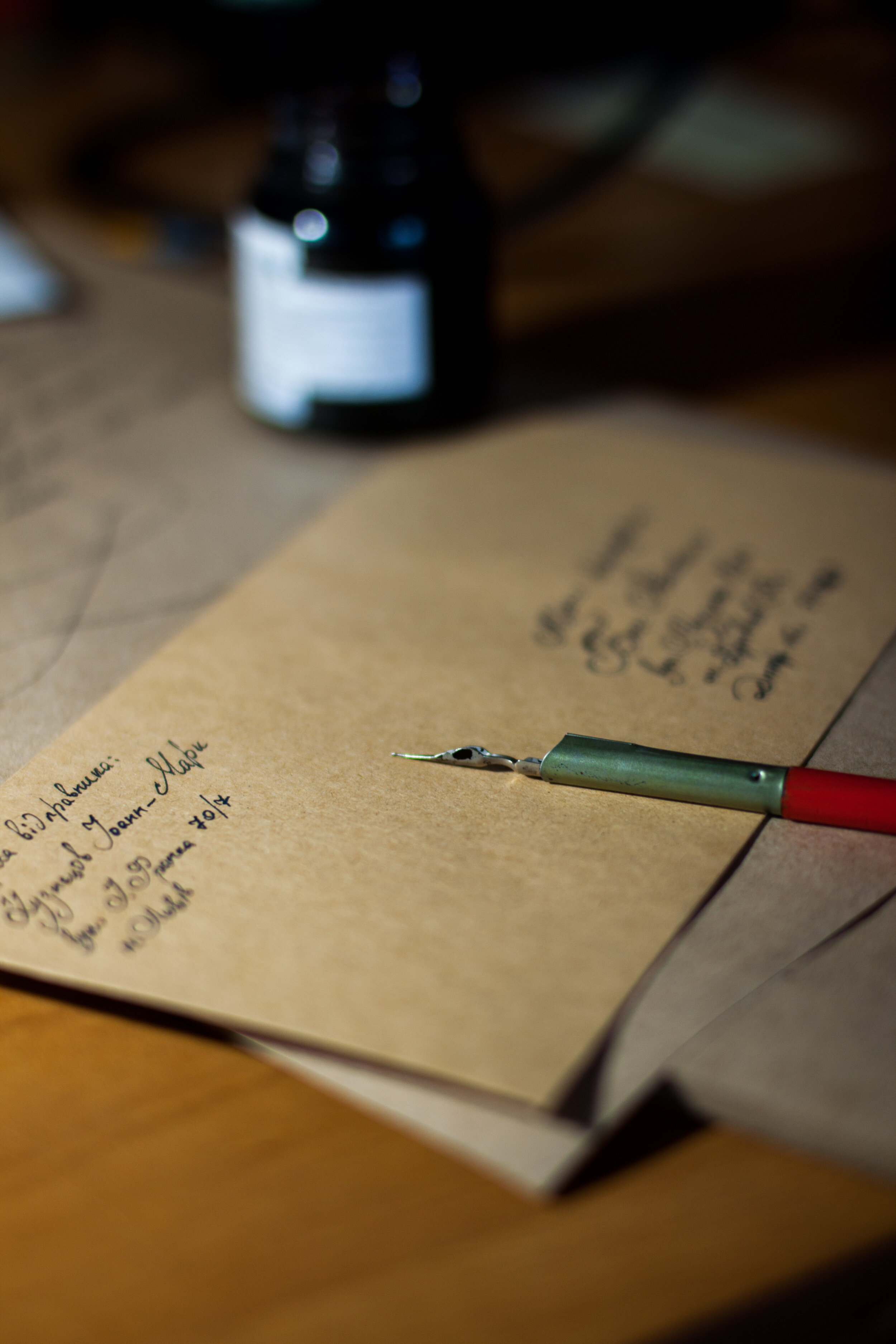
There is something about sending and receiving a letter…Knowledge that you and the other person actually held and touched the same paper. The act of writing slows one’s thoughts and gives space to be introspective.
Neither snow nor sleet nor rain…. can you recite the remainder of the line? Know to what it refers?
The unofficial “motto” of the United States Post Office (USPS).* Whether we remember the refrain or not, we have come to expect that no matter what, the mail will be delivered.
Except when it will not- which may occur sooner than we think. The end of the postal service as we know it may happen in September.
Is anyone concerned about this? I find it alarming.
For a free and informed democracy to survive, the mail system is key. (Along with a free press, free speech, free public libraries, free public education, freedom of assembly, freedom of religion) How else can we disseminate information? Without being informed about politics, ideas, science, liberal arts, medicine, we cannot employ critical thinking skills which can lead us in poor decision making. In our ignorance we make ourselves vulnerable. We become easily manipulated by fear, myth, hearsay.
The system of sending letters, notes or packages is amazing. Over the centuries letters and packages have been delivered using couriers, boats, horseback, trains, planes, helicopters, bicycles, cars, trucks even a rocket. Mail is sent in all kinds of conditions- war, natural disasters, inclement weather, etc. During wartime though some words might be censored due to their sensitive nature, information, news, thoughts, and correspondences were sent. The letters might have been sent from the front lines, trenches, or make-shift hospitals, yet the majority of them were delivered. It is vital to national security and strategy to convey information without meddling as well as an individual’s wellbeing to be able to express one’s thoughts or beliefs via mail without interference.
With the closure of the USPS I am concerned that people of limited means will not be able to communicate or receive any goods or information. Using FedEx, UPS, or Amazon is costly. Subscribing to an internet service is not cheap, especially when you have to have the hardware- computer or phone to support and use the technology. Not that the postal service is inexpensive (and rates are always rising) but with limited means it would be costly to use private enterprises to send things or to communicate with others.
Of course, the decline and possible demise of the service is no surprise- inefficiency, poor judgement, elitism of the USPS ( government benefits, salaries, tenure), have all led the USPS to this place. It has always been a mystery to me why the USPS supported a bicycle team, one in which Lance Armstrong had his issues. (And we are a cycling supportive family.)
Should the nation do anything about protecting this freedom? Are we done with this “technology”?
I wonder. Are words on paper the apex of communicating? Writing can replicate ideas, thoughts, feelings, explanations, and law. (After all, something had to be created so that Adam could remember Eve’s honey-do list.) Actually it was later in history when we moved from an oral to written tradition. When we did that, there were those who thought writing it down made us “weak” and that it wasn’t such a great idea. Socrates in Plato's Phaedrus, quoting the prophecy of Ammon(Thamus) : "[Writing] will produce forgetfulness in the minds of those who learn to use it, because they will not practice their memory. [..] You have invented an elixir not of memory, but of reminding; and you offer your pupils the appearance of wisdom, not true wisdom..
The question becomes do the words have to be formed through some type of ink and does the paper have to be 3-D- a crinkly, tangible, weighted tract? Isn’t the computer more efficient? It certainly sends information quickly and I love its word processing capabilities. (I literally cut and pasted different drafts of my honor’s thesis so that I could type up a final copy.) Also true that digital files have expanded the depth and breadth of previously limited research. And true too, there is a lot of junk mail coming in the front door and going out the back into the recycling pile.
Still, I am not giving up on the truly written word. The pros of having something written permanently (no worries about an outdated computer or storage unit -floppy disc anyone?) seems worth it.
So, what am I going to do about this? While we still use snail mail for some correspondences, I know that my patronage isn’t enough. Should I just accept the changes? In reading what the founding fathers wrote I would say no. Perhaps the current legislative branch wants to update the freedom of the press through a national web service for free unbiased information and provide a national digital communication system - one that every home could receive for a nominal fee. Short of something like that, I question the demise of the postal service. How can we provide a basic function to bind our nation together?
According to the History of the Postal Service**:
“The Founding Fathers believed that to succeed, a democratic form of government depended upon the free exchange of news, ideas, and opinions. Thomas Jefferson wrote in 1804: No experiment can be more interesting than that we are now trying . . . that man may be governed by reason and truth. Our first object should therefore be, to leave open to him all the avenues to truth. The most effectual hitherto found, is the freedom of the press.
The first major postal law, passed by Congress in 1792, encouraged the exchange of newspapers by allowing them to travel through the U.S. Mail at extremely low rates of postage — in some cases for free — to ensure the success of the democracy.”
According to Title 39 of the U.S. Code: The Postal Service shall have as its basic function the obligation to provide postal services to bind the Nation together through the personal, educational, literary, and business correspondence of the people. It shall provide prompt, reliable, and efficient services to patrons in all areas and shall render postal services to all communities.”
What about you? Do you use the postal service? If so, for what? If not, how do you communicate? What service or procedure do you use for sending notes or packages? What other areas do you think are important for a free and democratic society? Where have we shifted our emphasis over our 244+ years as a Republic? For the betterment or not?
Guess it is time to write my congresspeople and senators. Ironically I will have to use email.
* "Neither snow nor rain nor heat nor gloom of night stays these couriers from the swift completion of their appointed rounds.” Herodotus in paragraph 98, book eight of The Persian Wars. The quote was inscribed on the neo-classical former post office building in NYC (8th and 33rd St). It became its unofficial motto.
** Click here to download the History of the USPS.
Weeds Disguised as Truth

While this plant is attractive and seems innocuous it can choke many of the plants around it.
Our backyard has once again morphed into a jungle. In the beginning of the season, my perennial gardens start out looking controlled, contained and cared for. By the time it is mid-growing season, the plants have spread and are all over the place. In addition, the weeds have sprung up over night. One of the problems in trying to pull out those weeds or at least to contain them is that they grow incredibly close to the plants I want to keep. In fact some, like the morning glories have become so intwined with my butterfly bush, roses, bee balm and peonies that I cannot yank out the morning glories without doing some damage to those other plants.
This past weekend my husband and I watched Mrs. Wilson, a three episode “mini series” on Masterpiece theater on PBS. What I find fascinating is that it is based on a true story that happened not too long ago. The story begins with the death of a conventional loving husband who leaves behind a distraught wife and two sons. What begins to unfold is the story of his life, his many wives and children and the deception that he conveyed. While he was a published author (23 books), there are questions to ask if his behavior was all a cover for his spy activity for the British government. As with all intrigue and subterfuge, every statement or fact is questioned whether to its truth or not. One wonders was he really a spy or just a pathological liar?
Closer to home in geography and time, I know of a couple of people who either were children of a deceptive parent with other families or wives of deceptive husbands who juggled simultaneously multiple families.
It makes me think of the concept of lies and truth. In all the thrillers that I have seen, when prepping a person for deception the “handler” explains that if one wants to lie, it is best to stick somewhat to the truth and deviate just slightly. Supposedly there is less error to be tripped up by trying to remember all the details. By slightly veering off the truth course, the information imparted is seemingly more believable.
Ahh. Doesn’t the father of lies just love how we justify deceit. Nothing is new under the sun the Hebrew wiseman suggests. “Go ahead and eat the apple,” the snake advises Eve. “You are not going to die,” he tells her.
In one sense, that is partly true. Eve and Adam did not die after eating the apple but, they did kill their open, innocent, shame-less, face-to-face relationship with God. Their physical bodies became the expression of their spiritual sin and through their disobedience caused them (and us) to experience hurts, illnesses, pain and eventually physical death.
So, “No. Mr. Serpent”, they didn’t die but it brought forth human tragedy.
I feel that as a society we are still experiencing the tragedy of half-truths and bold lies. Falsifications that appear to be quite close to the truth but are not. Falsifications which puts us, as a society, in a position of hurt, pain and even death for ourselves and for others.
Lies and truth seem to be on the front page of the news every day. It doesn’t matter where you fall on the political spectrum or from which news source you get your information- all news seems to report half-truths. It is very rare to find some source that reports “just the facts” from all angles. In some instances, what is reported are blatant and bold-faced lies. Even then, one wonders if the refuted “facts” are true? The cry, “fake news” is in itself fake news.
How do we cut through to the truth? Is it like my trying to entangle the morning glory from my butterfly bush? Will there be loss of integrity in the process? Do I just let the morning glories stay entwined and not pull it out until the fall? There is a parable by Jesus: a farmer planted wheat and unbeknownst to the farmer, his enemy went at night and planted weeds among the seeds. When the wheat sprung up, so did the weeds. When the farmer was asked if the weeds should be pulled, the farmer replied to wait until the harvest lest the wheat plant be pulled up along with the weed.
In discovering truth we might have to pull the weeds and suffer damage- as was the case with Mrs. Wilson. Innocent people can get hurt when the truth is exposed. Yet we know that the truth sets us free. It frees us from guilt and shame. It can set us up for forgiveness- both to be forgiven and to forgive.
At other times we need to let things be, let the weeds and the wheat develop, to wait until harvest time when the true plant (truth) can be separated from the weeds (lies) which will then be destroyed. Sometimes by waiting, the true nature of the situation or person is exposed without having to try and convince another about it. Like the old adage, “The truth will come out in the wash,” in the due process of time, truth will be revealed.
It still can be difficult to stay the course for truth, both in our individual lives and in our society because lies by nature and definition, are very close to the truth. It is hard to ferret it out. For myself, I try to use Biblical teaching as my litmus test to Truth- what does God say about the current situation, specifically and/or fundamentally? What is the true motivation behind the story? What is being camouflaged? What is the emotional, “fluff” of the discussion? What is the essence of what is reported?
What about you? How do you suss out the truth? Do you pull out it regardless of the cost? Has there been collateral damage in the process? Have you been set free by truth? What lies have you heard? What lies have you told? What information with the passing of time have you found to be true or not?
One thing that always occurs to me as I am weeding: if I had kept on top of the weeding from the beginning, I would have destroyed them when they were manageable. That is the other thing with lies. They need to be stopped as soon as they are uttered. If not, they will grow and grow until there is no other recourse than to destroy everything.
Honoring Others
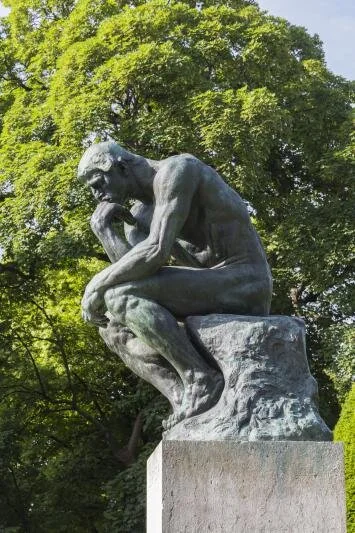
THE THINKER Auguste Rodin (1840 -1917). Cast made by Fonderie Alexis Rudier in 1904. Transfered to the musée Rodin in 1922. Maybe we should all be a little more thoughtful in our relationships…
Last summer we had our nephew and family visit with us at our little cottage. As typical of siblings, my nephew’s two children were squabbling. The older brother was annoyed with his younger sister and with her taking some toys he wanted to use. My niece-in-law patiently chided her son telling him that 1) when he was hoarding the item, what was he conveying to his sister about its importance? and 2) the relationship with his sister is more important than the item.
Not only was I duly impressed with my niece’s mothering skills (alas, there were many a day when my mothering was not so calm) but I also recognized that she was conveying to her children a wonderful life lesson: people are more important than things.
This week I heard someone comment on an article she had read. The details of the article are lost to me but the essence was that in the day of quick opinions and responses through social media, never forget that the person behind the opinion is more important than the opinion.
I think as a society we need to remember relationships. Ironically we are in a time of history when we can develop more relationships and contact with people than ever before. Yet, more and more people feel distant and abuse the relationships that they have. People are so quick to dismiss one another with a push of a button. We live in an era where we have much discretionary time and money. We do not have to be on guard every second of the day for attacks from other tribes or animals. We do not have to spend every minute hunting, gathering and preparing for our next meal. One would think that we would have enough time to develop deep relationships, yet we seem to fail at that. Rather we collect relationships as if they were something that could be bought and sold.
If we view relationships as another commodity, how do we go about rectifying that? How do we go about building those relationships? How do we remember that people, not opinions, not things, not even actions are the most important item in this world? How do we go about honoring people?
In honoring someone, I recognize God in them. I recognize they have been made by God, that they have received the same grace from God as I and that while I may not agree or even like them, I can still celebrate their humanness.
Here are some interesting suggestions I found on ways to honor one another:
Listen
Do not jump to conclusions
Keep an open mind
Ask questions
Be patient
Find common ground
Be compassionate
Be empathetic
“Live” in another’s shoes for a while
Forgive
Extend grace
What about you? How do you view relationships? How do you honor others?
I like the below quotes. If one thinks before she speaks, then the attitude and feeling one conveys is one of honor and respect for the other person.
Before one speaks, THINK: Is it True? Is it Helpful? Is it Inspiring? Is it Necessary? Is it Kind?
I have heard the following quote many times by many different people. It both comforts me (I truly hope that at times people have forgotten what I said and did) and frightens me. (How I hope that regardless of my speech and actions, those who are around me would feel encouraged and good about themselves.)
I've learned that people will forget what you said, people will forget what you did, but people will never forget how you made them feel. ~ Maya Angelou