Profiling Close to Home

Our house is located on a non-through street. While it is not a dead end, it is shaped more like a horseshoe. It makes our neighborhood semi-secluded for traffic. Generally the cars that navigate the street are ones belonging to the residents and their guests.  The homes are close together so that the children can play out on the street and front yards while the adults can talk over raking leaves, shoveling snow and monitoring children. 

Yesterday I witnessed racial profiling in our neighborhood.  It made me quite uncomfortable and it made me wonder what I can and cannot do about it.

I was outside on our front lawn raking leaves. As I am want to do, with any car passing I usually look up and wave.  Most times I recognize the car and driver but if I don't, I still wave because we have had some new neighbors move in and I am not completely sure of all their identities. 

A car I didn't recognize was driving quite slowly down our street.  It was obvious that they were looking for a specific house number.  After a turn-around in a driveway and two failed attempts to park on the curved street, the car stopped across the street from where I was.  I was about to approach the car and offer the driver a suggestion for easier parking when a police officer drove up.  He started to ask me a question then said never mind and proceeded to get out of his car and approached the parked one.  He rapped on the window and said, "Hey, what are you doing here?" As he spoke I cringed because the tone wasn't so nice. The woman was polite in explaining that she was here to do some cleaning and wondered why she was questioned "because I am black?"

The officer accompanied her to the house of her appointment and very shortly got back into his car. The woman then came back to her car to get her equipment.  I went over to talk to her and apologized for the general misunderstanding.  I explained that there had been a bunch of break-ins in our neighborhood recently and the community association was told by police to call them if someone we didn't recognize was in the neighborhood.  We had a nice chat.  She told me where she worked and how she knew our neighbor. I offered her a place to park in our driveway if she ever had trouble parking. 

I found the incident disturbing.  Partly because it was embarrassing that one of our neighbors felt threatened by a "stranger" in our midst and called the police . Just because she didn't look like one of us.  I wondered, will the neighbors now be calling the police on my sons' friends when they come over to our home to visit? 

 I felt disturbed because in the few minutes that the officer and woman were validating her reason to be in our neighborhood, I had the panicked feeling, "What if she thinks I called the police?  What if she really isn't here for legitimate reasons and decides to retaliate?"  I was disturbed that I had that thought at all. 

I also was embarrassed that the police officer's tone wasn't nicer.  It seemed to go in line with all that I hear on the radio about the clashes with police and people of color.   But then again, I haven't walked in his shoes, seen what he has seen nor am privy to what he knows. 

I understand why my neighbor called. I realized afterwards who probably did make the call.  These folks have had a number of break-ins at their home over the last couple of months.  They are overly cautious.

I can see why the racial problems are escalating. It doesn't take very long nor take much imagination to have a full scale misunderstanding.  Thank goodness the woman was very gracious.  

What can be done?  I do think conversation and getting to know one another is key. I generally don't like to get involved with neighborhood things but I somehow felt that I should reach out to that woman.  I am glad I did.

I also realize that sometimes things happen, misunderstandings occur and it is a risk to try to rectify.  If the woman did suspect that I called the police and I had not talked to her, both of us would've have continued building the wall of stereotype and division.  She would've thought I was another paranoid privileged white person and I would've thought that she was another defensive black person.

Sometimes trying to reach out and talk doesn't help at all.  The walls are quite thick. Neither party wants to hear what the other has to say.  Judgements and ideas are solidly formed. But over time, walls can be chipped away. Thoughts can be changed.  Stereotypes can be laid to rest. 

There is a great story of racial tension and transformation called The Best of Enemies:

"C. P. Ellis grew up in the poor white section of Durham, North Carolina, and as a young man joined the Ku Klux Klan. Ann Atwater, a single mother from the poor black part of town, quit her job as a household domestic to join the civil rights fight. During the 1960s, as the country struggled with the explosive issue of race, Atwater and Ellis met on opposite sides of the public school integration issue. Their encounters were charged with hatred and suspicion. In an amazing set of transformations, however, each of them came to see how the other had been exploited by the South's rigid power structure, and they forged a friendship that flourished against a backdrop of unrelenting bigotry.

Rich with details about the rhythms of daily life in the mid-twentieth-century South, The Best of Enemies offers a vivid portrait of a relationship that defied all odds. By placing this very personal story into broader context, Osha Gray Davidson demonstrates that race is intimately tied to issues of class, and that cooperation is possible--even in the most divisive situations--when people begin to listen to one another." (taken from the sales description at UNC press)

I still am stumped about the best way to handle situations like those I witnessed but I hope that by keeping the dialogue and conversations open, we might be able to have some type of break through in our racial divide. 

What about you?  Have you ever witnessed or been part of racial profiling?  What happened?  How did it make you feel?  

Have you ever experienced profiling close to home? 


MayFly

Over the weekend I heard an interesting podcast about the Irish aviatrix Lilian Bland (1878-1971) Ms. Bland was an extremely bright, independent and energetic young woman.  By all accounts, whatever she put her mind to do, she was extremely accomplished: photo journalist, equestrian, marksman, car driver, aeronautical engineer and an aviator.  All this in the beginning of the 20th century.  While Amelia Earhart was just a pubescent, Ms. Bland was designing and experimenting with building her own airplane. 

Lilian Bland in her self-built plane- The Mayfly.  Image found: http://news.bbc.co.uk/local/cornwall/hi/people_and_places/history/newsid_8956000/8956919.stm

Lilian Bland in her self-built plane- The Mayfly.  Image found: http://news.bbc.co.uk/local/cornwall/hi/people_and_places/history/newsid_8956000/8956919.stm

What I love about her story is her pluck and determination.  She carried on doing what she felt called to do regardless of the norms of the day.  She contributed much to aeronautics but I think, her major contribution to society was being an original. 

Even the play on words of her plane, "Mayfly" is an example of her humor, her humility and her hutzpah.  By all accounts, her letters and articles to Flight magazine were accepted and admired. It doesn't appear that she was patronized, nor does it seem that she was demanding and militant in her role as a woman.   She may have felt such a struggle in her work but in hearing her story I get the impression that if she did, she was more interested in achieving an outcome than by worrying about a difficult process.

I find her story very encouraging. If I feel called and compelled to do something, I should just carry on.  Not worry about what others think, nor get bogged down with a struggle during the process.  Just focus on the outcome I would like to achieve.

What about you?  Do you have any dreams or callings?  Are society norms or expectations of others holding you back? 

Try taking a page out of Ms. Bland's book of life-  whatever you want to achieve, "may" or "may not" get off the ground but you have to try.  

Take a Walk

I was reminded the other day that when one is feeling stressed, out of control or general malaise it is best to take a walk.  Walking seems to be up there in the top 10 tips for handling stress.

Has it always been this way for humans?   Certainly when our ancestors walked it was to either find dinner or escape from being dinner.  Sounds stressful to me.  

Joking aside, we were designed with walking in mind for both the physiologically and psychologically benefits. 

I read an interesting research article on the benefits of walking in an urban setting green space (e.g. a park). Turns out that a brief walk in an urban park can induce parasympathetic nerve activity, suppress sympathetic nerve activity, decrease the heart rate, enhance the mood state, and reduce anxiety.

Certain veterans had discovered the psychological benefits of walking in green space long before this study.  In the late 1940's WWII veteran, Earl Shaffer decided to "shake the Army out of his system" by walking the Appalachian Trail in one season, all 2,190 miles from Georgia to Maine.   By all accounts he is the first person to do a thru-hike, completing the walk in continuous journey. These veterans have discovered the healing properties of the long journey. 

Walking for a therapeutic or religious purpose is nothing new: Mecca- Saudi Arabia, Lourdes-France, the Camino de Santiago-Spain, Mount Kailash - Tibet, The Ganges River - India, Madron Well - Cornwall, England, Vaishno Devi Temple - India, Our Lady of Guadalupe Basilica - Mexico City, Mexico, Naag Mandir - Fiji.   I am sure the majority have found benefits in the process of walking much less any religious significance. 

Walking slows the rhythm of one's day.  It seems that the farthest a person could walk in a day is about 70 miles. According to reference.com at a speed of 3mph, a fit person could cover 72 miles in a 24 hour period.  Of course, one has to factor in terrain, weather, stoppage, sleeping, eating, etc.   Try as we might, a person would be hard pressed to cover more territory.  That limitation alone helps slow us down. 

Walking allows one's mind to ebb and flow with mindless thoughts and directed focus.   Have you ever noticed that sometimes you might be walking along and wonder what you passed?  You might be ruminating over a problem or idea and were so engaged that you mindlessly put one foot in front of the other but that was all you noticed.  Then at other times, you might notice the flight of an overhead hawk, or the flame colored leaves against the backdrop of a brilliant blue sky.  I have found that I toggle between the two mindsets even on the same walk.

Walking helps with perspective.  Because the process can only go so fast, walking does help put things into perspective.  Items that were urgent don't seem so after a nice walk.  The natural world has a way of putting us in our place.  Compared with the majesty of trees, the vastness of the sky and even the seemingly insignificant yet completely cared for sparrow, who are we to feel that we need to be in charge? 

Walking especially in a green space provides everyday beauty.  As the research article noted, the green space has a way of mellowing us out. Seeing beauty sublimely reminds us to focus on those things that are significant: truth, beauty, goodness.  

What about you?  Do you walk?  How often?  Have you ever taken a walk just to cool off or as a stress reliever?  Have you ever made a pilgrimage or a long walking journey?  What lessons did you learn? 

How are you feeling today?  Do you need to take a walk?

Malfatti

What do you think the word means?

1. mistake 2. small dumpling 3. Starbucks drink 4. computer glitch  

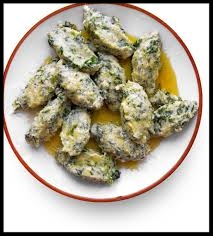
For those of you who may have heard the radio news story this weekend, malfatti means "mistake" but it is also a small Italian dumpling.   The Depot restaurant was the originator of malfatti back in 1920.  Italian immigrants had fled the earthquake ravaged San Francisco in 1906 and had settled in the Napa Valley region of California.  One of transplanters opened a local restaurant serving homemade Italian cuisine.  As the story goes, this local restaurant ran out of ravioli when serving a large group.  The only thing remaining was extra filling- spinach and ravioli- which the resourceful cook made into little dumplings to serve with her meat sauce.  It was a hit from the beginning. The cook called them, malfatti which means mistake or poorly made. 

I love these types of stories.  

Stories like these  remind me that mistakes happen.  No one knows why the Depot ran out of food- someone didn't know that a visiting sports team was coming to dinner; reservations weren't made or were but got misplaced; food ordering didn't happen?  Sometimes things do not go according to plan.  Whether it is someone's fault or not, these things happen.  We cannot control everything in our life. 

Stories like these remind me that sometimes the correction of the mistake creates an idea, item or recipe that is even better than the original.   In googling "malfatti" there are a plethora of websites that have the recipe.  The little mistake has become a standard in cooking. This is not the first time something wonderful was created out of a potential "disaster": penicillin, post-it notes, chocolate chip cookies, potato chips, x-ray machine, implantable pacemaker, microwave oven, ink-jet printer. 

Stories like these remind me that whenever there is a change- to a schedule, to resources or to plans- we need to go with it.  We cannot just complain and gripe about the loss or the actual mistake.  We need to look for resourceful ways to keep going and improve the situation.  If anything try to reuse, reassess or redeem the situation. 

What about you?  Have you ever had a mistake that turned into something great?  What did that teach you? 

Are you currently going through a situation that doesn't appear to have a good ending?   How can you turn it from something that is called a mistake or poorly made into something that is inventive and new? 

What is the "malfatti" in your life? 

Wanted: Encouragers. FT & PT. Inquire Within.

Are you a Starbucks fan? I am not particularly.  I find the coffee quite strong, even for me. However, I do like their employment practices.

The other day I heard an interview with the CEO , Howard Schultz.  Howard was explaining about the history of the company, its vision, ideals, challenges, troubles and successes. He shared that he owes his success to his wife of thirty-four years, Sherry.

At the time that Howard was planning to buy Starbucks (at that point it was a three coffee house operation with an additional three Pete's coffee places), he was trying to raise capital.  He envisioned a company that was more than just coffee shops. They would be a place for community.  He also envisioned a company that in treating its employees well would be the foundation for success. Employees who catch the vision, feel that they are part of a bigger ideal, work together, have respect for one another, have a connection to the success of the operation by providing great customer service, which brings in customers, which leads to profits. 

During this time his wife was eight months pregnant with their first child and still working full-time.  His in-laws came for a visit.  As one might expect, his father-in-law suggested, "Let's go for a walk, son." On the walk, his father-in-law got right to the point. "I applaud what you are trying to do.  But let's look at the facts:  Your wife is eight months pregnant.  She is working full-time.  You do not have a salary or income.  It is time to get rid of your hobby and get a job."  As Howard recounts he was embarrassed, mortified and realized that his father-in-law was right. Howard was torn because he didn't want to give up the dream yet he knew that things were tough.

That evening, Sherry asked Howard, "So, you went for a walk with my dad?"  Howard relayed the talk.  Immediately, Sherry said, " No way are we giving it up."  Howard said that if Sherry had agreed with her dad, Howard would've stopped then and not pursued the dream.  But those words of encouragement carried him through.  Currently there are over 22,000 Starbucks across the globe.

All from some encouraging words. 

Sometimes the words are big statements, like Sherry's.  Those encouraging words were filled with sacrifice and hard times.  Not only does the one who has the dream struggle, so does the one who encourages. It may take a long time before the dream comes to fruition.  During which time it is easy to become discouraged. 

Other times the words can seem small but still carry a big impact. "You can complete a 5K." "You handled that difficult client well." "You would make such a good mentor."  "Have you ever thought about taking art lessons?"   The words might even be said in an off-handed way.  But they might just be what the listener needs.

What about you?  Do you need some words of encouragement today?  Can you offer some to those around you?  Have you ever received encouragement?  How did that make you feel?  Was it life-changing? 

Who can you encourage today? 


Some Time Next Year

The crepe myrtle we purchased.  These lower limbs need to be pruned next spring.

The crepe myrtle we purchased.  These lower limbs need to be pruned next spring.

The other day we purchased a crepe myrtle tree to replace a dying/almost dead dogwood. I don't know too much about crepe myrtle just that I like the looks of the tree especially with its colorful blossoms, smooth bark and fringe canopy of branches.  What I didn't know was that the tree in its natural state has many lower branches causing it to look more like a bush. It is only in pruning and training those branches will the tree look like the smooth trunk crepe myrtles I see around town. 

When we spoke with the nursery owner about the tree's care, he suggested waiting until next spring to do any of the pruning of the lower branches. Once we do that, then the lower portion of the tree's trunk will remain smooth. Also he suggested that we wait another year before we "topped" the tree (cutting back the top branches so that it remains at a certain height). 

It got me thinking...  

How many times do I want to get things done and in the process rush and not do them well? Or in my impatience I don't take the time to learn and understand the significance of what I am doing?

The crepe myrtle shape we want- smooth lower trunk with fringe canopy. 

The crepe myrtle shape we want- smooth lower trunk with fringe canopy. 

Sometimes I have to wait until what I want to accomplish can be done.  Sometimes I have to let things be, before they can be improved.  Sometimes I need to uncover more information before I make any decisions. Changing things too early or too often can be detrimental.  In the case of the crepe myrtle, if I remove the lower branches now, I can stress the tree as it prepares for winter.  If I hadn't asked the nursery owner about the tree's care, I could have done irreparable damage. 

What about you?  Have you ever had to wait a while before you could accomplish something?  Did you ever have to research and learn something before your could even begin? How did that go?  What was your strategy in waiting? 

Sent By God

Last month I wrote about Lisa Fenn, Dartanyon Crockett and Leroy Sutton- the remarkable individuals from the ESPN Carry On story.   On another radio program I heard a more extensive interview with Lisa.  She gave more details regarding her involvement with these young men.

When Lisa arrived at the Cleveland High School to film the boys she first met the wrestling coach.  He shook her hand and pulled her in a little close so he could speak privately to her.  "You've been sent by God", he said.   He had been praying for these boys every day that God would send something/someone to help them.  

Little did Lisa know that when she saw the newspaper photo of the boys that the pull she felt was a God pull.  

How cool is that?  That she was willing to go with her instinct, gut, calling- whatever you might name it- and follow where it led. 

Later, during the filming of the boys at a match, one of them had all their possessions stollen- wallet, phone, books, money, etc.  He was devastated and mad.  How could someone do that to him, when that was all he had?  At that point, Lisa said she made the choice to get involved.  As a journalist, she knew that her role was to just report and observe. One is not to influence the trajectory of a story but she didn't know how she couldn't.   What bravery on her part to get involved, not knowing how it might turn out, not knowing if she completely compromised her journalistic integrity.  But it was the right thing to do.

Got me thinking.  Do I listen to the still small voice of God?  Do I get involved?  Am I willing to be sent by God?

What about you?  Have you ever had an experience where you were placed right where you needed to be in order to help someone else?  Did you weigh the costs before hand or was the pull greater than any risk? 


House of Memories

A while back there was a report on the radio about an unique museum in Denmark that doesn't really explain history as much as encourages the visitor to experience history. 

This museum is not open to the general public but to groups of elderly suffering with dementia and Alzheimers.  The museum is an exact reproduction of an apartment in the 1950's, during the time when those who visit would've been in their teens and twenties.  

It has been discovered that associative memories- smells, sights, sounds, touch that we associate with certain experiences- help retrieve the "reminiscence bump."- that teens and twenties time of early memories.   For those who are suffering from Alzheimers/dementia they need to by-pass strategic retrieval of the memories.  Instead they need to jump the executive process and go directly to that "bump". Sensual associations are the key to unlocking those memories. 

One of the reasons this retrieval is important, is that it allows those who are suffering from memory loss, feel as if they are still useful.  They can explain for what some of the past items were used and what they did.

"When people are old and with dementia, we are taking too much care of them," says Henning Lindberg, who came up with the idea for the House of Memories. "[We say] 'Sit down. Do you want coffee? Can I get a blanket?' No! If you want coffee, make it yourself! Of course, it will take double the time to make those things, but it doesn't matter because they will be useful again. It's what they tell us again and again and again — 'I'm so happy I could be used.' "

Who doesn't want to feel useful?  I know most people will express that if they cannot do "such and such" they might as well be gone.  The "such and such"  is usually an activity that makes the feel alive, human and useful.  

What is it about humans and our feeling of usefulness?  Is that what separates from all other living beings?  How about you?  Do you have loved ones that need to feel useful?  How would you go about including them into your day to day?  What things can they contribute to your household?  What are you learning from them? 

Are you building a house of memories?  

Closets, closets, closets

Last time I wrote about my plan to declutter our home.  It is definitely a work in progress.  But like all home projects, one thing leads to another.

It started with my switching my summer and winter clothes.  I was going through my clothing closet as I usually do, culling out the items that were too big, too worn, or that I really wouldn't wear again.  I am trying to be ruthless in my purging. 

Things were going well and then I realized that it had been over twenty years since I had everything out of the closet and had it painted.  So, on Sunday night I painted the interior of my closet. (My husband gave me a questioning look as to starting mixing the paint after dinner.  The look dissolved after I explained it was either I do it now or at 5 o'clock the next morning when I generally do home projects.  Seeing that the opening of the closet is close to the head of the bed, he wisely choose to remain silent with any other suggestions.) 

That led me to thinking perhaps I should reconfigure the space better.   In viewing the space, and short of having a contractor come in and knock down a few walls in order to widen it, I started looking at another upstairs closet.  That led to a thought, "Should I redo that closet to be my main closet and switch the items around?" That will probably lead to another project and so on and so on...

What is so difficult is that neither closet is a "normal" or average closet space. I have looked at the myriad of closets on Pinterest (and there are thousands more that I can peruse). I can not find any other closets that would match the size and scope of what I want to do.   So, it is hard to imagine how best to maximize the space without feeling overly cluttered.  Of course, after looking at all these pictures, I am wondering if people actually live in any of these pictures.  Are they seriously suggesting that people stack and keep stacked their color coordinated t-shirts on wire shelves with only slim wire dividers to hold things in place? 

I am still researching ideas as I am continuing to cull out the closets.  I really want to live into the quality not quantity ideal.  In putting the actual decision off for a bit while I am still sorting, I am hoping to eventually have an actual plan for the two closets and not just my wing and a prayer type of DIY.   I'll let you know how it goes.

What about you?  Have you ever redone a closet?  Did you use a closet system?  Is it still working?  What would you suggest as a plan for our main closet?  I would welcome your comments below. We don't plan on reconfiguring any walls or doing any major renovation, just want to reconfigure the interior to house hanging clothing (shirts, skirts, pants, dresses, blazers), shoes and handbags.  It is narrow- 30 inches across but deep- 88 inches deep. About 55 inches into the closet the 88 inch tall ceiling slopes down so that the back of the closet is only about 48 inches tall.  There had been two shelves in the back of the closet (you can see the wood side bars that held them up.  Also the two rods are the same height.  One of the issues I have is that currently I use both rods.  In order to access anything behind the first set of clothing rods, I have to duck down and waddle into the closet. I feel like I am going "to ground" like our terriers when they enter the wood pile after spotting their prey.  

Closet Project Number 1...

Closet Project Number 1...


Stuck in the Goo

Do you ever wonder what happens to the caterpillar in the chrysalis?  How does it become a butterfly?  What happens when it metamorphoses?  I heard an interesting audio from the show RadioLab.  It discussed just that as well as the philosophical implications and the common metaphor of caterpillar/butterfly to old/new life. 

What I find interesting is that at first look, there appears to be nothing from the first form to the second. How can a plodding, crawling, insect be the same as a graceful, flying winged creature?  

When they open the chrysalis what they find is goo.  Nothing formed, nothing recognizable. Yet when they have dissected caterpillars, they can see structures that will form wings.  Amazing.  

There is something new in the old, some hope and expectation yet it is not visible at first. Perhaps there is hope for humankind and for each one of us. 

While we may not be our "perfect" selves and we are always a work in progress; nonetheless, we do have potential to be the butterfly that we were created to be. In some ways we are both caterpillar and butterfly.

Though in my experience, being caterpillar and butterfly is not a linear caterpillar-chrysalis-butterfly process.  It is not as if once I go through the change, that is it- I stay as a perfect butterfly. Sometimes I am the caterpillar, munching away in my own selfishness.  Other times I have been changed into a butterfly and have the experience of growth, new habits and a feeling of new life. Yet my experience is short-lived and fleeting.  Life has a way of circling back.  

Just as soon as I may feel that I have finally "gotten it", experienced a situation without jealousy, anger, impatience, etc.- you name the poor behavior that I have avoided, then I resort back to my old self. I may be floating like a butterfly but before I know it, I am stuck on the ground, mired down with my selfish ways.  It seems as if I will keep going through the process until one day I am finally, totally transformed into the creature that was contained, albeit snippets, even while a caterpillar. 

What I am learning about the caterpillar/butterfly metaphor is that chrysalis means preparatory or transitional state. In the life of the insect, the chrysalis stage is about the same amount of time it is a caterpillar. Which means it is a necessary stage and which means that I have to go through it and cannot shorten it if I want to come out a butterfly.

In my "life cycle" I come to places where I "think" I know what type of butterfly I should be.  I am quite ready to vocalize my thoughts and plans to God.  I "know" what is the best for me and just want Him to get on with any metamorphoses He has planned for me.  I am "thinking" that I will be a Monarch butterfly. And so, I just want to get to that stage.  I truthfully don't want to go through goo. I don't want to be in the place where I am unrecognizable and all preconceived ideas are eliminated.  I don't want to live in this vulnerable stage.  I want to snap my fingers and get to the place, the attitude, the changed behavior without any inconvenience or messiness. 

There comes a time when I am choosing to accept the transitional stage, when I am choosing to accept being "goo" and when I am preparing my heart and mind to be the person God has originally designed me to be.  It requires me to be open to new possibilities, to change some old habits and ways, to listen to His voice and to be willing to be vulnerable in the transitional stage.  It requires me to enter this transitional stage trusting that the butterfly I am becoming is exactly the right butterfly that He wants.  No use trying to be a Monarch butterfly if I am a moth. 

What about you?  Ever thought about the caterpillar/butterfly mystery?  Which stage are you in?  Are you willing to go through the goo? How open are you to change?  

Click here for the audio to RadioLab

Slow Food Fixed Quickly

In my last post I mentioned fast food and the need for slowing down in our food ingestion. The thing that I find difficult is not so much the time to slow down the eating but the time to fix the meal in the first place.  

I love trying new recipes but generally I don't have the time to do so on a week night. After a full day of work it is tough to enter a lifeless kitchen and stare at an empty kitchen counter and an inactive stove.  If I have a plan for the meal it is a little bit better.  This summer I have gotten away from meal planning. I notice it must be a universal habit to forego any structure in the summer,  since many of the magazines run fall articles about meal planning. I guess when it is summer time, the living (and lack of planning) is easy.

So, in order to start the process of slowing down with our food so that we eat healthy, here are some suggestions that I have found for planning meals:

1. Google "meal planning ideas".  There is a plethora of resources.  100 Days of Meals, Everyday Meal Planning, (While I have found Real Simple's menus good with providing main dishes they are lacking in the veggie/fruit/side dish area- I always need to supplement)

2. Many grocery stores are selling pre-chopped, pre-measured, ready to cook food.  They also provide recipes either on line or through a store produced magazine. In our region, Wegmans is such a store. I use their recipes as starting points. Wegmans info.  Many times I feel that I can chop (and thus save some money) and prep myself. Buying the ready made food can be expensive but you will have to weigh time versus money.  Many organizers suggest prepping your ingredients ahead of time. Some suggestions.

3. A neighbor recently told me about Blue Apron.  It is a subscription-based food prep company which will send you all the ingredients, recipes and technique to fix delicious, farm to table, home made food.  You can order different meal plans each week.  It isn't cheap but it isn't as expensive as I thought it would be. Certainly it is less expensive than "picking up a bite to eat" plus you have the added benefit of farm fresh ingredients.   If, you have some time to fix your meal (the recipes aren't complicated or long) and want some variety using in-season, local food, this seems like a great option. (plus you don't have to do the planning or purchasing) 

4. Eating healthy doesn't have to cost more than eating unhealthy foods. Google "budget friendly healthy meals" for some ideas. Budget-friendly  I know some people who spend a couple of hours each weekend to prep/freeze meals for the coming week. Or whenever they make a meal if it is freezable, they will double the recipe and freeze one.  

I guess as with anything it comes down to planning.  Taking a little time each week to determine the upcoming meals is probably worth it in the long run.  

What about you?  Do you have a method of meal planning? What are your considerations? Finances?  Time?  Both? Do you have a go-to site for quick, easy meal planning?