
Adjustments

Adjustment: noun; plural noun: adjustments
a) a small alteration or movement made to achieve a desired fit, appearance, or result.
b) the process of adapting or becoming used to a new situation.
I have been doing yoga on and off for the last couple of years. I say “doing” rather than “practicing” because I do not go through the motions in any consistent way. (Just like I am not "practicing” the piano, I just dabble.) Also, I do not use yoga for any religious or spiritual reasons. I just like the stretching and toning it provides.
The other day I was doing my yoga stretches and was moving through a pose called “cat/cow.” One is on all fours (palms on ground under shoulders and knees under hips). One “drops the belly” producing a sway back - looking like a cow hanging down with belly and udders full- and then “curls back”- lifting one’s back in an arch like a cat would do.
I have done that pose numerous times but, as is said in every yoga practice, one needs to think about the movements each time and not just quickly go through them. The instructor reminded me that in the cow position I needed to reach my heart (upper chest) forward as the belly dropped. It was a slight shift and change than what I had been doing and it really made a difference with the stretch.
I thought about that small change as I was playing tennis the other night. Just a simple extra movement in my feet or shoulder position can make a huge change in how I handle the ball. If I step forward into the ball instead of waiting for it to come to me, I can sometimes produce a winning shot.
A small alteration that can make a big impact.
The other part of the definition for adjustment is the process for adapting to a new situation. I would say that most of us are in that category just by default of the pandemic. I think of teachers and students in the classrooms: they have had to adjust to masks, where they sit, what type of recess and play they can have, even how close the instructors can be in helping them.
Anyone of us who has been in a store or any position of waiting knows how we have unwittingly learned to adapt. For instance, it now seems normal to be six feet apart while queuing at the grocery store. I think of the old days that if I saw people standing beyond the conveyor belt, I would think that was such a long line and look for another checker. Now, seeing a person beyond the conveyor belt means that the line is only one person long because of the space we give one another.
I am finding the word adjustment in my spiritual thoughts as well. In the NT, Paul reminds us that we can transform our hearts through the renewing of our minds. One way we do that is in reading and rereading the Bible. Each time we look at a passage, God speaks to our hearts and we can choose to adjust to a new mindset, behavior or attitude.
In reading the book of Ecclesiastes, I am adjusting to the concept that I am nothing outside of God. As is the case with God, He (and life) is always a paradox: we are nothing apart from Him but everything with Him. The things that I worry about and spend my time doing or thinking about are not that important and won’t last. What is important and will last is my contribution to what God is doing. An idea that is humbling and strengthening all at the same time. Humbling, knowing that I am a mere cog in the wheel of life but also strengthening (to my confidence), knowing that I am a cog in the wheel of life and that what God has called me to do and what plans He has for me are things that only I can do. My contributions are important. Each day, I need to concentrate on that which I am called to do and to enjoy what comes down my path.
For if I would die today, tomorrow or in the next couple of minutes, I wouldn’t change a thing. It is like the lesson the main character, Emily learns in Thornton Wilders’ play Our Town: I appreciate and love the ordinariness of life and my daily activities. It is in the ordinariness of our calling that we find the extra-ordinary meaning of life.
What about you? What adjustments have been made in your life? Were they (are they) big or small? To your work schedule? To your finances? To your family? To your values? To your priorities? What adjustments can you make in your day today? What small changes to your physical, emotional, intellectual or spiritual activities can you make?
Some possible ideas:
Getting up fifteen minutes earlier to just collect your thoughts.
Choosing to forgo the dessert.
Trying a new recipe.
Smiling to someone who generally ticks you off.
Straightening your desk at the end of the day.
Refusing to answer or comment on a snarky social media or email.
Breathing deeply when feeling stressed.
Finding pleasure in small things of life: A flower on your desk, glancing at the star-filled sky, noticing the weather outside your window (whether it is rain, snow, fog, sun).
Reading a chapter in a book.
Memorizing a favorite quote or Bible verse.
Driving home via a new route.
Saving $10/week (or whatever might fit your budget).
Sending a note of gratitude to a co-worker.
Rotten Potatoes

For the last two weeks, every time I would enter our back basement I smelled something unpleasant. At first I thought it was the remnant smell of some wet wool carpets I had been cleaning and drying. Then I wondered if the dogs had “done something”. Next I was convinced that the sump pump was emitting an unused odor. I even added some bleach water to pump it through and freshen it up.
Still the smell remained.
It was only when I was getting some food out of our small basement freezer that I discovered the problem- there were rotting potatoes in our “root cellar” basket. I keep the extra potatoes and onions in a basket in our back cellar. It is cool enough there to keep the items for a while.
When I looked through the basket I found the source- a small rotting area on one of the potatoes. What is amazing to me it that something so small could be so odiferous. One would have thought the entire basket was rotting.
It is another reminder of how small things in our lives can matter: how a mean comment in our youth can dictate our views of ourselves or how a small decision may change the trajectory of our life.
They say "don't sweat the small stuff", but most of life is made up of small stuff- the day to day grind or the proverbial rat race. For me it is the little stuff that trips me up and makes the air around me unpleasant. It is my lack of discipline (Why did I spend thirty minutes watching something useless on youtube?) or hesitation (All I needed to do was to introduce myself to that new member at the club) or laziness (I just don't feel like updating my linked in page) that creates and spreads further problems. First of all I berate myself for not doing a simple task. Then the more I don't do it, the more it becomes a problem and the more self-loathing I experience.
The basket of rotting potatoes is also an example of how even a small sin, that which keeps us from God, can permeate the life around us. If I had left the rotting potato in the basket, it would have completely spread the rot to the others and the whole basket would've been ruined.
My heart breaks when I hear someone feel distant from God because of some small issue- may have been a choice of the person's own doing or one that happened to him/her. Either way, it has continued to grow and spread so that his/her life now has become so distanced from God that there is feeling of hopelessness and never getting things right. There even becomes an adjustment in one's thinking that this distance is normal and will always be this way.
The thing is- you can always clean the basket. In getting rid of the basement odor, I had to identify its source. Some times we need a good self examination of what is going on in our lives. David in the Psalms asks that God examine his heart. That is a good place for all of us to start when we cannot locate the unpleasantness in our own lives- asking God to show where we have fallen short. Then clean the basket: ask for forgiveness from God, or in the case of negative attributes (like my laziness) plan to be proactive with positive attributes. Finally, proceed on the new path. Start behaving or living your life in this clean environment. It doesn't have to be a big production. Just like small negative things add up, so do small positive things.
What about you? Any rotten potatoes in your life? Do you even smell anything bad? Or, have you lived with the smell so long you don't even notice it? What steps can you do to "clean that basket"?
Good News

Mother and Calf. http://www.noaa.gov/media-release/successful-conservation-efforts-pay-off-for-humpback-whales.
Last week I heard an encouraging environmental story. For many years any news story related to the environment was one of doom and gloom. But last week it was exciting.
Humpback whales have made a comeback. In NYC! There has been many sightings of whales, dolphins and seals in the harbor and waterways around the city. The water is cleaner and less contaminated. Schools of fish and smaller organisms fill the harbor and rivers.
According to Popular Science magazine website:
“Because of the improvement of the water quality, algae and zooplankton have multiplied, giving good food for the menhaden [a small oily forager fish beloved by whales], which have returned in numbers that the fishermen say they have not seen in their lifetimes,” Paul L. Sieswerda told PopSci. Once a curator at the New York Aquarium, Sieswerda has since founded Gotham Whales, an organization that conducts tours and monitors the presence of whales, seals, and dolphins in NYC. “Our surveys show an exponential increase in the number of whales since 2011 when we first began our studies," he said. "Prior to that, whales were only seen intermittently."
I remember talking about ecology in my eighth grade science class. The teacher had friends in the NYPD who told him that if there was an investigation that required a dive into the Hudson or any of the surrounding waterways, no one could enter the water with any cuts or abrasions. The slightest opening in one's skin could be potentially dangerous or lethal because of the toxins in the water.
What a far cry from today.
I am encouraged because the cleanliness of the water has turned around in my lifetime. When the reports came out in the 1960's and 70's, who would've believed that change could happen? The turn around for the whales required both the habitat to be improved and safe guarding the population through legislation with the whaling industry. We may not have personally changed the habitat for whales, but our awareness of not dumping into city water ways or our decision to support or not support an industry or manufacture which honors or ruins the environment, does.
Our biology major son has said that if we, world wide collective, would reduce the consumption of fish and consequently the fisherman would reduce the over fishing practices, that in five years we could reverse the problem of species annihilation and gaps in the food chain in the seas. Our oceans could return to a healthy balance.
When everyone makes a small change or sacrifice, big things happen. Small or large, it is all interconnected.
I find it interesting that one of the largest creatures, the whale, ingests some of the smallest creatures, plankton, for fuel and food. It is because the habitat for the algae, zooplankton, and small fish have improved that the larger creatures have come back. Small impacts the large.
What about you? Hear any good news stories lately? What do you do, small or large, that has consequences on the environment? Have you noticed any changes? What small change can you make today in your life? Environmentally? Physically? Emotionally? Spiritually?
The whales story is more than just about the environment. It is a reminder to all of us that small change can have a big impact.
There is a photographer who spends most of his time capturing these beautiful water behemoths around NYC. Click here to see his amazing photos.
Fever
The last couple of days I have been in bed with a fever. It finally broke last night and so I feel a little bit better. I still am exhausted especially in doing the simplest activities. Who knew that a shower would feel like a workout?
The thing about fevers is that it doesn't take that much of a body temperature increase for the bugs and viruses to be killed. Your body was designed for that. The increase temperature of the fever stops the replication of viruses so that our immune system can attack what is currently assaulting our bodies and not be overwhelmed with a new host of reinforcements.
When you think about it, many things can be impacted by just a simple or slight change. One small change does have impact on other things. According to earthday.org "if the entire U.S. did not eat meat or cheese for just one day a week, it would be the equivalent of not driving 91 billion miles – or taking 7.6 million cars off the road. Or as an individual you ate one less burger a week, it would be equivalent of taking your car off the road for 320 miles." That's because meat production produces 1/5 of the green house gas emissions.
There has been other types of research about small changes. Studies have show that a modest weight loss- 5% of body weight- produces heart health gains, lowers diabetes risk, reduces risk of sleep apnea, lowers cancer risks.
There are also the interesting stories of major flubs, all brought to fruition by small problems. In the 1998 Mars exploration, they missed the target for failing to convert English to metric units. The original pictures sent back from the Hubble telescope were fuzzy. All due to a 1/50th of human hair width problem of one of the mirrors.
What does that have to do with us?
I've been thinking about the zero waste advocates (see February 6, 2017 post). They seem so hard core. Is it really feasible for all people to live that way? I am just grateful that my eighty-eight year old father is eating, much less worrying about the packaging it comes in.
But we can do our fair share. If we all tried to reduce our waste- making choices to avoid plastic and reuse what we have, it would be beneficial to all. If we all choose to make small changes the impact can be large. Of course we all have to figure out what works for us and our family. But wouldn't it be empowering to know that we have contributed to change and we didn't have to do too much?
What about you? What types of small changes do you do that have seen big impact? Is there something small you can commit to today? Could you monitor it for a month and see if there are any changes?
Thinking Outside The Trash Can
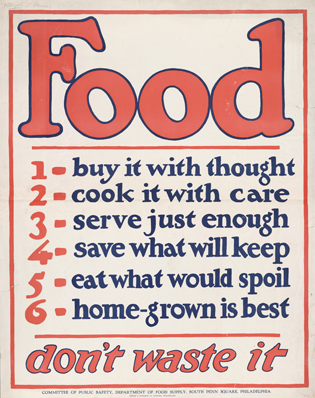
WWII poster encouraging civilians to do their part. Source: http://www.usda.gov/oce/foodwaste/resources/consumers.htm
I guess because it is the holiday season, food has been on my mind. In going to the grocery store these last couple of weeks I am reminded of the blessings of the many many food choices and the quantity of items in everyone's (my own included) carts. There was an interesting article in the November issue of Reader's Digest about ordinary people who are concerned with how we use our food resources and how best not to waste it. These individuals have thought of different ways to either help with the distribution of food or highlight the problem of food waste.
According to the US Department of Agriculture the US wastes between 30-40% of food. Food that is/was perfectly edible gets thrown into the land fills. The USDA notes that in 2010, that equated to 133 billion pounds of food and $161 billion worth of food that was wasted. It is more than a problem of edible food wasted- there is an impact on our environment. As stated on their website, "the land, water, labor, energy and other inputs used in producing, processing, transporting, preparing, storing, and disposing of discarded food are pulled away from uses that may have been more beneficial to society". Food waste is the single largest component going into our landfills causing landfills to be the third largest source of methane production.
On top of all that, there is the problem that people could have benefited from the food. As a country we are blessed with seemingly unlimited food resources, yet there are those among us who do no have enough to eat or enough healthy food to eat. When you think that there are people who go to bed hungry it seems a sin. It is not a question of our country not having the resources, but more of an equitable distribution of the food.
There is a woman from California who has designed an app for restaurants or businesses who have excess food to alert those in need- non-profits, food kitchens, etc. of edible food that won't become food waste. By using the technology of an app, those with excess food can alert those who can distribute it before the food becomes perishable. Her program operates in over 40 cities in Northern California. Hopefully in building an infrastructure in other areas the program can be replicated beyond the California region. Click here to download her app
On the East Coast, a group is demonstrating the problem of food waste by offering dinner in a dumpster. "One man's trash in another man's 6-course meal." They are highlighting the problem by using "imperfect" food in their creative meal plans. e.g. Office Coffee Butter & Recycled Rice Bread -Fresh butter whipped with an end-of-the-day office coffee reduction. Served on freshly baked bread with yesterday's rice or Broccoli Stalk Slaw - Shaved stalk of broccoli and blanched organic carrot peel with a soy-ginger drizzle, topped with black sesame.
They serve the meal in a (sanitized) dumpster. As is only in New York City, it is a big hit. One needs reservations and there is a waiting list. It certainly engages people in a conversation and raises their awareness of food purchasing and food preparation that decreases waste. "Salvage Supperclub exists to create inspiring food experiences with a purpose. We recognize how essential food is to all of us, but believe that the power of a shared meal can (and should) go beyond our base needs. It should not only nourish us but also delight and empower us. We don't just make great food. We put great food at the center of a dialogue about a more sustainable food system. We hope you'll join us." Click here to see their website and pictures of their meals.
The last story was about a former NFL football player who gave up his materialistic life to be a farmer who shares his bounty with others less fortunate. Jason Brown played for the St. Louis Rams but felt a calling to not just use his money to buy food and donate it but to actually be part of the solution. As he says, "I had to be out there doing the work and leading the way." His produce is given to local food pantries, churches and food banks in Eastern North Carolina. His ministry is called First Fruits Farms. Click here to see his website
I have heard of other similar food distribution programs: Campus Kitchen (college campuses give their excess to the local food bank) or Society of St. Andrew (an after harvest, gleaning-the-extra program to gather fresh produce) to name two. On the USDA website there are many other national programs. Click here to see a list of national food recovery programs
What I love about these stories and these programs is that they are comprised of ordinary people. People like you and me who have decided to act on an issue that was laid on their heart. They used their interests, talents and resources to create something bigger than themselves. And, they came up with ideas "outside the box"- looking at a problem in a different light.
What about you? Have you ever had an idea about a social situation? Did it seem impossible to you? Are there others who feel the same way? How can you take steps to try it out? Or can you partner with someone who is already doing something similar?
How are you and your family with food waste? Do you find mystery items in your fridge that need to be thrown out? Do you end up scraping half of your meal into the trash? Would you say that 30-40% of the food coming into your household is wasted? Higher? Lower? Are your "eyes bigger than your stomach" at restaurants?
EPA's Suggestions for Reducing Food Waste:
- Shop your refrigerator first! Cook or eat what you already have at home before buying more.
- Plan your menu before you go shopping and buy only those things on your menu.
- Buy only what you realistically need and will use. Buying in bulk only saves money if you are able to use the food before it spoils.
- Be creative! If safe and healthy, use the edible parts of food that you normally do not eat. For example, stale bread can be used to make croutons and beet tops can be sautèed for a delicious side dish.
- Freeze, preserve, or can surplus fruits and vegetables - especially abundant seasonal produce.
- At restaurants, order only what you can finish by asking about portion sizes and be aware of side dishes included with entrees. Take home the leftovers and keep them for your next meal.
- At all-you-can-eat buffets, take only what you can eat.
52 (Give or Take) Ideas
How are you doing with your plans for 2016? As we settle into the year I have found that some things I was so gung-ho on doing have fallen by the wayside. (My idea of running during lunchtime has stopped- somewhat due to the blizzard but any excuse is always welcomed!) I find that I need to have smaller more frequent goals, ones that I can easily achieve which in turn become the foundation for healthy change and healthy living.
So in that spirit I offer to you 52 ideas (an idea a week) -some new and some old. All are reminders that small changes can lead to heathy living. As we are starting in February, there are 5 extra items to mix and match throughout the year. If you want, copy and print out the list and keep in your calendar or on your refrigerator as a weekly reminder. Hopefully this list will incentivize you to work on something small each week. If not those listed below than perhaps these suggestions might spark some other idea for you:
- Eliminate drinking soda this week
- Incorporate one new veggie or fruit into your diet
- Plan your meals for the week
- Use a smaller size plate for your dinner this week (don't go back for seconds or thirds)
- Drink 8 x 8oz glasses of water each day. If you need some flavor, add slice of orange, lemon, lime or a splash of juice
- Eliminate desserts this week
- Sit down for your entire dinner this week. Set the table, light a candle and dine. Whether by yourself or with your family- enjoy not rushing through dinner.
- Start lettuce seeds, spinach seeds or other greens indoors
- Walk for ten more minutes each day (or start walking ten minutes)
- Sign up for an exercise class
- Get up and move away from your desk (try marching in place for a minute) every 60 minutes
- Do sit ups during commercial breaks
- Get to bed earlier this week (by an hour or half-hour)
- Take your daily shower before going to bed (give yourself a little extra time in the morning as well as wash away any daily allergens)
- Remove electronic devices from the bedroom (put your cell phone, laptop in another room)
- Eliminate alcohol this week (no glass of wine with dinner, beer or nightcap)
- Limit caffeine this week- switch one of your cups of joe to herbal tea
- Visit your local library
- Read 1 book this week instead of watching TV
- Complete a crossword puzzle (or one or two levels of a word game app)
- Color in an adult coloring book (pick one up in a supermarket or craft store)
- Say no to requests this week (say you are temporarily on hiatus)
- Write out goals for the year (or the remainder of the year)
- Keep a bouquet of fresh flowers by your bed or on your desk this week
- Do something for a colleague- bring them a cup of coffee or tea, drop off a funny card on their desk
- Surprise a loved one with a favorite meal, meaningful note or "just because" gift
- Become an organ donor or a bone marrow donor or sign up to donate blood
- Write out a budget- include a savings plan
- Only spend $ on essentials this week- food, housing, transport to work, contribution to church/place of worship
- Donate to your favorite charity
- Go window shopping. Create an outfit that appeals to you but do not purchase.
- Write out your will: include living will, power of attorney, etc.
- Go through your coat closet- dry clean what needs it, eliminate unmatched gloves, unflattering hats, scarves never worn
- Sort through dresser drawers- do one drawer a night. Eliminate ripped, stretched out, stained, non-fitting clothing
- Sort through kitchen drawers- one drawer a day. Eliminate items that haven't been used or will probably never be used
- Go through garage and/or basement- get rid of things that you haven’t used in a while or are broken or are unrealistic projects
- Plan for a yard sale- sell household items that no longer want/need. Go in with the neighbors for a bigger turnout
- Get ready for your next day, the night before (clothes laid out, lunches packed, bags by the door)
- Go through linen closet- donate old towels and blankets to your local animal shelter
- Write in a gratitude journal each day
- Find a Bible study plan
- Commit to reading/listening to Bible each day
- Go to place of worship this week
- Pray for five minutes each day
- Find out information about volunteering in an area of interest
- Take a gift inventory- discover your strengths and abilities
- Plan for a retreat (commit to 1 hour or 1/2 a day or weekend)
- Write a note to a person who had an impact in your life- thank them for their love and support
- Plan out your funeral- any favorite hymns, songs, poems, Bible verses
- Practice random acts of kindness (hand out gift cards to a local coffee shop to road repair workers, trash collectors, rest room attendant)
- Do something nice for your neighbor- shovel their walk, mow their lawn, drop off a bouquet of garden flowers
- Sit outside for ten minutes- enjoy the sights and sounds of nature