
Day 20: Words and Pictures: Diversions and Distractions

What is it? *
Can you tell what the above picture is? Perhaps you know the game- there is a magnified section of a common object and you have to guess what it is. There are different ways to play: 1) give a person a specific time to figure it out 2) disclose more and more of the object- perhaps 3 tries- before the answer is given. Either way it is something one can do with friends and family during this quarantined time.
As this stay in place continues, we might need more positive diversions. Here a some others:
1) Read a book together. One of our neighbors reads a bedtime story via Facetime to her grandchildren across town. Or, form your own online book club. Pick books that are easily downloaded from local library or order from local bookshops.
2) Make your own online class. Ask a friend to join you in watching online classes/instructions from youtube. I have mentioned before that there are instructional videos from well-known universities, museums, etc. Pick a class- learning a new language, basic philosophy, music or art appreciation, poetry or writing exercises. Pick a time when you will convene and share what you have learned or what you are creating.
3) Write a letter. Write a letter to someone who has made an impact in your life. Or, write a letter about your feelings during this Covid-19 episode. Whether you mail it or not, take the time and process of writing your thoughts on paper. You could also respond to Benedict Cumberbatch’s request for letters. Click here to see how to respond. On a side note- if you notice the bookshelf background, it appears that the books are arranged by color (do not know if that is the intention of the decorator). However if you like that type of look, Click here to see how you can get colored book covers.
What about you? What diversions and distractions are you employing? What have you seen online or heard your friends and neighbors talking about?
* Answer to the above picture: In honor of our current pandemic- roll of toilet paper.
Day 19: Words and Pictures: Good
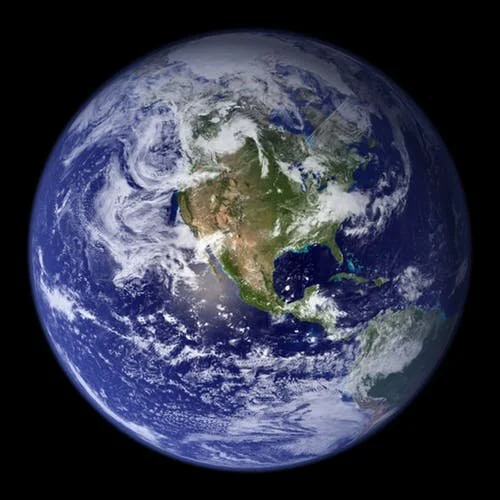
Our good and beautiful planet.
Good: Adjective: morally excellent; virtuous; righteous; pious: satisfactory in quality, quantity, or degree; of high quality; excellent. Noun: profit or advantage; worth; benefit: excellence or merit; kindness:
It has been interesting during the pandemic to see different celebrities/personalities use the internet to deliver communication that is uplifting, positive and encouraging. While I mostly suspect it is being done to keep one’s name on the top of everyone’s list and to promote good PR (as there is such a thing as bad press), I find it interesting that it is being done nonetheless. How strange and refreshing it is that the majority of entitled, overindulged narcissistic individuals find that in times of crisis they turn to one another and values not bought with the Amex black card.
Actor John Krasinski has inaugurated a weekly SGN (Some Good News) youtube broadcast. I cannot tell his motivation- does he truly want to talk about good things happening with ordinary people rather than Hollywood and entertainment?- but he is recognizing hometown heroes and is trying to help those who have had to sacrifice something that was important to them due to the corona virus. The highlighted stories of the delivery people, the health care workers, grocery store folks reminds those who are providing the services, they are not forgotten and those who hear the stories to not forget that we are all in this together. I am sure that he hopes that one story of encouragement might lead to another person contributing to another story of encouragement and so on.
Isn’t that the way with good news? Bad news can spread like wild fire but good news can be the rain that puts the blaze out and contributes to the nurturing of the burnt ground. Bad news destroys but good news rebuilds. It rebuilds our faith in one another and ultimately can lead to rebuilding our faith in something/someone larger than ourselves.
In this past week’s segment, there is a little video shout-out from some members in the International Space Station. One of the astronauts, Dr. Andrew Morgan stated, “Earth in crisis is still a world worth returning to”. What a lovely and true sentiment. For all our problems and conflicts, the world is an interesting, beautiful, and wonderful place with interesting, beautiful and wonderful inhabitants. I think it is through crisis that defines and makes us: tension and conflict exposes vulnerability which exposes authenticity which aligns connectivity and community. That brings about the good in people and society.
What about you? Have you seen any of the celebrity youtube broadcasts? Where have you seen the greatest good happening in your community?
Day 18: Words and Pictures: Notice

They may be weeds or unplanned perennials but I love the delicate flower and the serrated edging on the leaves. Why, though do weeds always seem healthier than my legitimately planted flowers?
Notice: the fact of observing or paying attention to something. To notice: become aware of.
When our boys were little and we went on our daily walks, I used to pay more attention to my surroundings. I think partly it was to be able to point out flora and fauna or the latest digging equipment or animal. If I hadn’t spied something before them, I would soon be made aware of it with the, “what’s that, mommy?” inquiry. But I think the reason I could notice things around me was because I had time. At that point in our lives I was taking a hiatus in my “career” to be at home with them. The pattern of our days was unhurried.
Lately I feel as if that luxury of time has been returned through this global pause in activity with the corona virus. In the daily walks with the dogs we see more people out walking and are able to have more leisurely (socially distanced) conversations. Unlike before the pandemic when we would rush home with the hope to complete our canine rounds before the next outing, our current evening walks are not rushed. The global pause gives us daily pause.
The following are pictures of items I have seen on my dog walks. Not overly exciting but they are things that I have noticed.
What about you? Have you had a chance to get outside? For even a few moments? Or for a longer walk around your neighborhood? What have you seen? What have you noticed?

Bleeding hearts. String of “heart lights”.

Ah violets. (tucked among chickweed, clover and grass) Reminds me of my grandmother. It was she who let me eat them. (She was an Euell Gibbons fan)

The young artist was out on her yard and was pleased as punch that I asked her if I could take the picture. She was glad someone noticed.

The remaining daffodils. Most of them have already past their blooms but this one… either a late bloomer or a tenacious survivor. Hmm. Must be a lesson there somewhere…?
Day 17: Words and Pictures: Live for Today

Courtesy of visitgreece.gr website.

Courtesy of visitgreece.gk website.
In our neck of the woods we have been “sheltering in place” for over a month. In some ways it seems a lot longer than that. It is hard to remember a time “before”- before empty grocery shelves, decreased road traffic, public face masks, social distancing. There are certain markers that remind me when this began: the news reports on the television in my mother-in-law’s hospital room, the first Sunday of “no church”; the beginning of daily drives of a friend to the hospital for appointments and procedures and our discussions of pandemic plans.
How much of our lives are remembered by such markers? “The afternoon I broke my wrist, the day mom died, the day of the diagnosis, the night of the phone call, the morning Fido died.”
In a short amount of time, our world and its view becomes changed. Even my physical view has become very limited to what I see outside my office window, the square images of blurry faces on zoom calls, the weekly trip to the grocery store.
It wasn’t until yesterday when I was contemplating standing in a grocery store line entrance (decided the hour long wait just to enter, not even knowing if what I planned to buy was in stock, was not worth the items) that I truly realized this might be the long haul; there is no going back to the way things were.
We have been watching The Durrells of Corfu as a nightly diversion. A fun, entertaining story set on the spectacularly beautiful Greek island of Corfu, it shows the life of the eccentric English Durrell family who lived there for about five years leading up to WWII. As we watch the show unfold, there is a sadness in my heart knowing that for the real Durrells as they lived during this time, they had no idea of what would befall them or the world in the future. I want to shout at the TV, “Enjoy what you are experiencing now, because in a couple of years all hell will break loose.”
It makes me hyper aware of what is going on in this world. Will we look back at the beginning of this pandemic and think, “If only we knew how good it was during these first few months. We had no idea of what was going to hit us”? In the first week I was worried about getting the extra items from downsizing my mother-in-laws apartment to the Salvation Army store before all closures happened. Now, worrying about our son and his fiance’s health in the thick of it outside NYC is much more of a concern.
Yet for all the time markers that remind us of what was and how it used to be, there are time markers that remind of us what is possible and what might be in the future: the day a baby is born, a family member gets married, the day a job starts, the email of the school acceptance.
The thing is, there will always be a melancholy for what is missed and what was. That is not a bad thing. It is important to remember our past and the lessons learned. If we do not contemplate what happened before and its cause and effect, we are in danger of repeating the happening. But I think that there is an even sadder situation if there is a missing of the future because of the continued remembrance of the past. I have heard it explained that if we try driving a car by only looking in the rear-view mirror, we will definitely have an accident as we accelerate forward.
While we have been going through this for over a month and we may be enduring this for more months to come, I do not want to only be thinking of what could have been or things that have been missed.
Not that my broken wrist is on the scale of a pandemic, but the time since last November when I broke it, have been times of wondering- “what could’ve been, what I have missed, what I will miss because of it, if only…” As I have moved through the healing of my wrist and recognizing that things may never be exactly as they once were, I am also in a newer place because of it. I have a new friend in the once-acquaintance who helped me immensely in my physical therapy regime. The broken wrist led to other surgeries that I had been putting off but desperately needed. I have a better appreciation for those who go through physical pain. The healing time for the wrist provided me time to regroup and consider my own work and my dedication to it.
We do not know what the future brings. This pandemic has underscored that we need to hold our future plans loosely. But that doesn’t mean one needs to be fearful of the future. Sure, things can deteriorate but they can also improve. While our past molds and shapes us, it doesn’t have to cement us into a permanent segment of time.
The story of the Durrells did not end in Corfu. Yes, they endured WWII and life changed dramatically for them. Perhaps they pined for those idyllic days but they had to move on. However, the experiences from Corfu helped define their future: Gerald Durrell wrote delightful memoirs of his time there and the outdoor explorations he experienced led him to become one of the world’s first conservationists.
What about you? Do you have remembrances that are marked by certain events? How does that shape your outlook? Do you “drive your life” looking in the rear-view mirror or looking ahead? How can you enjoy today without clinging to yesterday and worrying about tomorrow?
I am reminded of Ecclesiastes 3: 11-14: “He has made everything beautiful in its time. He has also set eternity in the human heart; yet no one can fathom what God has done from beginning to end. I know that there is nothing better for people than to be happy and to do good while they live. That each of them may eat and drink, and find satisfaction in all their toil—this is the gift of God.”
Day 16: Words and Pictures: Art

William Michael Harnett, The Old Violin, 1886, oil on canvas, Gift of Mr. and Mrs. Richard Mellon Scaife in honor of Paul Mellon, 1993.15.1
And now for something completely different… (well, not totally)
One purpose in our 30 Days of Inspiration is to have a moment for thinking about our lives in a different way. Perhaps re-set our focus. Perhaps give us a diversion. Perhaps give us a new direction.
Click here for an activity from National Gallery of Art. Give it a try. While one exercise is designed to look at art with a family member suffering from memory loss, I think the questions and ideas can apply to anyone. You may even want to “poke around” the NGA’s website for other works of art to ponder. Hopefully it will give you some type of reprieve from the monotony of the days. Might even give you a chance to look around you in a different way. I know that art gives me a different perspective.
Day 15: Words and Pictures: Innovation
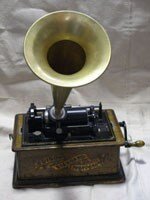
Edison Standard Phonograph. NPS photo
They say that necessity is the mother of invention. I guess that is true. Think of Eli Whitney’s cotton gin (combat the labor intense hand picking of cotton); James Watt’s steam engine (to pump water out of Britain’s coal mines) or WWII’s Manhattan project (USA’s determination to build an atomic bomb before Nazi Germany).
I read that inventions are created by individuals who are curious or just like to tinker. Their new innovation may or may not be a perceived need by society. Sometimes it becomes needed. Other times it becomes needed in a way unintended by the inventor. Such was the case with Thomas Edison’s phonograph. When he originally developed it, he thought of ways it might be helpful: preserve the dying words of an individual, teach spelling, announce the time, recording books for the blind to hear. He did not foresee the use for recording music. He thought that recording music would take away the seriousness of his invention and was very slow adopting its use in that way. *
I am wondering about the innovations that will arise from these times. What intended and unintended consequences and therefore innovations will this pandemic bring? Already it is amazing to see the creativity of individuals and organizations: The network of universities with 3-D printers, all producing parts for face shields for health care workers. The refitting of manufacturing plants for ventilators, face masks and other PPE. Even the cottage industry of people making their own face masks- using vacuum HEPA or coffee filters, t-shirts, pillowcases.
Correctional facilities are making face shields, masks and gowns instead of license plates, furniture and flags. A sporting manufacturer is making face masks and gowns. There’s the college student who is making lip-readable face masks (clear panel over the mouth) so that lip reading deaf individuals can understand. The list can go on and on… It seems as if there is no end to what humankind can invent and create.
Part of the beauty is the openness to possibilities that innovation brings. To be open, one has to be open to success and failure. To be willing to “give it a go” whatever the outcome. To be willing to try.
Thomas Edison once said, “genius is 1% inspiration, 99% perspiration.” Sure, we can be innovative and create some new ideas and technology but there is a lot of time, sweat and energy that passes before that might be so.
Makes me wonder how much I may/may not have the innovator’s spirit? Am I willing to try? “Give it a go”? Am I willing to put in the “sweat equity”? Are we as a society also willing to do that?
Innovation also requires some type of sacrifice. Whether it is in precious resources for the new innovation- both physical and in people power, or time spent ( and therefore not spent in other areas).
Am I willing to think of alternatives to situations-whether my own, my families, friends or community?
What about you? Has any necessity in your life brought about innovation in your life? What does/did that look like? Are you open to possibilities? Why or why not?
Click here to read more about Thomas Edison. It appears the Mr. Edison wasn’t the first to invent the phonograph.
Day 14: Words and Pictures: Inspirational Views

Japan’s Takizakura tree. Believed to be over 1,000 years old. Providing hope and inspiration for generations.
Having to “stay in place”, it is easy to only see one’s four walls- to feel closed in and cramped. Even if the sky is grey and rainy, I still feel better- more hopeful, positive- when I see the vastness of earth and sky and sea. When I look up and see the clouds floating by or watch the ocean waves crash and roll on the shore I gain a perspective that there is more to life than just this very moment. Life was, before me and will come, after me. I am just a drop in the bucket. Instead of depressing me, it gives me a sense of peace- that I am a part, albeit small part, of this world and the continuum of time.
When I feel down, I look up.
Here are some pictures that bring a smile to my face and a warmth to my heart. What about you? What pictures provide inspirational views for you?


Day 13: Words and Pictures: Courage

Artemisia Gentileschi, David and Goliath. Courtesy of Simon Gillespie Studio. **
Courage: “mental or moral strength to venture, persevere, and withstand danger, fear, or difficulty.” The word originates from “the Middle English corage, from Anglo-French curage, from quer, coer heart, from Latin cor- meaning heart.” (meriam-webster.com)
What do you think of when you hear the word courage? A larger than life hero? A superman who steps in front of a speeding bullet? A singing, skipping shaggy lion seeking on a yellow brick road?
For me, courage has always been exemplified by the underdog. The David versus Goliath mentality. (Give me the David- types any day.) The one who has been discounted by others, yet despite her personal failings or lack of resources still enters into the face of difficulty. I think of the health care workers, those who work in the grocery stores, the cleaners, the trash collectors- people who are out and about in order to keep our society going during this time of corona. As this pandemic continues it takes courage for them to persevere in the face of danger. It takes courage for the health experts and politicians to make policies and rules that protect the health of Americans even if it requires a sacrifice of popularity. It takes courage for parents and grandparents to keep things “normal” for their children and to carry on in the face of uncertainty.
The portrait of courage: Those people who rush into the fire to help rather than away from a heated situation. Those individuals who provide for their families, day in and day out, doing whatever it takes to put food on the table. Those explorers, adventurers, immigrants who took (and take) a chance on traveling to a new country in order to have freedom and a better life for their children and grandchildren. Those family members who consent to intubation not knowing if they will ever speak to their loved one again.
How do we cultivate courage? Can we?
The old adage is that there is strength in numbers. I believe that is true in providing courage for a community. We can handle things when we do not feel alone. We can have courage when there is someone walking beside us. “Two are better than one,” the Hebrew wiseman said. “ And though a man might prevail against one who is alone, two will withstand him- a threefold cord is not quickly broken.” (Ecclesiastes 4: 9, 12)
To encourage is to give another person courage to continue, it requires more than one person. Sometimes one’s lack of courage can be cultivated by another’s- the other can offer en-couragement. Knowing how a person in the past handled a difficult situation and took courage in the face of it, strengthens my resolve to do likewise.
I know that when I start getting anxious, worried and my strength falters, I take a deep breath and find comfort in the words of others and the Bible.
“Be strong and courageous.” Joshua reminds the Hebrews when they as the underdogs are ready to move into the promised land. “For nothing will be impossible with God,” the angel tells Mary when her life is turned upside down with the unexpected visit and change to her life circumstances. “I will never leave you, nor forsake you,” God reminds His people, both in the Old and New Testament.
When our courage falters, take heart. Look for stories of people being courageous. Find out what others are doing. Share with one another. Encourage one another. Be the David for someone else.
** To find out more about this fascinating woman artist- click here.
Day 12: Words and Pictures: Grace

The Incredulity of Saint Thomas, Caravaggio, 1601-1602, Sanssouci, Potsdam
And so, today is Easter Monday. In normal circumstances, it may be a day off following a holiday. A time to recoup: vacuum the crumb- laden carpet, discover well-hidden Easter eggs, clean up the chocolate wrappers, put away the holiday china, get ready for the remainder of the spring.
On the spiritual side, it is a day to let the events of last week and weekend settle into our hearts. How are we to respond? To ponder what does it mean for us? The concepts of sin? Mercy? Forgiveness? Grace?
Grace. God giving us what we do not deserve. A gift. We cannot earn it, we not deserve it and we cannot buy it.
When I truly think about it, it elicits a response of immense overwhelming gratitude; by accepting the gift of God’s love for me, I can have eternal life- never being separate from God. Amazing.
I am drawn to the paintings of the Renaissance painter Caravaggio. His subject matter can be a little off putting but the way he captures light onto the canvas is nothing short of miraculous. If you think talent is given in proportion to a person’s moral character, then he certainly didn’t deserve the accolades. He was the bad@!! renaissance painter. He never showed any morals (constantly arguing, fighting, seeming to have a demon in his soul) yet he was given the incredible gift of painting.
I think of Wolfgang Amadeus Mozart. Another genius with questionable morals. The whole question about a selfish, arrogant, brat being gifted with enormous talent and genius is at the heart of the story, Amadeus. Certainly Mozart’s rival, the religious Anthony Salieri wonders about it.
Undeserved gifts.
I love the story behind the hymn Amazing Grace. Written by John Newton, a former slave trader turned abolitionist, it expresses how none of us deserves this grace. We all are wretches in some form or another. As exemplified by Newton’s life, none of our actions or thoughts are pure one way or the other: good versus evil. We are complicated beings. Inconsistent, sometimes getting it, sometimes not, at times good, at times bad. Which again is the point of grace- we all fall short when it comes to being absolutely good/perfect people. Cannot be done.
And so, we need to accept the gift of God’s grace to move along in the world.
What about you? What do you think of grace? For yourself? For others?
Part of my reaction to the grace I have received is to extend grace to others: do I give people the gift of understanding, compassion, love when they may not “deserve” it? How can I be a grace-filled, grace- extender in my corner of the world today? How about you?
Click here for Andrea Bocelli: Music for Hope. At minute 19 he sings the old hymn: Amazing Grace.
Click here for more about John Newton.
Click here to read more about Caravaggio.
Day 11: Words and Pictures: Easter

William-Adolphe Bouguereau: Les saintes femmes au tombeau (The three holy women at the tomb) , 1876.
Happy Easter! In the words of Christendom- He is risen! He is risen indeed!
One of the things I like about this painting is that the subjects are women at the tomb. The fact that women were noted, named and chronicled in the Bible, especially the New Testament speaks to God’s love of ALL people. All individuals, even those with low social standing such as women in those days, were noted, named and chronicled by Jesus. It speaks to how ALL people, no matter their bank account, influence, schooling, family background, race, lifestyle are welcomed in His arms. God relentlessly pursues ALL to come back to the tomb, find it empty and discover Jesus is living. God desires to have a relationship, not a “religion-ship”, with ALL. What an amazing concept! A Happy Day indeed.
Day 10: Words and Pictures: Interval

“Bump, bump, bump”. Once again the cardinal flew into the dining room window. He wouldn’t stop and I was convinced he was hurting himself. Unfortunately I couldn’t tell him to not do that. I don’t speak “bird” and so couldn’t communicate and explain that there was not any rival bird in the window, just his own reflection.
In some ways, that is the Jesus’ story: He came to earth to be able to communicate to us in a way that we would understand and to prevent us from the ultimate harm- separation from God.
But this is where the analogy ends. Jesus sacrificed all for us: humbling himself as a human and suffering all the conditions we do including the most horrible death. The good news, why this weekend is one of eternal importance, is that Jesus also conquered death- He rose from the grave (spoiler alert for tomorrow) and lives (no past tense).
Holy Saturday. The day of rest or Sabbath, for the Jews in Jesus’ day. They had to quickly take him off the cross Friday night, before sundown and bury him before the Sabbath began. What I find interesting is that God didn’t have some cosmic resurrection from the cross. He could’ve. He could’ve saved himself, come down from the cross, as many in the mocking crowd suggested but Jesus had to be declared dead and buried in order to completely conquer death and win the battle for all of us and our sins.
For us, Holy Saturday should be a comfort. While it is a day of mourning, Saturday represents the time when things are becoming right with God. The time cannot be rushed. There is some waiting involved. I wonder if the waiting is another analogy of the waiting that God is doing until all His beloved children come back to Him. We are living in the interval time from what was (Creation) to what will be (new Heaven and Earth). The intermission between acts.
And so Saturday is a day of “rest” before Easter Sunday. While we know what happens tomorrow and what that changes for us and for humankind, we still have to live through Saturday. A day that must’ve been surreal, troubling, full of anguish for Jesus’ family, friends and followers. For many, mourning is a season of rest, a complete pause from what was and what will be. It is an intermission that is difficult, emotional, and seemingly unrelenting. Yet it cannot be rushed. It is a time that prepares us for an eternal reunion. It is the interval that connects the past to the future: mourning that will turn into dancing someday.
As we prepare for Easter, do you believe that Jesus did come to earth? That he lived, suffered, died and rose again? Do you think that he saved us from ourselves or is that a manmade ideology to provide comfort in unexplainable circumstances?
Are you living in your own “Holy Saturday”? Are you grieving the loss of a loved one? How can you come alongside someone who is mourning? In this time of Corona, while we may not physically come alongside one another, could you offer support over the phone, a letter or email?
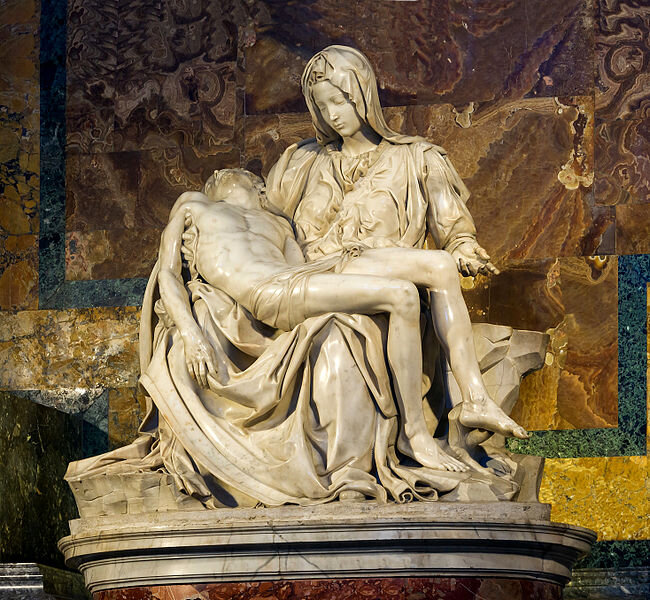
the "Pietà" by Michelangelo, Saint-Peter's Basilica, Vatican City. A magnificent work of art- this was carved out of one block of marble- the folds of her robe look more like cloth than stone.
One image that I think of for the suffering of Christ: death and the (temporary) separation of loved ones. This was Mary’s “Holy Saturday”, the interval before she sees her beloved son again. Any mother who has lost her child…
Day 9: Words and Pictures: Mercy
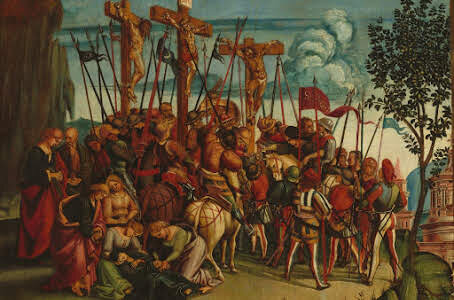
Luca Signorelli, The Crucifixion c. 1504/1505 tempera, oil, and gilding on panel. National Gallery of Art. I like the reminder of the two criminals alongside Christ: which one am I?
Good Friday. The day that is remembered for Christ’s crucification on the cross. His death was the eternal symbol for our death: through His sacrifice we are not sacrificed.
Mercy. In the Christian tradition, mercy means God not giving us what we deserve. As flawed humans due to our freedom of choice for original sin, we broke our relationship with the perfect, sinless God. Because of that, we cannot be in God’s presence: to be in His presence full of our sin would be our death. Our sin causes our death. In essence, we deserve to be on the cross but Jesus intervened for us.
I think all of us know the feeling, to some degree or another, of knowing we have received “a pass”: we know when we really deserved an “F” when we didn’t study; we didn’t get a ticket when we were pulled over for speeding; not being as caring as others seem to think we are. The two criminals condemned to death alongside Christ were going to get what they deserved- physical and spiritual death yet Jesus intervenes, “Assuredly, I say to you, today you will be with Me in paradise’”.
As I reflect on this day, I am grateful that a loving God gave me an eternal “pass”: that He is not giving me what I truly deserve. The two criminals represent how I can be- one in mocking about Christ and one in accepting Him for who He is. God has shown great mercy on me. All I need to do is respond.
Do we offer mercy to others? We might even feel justified yet we choose not to act, do, or say to another what they truly deserve. What does that look like?
Day 8: Words and Pictures: The Last Supper

One of the world’s most famous murals- Leonardo da Vinci, Last Supper, 1498, tempera and oil on plaster (Santa Maria della Grazie, Milan)
Today is Maundy Thursday, the commemoration of Jesus celebrating the Passover feast with His disciples. At the gathering He washes His disciples’ feet in an act of humility and asks that His disciples do likewise. He uses the items from the Seder as new symbols of remembrance: the cup and bread. He also tells them, “A new commandment I give you, that you love one another, just as I have loved you, you also are to love one another.”
It is interesting that in Leonardo da Vinci’s depiction of the last supper, he chooses to draw the scene when Jesus tells the disciples that one of them will betray Him. He also does not add halos to any of their heads. He is letting their human emotion and commonness be viewed.
While I do not believe Leonardo was a theologian (and neither am I), I like the idea that he doesn’t add any sainthood to those seated at the table. While Jesus would certainly deserve the halo and I do believe (while I may not completely understand it) that Jesus is fully man and fully God, Leonardo’s depiction of Jesus without the halo speaks to His human nature: He was resigned to the plans His father had given Him- to be the Savior for the world. As we know from the writings of His time on the Mount of Olives, Jesus did not enter into His death blithely. His human side wanted the cup (symbolism of his death) to pass over Him but He was obedient to the will of God.
While we are not perfect like Christ, we can be obedient to God’s direction of loving one another. Certainly we can get it wrong. All twelve of those depicted there got it wrong at one point or another. Yet Jesus did not hold it against them (da Vinci depicts a serenity on Christ’s face) for He forgives them and loves them even knowing that they will not be obedient at times and will betray Him in large and small ways. It could only be God who could forgive like that. This last supper, this time to impart His final words to His disciples are also words for each one of us. He knows that we will betray Him in large and small ways yet He loves us unconditionally.
On this day, a day of remembrance, what can we learn from Jesus’ behavior? Are we obedient in loving our neighbors, even when we may be frightened about our individual safety? Are we willing to share our resources so that others might live? If you were partaking in your last supper, what words would you impart to your guests? For what would you want to be remembered?

The Tongerlo Last Supper, by Leonardo da Vinci and his studio. Courtesy of the Sheen Center. “Second copy” of his work. While it is thought not to be a true copy, it does give an idea of what the original might have looked like in 1498.
Day 7: Words and Pictures: Faith

Salvadora persica or “Mustard” Tree
Faith. What is faith? Do you have it? What does your faith look like? Is your faith in the government? Faith in health care? Faith in science? Faith in God? Faith in your fellow human? Faith in yourself? Is it growing? Is it faltering?
Faith’s definition: “1) complete trust or confidence in someone or something. 2) strong belief in God or in the doctrines of a religion, based on spiritual apprehension rather than proof.” It comes from Anglo-French feid, from Latin fidēs: trust, confidence.
Faith seems to be a state of mind rather than a position of action. I can have faith that the chair will hold me up but not until I sit in it and physically experience that it will not collapse under my weight, can I be sure and have complete confidence.
With all that we, both individually and as a people, have experienced thus far of the corona virus is a test of our faith. Do we have complete confidence in someone or something? Do we base our faith on spiritual apprehension- understanding or grasp- rather than proof?
Some days I feel that I have the strength to carry the world and at other times, I don’t have enough faith to get out of bed. Where I draw comfort is through the words of Jesus- he reminds his followers that all we need is faith the size of a mustard seed. When asked by his disciples, to increase their faith, the Lord answered, “If you have faith the size of a mustard seed, you can say to this mulberry tree, ‘Be uprooted and planted in the sea,’ and it will obey you.” [Luke 17: 5,6]
A mustard seed is quite small. It is hard to believe that it would amount to anything, yet the mustard tree can grow to about 20 feet. It can germinate quickly. And it has so many properties- can be used for medicine, food, tools, etc. All of those analogies comfort me. They remind me that I do not have to begin on a faith journey with large expectations or plans- wondering about the overall goal or specific plans. I do not even have to worry about the growing conditions. I just have to be willing to put my small seed of faith into the fertile soil of the master gardner.
For me having faith is not so much in an idea or object or human but rather in a being- the divine. If I put whatever size faith I have into the one who has created the world, ideas, objects, people, then I can be assured that it will not be shaken.
And while trust is the action to the idea of faith, faith has to come first. Sometimes we have faith because we have seen the faith of others. Sometimes we have faith because we remember the past and the way things have worked out. And sometimes, we just have to jump right in. The “leap of faith”. There isn’t time to verify. Sometimes there is no rational explanation but just like falling in love, you know that without a shadow of doubt, He is worthy of our
In these times of crisis, I need to remember that all it takes is having faith as small as a mustard seed to get through it.
What about you? How is your faith? Needing to be cultivated? Growing? Spreading?
Tonight my Jewish friends will be celebrating Passover. A time of remembrance of the faithfulness of God.
Day 6: Words and Pictures: Prodigal

The Prodigal Son c. 1669 oil on canvas, 262 x 205 cm. The Hermitage Museum, St Petersburg
Rembrandt van Rijn is one of my favorite painters. In some ways I do not know why- the paintings are quite dark both literally and figuratively (much of his subject matter is somber) yet his expertise in capturing the human condition intrigues me.
Rembrandt’s The Prodigal Son is one that captures the essence of the parable told by Jesus:
“The parable begins with a young man, the younger of two sons, who asks his father to give him his share of the estate. The parable continues by describing how the younger son travels to a distant country and wastes all his money in wild living. When a famine strikes, he becomes desperately poor and is forced to take work as a swineherd. When he reaches the point of envying the pigs he is looking after, he finally comes to his senses:
But when he came to himself he said, "How many hired servants of my father's have bread enough to spare, and I'm dying with hunger! I will get up and go to my father, and will tell him, 'Father, I have sinned against heaven, and in your sight. I am no more worthy to be called your son. Make me as one of your hired servants.'" He arose, and came to his father. But while he was still far off, his father saw him, and was moved with compassion, and ran, and fell on his neck, and kissed him. – Luke 15:17-20.
The son does not even have time to finish his rehearsed speech, since the father calls for his servants to dress him in a fine robe, a ring, and sandals, and slaughter the "fattened calf" for a celebratory meal. The older son, who was at work in the fields, hears the sound of celebration, and is told about the return of his younger brother. He is not impressed, and becomes angry: But he answered his father, "Behold, these many years I have served you, and I never disobeyed a commandment of yours, but you never gave me a goat, that I might celebrate with my friends. But when this, your son, came, who has devoured your living with prostitutes, you killed the fattened calf for him." – Luke 15:29-30.
The parable concludes with the father explaining that because the younger son had returned, in a sense, from the dead, celebration was necessary: "Son, you are always with me, and all that is mine is yours. It was fitting to celebrate and be glad, for this your brother was dead, and is alive; he was lost, and is found.” - Luke 15: 31-32. [excerpt from www.rembrandtpainting.com]
The thing about the story and the painting- I can relate to both the older and younger son. I can see myself as the elder standing aloof in the distance- disgusted by the unfolding of events and seemingly “favoritism” being shown by the father. I would be thinking, “The ingrate. How can he come back, getting more things from the father when he already squandered his inheritance? What about me? All my hard work?”
And I see myself as the younger son- brash, insensitive, cocky, presumptuous- (asking for an inheritance that is disrespectful to the father as this societal action would basically tell the father you are dead to me.) I see myself squandering all that I have been blessed to receive (time,talent and treasure), by not using it for others or for the future. I also can see myself when life bottoms out or becomes too difficult, to come with tail tucked under and hoping upon hope that I could just be near the presence of a stable situation. What I long for but know I do not deserve is to bury my head in the folds of enclosing arms with the whisper of “Welcome home. I have been missing you. All will be okay.”
I am drawn to the father of the story- calm, loving, showing mercy to both sons. While the elder son’s actions over the years were appropriate and “right”, his words underscore his transactional view of the father just like his brother’s. He wasn’t at all thinking of a relationship with his father. He may have not asked for his inheritance early like his younger brother, but he was certainly only going through the motions until his father’s demise. The father doesn’t chide him on that, but lovingly reassures him that he is not forgotten, that all he has is the sons and that he is loved.
The younger son is a long way off when the father runs to meet him. What an image- the parent, sick with years of worry and grief, longing for his son’s return, spies him in the distance. It didn’t matter what happened in the past, it was just a celebration that he returned home.
Today in my reflections, I am thinking of this picture and the word prodigal. Prodigal as an adjective means, “1: characterized by profuse or wasteful expenditure : LAVISH 2: recklessly spendthrift 3: yielding abundantly : LUXURIANT —often used with of”. (merriam-webster.com) I like that, even though it describes one being wasteful and reckless, one can also be luxuriant in one’s actions. This story upends the societal notion of keep your head down and do what is right and you will get the big reward. While that is true, after all the father did not neglect the older son, the story also reminds us that it is never too late to come home. That the father is longing to lavishly celebrate when one of his beloved comes home. Isn’t that the picture of mercy? Provision of abundance when we least expect it?
What about you? Are you the older or younger brother? What experience would cause you to come “home”? Is it hitting rock bottom? Is it a reassurance that you have been loved all along?
[As an aside- Another thing I love about this painting are the father’s hands. If you look closely, they do not appear to be similar. One is more delicate than the other. A feminine looking right hand and a masculine left hand. For me, that represents God- both male and female. God made us in His image, male and female. Each one of us may have masculine and feminine traits which transcends more than gender or sexual traits. We become reflections of God. ]
Day 5: Words and Pictures- Expectations & Expectancy

Expectancy and expectant…
What are your expectations? About your future? Your family? Your self? Your health? Your job? Your life philosophy? The corona virus? I think part of my anxiety of this pandemic is that we do not really know what to expect. Sure, there are predictive models and interpretation of past pandemics or current countries but there is really no set plan or pattern for what the next couple of months, weeks or even days might look like.
They say that much of the stress of holidays, family gatherings or lifetime events is due to false or high expectations. We think: “This Christmas, everyone will be happy with their gifts.” “We will have a family photo and everyone will be in a good mood…” “The weather will be perfect for the outdoor wedding…” We set ourselves up with expectations only to be let down.
As I reflect during Holy Week, I think of the false expectations the people in Jesus’ day had about Him- they wanted a conquering, warrior king to relieve them from the oppression that they were experiencing. Jesus’ reason to coming to earth was broader and more expansive than that: He conquered death and sin for the ultimate relief of oppression. He came so that ALL may experience abundant life both in the present and the future.
If I am honest, I must admit that sometimes I have false expectations of Jesus too. I (falsely) think that if I do the right things, behave in the right way then I will have a life without any struggle- I will remain healthy, financially solvent and all will be well with kith and kin. The thing is, that is not true. Jesus isn’t a genie or fairy godfather. There isn’t a cosmic “if this…, then that…” cause and effect equation. My relationship with Him is not conditional on my good deeds or works.
I wonder if one reason our expectations are disappointing is because rather than understanding the entire word and its definition-hoping or thinking something pleasant will occur, we get stuck on the “expect” part of the word. We expect that when we do certain things (follow the rules, plan to the nth degree, be a “good” person) we are entitled to a struggle-free life. One thing I am learning is that feeling entitled or expecting exactly what I want is a recipe for total disappointment. It produces bitterness, superiority and despair.
I like the word expectancy instead. While expectations and expectancy have similar definitions (the act or state of looking forward or anticipating, the probability that something will occur, the state of thinking or hoping that something, especially something pleasant, will happen or be the case) I think the word expectancy has an emphasis on positive energy- a future, an arms-wide-open life experience that whatever happens, I will embrace and rejoice. It is living into a not-knowing, yet hopeful, anticipated outcome rather than “this is what I want and am disappointed if I don’t receive it” one. (Kind of how dogs live their lives.) It is not that I am suppressing my desires either. Rather, if I align my expectations with what Jesus teaches- compassion, truth, goodness, loving God and loving humankind- and try and live into that with expectancy, then my expectations will be met even in the midst of illness, financial struggle, or insecurity.
It takes faith to let go of the expectations and let the future unfold in alignment with Jesus. I still am going to be smart about my life choices and the way I conduct myself. I just would rather have a future that is totally entwined with expectancy of seeing Jesus work in my life.
In a recent sermon, I heard the following quote: As we don’t know our life expectancy, live your life WITH expectancy. I would hope that when this pandemic ends (and it will eventually), I will look back and realize that I did just that. What about you?
Day 4: Words and Pictures- Holy

Entry of Christ into Jerusalem by Anthony van Dyck
This week is the beginning of Holy Week for Christians around the world. It is also the start of Passover for those of the Jewish tradition. A Holy Week for 2 of the 3 major religions
It has made me think of the word “holy”. Merriam-Webster describes holy as “worthy of complete devotion and trust 2 : DIVINE 3 : set apart to the service of God or a god : SACRED 4 : respected as sacred 5 : COMPLETE, UTTER (holy cow). The Hebrew word for holy is “godesh”: apartness, sacredness, separate while the Greek for holy is similar: “hagios”- pure, morally blameless.
Concepts about which we do not really consider in this modern culture.
But I wonder if we should think about holiness especially this week. What is worthy of our complete devotion and trust? Have you thought about it in light of our current condition? Is science worthy? Possessions? Financial security? Political parties or theories?
What I like about the van Dyck painting is the various expressions on the faces in the crowd: skepticism, awe, disbelief, compliance because everyone else is there. For me, Holy week is a time for me to think of my devotion and to whom I put complete trust. I wonder if I were there over 2,000 years ago, would I have just gone along with everyone else, placed my palm down and raised a hallelujah because everyone else was doing it, or because I truly believed?
This week is called holy and it is a week to be set apart. It is a week of reflection, remembrance and renewal. Maybe you are like me and need a week like this. Time to consider my life, my role in this world and my future. Time to consider my devotion and trust.
What about you? What do you need to remember- about your faith and beliefs? On reflection do you need more information or understanding? What can you do to renew your beliefs? What can you do this week to make it holy?
Day 3: Words and Pictures- Calm

A calm day at one of our favorite dog walking places. Where do you experience a sense of calm?
In light of the emotions that this pandemic have evoked- do you feel calm? Or are you fearful? What is the opposite of fear for you? According to dictionary.com, the antonym of fear is calmness and confidence. In a poll of two (my husband and myself- we are complying to the stay-at-home order), we were saying the opposite of fear could also be trust and courage.
My nephew has spoken about fear in one of his latest sermons and blog posting. #fearstopshere. He likens the contagion of fear to the pandemic and challenges each one of us to stop the spreading of that fear and be the non-anxious presence in your networks. I would say, be the face of calm.
I like the word calm and the picture it evokes in my mind: that of stillness, peace, and tranquility. It reminds me of the little-to-no breezy days of the beach. The days when the water is calm and you can see the sandy bottom- the little minnows, the snails, the hermit crabs and all the water life.
It is only through calmness that we can see clearly. It is only through peace can we promote understanding. It is only through stopping fear that we can trust and be courageous.
What about you? How can you be the calming presence in your community? Do you need to name your fears? Do it. Say them out loud or write them down. Then rip up the paper and say, “I choose to not be fearful. I choose to be the face of calm today.”
Day 2: Words and Pictures- SCULPTURE

The gathering of “lace” about the neckline… Amazing- all one piece of marble.

The thought was that the sculpture was the depiction of the “lady” written by Verrocchio’s benefactor- Lorenzo De’Medici.

Notice the fringe on the bottom…
The above sculptures were on display at the National Gallery of Art in Washington, DC this past fall. My husband, son and I “metroed” in to see the exhibit about Andrea del Verrocchio. I had read about the artist /teacher (his most famous pupil- Leonardo de Vinci) and wanted to see some of his work. What I find so interesting is his talent in making a block of hard, heavy stone appear to be a delicate, translucent piece of fabric. (lace for the lady and the fringe on David’s loincloth) I find that when I know more about the artist, the work, the timeframe in which it was produced, the technique- I enjoy and appreciate the creativity so much more. Usually I am just a Neanderthal when it comes to anything art but I am always willing to learn.
Words and Pictures. What artwork inspires you? What gives you a glimpse into the beautiful and the truth?
What have you learned about creativity during this time of confinement? How have you been creative in the newly thrust upon home-schooling/ keeping my kids occupied mode? While we cannot visit art galleries for now, we can visit them online. Why not take a break from the news and the thoughts about the virus and learn something new?
Click here to escape to an informative video about an Italian artist Verrocchio.
Our truest response to the irrationality of the world is to paint or sing or write, for only in such response do we find truth. Madeleine L'Engle
Day 1: Words and Pictures- Hope

Today I am going to start a 30 day Words and Pictures of Encouragement. It is my intention that we can encourage one another either with words and pictures we have created or ones that inspire us. The thought is that these simple ideas might resonate throughout our day and give us hope.
To live without hope is to cease to live.
~Fyodor Dostoevsky
Hope. It is one of the essential elements to life. Sure, we can have food, water, shelter, clothing. But if we do not have hope, as Dostoevsky noted, it is hard to press on. According to dictionary.com, hope is “a) desire accompanied by expectation of or belief in fulfillment: expectation of fulfillment or success b) someone or something on which hopes are centered c) something desired or hoped for.” Hope inspires, motivates, gives us purpose and focus.
The verb form of hope is also crucial: “to cherish a desire with anticipation : to want something to happen or be true: to desire with expectation of obtainment or fulfillment: to expect with confidence : TRUST.” The act of wanting something, of pondering, of dreaming about a future or situation is also important to keep going. Even more so in this day and time. During this unsettling time, grab onto and hold on tightly to hope: to your future and to your plans.
What quotes about hope do you like? Have you ever given any thought about your hopes? What are they?
“For in this hope we were saved. Now hope that is seen is not hope. For who hopes for what he sees? But if we hope for what we do not see, we wait for it with patience.” (Romans 8: 24-25)
“So we do not lose heart. Though our outer self is wasting away, our inner self is being renewed day by day. For this light momentary affliction is preparing for us an eternal weight of glory beyond all comparison, as we look not to the things that are seen but to the things that are unseen. For the things that are seen are transient, but the things that are unseen are eternal.” ( 2 Corinthians 4: 16-18 )
“Hope” is the thing with feathers –
That perches in the soul –
And sings the tune without the words –
And never stops – at all –
And sweetest – in the Gale – is heard –
And sore must be the storm –
That could abash the little Bird
That kept so many warm –
I’ve heard it in the chillest land –
And on the strangest Sea –
Yet – never – in Extremity,
It asked a crumb – of me.
~Emily Dickinson