
Questioning Change

The other week in the wee hours of the morning, I stumbled upon a podcast/youtube interview with my favorite singer- Amy Grant. Sometimes I feel that I am quoting her a lot. I have always admired her and there is still a little of the younger me who wants to be like her. Well, when I was a kid ( I still have her original debut album- the one with the unpolished photo of her on the cover- wild curly hair and the facial “pudginess” of youth) I identified with her as everyone else who seemed cool had straight blond hair, blue eyes and rail thin faces.
As I have aged, I appreciate her wisdom and her use of her platform to humbly share about community and God’s love.
One of the nuggets that she shared on the interview was (for her) a game-changer journal that she received during Covid: 5 Minute Journal. It is a daily journal with questions for reflection: 3 questions in the morning and 2 in the evening. The same questions for each day, yet all designed to help one become be more intentional and mindful of one’s thoughts and actions throughout the day.
The morning questions:
1) I am grateful for…
2) What would make today great?
3) Daily affirmations. I am….
The evening questions:
4) What 3 amazing things happened today?
5) How could you have made today even better?
I like the evening questions the best. Writing about “amazing things” trains us to realize that amazing doesn’t have to be the awesome, super-duper events. Rather it is the small and ordinary that are truly the remarkable. For when you really think about it- very rarely do HUGE things happen to us on a daily, consistent basis. Sure, there are the births, the deaths, the marriages, the job hirings- the big events of life-but they do not occur every single day. When we realize that daily life is made up of small, seemingly insignificant events, we are more likely to notice them and to keep an eye out for them.
I also like the process of thinking about how the day could have been even better. It is another way of re-framing a reflective question so that we do not beat ourselves up over missed opportunities or conversations. For example, instead of kicking ourselves for not exercising that day, we can re-frame it by responding to the prompt of making the day better -“if I had gone to the gym in the morning”. Writing the plan/idea down, puts those thoughts into our heads so that next time, we will be more likely to complete the task or plan.
This idea of self-questions and reflections has me thinking about the questions and inquiries we ask of others. Perhaps we also need to change our thinking of how we question and interact with one another. I have read and heard from different social media people, news reports and various book authors that we need to ask better questions of one another if we are to begin to understand one another.
I think better questions begin with humility: taking the posture of “what do I need to learn from this person” rather than “what can I do to either impress them with my knowledge or dominate them (which in turn will have then become defensive) through my inquisition”. Then to ask, in some form or other, “what does this (whatever this may be) look like from your vantage point?”
There is also the thought that asking from a different posture can give us a better answer. Think about the questions that children ask: many times the questions appear obvious, but they get to the heart of the matter. They, due to their very nature of being young and inexperienced, ask questions with a natural humility.
The story goes that Edwin Land (founder of Polaroid) was asked by his three-year-old daughter why she couldn’t see the picture he had just taken of her. Why indeed? Her question makes sense in the present world of children because, at that time, waiting for a photo to be developed would be quite a long time. His daughter asked the obvious but simple question and thus the idea of instant photos was born.
What about you? Do you ever ask yourself questions or reflect on your past? What are those questions? Do you journal? What does that look like? Do you always ask the same things of yourself, your family, your acquaintances? Do you get frustrated with the same answers? What questions might you ask to change things up?
I know that I am looking for different questions. I am daily trying to find ways to dwell on truth, goodness, beauty, and things that are lovely, honorable, just and pure (Philippians 4: 8). I think that if we humbly go about our days, asking others and ourselves questions that expand our understanding of one another, we will be able to make tomorrow even better than today.
Personal Signs

Seen on a recent drive…
New Driver. Rookie Driver.
Have you ever seen those bumper stickers on the back of a car? When I see it, I tend to give some space and latitude to the driver. I remember what it was like to be a rookie driver (and my poor patient father, God rest his soul), and I know what it was like to be a parent of rookie drivers. (Was that the beginning of the grey hair?)
Knowing who is driving and what their experience may be, puts me in a more attentive frame of mind when I am out on the road. I will be forgiving of the cautious driving, the slow acceleration or the wide turning ratio. I will give that driver room and time to make the turn or park the car.
I also think of the other type of bumper stickers that can define the driver- the political, social, and educational ones. Through bumper stickers or window stickers, you sometimes can assume a whole story of someone: their family size, occupation, interests, educational background (themselves or their children), for whom they voted, vacation preferences, even their sense of humor. While it can give us a picture of the other driver, those signs still are all assumptions: I assume that because this driver promotes “x”, they will be in my “y” category of people. I may give them latitude and understanding and I may not.
But what if we all had personal bumper stickers explaining our states of mind, our experience, and our internal struggles? Would we be more gracious and forgiving of one another? Would we give others latitude knowing their struggles? Would we give them time to learn?
If only they knew…. “Best friend overdosed.” “Parents drunk, again.” “Spouse left me.” “ First time out of the house in eighteen months. Petrified.” “Feel like a failure.” “ Lost my job.”
If others only knew the thoughts and worries going in our heads, perhaps they would be a little more patient with our cautious-ness, slowness or general poking along the road of life. Short of knowing what others are going through, we just make assumptions that everyone else should just straighten up and fly right.
Instead of putting the onus on others to disclose their story, what if we just treated everyone with universal respect and kindness? A version of “personal protective equipment or universal precautions of pleasantness”, if you will.
Jesus tells His disciples to act towards others as you would want them to behave towards you. The Golden Rule (Matthew 7: 12). I am sure that we all have “stuff” going on in our heads. (Can’t only be me.) When we are bothered by things, isn’t it refreshing to have people around us that give us a little grace when we may forget an appointment? Or latitude for our lateness? Or just a smile when we are feeling blue? Imagine what our world would look like if we gave room and grace to those who are struggling?
We should treat all people as the image bearers of God that they are. Especially those who have experienced and are living into the grace of God. “We should be called the children of God; and so we are.” (1 John 3: 1). We should treat others with compassionate hearts, kindness, humility, meekness and patience. (Colossians 3: 12).
What about you? What would be your personal bumper sticker? Is it one you have worn for a long time? Do you wish it could be removed? Do you find yourself affected by the stickers and logos on another car? How do you respond?
The thing is, I truly believe that with God’s help, we can change those bumper stickers. They can be removed: that rookie driver will become experienced, the addict can be healed, the marriage can be saved, and the broken life can be restored.
In the meantime, wouldn’t it nice to have the leeway and space as we go along, knowing that how we behave and treat others, they in turn offer to us?
Rejoice ?

“Rejoice with those who rejoice; mourn with those who mourn.” (Romans 12:15)
Not too long ago I heard a radio announcer speaking about this verse. She noted that it usually isn’t too hard to mourn with others, but it can be tough to rejoice with others especially when they have received something which you have been wanting and wishing to receive yourself. Touche!
I have been thinking about that comment. Immediately a dear friend came to mind. She has had a tough go of it in life- many disappointments in how things have worked out for her- yet, she can rejoice over another’s good news. I am always in awe of her. I do not think that I am that generous with my emotions. Internally I’m still grumbling and complaining to God, “Why her, not me?” (As much as I think I am getting better and more mature about it, those ugly thoughts still sometimes, overtake my response.) But my friend is genuinely happy for you. I have never asked her how she does it.
My guess is that she doesn’t compare her situation to anyone else’s. She is very comfortable in her skin and she doesn’t worry what other people think. I also think that she is a very grateful person. She is able to see the good in each and every situation and person.
When we pull the focus off ourselves and onto others, we do not have time for comparison, self-pity or ingratitude. We can truly be present with those who mourn and with those who rejoice.
Children have the capacity of joy for themselves and for others. Sure, in the development of little ones, there is the call of “mine” and taking toys from others, but generally they are excited when others are excited. If someone has a birthday, there are just as excited to “help” open the package and see what is inside as the person receiving the present.
Sometimes I wonder, “Why can’t I be like a kid- excited for and thinking only about the present moment? Can I go twenty-four hours without thinking about myself?” Any aspect of myself- whether it is physically (thinking of every ache, pain, itch, or how I look in “getting ready” for the day), mentally (relieving the conversations and reactions of others), or emotionally (thinking that I should’ve handled a situation better). I think of all the wasted time thinking of myself when it could be time better used.
Imagine what our world would look like if everyone spent less time thinking about themselves and more on others.
I think we would be less polarized. Most either/or arguments (the extremes) come down to selfishness: both sides want what they want, when they want it and are inconvenienced (mild reaction) or violent (extreme reaction) when others won’t do what they want or even support what they want. Perhaps in thinking of others, arguments would never get so polarized in the first place because as we first looked into ideas we could see the other side.
I think we would be more empathetic. Thinking about others allows us the room to walk in another’s shoes. We might not choose the path the other person has taken, but we are in a place of better understanding of why they chose what they did and think the way they do.
Jesus’ cousin John recognized that life was not all about him. John spent his entire life talking about Jesus, “the One who was greater than he” and getting others ready and prepared for Jesus’ coming onto the scene. Of course, this was thinking of another person who happened to be Divine. Yet with John putting Jesus before him, John modeled a posture that we should try and emulate: “He must increase, but I must decrease.” (John 3:30).
Becoming more like Jesus and less of ourselves, we will start exhibiting those attributes we all want but have trouble doing: kindness, thoughtfulness, mercy, forgiveness, grace, love and joy. When we start thinking of Jesus and of others, we can mourn when others mourn and we can truly rejoice when they rejoice.
Expectations

Our unexpected, little fun car…
Do you have expectations? Of yourself? Your family? Your employer? The general public? Your government?
I have high expectations of modern cars. With our 2013 SUV I expect it to run and run well. It claims to be the “ultimate driving machine” and I expect it to be so.
Unfortunately, there have been times when the car, namely the onboard computer, decides that it has to change things up a bit and makes all sorts of dings and lights up the dashboard. It is quite unnerving. I expect the modern car to run perfectly each and every time I turn on the ignition. Instead, there are times when I see a yellow light or hear a ding, and my anxiety is heightened. I then expect the car to abandon me on the side of the road. (Why oh why do they have to have the same sound for the fasten seatbelts as for a major engine problem? ) In all fairness to the car, it has never abandoned me, but I would not be surprised if it did.
Conversely we have recently purchased a classic “fun” car. For a forty-three year-old car, it looks great and seems to be in very good working order, yet I expect it to break down or not start each time I get behind the wheel. So I am always pleasantly surprised each time I turn on the ignition and each time I arrive at my destination without problem. I have no expectations of perfection from this vehicle yet it gives me a satisfied pleasure in driving it.
Expectation: a strong belief that something will happen or be the case in the future.
In looking up the psychology of expectation, there is a bevy of information: Piaget’s magical thinking (thinking something will happen will make it happen), feelings of happiness (pinning our hopes of happiness due to the expectation), Law of Attraction ( pseudoscience/philosophy that thinking positive or negative thoughts brings about positive or negative experiences), visualizing outcomes (mentally “seeing” oneself complete a specific task, one is more likely to have that outcome). Interestingly there are also studies about individuals having low expectations for positive outcomes and high expectations for negative. (The psychological definition of pessimism.) There are even studies looking at those individuals who have high expectations for oneself (perfectionism).
Seems to me, all of the studies and analysis are attempts to quantify or understand how we, as humans, try and control our future. If things go according to our expectations, we have in some sense controlled what we thought, planned or did. Yet many times our expectations set us up for feeling of failure or high anxiety especially if things don’t go according to thoughts, plans or actions.
There is an old adage: “expectations are premeditated resentments”. Expectations can set us up for lots of issues. Years ago there was a woman in my Bible study group that used to say “lower the expectations and improve your attitude”, whenever she found herself disappointed with an outcome.
Is it wrong to have expectations? Are we setting ourselves and others up for failure by having them? Or, as I think might be that case, we need balance in our expectations. Every year there is a World Happiness Report. In the World Happiness Report, independent reviewers ask citizens of a multitude of countries, main life evaluation questions: levels of GDP, life expectancy, generosity, social support, freedom, and corruption. For the last four years, the Nordic countries (Finland, Denmark, Norway, Sweden, Iceland) have ranked at the top- meaning they are a happier society than other countries.
My husband jokes that the reason these countries seem to annually score high in the World Happiness Report is that they have low expectations. If weather is one indication of a group’s happiness, the cold, dark winter climate of the northern areas would seem to tip the balance for many of the inhabitants to be unhappy. Yet, the researchers discovered that the individuals most unhappy with weather are those who live in the tropics. I am wondering if that is because those in tropical climes expect better weather all the time and the Nordic citizens are grateful for whatever type of weather they receive.
All joking aside, if we lower expectations we would be happier? I think if we have too low an expectation about life, ourselves and others, we might live into the lowest common denominator. If I don’t expect anything from someone, then that is what I will get- nothing.
I wonder if our response needs to be more middle ground: to not have too high expectations of ourselves, others or the situation yet still retain a feeling of hope for what might be in our futures, the future of others and to belief in ourselves and others. The writer Paul reminds us to “not to think of himself more highly than he ought to think, but to think with sober judgment.” (Romans 12:3) Part of that sober judgment is to be realistic about our expectations: to be grateful for whatever befalls us, to work for what we want to achieve, to be prepared for the worst but hope and pray for the best.
What about you? Do you find yourself with expectations? About what? Are they met? Does it cause anxiety or stress for you? For others in your household or networks?
All this talk of expectations, hopes, dreams, positive and negative thoughts, and perfectionism reminds me that as humans, we have no clue about the future. Only God does. As the wise Hebrew leader wrote, “ “I trust in You, O Lord; I say, You are my God. My future is in Your hands.” (Psalm 31: 14, 15). All the anxiety, expectations, feeling disappointed with the future needs to be turned over to the One who holds the future, our future and our expectations, in His hands.
It is finally HERE! Guideposts’ 2022 All God’s Creatures Devotional. I have six devotionals in this compilation. I had almost forgotten that it was coming out since they work years in advance. To pre-order, click on the link below:
https://www.shopguideposts.org/devotionals/all-gods-creatures/all-gods-creatures-daily-devotions-2022.html?utm_source=promotional-email&utm_medium=email&utm_campaign=prod-pre-sale_annual-agc_half-off_e-1608_aug-7-2021
Sportsmanship

Image from www.olympics.com, Tokyo Gold Medal
Are you a good sport? A poor loser? A gracious winner?
Over the weekend there was an example of good sportsmanship in the men’s high jump at the Tokyo Olympics. Qatar’s Mutaz Essa Barshim and Italy’s Gianmarco Tameri, each of whom cleared 7 feet, 9 1/4 inches asked the officials if they could share the gold medal rather than have a jump-off. In some ways it was definitely a win-win decision for the fellows. (Although if one was super competitive, he might not have wanted to share the podium.)
Both gentleman are good friends having met at a junior meet over ten years ago. They have trained together. They suffered injuries and recovered together. Without a second hesitation, when confronted with the tie, they immediately thought of sharing the podium.
According to Merriam-Webster.com: sportsmanship is conduct (such as fairness, respect for one's opponent, and graciousness in winning or losing) becoming to one participating in a sport.
Diana Abed, Department of Philosophy at TU Dortmund, Germany says that with sportsmanship, there are four elements: fairness, equity, good form and the will to win. These four elements are equally important and not reducible to one another. Yet, the will to win is in systematic conflict with the other three elements. Hence, sportsmanship is not only compromised of these four elements, but also requires that a balance be held between them.
In the case of the two Olympic athletes, did friendship make it easier for them to demonstrate good sportsmanship? Or the fact that they understood each other: the sacrifices and rigors of the sport?
There has been much written about good sportsmanship, especially in teaching it to the younger generation- probably due to the fact that poor sportsmanship abounds both with the players and with the parents. When poor sportsmanship runs amuck, more than just hurt feelings occur- sometimes major injuries.
In our family, I have a nephew who was the victim of poor sportsmanship: a soccer opponent was angry at his team being down a goal. In the midst of a play, my nephew was fouled and tripped to the ground. The opponent cleated him on his face so that my nephew was rushed off the field and had to have a titanium cheekbone to replace his broken one.
When confronted, both player and parent demonstrated anger issues. They didn’t see anything wrong with the extremely aggressive behavior. For them, the risk of injury or causing injury was the cost of playing the game and in winning.
On the BBC website (https://www.bbc.com/sport/37405389) there is a brief article highlighting what they consider eight of the greatest displays of good sportsmanship (as of 2016 when it was written). I like the description from the 1969 Ryder Cup:
At the 1969 Ryder Cup, an event that was dominated by the USA at the time, Britain's Jacklin and American Nicklaus reached the 18th hole all-square with the overall scores tied at 15.5-15.5. It was the final match of the competition and, after Nicklaus holed his putt to make par, Jacklin faced a three-footer to earn the first ever tie in the event. Instead of forcing his rival to take his shot, Nicklaus picked up Jacklin's ball marker and conceded the tie. "I don't think you would have missed that Tony," Nicklaus said, "but I didn't want to give you the chance."
Good sportsmanship translates to more than just sports. It equates to being well-mannered and mature. It requires self-control. Sportsmanship builds character, team work, resilience, respect, discipline, kindness, inclusion, perseverance, humility. It is like all attributes: one display of good sportsmanship begets another. It not only shows respect for your opponent and the game but also for yourself. If you are angry at teammates or frustrated with opponents, then you (and if you have teammates) don’t play your best. One learns lessons by being a good sport: with both wins (humility) and losses (empathy), a person learns perspective in the game and in life. One learns balance.
Sometimes I wonder about the young man who injured my nephew. Where is he today? In looking back, no one recalls the significance of that game. Was it regular season? Tournament play? For that young man, was it worth it to have the blot on his character and record?
There is a sleeper hit on Apple TV- “Ted Lasso”. (Received 20 awards and nominations) It is a television series based on an old television commercial. A corny, mid-westerner coach is hired by a scorned ex-wife, now owner of a UK Football Club determined to ruin the team by hiring a man who knows nothing about European football. What she doesn’t expect is Ted’s positive, nice guy attitude and how he touches the lives of all he meets through his actions and words of wisdom. As Ted says to a cynical reporter, “For me, success is not about the wins and losses. It's about helping these young fellas be the best versions of themselves on and off the field.”
What about you? Do you show the best version of yourself? At work? At play? At home? I feel that sportsmanship is much more than what happens on the field, court, course, or ground. It is all about relationships: how we treat one another and how we want to be treated.
If the two Olympians didn’t know that about sportsmanship before, they certainly do now.
As Knute Rockne, football player and coach at the University of Notre Dame, said, “One man practicing sportsmanship is far better than a hundred teaching it.”
Memorization

How are you at memorization? Can you rattle off any poems? Verses? Quotes?
Upon reflection, I do not think I was ever good at memorization. Certainly the things I do remember now are verses or quotes I learned a long time ago. Anything recent seems to be retained in a sieve- in one ear and out the other.
And so, I found it interesting to hear a news report on the benefit of poetry on our neurological health. Turns out memorizing is not just for tests or for cocktail party anecdotes. It keeps the neurons firing and helps develop areas of one’s brain (even for old codgers).
Part of poetry is that is engages both the control and the default network of our brains. The control area is when we are thinking hard and deeply about a topic, while the default is more of our mind-wandering, thinking about nothing specific or demanding. Apparently, we are not so much either/or in our thinking but more of an “and” in that we use all aspects in a network, intertwined approach.
According to Keith Holyoak writing for MIT press, “suppose you wanted to exercise the parts of your brain that underlie language and thought. And emotion. And music. And that generate internal reward signals. And you wanted to trigger all of these brain regions simultaneously. What would you do?”
He recommends that one picks up a book on poetry and starts reading. Especially reading out loud since much of poetry has a rhythm and pace. Not surprising that hearing it spoken out loud connects with us- we come from an oral tradition of stories. The words that we use generally contain metaphor. It produces in us the ability to be flexible and ponder multiple meanings. That helps us with navigating unpredictable events and in making choices in our lives.
But memorizing what we read and hear is also good for our brains. According to the Cleveland Clinic, Small children reciting nursery rhymes are honing their developing memories and gaining an introduction to language patterns. At the other end of the age spectrum, “Older adults who work their brains through memorization are stimulating neural plasticity, which alters the brain’s neural pathways in response to new experiences,” says Marwan Sabbagh, MD, Director of Cleveland Clinic Lou Ruvo Center for Brain Health. “These functional brain changes occur whenever we acquire new knowledge or learn a new skill, and they appear to be important in warding off cognitive decline.”
It appears that it is easier to memorize words when there is a rhythm, pace and rhyme- think of how easy it is to remember words of a song or a limerick.
What about you? Have you had to memorize anything lately? How is your recall? Anything you wish you had memorized at your fingertips? Do you have a favorite memorized saying?
What if for the rest of the summer, we challenge ourselves to memorize something: a poem, a Bible verse, a speech? What would you memorize?
Ideas:
Ogden Nash-poems
Shel Silverstein-poems
William Shakespeare-sonnets
Bible- Proverbs, Psalms
Presidential speeches- Gettysburg Address, Theodore Roosevelt’s The Man in the Arena
Lines from a favorite author
Quotes on various subjects (ex. perseverance, encouragement, inspirational) by various authors
Words to a favorite song or hymn.
Memorize with the little people in your life- nursery rhyme or Bible verse
Challenge those in your household to memorize a poem. Tack the verse to your fridge as a reminder.
Instagram Envy

When you see pictures on Instagram or Facebook, do they inspire you? Depress you? Annoy you?
Recently it occurred to me that what I enjoy about the few Instagram accounts that I visit, is that the posts are of items that do not seem to have much angst in their postings. Meaning, most of the things I like to view are either gardening or interior decorations. There is a visual peace and tranquil quality about the postings.
Of course I am not naive in my thinking. I know or can correctly assume that the neat and trimmed bushes of a side garden most likely have a wild, overgrown section off-camera. Or that the tidy, beautiful and perfectly placed decor belies the clothing strewn, piled papers, toys galore, and animal debris in areas behind the snapshot.
Instead of seeing those photos and thinking it is all a hoax- the “highlight reels” of one’s life and it is all fake- it gives me hope. Hope in the sense that for a brief period of time or in a selected physical section, we all can have peace and tranquility. Makes me look at my surroundings differently: If I look at a selected area of my life or my physical surroundings would I see peace and tranquility? Would I experience a pleasant aesthetic?
If I looked at my family and friends in a Facebook snapshot, what would I see? Would I catch their kindness? Their grace? The small conversations of encouragement? Would I witness their highlight reel and applaud and encourage them?
It is not so much that people are faking their entries, but rather using these snapshots to either escape their reality for a little bit or to try and put a positive spin on what is actually happening. In some ways, that is not such a bad thing. “Act as if…”
If we humbly approach our “highlight reels” and our snapshots, will we begin to have that peace and tranquility spill over into other areas of our lives?
For me, the gardening accounts inspire me and validate that my attempts at gardening are not that bad. I am more relaxed with my own garden or lack of gardening. I think, “Well heck, if she is attempting something new and different and sometimes it works out, sometimes not, I can too.” It is all about my attitude. Rather than feeling defensive or covetous about what I do not have, I can look at my surroundings and see what I do have.
I find that attitude adjustment also helps in the realms of those who have the “perfect” travel, home, family situation. We know that is not true. Everyone has something but if we can look at our issues with a more selective lens perhaps we would not be so depressed that everyone else seems to have it all. We would see the glimmers of hope in our own situations?
What about you? Do you follow many Instagram or Facebook accounts? What attracts you to them? What inspires you?
While it is hard not to compare and contrast, I think social media can be used for societal betterment when it is used judiciously. Certainly, we need to learn to just turn it off especially when focusing too much on what others are doing or if we find ourselves envious of another’s lifestyle. But there is a community of encouragement that can be formed. We just have to be discerning in our viewing and in our attitudes.
Depth
I heard the musician Mike Donehey talking about this new song, All Together. He said that many times while we may feel comfortable sharing our testimonies of past struggles we hesitate to share what we are currently going through. I thought that was an interesting observation.
The hesitancy to not share the current struggle is, I think, due to a fear of being vulnerable: exposed, unguarded, susceptible, unsafe, weak, accessible, defenseless, tender, wide-open. When we share our past struggles, there is an implication just by being “in the past” that those struggles do not plague us now, that we have learned, moved on or have become stronger. Admitting current struggles puts us squarely in the bulls-eye of vulnerability.
While there is a risk involved in sharing one’s issues, there is special bond between people when we do share with one another. I think of recovering addicts and those in a twelve-step program.
While I am not personally knowledgeable about the addiction community, from what I hear from friends and family who struggle and attend meetings is that the community is incredibly honest about their current struggles. Part of the whole point in the daily/weekly meeting is having accountability and recognizing that every day, sometimes every minute is a fight and the addiction is never once and done. There are no past testimonies only current ones.
“Cracks are where the lights get in…”
I love this line from the song. What a great image. I envision cracks in the sidewalk. A small opening that becomes wider, filling with dirt and debris, followed by a stray seed blowing into the opening. Water and sunlight mix and suddenly, a lone plant emerges. The jagged thin line of the broken cement can be the beginning of growth. Sometimes I think the most thriving plants grow and develop in the cracks of my front sidewalk.
I sometimes forget the importance of sharing with one another. Of course, there is a time and place to share. No one wants to be an Eeyore for every problem, but there are times when sharing about our difficult situations can help others. For in sharing, others realize that they are not alone and that if someone else can manage in similar circumstances, then perhaps they can too.
Years ago I shared with an acquaintance how I had struggled with depression due to a very stressful work situation. I explained how I did not handle the situation in the best way and was able to share my lessons learned. Whether that ultimately helped the individual, I will never know, but I think it did create some closeness that otherwise would never have occurred.
What about you? Do you try and hold it all together? Have you ever shared your struggles? Not just past, but present? What happened?
There is a risk in sharing about ourselves. I have felt the pain in sharing and having my feelings not well-received or nurtured. It stings one’s pride and makes one want to retreat into a little turtle shell. “Laugh and others will laugh with you. Cry and others will laugh at you.” was a maxim that I heard when I was little. From an early age I was taught to not share too much. Don’t be vulnerable because you most likely will get hurt.
As I have aged I have thought a lot about those sayings. While I struggle with sharing “my true self” and the ups and downs, I would rather be authentic in my life- which includes struggles. There is a line from a song Vince Gill sings about his wife Amy Grant. In it he says she likes the color black because without it there would be no depth. I think our sharing our current struggle, the darkness in our lives, brings depth into our relationships and light shines brighter in the darkness.
2021 Summer Reading List
Read any good books lately?
I have a stack of half-read books on my bedside table as well as scattered around my office. In fact, I had to re-shelf some of the books for I was tired of seeing the towering spines. I thought if I removed some I would be more motivated to finish reading those that were left.
Alas, that did not happen. I still have a stack with bookmarks dangling out of the pages. I just cannot seem to get back into the swing of reading them. And so, I am wondering if I need to find some other books to read?
Joyce Carol Oates suggests that individuals should have a systematic reading schedule. Sure, you can spontaneous pick up a book that appeals to you but she suggests that one should plan out one’s reading and immerse oneself in an author’s body of work. I have never really done that except for books that are part of a series. I have loved Jacqueline Winspear’s Maisie Dobbs books. Her latest one , The Consequences of Fear, has recently been released. I devoured it in two sittings, pushing my book stack aside.
Short of reading all the works of an author, I think I might try working through some book lists because I like variety. Many local libraries have reading suggestions especially during summer. Various universities and schools do as well.
One thing I want to try is to read more poetry. Listening to Joanna Lumley read some of her favorite poems is enough to want to get anyone back into English class.
What is on your reading list? Do you have one? Or just a stack of half-read books on your nightstand? I have read different accounts on how to increase one’s reading time:
Read 52 books a year (1 book/week). A person can do that by reading 10 minutes at breakfast, 10 minutes around lunch and 20 minutes before bedtime. (according to a former Oxford Univ. grad who has a website that gives you all the info you need to have a comparable Oxford education without the expense that he shelled out- For a nominal fee of course!) Reading this way does depend on the length of the book and how fast a reader one is. There is another website that has guidelines for the types of weekly books- for example, the first week- read something set in a school. https://www.the52book.club/challenges/2021-reading-challenge/
Read for 1 hour before bedtime each night. My problem with that is by the time I am ready for bed, I am exhausted and I only can read a couple of paragraphs before I feel the weight of the book slipping out of my hands (and sometimes hitting me in the face).
Have a book with you at all times. Read whenever you have to wait- in the doctor’s office, commuting, curbside delivery, etc. John Adams once said that one is never lonely with a poet in one’s pocket. A fictional book would also suffice.
If it has been forever since you read any books- aim for reading one book this summer or two or five?
If your child has a summer reading list- read alongside with him or her.
Check out your local independent bookseller. Book tours are returning and hearing an author read her work may give you an idea for some future reads.
Links to various reading lists:
www.goodreads.com has a variety of book lists- just need to enter a category or look up summer reading.
https://www.ala.org/alsc/publications-resources/book-lists/2021-summer-reading-list
https://www.nytimes.com/interactive/2021/books/summer-reading.html
https://zsr.wfu.edu/2020/book-recommendations-from-our-summer-reading-social/
https://www.theguardian.com/books/2015/aug/17/the-100-best-novels-written-in-english-the-full-list
https://www.oxfordscholastica.com/blog/classic-books-everyone-should-read/
https://oxbridgeapplications.com/resources_category/reading-lists/
https://www.english.upenn.edu/graduate/requirements-rules-procedures/first-year-oral-exam/50-book-list
https://www.goodreads.com/list/show/18337.Timeless_Classics_of_the_Christian_Faith
Heirs to the Kingdom

Recently in our church small group we were studying Galatians (in the NT). The book is part of Paul’s letters to the newly formed church in Galatia. Paul wrote letters to encourage, admonish and connect to the churches that he formed along his journeys. Part of the Galatian letter talks about feeling the sense of freedom through Christ. Freedom which comes from being heirs to the kingdom. Which begs the application question to today- do we? Because we have a relationship with the God of creation, do we feel that we belong? That we are heirs? If we do, how is that expressed?
It makes me think of an episode from an old British series, Monarch of the Glen. Archie, the reluctant second-son, now heir of the manor, due to the death of his older brother, returns home to help keep the estate from collapsing under debt and financial responsibilities. Most episodes in the seven seasons consist of another overly dramatic scheme to thwart another financial disaster of losing the estate. Add eccentric but lovable characters set in the most spectacular area in Scotland and it is a recipe for mind-numbing, good ole fashioned entertainment.
In this one particular episode, Archie returns home and his parents spring on him that the next morning, he is to run in a local hill race in which the laird always competes. In addition, he is to wear the most ridiculous hat- an overstuffed tam o’shanter plaid. He just plops it on his head and away he runs. What I like about the character and the actor’s portrayal is that there is such confidence and self-awareness of who he is, where he belongs, what is his purpose and who is his family. There is no self-conscious awkwardness in his manner and certainly not in this running exchange.
If I truly believed I was free in Christ, would I also truly believe that I am an heir? Would I have such confidence and self-awareness that I would know who I am, where I belong, what is my purpose and who is my family? Would I then be content?
I wrote the other week about the concept of “enough”and generosity. I also think being content is knowing that we have enough. Or that we are satisfied with enough.
Recently, I discovered an article about contentment versus happiness. The author is a researcher and had been looking at numerous world cultures and their various emotional states. He discovered one of the last remaining, un-contacted cultures in Nepal, and asked them the same questions that he asked other people groups. In general, the Nepalese group had similar emotional reactions to the survey questions as other groups, but one thing stymied them- contentment. For their definition was slightly different from others. For them, contentment is not happiness, but rather the “knowledge of enough”: “It basically means that right here, right now, everything is perfect as it is, regardless of what you are experiencing outside.”*
What about you? Are you content? Are you confident? What gives you confidence? Power? Position? Your knowledge of God? Do you have an knowledge of enough?
Contentment is being confident. Not in a cocky kind of way, but rather a “I don’t have to prove anything” kind of way. If, because I am already an heir with the Creator of the world, then there is nothing to prove. I can be settled in what is happening around me, right here, right now. I can be present. I can run the race of life and not be concerned even if I have a stupid hat on my head.
* https://greatergood.berkeley.edu/article/item/what_if_you_pursued_contentment_rather_than_happiness
‘Tis a Gift To Be Simple…
It happens every year.
I try to stop but I just cannot help myself.
Every year when I start gardening, I begin to plan, add and change things.
Every year when I am in the middle of the project or having to weed, I think, “Why didn’t I keep this simple?” Too much to care for. Too much to tidy up. Just too much. As someone commented when visiting our home, “It’s a jungle out there.” And she is right.
I love a simple small garden. Yet I have a hard time editing (aka culling out) all that grows. Which is another way of saying that I am a plant hoarder. Probably stems from my experience with our first home which had poor soil conditions (large black walnut trees and Norway maples) so nothing grew. When we first moved to this home and I discovered that plants grew- I was astounded. Still am. I feel a moral imperative to keep things growing and thriving.
With all the volunteer simplicity that we have read, espoused and practiced over the years, one would think I would get it. - Keep things simple and it is so much easier to maintain as well as to enjoy.
It is true: when I do sort things out and keep things simple, I am so pleased with the result.
Case in point- This spring I thoroughly and ruthlessly cleared out our hall linen closet. I found old medicine bottles and lotions that needed to be tossed. I had quite a collection of “not quite” finished bottles of all sorts of sundries. There were ratty towels that I kept on the bottom of the stack. “Just in case”. In case of what, I asked myself? For having so many house guests that I could not offer my best?
I sorted, consolidated and threw out. I was able to remove other items from another closet and so our medical and toiletries supplies are each in their own space along with the linens neatly arranged in the original “linen” closet. (Hence the name.)
Now, every time I need a fresh towel or linens, I can easily see and collect what I need. When I need another bar of soap, I can easily obtain from our shelves. Not rocket science, but you would think that I had invented sliced bread I am so pleased with the results.
I think of simplicity as I think about my “re-entry” into a post-Covid world. The introvert in me is not quite done with isolation and quarantine. I am feeling anxious and greedy to stay in my little world. I have enjoyed the simple days of tending to myself and immediate family. But, I wonder if I can keep my “simple” schedule when life is getting geared up with increasingly demanding responsibilities. How do I not over commit and cram my days? How do I structure my days so that I feel unhurried yet purposeful. Like my overgrown yard, how can I not have a jungle of a schedule and a more simple garden plan?
Can I translate the lessons learned during Covid into my current situation? Can I edit my schedule so that is remains “simple”?
For me it also plays out in simple thinking. Simple in the “uncomplicated, presenting no difficulty” mode. I am thinking about culling out and editing my thoughts and actions. You know- those “do these 10 steps to a better you” kind of lists. The kind of lists that tells you that you should have only these couple of items in your wardrobe; only a couple of those in your kitchen and bathroom medicine cabinet; you need only to practice these exercises for a flatter stomach; you should do only this (whatever this is) everyday; make your gratitude list; say your prayers; call your mother; keep up with your closest friends; do only the top three to-do things on your work list, moisturize, floss, change the furnace filter monthly, etc. The perpetual list of what one should do in a day takes more than a day to complete. Whew!
All that thinking is way too complicated and needs a professional scheduler. No wonder why people have anxiety.
I know that I am guilty of even suggesting some simple things to try each day on this blog. It is offered not to confound you but in the hope to give other options as you figure out how to simply live each day. And to do so, well - simply.
I have decided to try and keep things simple: in word, thought and deed. As I think about my time and as I begin to respond to scheduling requests, I want to keep the “uncomplicated, presenting no difficulty” kind of simplicity foremost in my mind and how my schedule will enfold.
What about you? Did you keep things “simple” during Covid? How did that go? If so, what did you glean from that experience? Are you having Post-Covid re-entry concerns? What are they? Do you need to do some culling out and editing your thoughts? Schedule? Responsibilities?
One of the reasons it is nice to have a little get-away house is that each time I go there, I have an opportunity to practice a mini-vacation. For me, vacation means tidying up all things in our house so that when I return- all is ready to begin afresh. It is a chance to simply begin.
‘Tis The Gift To Be Simple Lyrics
‘Tis the gift to be simple, ’tis the gift to be free
‘Tis the gift to come down where we ought to be,
And when we find ourselves in the place just right,
‘Twill be in the valley of love and delight.
When true simplicity is gain’d,
To bow and to bend we shan’t be asham’d,
To turn, turn will be our delight,
Till by turning, turning we come ’round right.
‘Tis the gift to be loved and that love to return,
‘Tis the gift to be taught and a richer gift to learn,
And when we expect of others what we try to live each day,
Then we’ll all live together and learn to say,
(refrain)
‘Tis the gift to have friends and a true friend to be,
‘Tis the gift to think of others not to only think of “me”,
And when we hear what others really think and really feel,
Then we’ll all live together with a love that is real.
(refrain)
The Power of Vulnerability
I do not believe politicians. It doesn’t matter their party or particular political leanings. I know enough politicians to know that for the majority of them, it is hard to believe all that they say. They are the ultimate great actors- they can spin and say whatever they feel the audience at the time wants to hear.
But. I do like what I have seen of Joe Biden’s character. He truly seems empathetic to others, especially those who are grieving. I am always impressed with any highly visible personality/celebrity/politician who helps others not for any immediate photo op but seemingly altruistically and for the benefit of the other person. It is only after the fact does their good deed/word get in the news and sometimes only because someone has leaked it.
President Biden has been known to call and receive calls from individuals who have lost a loved one. He has also reached out to young people who have speech impediments, namely stuttering. Two areas of his life in which he suffered and was vulnerable.
I think of him meeting with Queen Elizabeth this past week. I imagine there will be some soul sharing regarding losing a spouse. Grief is grief regardless of the stage and age of the bereaved. I wonder how many individuals President Biden has connected to over the years due to his being drawn to those who are exposed to grief?
It reminds me that being vulnerable is what draws us together. There are people who I know who seem to have it all in order. While I enjoy being with them, it is only when they shared tough times or difficulties that I became closer to them. It is then that they are more relatable. We have more in common through our difficulties than our strengths.
Researcher Dr. Brene Brown has an interesting TED talk on the subject of vulnerability. It may be “old” but it is applicable to today. (See the above video)
As she states, “The data about being vulnerable leads to whole-hearted living.” She talks about courage, compassion and connection and how vulnerability leads to these strong emotions.
I think of the Apostle Paul and his statement, “for when I am made weak, then I am strong.” It is only through our weaknesses that true authenticity occurs and makes room for growth. At the end of the TED talk, Dr. Brown says this:
This is what I have found: To let ourselves be seen, deeply seen, vulnerably seen ... to love with our whole hearts, even though there's no guarantee -- and that's really hard, and I can tell you as a parent, that's excruciatingly difficult -- to practice gratitude and joy in those moments of terror, when we're wondering, "Can I love you this much? Can I believe in this this passionately? Can I be this fierce about this?" just to be able to stop and, instead of catastrophizing what might happen, to say, "I'm just so grateful, because to feel this vulnerable means I'm alive." And the last, which I think is probably the most important, is to believe that we're enough. Because when we work from a place, I believe, that says, "I'm enough" ... then we stop screaming and start listening, we're kinder and gentler to the people around us, and we're kinder and gentler to ourselves.
What about you? In recent months we have talked about a sense of belonging, of having enough, of sharing, of being grateful, of connection. Are you willing to be vulnerable? What does that look like for you? What steps are you willing to take to begin whole-hearted living?
I love the title of Dr. Brown’s talk- The Power of Vulnerability because there is Truth to that expression. While the world may say might makes right, Jesus declared that the meek inherit the earth. For there is strength through an honest and authentic declaration of weakness.
Below, view the follow-up to her vulnerability talk:
Enough

Incredible that the photographer could find just one cicada. At our home, there are more than enough.
What is enough for you? “Enough-A quantity that satisfies”? Enough money? Enough material things? Clothes? Cars? Enough friends?
What does is mean to be generous? “Generous-Ample, abundant, not stingy”. Can one be generous only when one has enough?
Is being generous the same as sharing? “Share- to divide and distribute in portions.”
My nephew tells the story of when he was visiting an under-developed nation. He was being shown around to different mission projects by one of the local pastors and a guide. Andrew had been advised to bring snacks along with him during the day as the availability of food, namely food that would agree with a westerner's stomach, was slim.
He brought out his little baggy of pretzels and was going to eat. He turned to the local pastor to see if the gentleman would want any. The man had never had pretzels. He was as poor as the people they were visiting.
My nephew goes on to say that without a moment’s hesitation the local pastor turned to the guide traveling with them and immediately offered him some pretzels.
As Andrew commented, what a testimony of generosity from someone who did not have much. Certainly from someone who didn’t have “enough”. The man’s first thought was to share, to divide and distribute his portion.
When I look at the natural world I see a system that is designed for sharing and generosity. Oh sure, there is the survival of the fittest and the “dog eat dog” world. The animal kingdom can be quite brutal. But I am thinking more of the plants and the growing world that sustains us. Take my marigolds- one little flower contains dozens of seeds. I saved some from last year and am now seeing the growth of multiple flowers. My hydrangeas are bursting with blooms just beckoning to be shared.
Currently we are living in the epicenter of the Cicada “invasion”. It is an unbelievable testament to the mystery of God’s incredible design. These strange, alien-looking critters only come to the surface every seventeen years and are short-lived. Their sole purpose is to continue the cicada line by surfacing, mating and then dying. The next generation lives and grows in the earth until the next seventeen years and the cycle begins again. Why we may ask? Who knows? But these critters aerate the soil, provide an abundant food source for birds and the like, and their composting bodies provide organic matter. Their abundance and “generosity” in the natural world provides more than enough. Supposedly there are 1.4 million cicadas per acre. If you lived at our home you would believe it- the sound of all of them vying for mates is deafening.
When I see the natural abundance around me I realize that with God, there is always enough. Perhaps that is what that local pastor knew when he shared his pretzels with his fellow guide.
What about you? What is your take on “enough” and sharing? Do you know people who are extremely generous? Time? Talent? Resources? Those whose first thought is to share?
My prayer is that when I turn to those around me, may my first reaction be to share. After all, with God, there is always enough.
National Memorial Day

“Did you have a nice Memorial Day weekend?” Isn’t that what people ask after the three-day federal holiday. The unofficial start of summer.
Although now, three days post- do you remember what you did this weekend? Or are you onto thinking about the upcoming one?
I’ve been thinking about freedom. I realize that I take freedom for granted. Unfortunately I always have and ashamedly, probably always will. Much as I would hope that I have an affinity for those in the military and their families, I probably think of them and the meaning of their service as I do the Memorial day holiday- infrequently.
It has been during these last pandemic fourteen months that any type of freedom has hit home. Because of lock-down, there wasn’t the freedom of movement that we once enjoyed. There were limitations to supplies and services. There were altered schedules. There was an assault/question (depending on one’s leanings) to the process of democracy. There were even long lines to get into grocery stores! All types of societal behavior to which we are unaccustomed. No more was there the instant gratification of impulse, “Let’s go here and do this or purchase that,” whenever we felt like it.
We are used to coming and going as we please. We are used to all the supplies and services that we can afford. We are used to freedom: in our thoughts, in our expressions, in our actions and in our speech.
Do we ever think how we can be so free?
I am in awe of the military men and women who exhibit incredible courage, judgement, and skill to put their lives on the line for the rest of us- who provide the means for us to be free while ironically do not have much freedom during their active service (military precision, being “one” unit, following orders).
Over the holiday, our family watched the Tom Hanks WWII movie, Greyhound. While it is a fictional tale (no real Captain Krause) it is historically accurate to the setting of the Battle of the Atlantic. The movie tells of the harrowing hours of “the black pit” when supply convoys to the Allies from the US are vulnerable to attack from German U-boats. Convoys traversed the Atlantic Ocean to provide aide to the allies during WWII. At both ends of the journey the convoy receives air coverage to spot and eliminate German U-boats. However there is a time (sixty hours) in the “middle” of the journey when the convoy does not have air coverage and they are vulnerable to attack. There are destroyer ships that patrol and try and protect the convoy but as is with all war, once bombs and torpedos begin moving, things get very confusing for all parties.
At one point, the captain of the destroyer, played by Tom Hanks is very troubled and discouraged by the loss of lives from one of the convoy ships. He had a choice to help the ship and possibly eliminate the enemy or stop and get survivors. He chose the survivors. He voices his regret on not making better decisions because the choices and options he has going forward is now limited. He (Captain Krause) says, “I wouldn’t need to take this risk if I’d been smarter yesterday.” To which his Lieutenant Commander Cole says, “What you did yesterday got us to today.”
While I know this post is “late”, it was done so deliberately: we should never forget those who have served and sacrificed. They are the ones who have gotten us to today. Memorial Day 2021 may be over, but our freedoms live on each day.
May we never forget.
May we think of freedom, not as the right to do as we please, but as the opportunity to do what is right. Peter Marshall
Freedom is the sure possession of those alone who have the courage to defend it. Pericles
A Dream Deferred

The first of many contributing devotionals through the Guideposts organization. Strength & Grace: https://www.shopguideposts.org/magazines/strength-and-grace-magazine.html.


Recently a friend of mine who has known me almost my entire adult life said that he felt the “old me” was back. He recognized that I had had some trying times the last couple of years and that at our last meeting he felt that I was back as the person of yore.
On one hand I felt honored that he cared enough to say something and that he recognized my distress over the years. On the other, I was embarrassed to think that perhaps I didn’t exhibit as much “grace under pressure” as I had hoped or thought I had over those years. Yikes!
But the more I thought about it, I realized that my return to the “old me” was due to resurrecting a dream deferred. Laying aside a dream is kind of like checking a coat: When you cannot keep a coat with you- whether visiting a museum, theater or dinner, you turn it in to an attendant who hangs it up on a numbered hanger. In return you get a chit or piece of paper with an identifying corresponding number or letter on it. Your items are carefully stored and watched and when you are done with whatever you are doing, you turn in your chit for your respective item. You don’t have to worry about your checked items. They are being attended to by the attendant.
For a good number of years, I had to lay aside my writing plans in order to attend to the needs of others. At the time I felt that I had thrown away those plans and the thought crushed my soul. I was internally angry, upset and disappointed. It was especially hard because I thought that writing was my “calling” and God’s plan for my life. I was doubting whether I had “heard” correctly?
I hadn’t gotten it “wrong”, I just had to wait. In essence I was just checking the dreams: they were still there. I just had to delay until the time was right for me to collect them.
My hopes and dreams were put on a shelf for a little while. At the time I thought they were completely dried up and the thought did make my heart sick. I didn’t think that many people noticed but my friend must’ve recognized something. When we are disappointed with life we do have a tendency to change our demeanor. I just wished that I had realized that even though the dream was deferred, it was still there. God was carefully storing and watching over them. If I had realized that, I would’ve appreciated that deferred time better. I wouldn’t have wasted energy kicking, screaming and behaving badly before God. In essence, I would’ve enjoyed the meal and not worried about my checked coat.
The thing is, the experiences that I had while my dreams were “sitting” have aided me in what I am doing now. In truth, nothing is wasted in God’s economy. Even our disappointments can be used for good. I realized that my feeling “heart sick” was not necessarily the delayed dream but the feeling of hopelessness that it wouldn’t happen. When hope seems lost there is despair and anger. I was mad at God. I couldn’t understand why He would put the creative desire in my soul to just let me languish. That is what I got “wrong”: God’s timing. It wasn’t that the dream was gone but that it was to be deferred. God’s timing was different than mine and so much better.
What about you? Have you had to defer a dream? How did that make you feel? How long did you have it deferred? Did the dream change while you were waiting?
While the Bible speaks to what happens without hope (“Hope deferred makes the heart sick.” Proverbs 13:12), it also speaks to waiting: “But those who wait on the Lord will renew their strength; they shall mount up with wings like eagles; they shall run and never be weary; they shall walk and not faint.” (Isaiah 40:31). In some translations the word “hope” is used for “wait”.
Recently I discovered that the play “A Raisin in the Sun” by Lorraine Hansberry got its title from the Langston Hughes poem, Harlem. While I agree with the descriptions of what it feels like to have a dream deferred, I would also want to encourage him to hold on- that even in a deferred dream there is hope. There is always hope.
Harlem by Langston Hughes:
What happens to a dream deferred?
Does it dry up
like a raisin in the sun?
Or fester like a sore—
And then run?
Does it stink like rotten meat?
Or crust and sugar over—
like a syrupy sweet?
Maybe it just sags
like a heavy load.
Or does it explode?
Mental Health Month
You are amazing. You are unique. You are brave. You are strong. You are loved.
Such were the sayings on the signs around the grounds of the psychiatric hospital as I biked through to get to the adjacent hospital and my doctor’s office for my annual check-up. It made me think of how universal the feeling of being loved, in essence, belonging is to us as humans. On one hand we want to be exclusive. Unique. Original. One of a kind. Yet, on the other hand we want the inclusion of being part of a tribe. To be like everyone else- part of a group. To belong. To be loved.
What I have found interesting as I age- it does not matter the age of an individual and this sense of belonging/not belonging. I know young children who are very comfortable with who they are and where they belong. I also know elderly people, who until they take their dying breath still feel inadequate and an outsider- even within their own family.
This month is mental health month. Mental health has always been important but it seems as if we are recognizing the importance more than ever as we all have been through the mental challenges of a pandemic: isolation, disruption of lifestyle, the economy, personal plans, and societal norms. While each person has experienced the pandemic in their individual way, we (humankind) have all had a similar experience.
There seems to be more awareness of recognizing that this past year has been tough on all of us and naming the emotions/feelings that we experienced. For many, dealing with the situational changes that stemmed from the pandemic, we were not equipped with tools in our toolbox. Perhaps we learned that we held our schedules, our loved ones, our very lives, too tightly. Maybe we recognized that we are anxious and angry for no apparent reason. Perhaps the pandemic awakened in us the need for self-care but were ineffective in implementing it.
The organization, Mental Health America has all sorts of tools and resources at their website: https://mhanational.org/mental-health-month You can download the entire toolkit or the bits that you find appropriate. There are practical ideas on all sorts of emotions and feelings. In addition there are worksheets for processing trauma and stress, managing frustration and anger, practicing radical acceptance, dealing with the worst-case scenario, dealing with change, prioritizing self-care.
I think that God gives us these tools, whether it is through medical awareness or the sciences to guide us in our life journey. Most times we do not have the tools handed to us but we need to find them through others and through their experience.
Once again, the introvert in me needs to recognize that God has called us into community. We need each other-whether that is to share information and resources, bear one another’s burdens or to give and/or receive help in our (collective) time of need. We are not alone even though we may feel alone at times.
The paradox of God is that we are both- alone yet part of a greater collective; similar in our humanity yet individually unique; weak yet stronger than we think; ordinary in our daily existence yet extraordinary to God- down to His knowledge of the very hairs on our head. After all, for anyone who has “created” something- you remember and care about every essence of that creation. So too, does God remember, care, know and love every essence of our being.
What about you? How has your mental health been this past year? Do you need to gather new tools for your life’s toolbox? What emotions have you experienced? Do they have a name? Have you ever said affirmations to yourself? What were (are) they?
The thing about the positive affirmations that I read at the mental hospital and that Mental Health America describes: They are the exact affirmations God is saying to His children every day.
Knots

Monkey’s Paw. A useful and beautiful doorstop.
Recently I was doing my spring cleaning. Part of it entails washing windows and curtains. I had some valences in my office that I had added some seashells to dangle along with the fabric. The shells were attached to the tab hangers by a thin filament thread. As I hand wash the curtains I thought that I did not need to remove the filament nor the shells.
As I should’ve realized if I thought ahead, the thread would get completely tangled. And it did. I tried many different ways to untangle but to no avail. I eventually had to cut all the threads and remove the shells. Actually, I now like the look better without the seashells.
As I was working through the knots I thought what a good analogy about life: we will encounter tangles and knots in our lives. Many times they come upon us unaware. Or they happen due to our lack of thought. There are many types of techniques to untangle knots as well as ways to handle difficult life situations. Regardless of how we do it, we must be patient as we work out our entanglements.
Sometimes we need to calmly lay the knot out and back track the way it was woven. Other times we need to walk away from the knot, take a break and come back later when we are refreshed. When I was younger and I encountered a knot, I would ask my mother to help me. She was very patient in pulling the threads apart and trying to see the pattern of the entanglement. Sometimes we would have to get a needle or something slender to push through the knot in order to help loosen it. At the last resort, we might have to just “cut out the bloomin’ threads” and start again.
When I have encountered difficulty, I can start panicking and thinking that my situation will never get better. I can feel the tightening of anxiety and the grip of hopelessness. I need to remember that if I calmly look at the problem, I may be able to backtrack to where things began. Or I could ask for help from someone more experienced with the situation. I might need a tool or technique to help me handle the problem. At other times, I may need to cut my losses and get rid of the problem so that I can go forward.
What about you? What are some knots in your life? Are they getting tighter? What can you do to loosen them? Need to back off? Retreat? Ask for assistance? Learn some strategies? Cut the tangle out?
The thing about knots- they can be quite lovely. We have a couple of how-to books on knot tying. Most of the knots are tied for some type of practical purpose- hauling, supporting or attaching, But sometimes the knots are purely decorative. While the monkey’s paws (picture above) was originally intended to be the weight at the end of a line so that it would be easier to toss, nowadays it is mostly decorative. I have seen them used as key chains, cuff links, drawer pulls, lamps, doorstops, bookends.
Perhaps instead of thinking of knots as a major problem, we should think of our knots as decorative challenges.
Candles
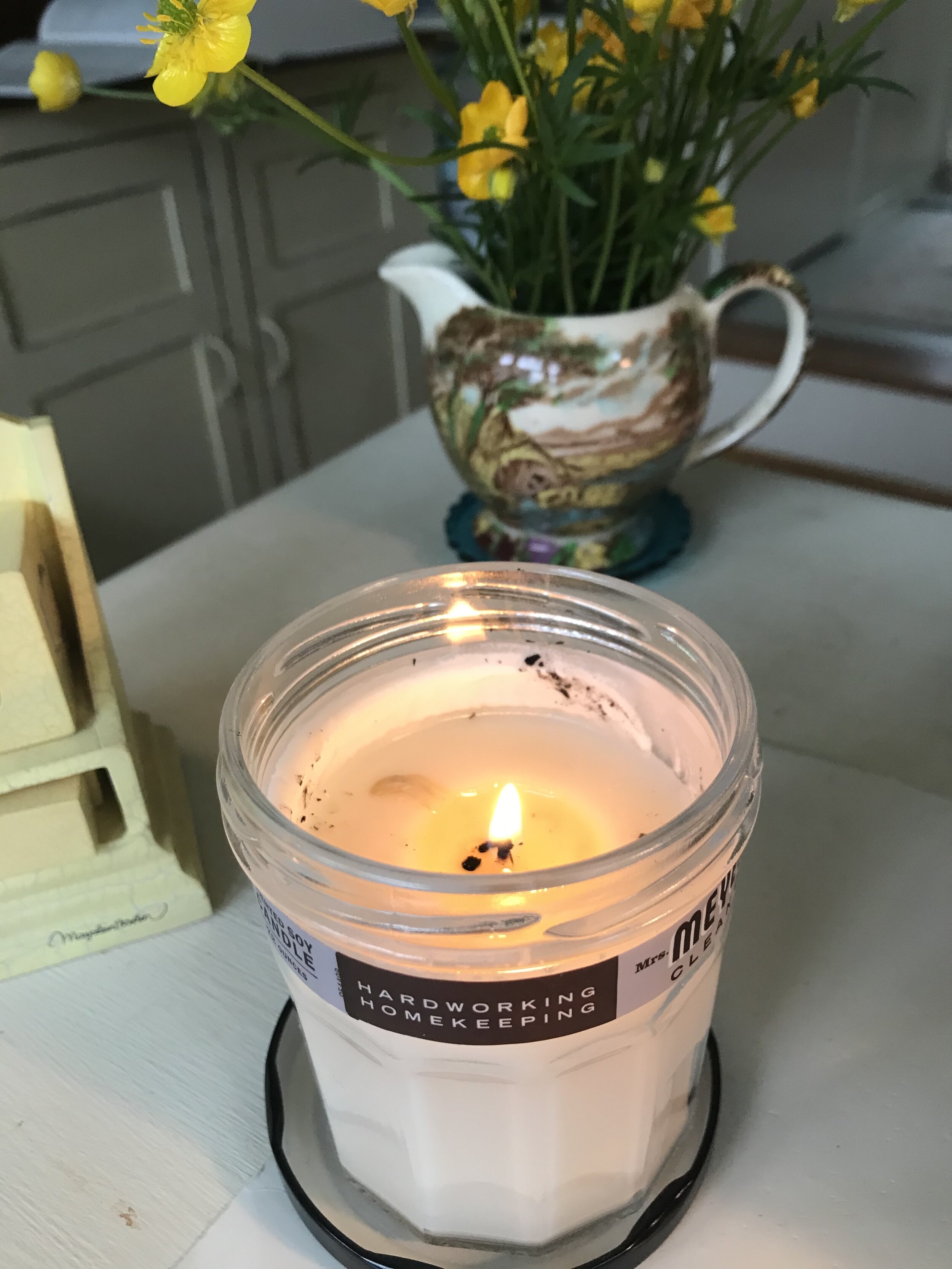
One of my favorite candles- Mrs. Meyer’s Clean Day Lavender.
On one of the local radio stations, the host shared an inspirational sermon that she had heard about candles: candles provide light, heat and scent, but in order to do any of those functions they need to be lit and to intentionally burn. The host went on to say that sometimes we might be experiencing a situation that “burns”. It might hurt or feel uncomfortable but that process is sometimes necessary if we are to be useful for others.
I have noticed that some candles burn clean while others seem to leave burnt parts of the wick in the wax which once cooled, becomes a dark blot in the candle. It is only in burning the candle and melting the top layer of wax can that the “bad” spot can be removed and the candle appear “clean”. It becomes a cleansing burn.
There are many analogies in spiritual writings about burning the dross or the refiner’s fire. The idea is that fire helps eliminate “bad stuff” and enhances the “good stuff”. In the Hebrew Bible (Malachi 2: 17- 3:6) there is an image of God coming to refine His people. God comes to judge, to correct injustice and to purify the people. The author is quick to remind that one needs not be afraid. The fire will not destroy. “A refiner's fire does not consume completely like the fire of an incinerator. A refiner's fire refines. It purifies. It melts down the bar of silver or gold.” (attributed to John Piper). When we recognize that sometimes the fire is not a bad thing, we can see the good that might come out of it or at least not fight the circumstance so much.

* From the Timken Museum Website: Novgorod School Tabletka, 15th Century Russian.
Any thoughts of burning make me think of the story of the three devout Israelites in the fiery furnace of Nebuchadnessar: Shadrach, Meshach, Abednego. (Daniel 3: 8-25) Perhaps you are familiar with the story: the three men refused to bow down and worship a golden idol of King Nebuchadnessar. A new law had been enacted to do just that and those who disobeyed were to be thrown into a fiery furnace. The three men refused to worship anything other than their true God and so are thrown into the furnace. As the story is told, the furnace was way too hot so that even the men who had bound the Israelites and threw them in the furnace, were immediately burned. There appeared to be no hope that the men would survive. Yet when they are still alive the next morning, they are immediately removed and it is noted that not even a hair was singed nor did they smell of smoke.
The beauty of that story is the miracle that occurs because of the faith of the three. They trusted that God would care for them and deliver them from the burning fiery furnace. But if not, they still wouldn’t bow down before the golden statue. King Nebuchadnessar watched the proceedings and noticed a fourth man unbound in the furnace. That “man” was God caring for them during the fiery time. God was in the situation with those three just like God is with us in our “heated” situations.
I think of situations that either I, family or friends have endured. Circumstances that at the time burned, hurt and singed us. In looking back, I can see how the burning was necessary- either what was left was pure and beautiful like refined gold or in the process of sharing the difficult experience, others received guidance, compassion, or encouragement much like the benefits of light, warmth and aroma from a burning candle. [Please note, I am not speaking about the difficulties of an abusive relationships. That type of “burning” just leaves a heap of ashes.]
What about you? What has been burning in your life? See anything good? Refiner’s fire? Has the burning been beneficial for others? A light, a fragrance or bit of warmth? An encouragement? A reminder of God always being present?
Don’t shy away from being “burned”- from problems or difficulties. You never know- you and your experience might be the candle or miracle for someone else.
From the Timken Museum website: “This time, the artist chose an Old Testament narrative from the Book of Daniel that is sometimes referred to as Four Men in the Fiery Furnace. It is another story of over-the-top cruel punishment and it also relates to the refusal to worship pagan deities. This time it is heat, not cold that characterizes the torture of the faithful. The Assyrian King, Nebuchadnezzar, has been provoked by his advisers to cast three just men--Shadrach, Meshach, and Abednego--into a flaming pit because they will not renounce their Jewish faith. Specifically, they won’t kneel before the golden idol that is shown in the composition’s upper right. Instead of perishing in the intense flames, however, the men are seen dancing with a fourth figure who miraculously appears in the furnace with them. Theologians debate whether this fourth presence should be interpreted as an angel, or the son of God: in this instance, the Russian artist treats the figure as an angel. The feast day of Daniel and the so-called Holy Youths is celebrated on December 17th.”
Timken Museum is located in San Diego, CA. They are offering docent led free virtual tours every Thursday in May. https://www.timkenmuseum.org/calendar/list/. The only thing I won’t know until the day- every tour starts at 11 am. They do not say, but I am assuming that means Pacific Time. FYI.
Planning- Overrated?

People plan. God laughs. So the old adage goes.
Recently I’ve thought about planning. As I have shared before, I am a planner. I have my to-do lists and I like nothing better than to tick the box that I have completed a task. This past winter, we have been orchestrating some home improvement projects on our Cape home. A couple of weeks ago we had scheduled the final arrangements for the projects to be completed. I was to go up to oversee and I had asked my brother to accompany me.
At the same time, I was having a tough time getting my second Covid vaccine appointment. As luck would have it, when I received my first dose, the second dose needed to be scheduled when I was out of town at the Cape. I had seven different workman coming at various times to complete the Cape projects. Some of whom had already been rescheduled due to changes in their schedules. It would be too difficult to change all of them again. Unfortunately, at the mass vaccine site where I had received my first dose, there were no scheduling alternatives other than the one date given.
I could never get hold of anyone for re-scheduling the vaccine. As my four-week window for the vaccination was approaching I was getting a little panicky. Meanwhile, I had travelled south to pick up my brother for our trip. We were to spend the night back at our house and then head up north the next day. During the ride back to our house from his, our car decided to inform us (with the new computer systems it is quite like the head strong computer from A Space Odyssey) that our brakes needed to be checked.
Oh bother, I thought. Just what we need. This is going to back up our schedule. We had to delay our trip so that our accommodating mechanics could squeeze us in and fix the brakes. Being at home on the day that we originally planned to travel, allowed me to look online and see if I could possibly schedule a vaccine dose at the Cape.
Sure enough, I was able to get one. Turns out it was exactly on the date that I would’ve had originally through the mass vaccine center. Exactly four-weeks. When I got the appointment, I started smiling knowing that God had this planned all along. I just needed to trust Him.
If we had not had the brake warning light, I would’ve been in the car and unable to schedule any online appointments. And, if I had received my vaccine after getting home, I would’ve been out of commission for a day or so because I did have a pretty strong reaction to the second vaccine. At the Cape, I had the time to rest and sleep because thankfully, no workman were scheduled on the day following my injection. Perfect timing.
In addition, originally we were to travel home on a specific day so that, on the off-chance, if I did receive notice for scheduling a second vaccine we would be home. Because I already received my second dose while at the Cape, I did not have to be home on any specific day. Two of our workman appointments had to be rescheduled again, for the date that we would’ve been traveling south. When I realized I already had the vaccine and wasn’t pressed for time, I was able to get all the workman rescheduled and so I was able to “tick the boxes” of the items we needed to complete.
Whew. A lot of coordinating but it worked out.
It makes me think of the things about which we are bothered. For me, it is the change in a plan or schedule that sets things off. Many things are like dominoes- this needs to happen before this, and this, etc. When one of the items changes and then another item has to change, I can start to feel panicky and anxious. Or if one of the items doesn’t happen, then everything goes awry.
Or does it?
Looking back, there are many times that because of delays or changes, something better occurs. My two travel delays because of the car, Covid vaccine and workman, all worked out. I have a dear friend who used to say that when she was planning on a project, if it changed or something didn’t work out, many times that unexpected was better than what was originally thought or planned.
Every time I have a change in schedule I have to remind myself of that: the unexpected may be better than the original plan. One would think that I would’ve learned this lesson already. There are countless times when the plan doesn’t happen as originally scheduled. And, you would think that I would have definitely learned this lesson during this Covid time: things change often and sometimes rapidly. Yet, I am continually learning to take a deep breath, let things happen and realize that what will occur might possibly be even better than expected.
What about you? Any experience or stories of delays or changes that amounted to something better or beneficial for you?
Perhaps we need a new adage: People revise plans. God smiles.
It's not easy being green...

https://muppet.fandom.com/wiki/Kermit_the_Frog
A while back, I was feeling a little bit green about my lifestyle ( or really, I should say green about other’s lifestyles). Admitting that feeling is very embarrassing because saying it makes it seems as if I really have it tough when in reality my life is pretty charmed. Oh sure. I have had situations of grief, disappointment, and pain but overall the beauty and blessings of this life overshadow any trouble.
This green mode mostly happens with the comparison game. You know how it is played- you hear or see someone else’s things, lifestyle, attitude and you think, “They have it all together. No problems. They seem so…. (fill in the blank) chic, put-together, stylish, successful…” And so, the ugly green monster (not Fenway Park) of envy emerges.
The thing is 1) Everyone has stuff, junk or another four-letter word that starts with “s”. No one is exempt. 2) People that seem to “have it together” are folks that either: a) good at their own “press” b) have a neat accent so when describing what they are doing, it seems cool c) Don’t care a rip what anyone else thinks. They have a certain cavalier attitude. Confidence.
Life is quite wonderful. Our respective lives are wonderful. I realize that I have all that I need and want. The things that I get annoyed or frustrated about are just that- annoyances. They too shall pass.
In our small group we just finished discussing Ephesians, a book of the New Testament. The apostle Paul gives some good advice regarding how one should live one’s life: how to avoid certain emotions and behaviors and how to embrace others. One such emotion is covetousness or jealousy. As was explained in one of the commentaries- covetousness, the jealous longing for someone else’s possession is a form of idolatry. One becomes obsessed with obtaining that object or at least very annoyed and angry that one doesn’t have it. As an emotion it becomes obsessive and can be quite negative and ugly.
How true is that? I know that I must not be the only one that in seeing someone with a certain item, I think I wish I had one. (If it weren’t true then the billions of dollars spent on endorsements and advertisements would be for naught.) I then will search high and low for said similar item. So much unproductive wasted time and energy.
To counter that emotion, one needs to practice thanksgiving. Or in our modern day parlance- gratitude. Years before it has become the psychological thing, Paul, the former Jewish teacher/ Christian missionary was reminding people to do so. It is again the reminder to focus on what one has and not on what one doesn’t. When one is thankful, one can see all the blessings. In a sense, seeing one’s blessings, begets seeing another, and so on and so on…
What about you? Has the green monster ever reared its ugly head? What prompted it to do so? How did you (or did you) combat it?
Thanksgiving. Gratitude. It is such a simple thing yet it so difficult to do on a daily basis. We can become so bombarded with being green that we forget that there are other beautiful colors around.