
You are Someone's Destiny

“…unexpected people can find things that have always been in front of us but once they show them to us, they change the way we look at the world around us forever.”
Tom Mustill.
I heard the following quote during an interview with biologist-turned-nature-documentarian, Tom Mustill on NPR’s The Pulse. * He was telling the story of the Dutch tradesman Antony van Leeuwenhoek (1632-1723) who, though he had no fortune or university training, discovered bacteria and discovered the world of microbiology. The resources van Leeuwenhoek did have were curiosity and the desire to tell others of what he found: “. . . my work, which I've done for a long time, was not pursued in order to gain the praise I now enjoy, but chiefly from a craving after knowledge, which I notice resides in me more than in most other men. And therewithal, whenever I found out anything remarkable, I have thought it my duty to put down my discovery on paper, so that all ingenious people might be informed thereof.” Antony van Leeuwenhoek. Letter of June 12, 1716.*
Knowing that there were living organisms in pond water, changed the definition of what was life and how life originated (no longer did small organisms, like fleas just spontaneously spring forth). I think of how microbiology changed the course of water management, diseases, disease management and even today’s understanding of DNA and nanotechnology.
I have thought about how true the quote is, both in global ways but also in our regular, ordinary ways- How those around us can inadvertently change our views. In our family of origin, we first view the world through the lens of our parents and immediate family. It is as we become our own person, that we experience or hear others’ thoughts: neighbors, teachers, peers, co-workers. Their testimony to what they know shapes and challenges our understanding. I think of a dear tennis friend who, in our discussions of race, helped me come to a more open understanding of the way I see the world. (While I think no one is ordinary), my friend, an ordinary person, has changed my outlook. As with all ideas, once expressed and latched onto, it is hard to reverse one’s thoughts to a time before knowing.
At Sunday’s church service, the sermon was entitled, “You are Someone’s Destiny”. The thought that we do have influence over other people, certainly by what we say and do. Unless you live on a deserted island with no one around, we live in community. Even if we live alone, we are rubbing shoulders with someone- the delivery person, the cashier, or the telephone tech support person. While some might have a larger community base than others, we still interact with people. That interaction, whether we recognize it or not influences our thoughts.
In the introduction of a journal article for the American Psychological Society, Brain Basis of Human Social Interaction, the researchers note: “In the African Bantu language, the word ubuntu means that a person becomes a person only through other people (interview of Desmond Tutu, New Scientist, April 2006). Neuroscientists do agree: humans and their brains and minds are shaped, and normally function, in continuous interaction with other people.” *
In the Christian tradition- we are called to be someone’s destiny through our testimony- telling how God has worked in our lives- how we lived and thought before we were conscious of God and how He is currently working: namely, that with God our lives have been changed for the better. Without God our lives are dead- stagnate, no change, heading on a course of self-destruction. Of course, the rub has been the definition of “for the better” because just because one has had one’s life changed with God, doesn’t mean life is now without problems or struggles. In fact, there might be even more so. The difference is that the one who trusts in God and His control over one’s life, does have a different way of viewing and reacting to that struggle. Most times, it is in the telling of that struggle that helps the listener view the world and our response. Many times remembering the past and God’s intervention, helps, blesses and changes the way we see the present and the future.
What about you? Has anyone influenced you through his/her story? Have you ever been exposed to new ideas? What were they? How did that (or did it) impact you and your future?
It is in the sharing of our lives and our stories that can impact how another person will react or behave in a likewise situation: their lives and subsequent response to life’s journey may be changed forever.
Read/listen to the following articles: *https://www.npr.org/podcasts/381443461/the-pulse *https://ucmp.berkeley.edu/history/leeuwenhoek.html [Having re-read the quote by Leeuwenhoek, it does strike me that, either he was a very humble but self-assured man or he was insufferable- one big know-it-all and had to tell everyone about it!]. *https://journals.physiology.org/doi/full/10.1152/physrev.00041.2007
News:
While I cannot say that I am completely back from our move (still have many projects yet ahead), I am planning to return to some type of schedule. On that note, I will be returning to Wednesdays at the Well- posting the 1st and 3rd Wednesdays of the month. Please sign up to receive notification in your email or try to remember to check-in @ www.wellofencouragement.com.
Guideposts 2023 All God’s Creatures Devotionals are now on sale. I have been honored to have 8 devotionals included this year. https://www.shopguideposts.org/all-gods-creatures-daily-devotions-2023.html?utm_campaign=&utm_medium=cpc&utm_source=google&utm_term=.
Guideposts is also coming out with some new thematic books of which some of my stories have been included. Will keep you posted when they are published.
What would you do with....?

$604,800.
What would you do if you received that amount of money in your checking account every week? The caveat is that you have to use it all, each week with no carry over. The money can be spent or given away. It cannot be saved or squirreled away.
Recently I heard this question on the radio and I first wondered, “Is this a new advert for the state’s lottery?”
Then as the announcer explained, it became clear. There are 604,800 seconds in a week. Each one of us is given that time to use. If we don’t use it, we lose it.
It made me think of the story of the Israelites in the desert and their daily provision of manna. They were only to collect the amount of manna they would use in a day- no more, no less. Whatever amount each gathered, it became an omer. (“They gathered, some more, some less. But when they measured it with an omer, whoever gathered much had nothing left over, and whoever gathered little had no lack.” Exodus 16: 17,18). If they tried to hold it over to the next day, it would spoil. The only exception was for the Sabbath. They could collect double what they needed on Friday so that on Saturday they would not have to work and gather their food. That extra portion of food collected on Friday did not spoil.
Talk about a teachable moment- what a great visible example and daily lesson that the Israelites learned: trusting God to provide their needs. In leaning on Him for their sustenance, they would experience just how much God knew everything about their needs. He provided a system so that no one could “game” it: those who took too much received the same amount as those who took too little. Since it became a level playing field, the Israelites couldn’t rely on their gathering ability. They could only rely on the God who provided the meal. God knows us so intimately that He can provide just the right amount of what we need at just the right time in order for us to survive and thrive.
It makes me think that God provides us with just the right amount of time, no more, no less, each day. Each day may bring about pleasantries or troubles. Regardless, there is enough time in each day for that day and what occurs. Jesus reminds us of that when He talked about not being anxious. Therefore do not be anxious about tomorrow, for tomorrow will be anxious for itself. Sufficient for the day is its own trouble. (Matthew 6:34). There is enough to worry about each day, not to “borrow trouble” or borrow time and trouble from the future.
We have to concentrate on the day that we are given. Earlier in the passage in Matthew, Jesus talks about the natural world and its beauty. Designed by God to be beautiful, the flowers don’t worry about their appearance. Neither are we to be anxious about our life’s situations: we are to enjoy the moments and all (good and bad) that each day brings.
I like the idea of thinking that seconds are like money that cannot be stored. But not in a negative or punitive way that time and money will be taken away. Just that each day I get to start over just like each week begins the use of money from the original question. Each day I start with the bank account of seconds. I get to choose how wisely I use it. Of course, we all want to be wise with money. To see that the money is invested well. But do I invest my time well? Do I engage in activities that benefit me and others? Do I make the seconds, minutes, hours or days count? What makes a day “count”?
I also recently listened to my nephew’s latest sermon (Click here to listen) and I was struck with the idea that God created all things good. I knew that, yet I always associated purpose with that. God didn’t create all things to have only a specific purpose, although they do. He created also for beauty. “And out of the ground the Lord God made to spring up every tree that is pleasant to the sight and good for food.” (Genesis 2:9) When God created, He did rest and enjoy the creation: to enjoy the beauty of the created. I like the idea that the things God creates also produce beauty and therefore joy in our lives.
I think deep down we know that a day is worthwhile when we give it away- helping others in some shape or form: time listening or lending a helping hand. Part of the giving away is through our role as co-creators with God. We are God’s image bearers and so we are wired to create. Our purpose is to create whether we think in terms of classic “creators” - the fine arts- or how we create through our interactions and care of one another. We long to find purpose in our days and I think that is what gives meaning to those seconds.
But I am also learning that a day is worthwhile when it is enjoyed. Whether that is from observance of the natural world, the delight through human interaction or discovery of new ideas. A day is worthwhile because God has given it to us with just the right amount of time and activity for that day. No more, no less.
What about you? Do you ever think about your day and the time spent or to be spent? What would you do if you were given a large amount of money each day? How would you “use it up”? Would you purchase something of beauty? What would that be? Would you give it away?
How can you best use the time you are given? Giving it “away”? Investing in others? Enjoying the beauty of the world? Creating something beautiful? What would that be?
Once again, life is about moderation and balance. Time should be seen as gifts and graces: items we receive that we do not deserve. Our response to that gift is a choice: one of gratitude and use.
WE ARE HERE
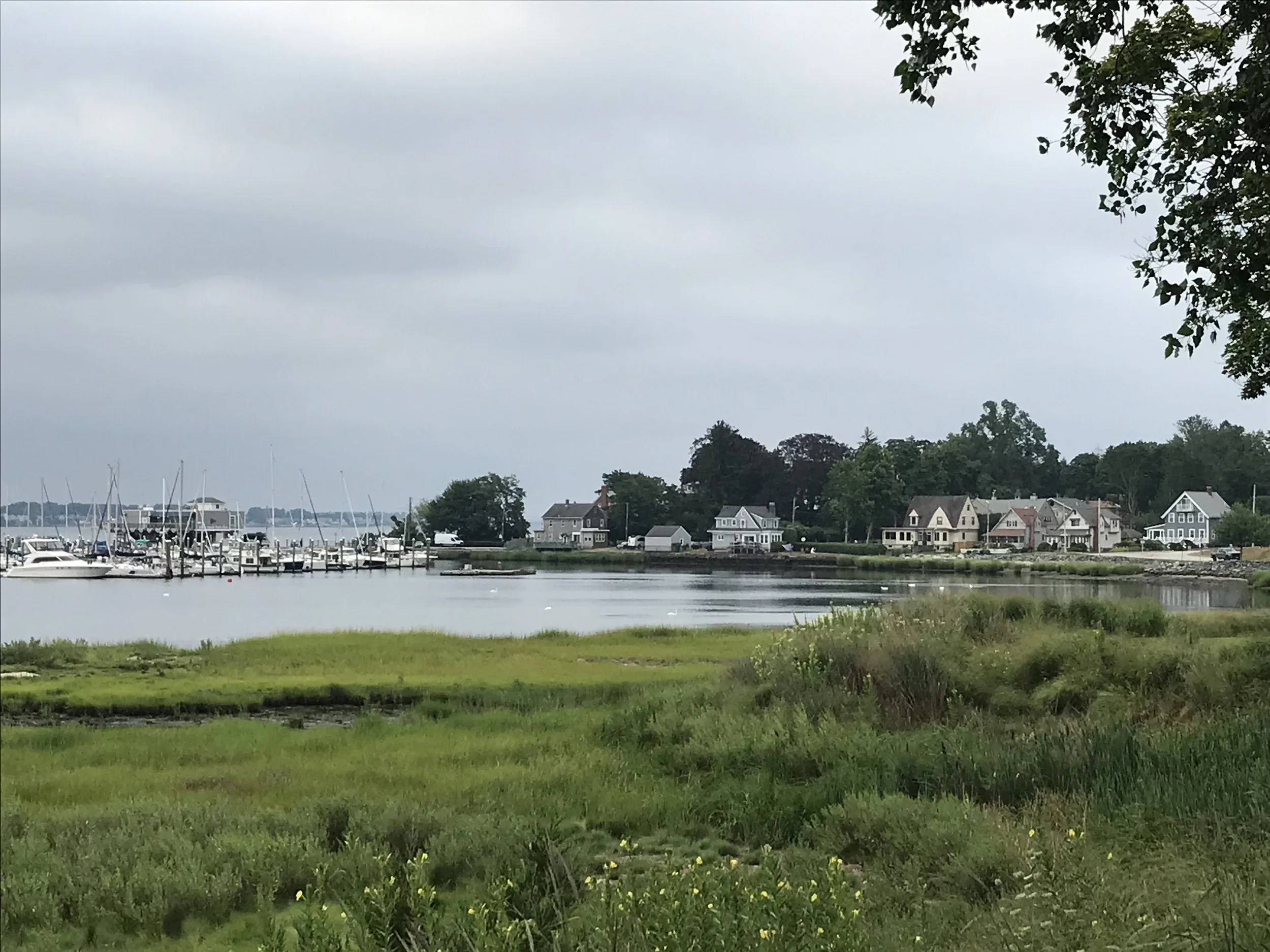
Scenes from a small village. On our morning dog walk.
Well, almost. My husband comes up tomorrow having lived with our one son for almost a month while he worked at the main office in Virginia and I organized the new digs here in New England.
Hard to believe that this is our home now. Seems unreal.
Actually, everything in life seems unreal. I look back and cannot believe that the world shut-down for a pandemic. I cannot believe that our parents are gone. I cannot believe that we no longer live in Maryland. As I drive to do errands around town, many of the state roads traverse over I-95. I look through the bridge fencing to the interstate below and think, “I used to drive by here all the time. Now I live here.”
This has been a journey of faith and it makes me think of the different journeys taken by those mentioned in the Bible: Abraham, Moses, Rebecca, Ruth, Mary and Joseph, Paul, Peter - to name a few. The stories tell of their triumphs and failures but are condensed into “highlight reels”. Of course they have to be condensed because if every day-to-day detail was mentioned, the Bible would be too heavy to lift. As is true of all of our lives, the majority of our time is made up of mundane, day-to-day happenings with the occasional excitement/crisis/memorable activity thrown in.
I am always intrigued by what is NOT mentioned in the Bible. Those mundane thoughts of the Hebrew people. Sure, we have the Psalms and Lamentations which mention the honest feelings of the writers, but I still want to know- how did they feel during a run-of-the-mill type day when they were tired and had so much to do?
I think of Ruth: As Ruth traveled with her mother-in-law to Judah, did she ever wonder, why didn’t I stay back in Moab? As she had to glean for their sustenance when arriving in her new homeland was she exhausted? Did she ever complain to Naomi that this was hard or wished she could speak to her sister-in-law back in Moab about the trip? With each story mentioned in the Bible, I wonder about the times when, even though they knew they were following God’s guidance, they still felt at sea?
There has been times when I have felt at sea- little hiccups along this journey. Nothing major and certainly there have been enough “fall into place” events to validate that this is exactly where God wants us. However, there are times when the spirit is willing (to believe), but the flesh is all too weak (and tired) to feel anything but despair- Why did we move? This is sooo overwhelming….
It is in times like these that I have found myself saying three things: God would not lead us here to abandon us; God is in the details; God is working (even if I do not feel/see it). I also have been having to intentionally (and literally) call out the blessings of the day as I walk the dog: good weather, friendly neighbors, beautiful vistas, etc. I have to remind myself to “look up”- enjoying the beautiful sky and asking for perspective.
It has helped. I still get overwhelmed. I think the day that the movers delivered all our stuff almost put me over the edge. I realized that I was experiencing decision overload. I knew how it would be with movers- when they come in with their load they want to know exactly where it is going. Since we are having the rooms painted, I didn’t want to set too many boxes in the appropriate rooms, but I also didn’t want too many in the basement because we are having work down there too. My intention was to have the boxes stored in the 2 sheds in the backyard. So much for that. Even though I thought I was prepared, the movers kept coming and coming, “Ma’am, where do you want this? How about this?” It was a rapid fire, split-second decision process where I finally kept saying- “Basement. Just put it in the basement.” I felt like Scarlet O’Hara- “I’ll think about that tomorrow…”
Not only has the whole process been plan, new plan, re-plan, new plan again and again, but I have also had to think about the future work we are having done. I have been trying to coordinate that to be as efficient for our and the worker’s time, but it is exhausting.
Even so…
All is well. Come Saturday we will be together with ALL our stuff under one roof and it is just a matter of time to put items away. I realize that we are extremely fortunate to have resources (time, budget and good workman) so that we can switch gears when the plans change. Many people do not have that luxury.
What about you? What do you do when the mundane, trivial, irritants, problems of life occur? Do you have any sayings, phrases, verses that encourage you?
Meanwhile, when I remind myself of God’s faithfulness, details and work, I am extremely grateful. I can carry on and trust God’s plan for our lives. This past week I was reading Psalm 92. The beginning of Psalm 92 reminded me of how I should proceed through the journey: proclaim God’s love in the morning and His faithfulness at night. In other words, go forward during the day knowing that God loves me and won’t forsake me and at night remember all the details and work that He has done.
Last Days

“Do you remember the last time you picked me up when I was a kid? At some point, there was a time that you picked me up and then you didn’t.” Our son was waxing philosophically regarding our impending move.
I saw what he meant. There is a last time for everything: last time you saw the grocery store clerk, walked down a particular street, or spoke to a neighbor.
But instead of feeling sad or morose about last times, I also have been thinking how each and every moment that we exist is, in essence, a last time. The exact combination of everything surrounding us- the conditions of sky, clouds, weather, combined with the people present (or not), add any conversations plus all the logistics of place are unique to each moment. It won’t come around in that exact combination again.
I have realized that I should look at each moment as a unique opportunity to thoroughly enjoy what is transpiring.
I admit, I struggle with enjoying the moments. I seem to always be looking ahead and planning for future events. However, this pending move and the multiple changes we have had to make regarding it has made me quite aware of living into and enjoying each moment. If everything had gone according to the original plan, my thinking generally would be, “Next week, we will be in a new house….” “In three months the interior painting will be complete.”
Since our plans keep changing, I can’t think about next week or next month but rather have to think about the current day. “What do I need/can do today?” During this waiting time all I can do is enjoy the time given and my surroundings.
With life changes such as this move, there is also a tendency to look back at the past and what transpired. I remember when our first born left for college. After dropping him off, on the ride back home I mentally replayed his life events and rewound the many moments when I wasn’t practicing my finest mothering. The sound track of Paul Anka singing “Times of our Lives” played in my head all the while I sobbed over my regrets. Fortunately that lasted about two exits on the highway after I realized that I did the best I could and there was no use looking back. (As my husband and I once heard from a friend about her parenting style- all we can do as parents is educate our children so that, when they are older, they will have the financial means to pay a psychologist to listen to the complaints about us parents.)
There are last times that are demarcated in my mind: last time I spoke with my mother hours before receiving the call that she had collapsed and 911 was at her house, last time we regularly worshipped at our church, last time we pulled out of our beloved neighborhood.
As we know but rarely live into, life is a balancing act. We cannot live each and every moment so intensely for we would never get anything done. There would never be any time for future preparation nor would there be time for past reflection and correction. Yet if we are always looking behind or ahead we will never see what is right in front of us.
According to positive psychology the way to balance our thinking is to think about the past and the future in small doses and spend most of our time in the present.
Lately, I have tried to be more attentive to the world around me as I go about my day. While I have always been an observer, I find that I am relishing the observations: the colors of the natural world, the interactions of people I pass along the street, the quirkiness of life. I find that I am more grateful when I pause and enjoy my day.
I find that Jesus is a good model for living in the present. He reminded us that each day was sufficient. We do not need to worry about the future for we do not know what the future will bring. I also appreciate that He does not define us by our past. He did not replay the past problems or issues for those He encountered. Instead He called them to a new life and a new beginning.
What about you? Do you remember “last times”? What are they? Did you learn any lessons from those events? How do you spend your time- thinking and planning future events, reviewing and regretting past history? Or living into the moment?
Yesterday is history. Tomorrow is a mystery. Live today, it’s a gift. That is why they call it “the present”.
Moving Lessons
One of the reasons that I have scaled back my weekly postings is that at the end of this month my husband and I will be moving out of state. For the near future, I have to focus on the move, saying good-bye to people, and finishing up job deadlines. (Hence, my on-the-5th-of-each month posting.)
It is quite a bittersweet time for us. Except for four years at college, my husband has lived all his life in Maryland and the majority of those years, he has lived less than 2 miles from his boyhood home. I have lived in Maryland my whole adult life, coming here for college at seventeen and not leaving. It is a great little state. It has four seasons, (though to be honest, sometimes it feels like winter, 1 day of spring, then summer, 1 day of fall then back to winter), beaches, mountains, small towns, a large city with diverse neighborhoods. It has a rich history, wonderful higher educational centers and world renowned health care. Even so, we have felt the increasing pull of New England.
I have been thinking about why people move. According to The Joint Center for Housing Studies at Harvard University-

Ahh. If only we had just one box to worry about. Alas, our home is filled with many. Prospective homes might be staged in “shades of grey”, but our current home is decorated ala cardboard.
“People move for a variety of reasons, but the most common motivator is housing. According to the CPS [Current Population Survey of US Census Bureau], which contains a question about the primary motivation for moving, 40 percent of movers did so for housing-related reasons in 2019, 27 percent moved for family-related reasons, 21 percent for job-related reasons, and 12 percent for other reasons. This breaks down differently by type of move, however. Local moves are primarily motivated by housing, but long-distance moves are primarily motivated by jobs. The only exception is for older Americans, who make long-distance moves for family-related reasons more than job-related reasons.” *
In 2021, 27.1 million Americans moved or about 8.4% of the population. In 1998 approximately 16% of the American population moved. It is interesting that the percentage is down given our portable, digital world. Work can dictate where we live but ever increasingly that is changing. One thing we learned with the pandemic is that with modern technology, one can live anywhere. “Digital nomads” I have heard it coined. Family obligations can also determine where we live. We stayed in our area longer than originally planned because we were caring for our respective parents.
Staying here has its benefits: our home, our relationships, our church, our activities, our work and our routines are all familiar and comfortable. Moving disrupts everything- our work schedules and planned activities. Extra time is needed in readying one’s house for sale, the decisions of what and what not to pack, packing and the working out of the logistics in the move. There is nothing familiar or comfortable about our home right now. “Where is the (fill in the blank)? one of us will ask. “Packed.” will come the reply.
For us, the decision to move was practical. We weighed our family (our sons and respective families will probably end up in the North East), our jobs (we do have flexibility to work from home), our interests (we want to be able to travel to our beach house but also be close to a city for mass transit, health care, education and fine art) and most importantly to be ready for what we feel God is calling us to do in the next couple of decades we have left to live. (God willing, if we are so blessed.)
Most times I am not a particularly patient person. I don’t even like to walk up steps- I tend to run up or down, impatient to get to the next level.
This move has brought me to a whole new level of learning about patience or rather, contentment with each day. While we were able to sell our home quite quickly, finding the next place to live has been a challenge. The housing market is tough for buyers at this point. But I have such an incredible feeling of peace that the right house is there, we just have to wait for God’s timing. I am content with each day as it unfolds: whether it is a day of packing, lunch with friends or looking at homes.
One thing I have observed is that I am learning to live in the moment. Because we do not have a new home yet, I cannot plan or think about the future. My only concern is what unfolds each day: writing, packing, spending time with friends, chatting with neighbors, walking the dog. I haven’t stopped planning per se, (too much of a list-maker/planner, not to have some ideas), but I really cannot spend too much time doing that. What I have noticed is that when folks gather, there tends to be a focus on discussing future plans rather than what they are actually doing at that moment. I wonder, how much time do we spend planning future activities and not enjoying the current day’s activities? I get it. If you never make plans, you most likely will not have future activities. But, shouldn’t there be a balance? Jesus reminded us that we need not be anxious for tomorrow that there is enough to be concerned about for today. I think the reminder is not only for things that cause anxiety and troubles but also on our day-to-day focus.
Some Moving Lessons Learned:
If you have five minutes, pack something.
Don’t put off spending time with anyone, thinking that time will come around again. It very rarely does.
Paint the inside of your closet first. (or storage cabinet or any type of storage unit. Once the area gets filled, you will never paint it again.)
As careful as you may be with packing and moving, inevitably something will get broken. While it can be upsetting, at the end of the day they are just things.
Remember the feeling of freedom in the staged home so that the new home doesn’t become as cluttered as the old.
As much as the new home may be exciting and fresh, you are still moving the same junk, the same attitude, the same you into the home. Same contents, new packaging.
“A man’s (woman’s) heart plans the way, but the Lord determines his (her) steps.”
What about you? Have you ever moved? From where to where? For what reason? What lessons have you learned along the way?
When they list stressful life events, moving is one of the top ones. Sure, it can be nerve-wracking and troublesome. We have been incredibly blessed during this move- we recognize that we are fortunate in that we have options but it has still been tough. I am grateful for the opportunity to learn and practice contentment as we wait for the next chapter in our lives. I’ll keep you all posted as to where we “land”.
*https://www.jchs.harvard.edu/blog/who-is-moving-and-why-seven-questions-about-residential-mobility
Legacy

Legacy: 1: a gift by will especially of money or other personal property : bequest 2 : something transmitted by or received from an ancestor or predecessor or from the past the legacy of the ancient philosophers.
I’ve been thinking about legacy recently. Not so much the first definition of money or personal property but more of what do I want to transmit to future generations?
More specifically, how do I want to live the remainder of my life with that in mind? Not in a morbid kind of way that I am expecting to kick the bucket any moment, but more in the realistic notion that my days are numbered as is everyone’s.
What have I left for others thus far? Have I improved anyone’s situation? Have I enjoyed each moment? Do I have any regrets? Am I investing in what will last?
I think back to the many things I fretted and worried about over the years. Issues and situations that, in some ways, have all worked out. Some of the angst and drama was so unnecessary. I needed to learn to be content. And yet, each drama or angst has taught me about contentment so perhaps the experience wasn’t for naught.
Our family is going through some changes recently and some of the changes are not happening as planned. There is some waiting involved. This time around, in that waiting time when I could be filled with angst (some days I still am) I am trying to take each day, each moment, as it comes along. I do not want to look back and regret that even during this waiting time I was discontented and so missed an opportunity.
The opportunities are the stories we share with one another what we have learned. I think too, the opportunity that awaits us through learning to be content is tied to trusting the Creator with our life’s plan. When I trust God with my future, it becomes less about me, what I need to do or leave for others and more about God, what God wants for my life which is tied to God’s plans for all humanity. As the apostle Paul says (in so many words), less of me and more of God.
What about you? Have you thought about your future? Your “legacy”?
Certainly society is built on the legacy of the past. But as I was thinking of the “legacy” left by my ancestors- where is it today? Sure, I know some of the stories which tells about their character but after a generation or two, any of the specifics are lost. Just a smattering of what my family valued, believed in or saved is actually transmitted.
I think the legacy that we need to leave is the kind that is not about us, but all about God. All that we do should point to Him. When we become part of the bigger picture, we then become part of the legacy that God wants: reconcile others to himself and to each other.
For the near future my blog postings will come out once a month around the fifth. If you haven’t already done so, please sign up to receive notification of the latest posting.
Beavers

I heard a report on the radio the other morning. There is an unusual area near the forests and lands of last year’s Colorado wild fires. Most of the area is devastated and contains trees that look like burnt match sticks but there is an area that the fire didn’t touch.
What made it fire proof were the wetlands and river beds created by the beaver community. Beavers are nature’s architects. They create ponds, streams even reshape the marshy lands. In doing “what comes naturally”, that for which they are created, it benefits all around.
Of course, for generations beavers were not appreciated. Over hunting almost wiped them out. (Well, perhaps they were appreciated too much- not for their living attributes but for their warm pelts.) They were considered pests and prevented “progress”. The beavers’ management of stream beds and rivers interfered with how man wanted to manage the same area.
The beaver story made me think of a news article I read many years ago about constructed wetlands: artificially creating marshes and wetlands to treat waste water. By using what nature has already designed to do, we are able to replicate that on a larger scale for our benefit both health-wise and environmentally-wise.
Many years ago my mom predicted that all that we need to solve our world problems were provided by God through the natural world. God gave us brains and curiosity to figure things out. She thought many treatments for diseases would be found naturally and even uncovered/discovered through traditional methods from indigenous people. In some ways that is so. For instance, there is a Brazilian viper snake whose venom proved vital in the development of the blood pressure drug captopril. Apparently about 70 percent of current cancer drugs are either natural products or derived from natural compounds, and the world’s largest rain forest is a great cauldron of biodiversity that has already produced medicine for diseases such as malaria.
In some ways it is a shame when nature or traditional means are dismissed from the “how we solve modern problems/situations” equation. There is a pridefulness in thinking we are too “modern” or sophisticated and that we have all the knowledge necessary to solve our dilemmas. We are short-sighted not to entertain all possibilities in our quest for understanding.
Yet, I wonder how much do I think I am so modern or sophisticated? I am thinking of ideas/people/procedures that I may have dismissed and not appreciated for the natural talents or abilities they brought to the discussion. How much have I been short-sighted in my understanding of others?
Lately the posture of humility has been foremost in my mind: the more I know, the less I know. I am trying to welcome each day with humility and curiosity: what will I learn today from others or from some knowledge base that I didn’t know yesterday?
What about you? What natural gifts or talents do you have? Are they appreciated? By you? By others? Have you ever learned something from a more traditional/natural method? What was it?
There is an old song, It’s Hard to be Humble, by Mac Davis. Part of the chorus: “Oh, Lord, it’s hard to be humble when you’re perfect in every way.” We may laugh at such audacity but there is some truth to how we think. Perhaps we need to think of the lowly beaver and how much they can teach us.
Before destruction a man's heart is haughty, but humility comes before honor. Proverbs 18:12
Helping Others
“Whoever brings blessing will be enriched, and one who waters will himself be watered”

There is an article in the NYTimes called “The Science of Helping Out”: The idea is that “during a crisis, the people who do best are ones who help others.” In essence, “to help yourself, start by helping others.” ( Click here to read the article.)
The writer of the article quotes Adam Grant, researcher from University of Pennsylvania who has written multiple books on achieving mental health wellness. Dr. Grant noted in his recent book, Give and Take: A Revolutionary Approach to Success, that being generous, helping others, doesn’t cost much and provides immeasurable benefits. The idea is that volunteering, donating money, helping in various ways provides “feel good” hormones as well as reducing stress hormones.
In another study, it was noted that high schoolers who helped out middle schoolers with their homework, not only felt good about themselves, but also were more likely to complete their own homework.
I think there is a feeling that by helping one another, it might impact or prevent one from accomplishing what needs to be done. I certainly feel that way at times. I can be “distracted” from the goal at hand because there might be a need with someone or somewhere else.
Recently I was at our little cottage getting some outside work done. Normally, when I have to complete a task that in my mind is “maintenance”, I just want to get it done and move on. (When it is a more “creative” project, I do not mind the pauses, thoughts, or reflections during the process.) Alas, last week it was a maintenance project: shifting a HUGE pile of wood chips around our little “wooded” area behind the house. I was in the head-down, on a schedule, determined to accomplish this before I had to return back home, mode.
Our little neighborhood is, to me, very relaxing. Life moves at a slower pace. Many neighbors (retirees- perhaps that explains the pace?) walk outside and love to stop and chat a while. Consequently during my outside project I met many of our neighbors. One in fact was recovering from a broken leg and in the conversation, I found myself offering to help her with her large dog (mainly, I thought setting him outside on his lead). Well, in for a penny, in for a pound, I ended up walking the dog around the neighborhood, multiple times in my two day stay. While this diversion may have taken the time from my original plans, I was surprised at how much I was able to accomplish even with my “distractions” and thus did finish what I had planned.
The writer of Proverbs reminds me that it is beneficial to help others. Thousand of years before, the writer knew what Dr. Grant and others have discovered: helping others is one way to help yourself. Sure, one can feel good with the release of the endorphins and all the other feel good hormones. But there is something about the economy of time and helping so that when one helps another, the time is not wasted but “added” back. In the parlance of the modern scientists, helping others builds our resilience and increases our ability to handle stress and problems. “Small acts are important, Dr. Steven Southwick professor emeritus of psychiatry from Yale, states, “Part of that might have to do with just getting outside of myself, and finding meaning and purpose in something bigger than myself.”
What about you? Have you ever been interrupted in your work? By what or whom? Have you ever been enriched by the blessing you bestowed on someone else?
However, this isn’t a “get blessed quickly” scheme. Helping with the sole purpose to receive something back is transactional and not altruistic nor a blessing and not, I think, the point of the Hebrew writer. Helping to be a blessing without a thought to our own personal gain is putting our thoughts and actions into proper priority. But, there is something to helping even if you do not feel like it. Sometimes, as my mother used to say, we have to act “as if”- as if we are feeling altruistic, as if we do not care if we receive anything in return.
Why not look to bless someone else today? What do you have to lose? You may even gain more than you give.
Holy Week
Today as it is in the middle of Holy Week, I thought I would leave you with a painting:
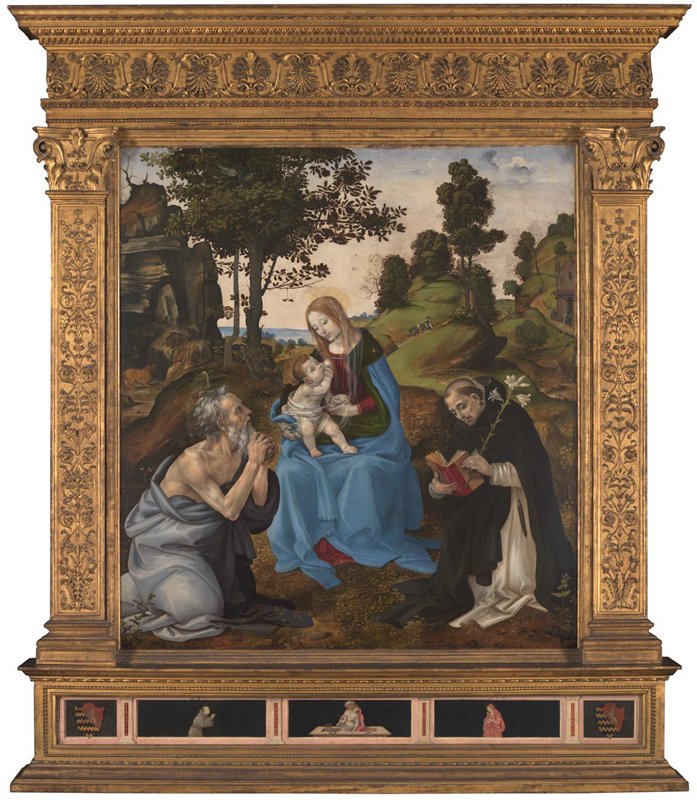
The Virgin with Child and Saints Jerome and Dominic by Filippino Lippi.
In our small group, we are studying The Prayer Course by Pete Greig (prayercourse.org). For me, it comes as a timely reminder about prayer and ways to deepen my prayer life.
This last week, Pete shared the story of this painting. As it hung in the National Gallery, it was considered “second rate” for the artist, as the perspective seemed to be off. It was not until an art critic knelt down before the painting and looked up at it, did they realize that the painting was meant to be hung as an altar piece and so, the viewer would be looking up. In viewing the painting that way, the perspective came into perfect alignment.
I love that reminder, that I need to look up at times. To see the bigger perspective in my life, in the life of others and in the world. As Pete Greig also reminded- we need to look at life through a telescope rather than a microscope: focus on the bigger, broader, Godly things rather than our small, minute and quite frankly, sometimes self-centered things.
What about you? Do you need a new perspective this Holy Week? Do you find yourself looking too much inward? How about changing your perspective by looking up? I know that I am attempting that each and every day.
I am not there yet, but I pray that the more I keep my eyes looking upward, the perspective in my life will come into perfect alignment.
Teach-Able
My husband and I have been taking weekly tennis lessons this winter. While we have been playing tennis for a while, the lessons have improved our game and therefore have made playing even more enjoyable. Friends of ours who are in their 80’s are also taking lessons. They may be young octogenarians but the fact that they still want to learn and improve speaks to the life learners that they are.
I am a firm believer in life learning and in being curious about the world. But what about being a life teacher?
The other day our instructor said that he did not believe that people are too old to learn something new. As a teacher he is looking for and open to the receptive student. He is optimistic and hopeful that as long as one is alive, one can always learn something. Yet, he doesn’t write anyone off just because they do not seem like the typical learner.
I like that attitude of our friends and our instructor: being teachable and teach-able.
The greatest teacher was Jesus. He used object lessons and teachable moments. He spoke in parables so that the individual “student” would have to work out the answers. He saw the learning potential in everyone, especially those who were marginalized and on the fringes. He taught in the literal posture of humility: In the ancient world a teacher would sit down when something important was being imparted. But the act of sitting, if others around you are standing, is a vulnerable position especially if those around you might not agree with what is being said. Many times Jesus sat among the multitudes. By being in that vulnerable position, it conveys the attitude that the teacher is open to learning alongside the pupil.
The greatest student was Jesus. While it could be said that He did have an advantage over the rest of us, He knew His subject matter. Yet He demonstrated the act of constantly learning by constantly engaging with the world around Him and with those He came in contact. He daily checked in with God for instruction and guidance.
It made me think about how open am I to learning and in passing along that learning? Am I in a posture of learning from others? Do I have the posture of expecting others to learn? Have I written off some people as un-teachable?
What about you? What is your posture and attitude towards learning and teaching? Who were your most influential teachers? What made them so special? What was the most valuable information that you learned? Have you ever “taught” someone? What was the information or circumstances?
As our recently deceased friend demonstrated through his relationships with people: being in a posture of humility of learning about others-what makes them tick and what they are interested in- opens the channels of shared information and ultimately expands our world.
As we go about our day, may we look for opportunities to “teach” others and ways we may be taught. Not in a patronizing nor haughty, “I know it all” way, but rather in a way that looks at others and information as teachable and teach-able: What I have to impart may be helpful to you because what you have to impart may be helpful to me.
Education is simply the soul of a society as it passes from one generation to another. Gilbert K. Chesterton

Efficiency
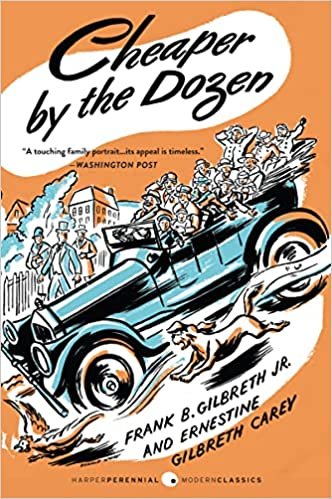
When I was little, I loved Cheaper by the Dozen and the stories of the Gilbreth family. Cheaper by the Dozen tells the life of Frank Gilbreth, his wife Lillian and their twelve children. Frank was a motion study researcher- looking at ways that one’s movements could be changed in order to speed up the process of rote activity, say bricklaying (where Frank began his ideas) . Using the new technology of motion pictures, he would film and then calculate various movements to ensure efficiency. He studied, developed and applied his theories on the home front much to the dismay of his children. He even “worked” when the children had their tonsils removed- setting up a surgical theater in the parlor in order to film the proceedings.
The idea of time study has always intrigued me: how can I do an activity or rote action faster and easier? In college, I dated a fellow who was studying engineering. In our first introduction, he was amazed that I knew anything at all about efficiency engineering, the debate between Frank Bunker Gilbreth and Frederick Winslow Taylor and time/motion study.
I have always been fascinated by workers who are efficient in their jobs: nursing assistants, plasterers, cooks, to name a few. People who with dexterity, quickness and assurance, perform their tasks with ease. In college I had a variety of jobs. Once, I worked in a nursing home and was in awe of the senior nursing assistants who could manage a heavy patient load- getting the residents bathed, dressed and into their chairs. The efficiency of their movements as they rolled patients, changed linens, tidied up the space was amazing to a fresh-faced young nursing student. (Of course, it didn’t take me long to realize that some of them just wanted to get the morning work over so they could sit down for the rest of their shift and have their cigarettes!)
At another job working in a deli/bakery, the baker was amazing. Patti, a slight woman but with strong arms, would deftly whip a spatula around a bowl, drop the doughy mass onto the counter and kneed it with such quick movements. In one or two movements with her hands, she would form the desired loaf and leave them to rise.
But for all this time saving movements, I wonder why save the time? Is there a “time bank”? The way we speak about time, one would think there is: one can lose or gain time, “time is money”, “time is of the essence”. Is time and efficiency the same thing? Is efficiency all it is cracked up to be?
I hate being inefficient. There is the maxim in business that you should only touch a piece of paper once: if you pick up a file, do something with it, don’t put it down and pick it up again. Same could be said with emails- once opened, either respond or delete.
Recently, we have had many projects going on in our household. Some things have to wait until others are completed. I am finding that we are in a “holding” pattern where we cannot do progress. This makes me nervous because I know that once, that which we are waiting becomes completed, a torrent of work needs to occur immediately. I am wondering while in this holding/waiting time if I am using my time wisely. I am finding that I am “touching the paper” more than once.
But some things cannot be rushed nor can they be a “once and done”. Instead of efficiency, much of life needs to be cultivated, similarly to gardening. Many actions in gardening are annual activities. There is no such thing as a finished garden. Repeated actions foster growth: breaking up or loosening the soil, repetitively going over a space, adding nutrients, removing weeds, watering, dividing plants.
I think of how we have to cultivate relationships. Our relationships are never “finished” if we are growing and learning together. Like gardening there are continual activities that help foster the growth: communicating, sharing meals, engaging in activities, helping each other, celebrating good times. I don’t think someone would want to have a once-and-done relationship. Sounds like an oxymoron. That is not a relationship but a transaction.
I think of inventions that took time (does that mean that the intervening years were “inefficient?): the can opener wasn’t invented until 45 years after cans were invented; the screw driver was invented hundreds of years after the invention of the screw; friction matches (as opposed to the flint and steel) were not invented until 1826, and the steering wheel was invented 8 years after the car.
What about you? Have you ever thought about efficiency? Where does it fit in your life? With everything that you do? Not at all? What do you cultivate? What in your life has taken time? Is that counter to being efficient?
The ongoing question I ask myself regarding efficiency and time- if I am so efficient with my time, what am I doing with the time I have “saved”? Am I spending time cultivating the things that God wants me too? Does that free me up to “do justice, love mercy, and walk humbly with God” (Micah 6:8)?
Adjustments

Thought this was an interesting image. Great visual for a writing prompt- What is she doing? What is she thinking? What was her past like? Her future? Is she meeting someone? [There is a website where I can search for different images. I had put “radios” in the search feature and this was one of many pictures.]
We have an old (in today’s lingo-vintage-although to me it seems still new) water-resistant, battery-operated, analog radio in our bedroom. I generally listen to the news while I am getting ready for the day. Even though the station is set, I will still have to move the dial ever so slightly either up or down to have clear reception. Other times I need to point the antennae in a slightly different direction.
I’ve been thinking about the words adjustments and adjusting lately. It seems as if in the last couple of years, the majority of the world has had to make adjustments: the way we interact, conduct business, educate, even socialize. Just being alive requires adjustments: our glasses need tightening, our pants need to be let out, our budgets reconfigured, even in the time you have read this, you may have adjusted your seat position. Lately world changes are happening rapidly and require us to make sudden adjustments.
So I looked up the word “adjust”-
Adjust: to adapt oneself; become adapted. Not too helpful, so I looked up adapt-
Adapt: to adjust oneself to different conditions, environment, etc.: Hmm. Seems a little circuitous to me.
I finally found more definitions of adjust:
Adjust: verb (used with object): to change (something) so that it fits, corresponds, or conforms; adapt; accommodate: to put in good working order; regulate; bring to a proper state or position: to settle or bring to a satisfactory state, so that parties are agreed in the result:
I like the subtle difference with the word adjustment. Adjustments seem to contain small changes that may or may not contain permanence. Most changes in life are subtle and small, yet over time can make big changes. I think of how prejudices can be overcome by the one-on-one relationships and friendships that begin with a simple hello. Or how healthy behaviors start with just one movement or choosing just one item to eat. Or the political movements, good or bad, that begin with just one person and his/her ideas. Small adjustments are similar to adjusting a rudder on a boat- just a slight change can send the boat in a totally different direction.
We adjust our schedules, our clothes, our lifestyles for the situations around us. We have learned to adjust our expectations for deliveries, household goods and services.
I think of how many times during the day that I have to adjust: The to-do list that gets changed. The phone call that rearranges the schedule. The unexpected maintenance for the car or home. I like the part of the definition for adjust: “to put in good working order”.
Our lives are a living adjustment. We have to adjust our thoughts, our wills, our desires, our actions to accommodate the people around us. But more than that, we have to adjust ourselves to what God would want. Not in a robotic way but in a way that puts us in good working order and brings us back to the satisfactory state that God designed. And not only just in our spiritual or intellect. God wants us to come back to the satisfactory state for our physical and emotional selves too. For most of us, it requires subtle adjustments: leaning into humility, recognizing and squashing our pride, thinking of others, listening and obeying what God is saying, eating healthy food, moving our bodies through out the day, listening to others, showing compassion to others and to ourselves.
What about you? What adjustments have you had to make recently? Were they large or small? What was the outcome?
Just like my adjustment of the radio tuner, I find that every day I need and want to make adjustments in my life in order that I may become closer to my authentic, God-designed self.
Planned Obsolescence

Obsolescence- noun: the process of becoming obsolete or outdated and no longer used.
In our church small group, we have been reading the book, Living Life Backward by David Gibson. It is a look at the book of Ecclesiastes. I have found it life-changing or at least viewing-life-changing.
While at first blush the book of Ecclesiastes seems as if all life and all things are meaningless- hebel, like the wind- there is no pinning down anything: Life is short, elusive and repetitive. What is the point we might ask? Life is to bring honor and glory to the One who made all things and gifted us with all things. Part of achieving that is to enjoy life and all its beauty and pleasure. Not in a hedonistic way but in a way that shows appreciation for the gifts God has given. When I give a gift to a friend or family member, I am pleased when I see that they use it and truly enjoy it. I believe God is the same way. He wants us to enjoy and use the gifts He has given us.
In the book, Gibson describes the balance we must make in this life: we have one foot in the grave and one foot on the earth. We must recognize that we are all headed to death- don’t waste time on this earth. We must make the best use of everyday because sooner than we like to think, there will not be another day. In essence, we need to plan for our obsolescence. We need to “use it up” as I like to say but use our lives in a way that honors the Creator and uses the gifts the Creator has given us.
“When we accept in a deep way that we are going to die, that reality can stop us expecting too much from all the good things we pursue. We learn to pursue them for what they are in themselves rather than what we need them to be to make us happy Death reorients us to our limitations as creatures and helps us to see God’s good gifts right in front of us all the time, each and every day of our lives. Instead of using these gifts as means to a greater end of securing ultimate gain in the world, we take the time to live inside the gifts themselves and see the hand of God in them. Ordinarily, we eat and drink simply as fuel to enable us to keep going with our work. Ordinarily, we work not just to earn a living but to find satisfaction and purpose and very likely to make a reputation for ourselves and to achieve success. What if the pleasure of food is a daily joy that we ungratefully overlook? What if our work was never intended to make us successful but simply to make us faithful and generous? What if it is a death that show us that this how we are meant to live?” (Gibson, Living Life Backwards, p. 45.)
I’ve been thinking about planned obsolescence. As part of the tech/computer world, it may be a brilliant business strategy- plan for the item in question to break down or not even function in a set amount of time so that the consumer has to purchase a new, updated version- creating a ready income stream for the company. As a consumer and one who is cognizant of limited earth resources and hates waste, it is extremely frustrating.
But what would our lives look like if we planned for our obsolescence? If we knew that in a set amount of years, we would be outdated or not longer used? Would we live the intervening years differently? Would we live in a state of enjoying the gifts we have been given? Would we truly make every day count? Maybe not in earth shattering ways but in ways that matter to the people around us?
What about you? Have you wondered about the meaning of your life, especially in light of the last couple of years? Have you felt discouraged that all things are just hebel/meaningless/like a vapor?
One of the most interesting points I gleaned from Gibson’s book is toward the end of the chapters both in Ecclesiastes and his book: God commands us to find joy and pleasure in our lives. “Walk in the ways of your heart and the sight of your eyes.” Now before we think, “Woo Hoo, God is commanding us to go all wild,” there are guardrails for that journey. We live under and within God’s Truth and Love. Within that guidance, there is plenty of room for our journey.
Prayer
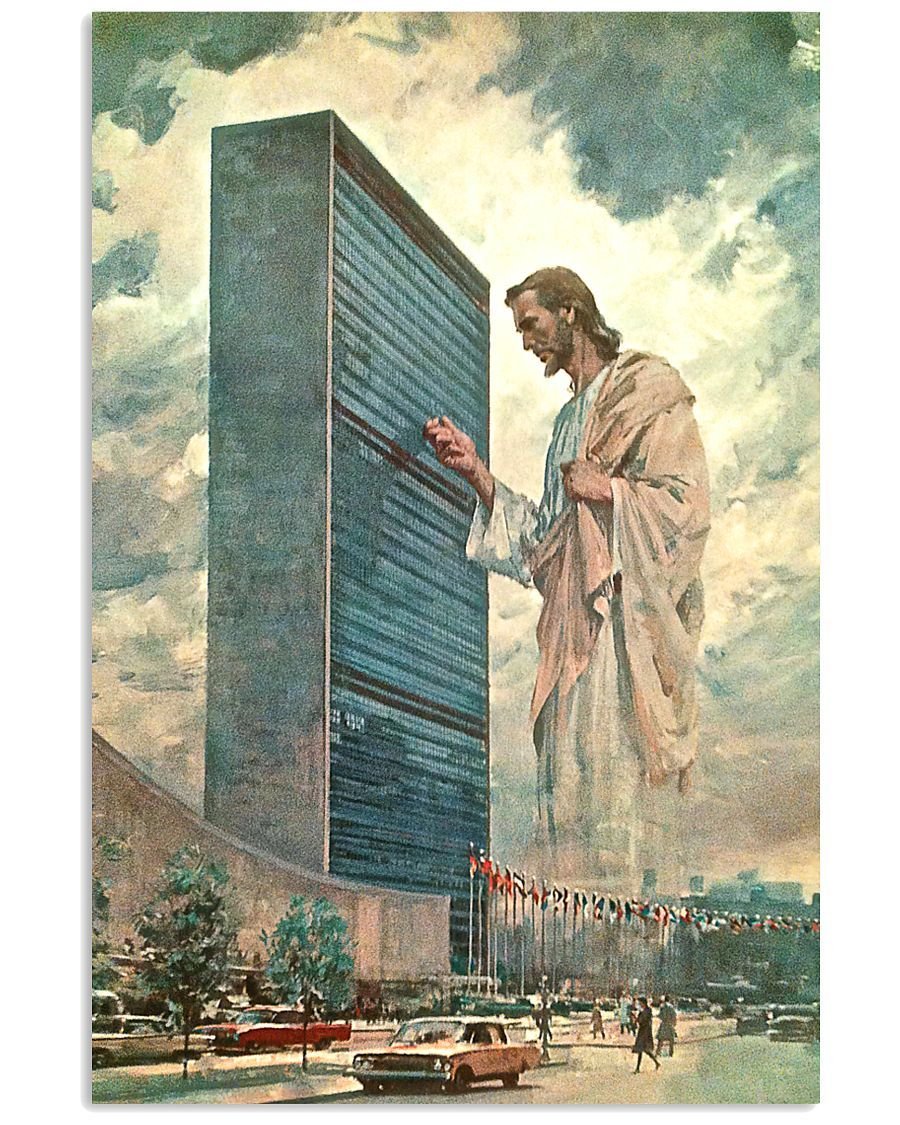
“Prince of Peace”, Harry Anderson, 1961.
When I was in nursing school one of the instructors gave us this advice: When you find yourself not knowing what to do next or unsure of what to say, wash your hands.
The thought was that you can collect your thoughts and plan the next steps while washing your hands. Even if you had already washed your hands, it is a good practice to wash hands when working with patients or clients.
I’ve been thinking about Ukraine and what I or any of us can do about it. It is so upsetting and unbelievable that at this day and age of 2022 we still have governments who think they can just trample over another sovereign country. (Ah, but therein lies the rub- there is no common recognition or definition among nations of who is sovereign.) But as we know, there is nothing new under the sun.
In this geopolitical scenario, we cannot solve this problem by washing our hands and certainly we cannot “wash our hands of the situation”. Even if one did not believe that we have any spiritual communality with and responsibility to one another (and by spiritual, I mean that we are all made in the image of God), we should be moved to do something by the sheer fact that these are fellow human beings- on both sides of the conflict: brothers, sons, fathers, mothers, daughters, sisters.
Lately, certain circumstances in my life have been totally out of my control. I find that I do not know what to do next and at times, unsure of what to say. But there is one thing I do know that I can do. I can pray.
I am thinking that the one thing that we all can do during this horrific situation with Ukraine is pray. Of course, the skeptics will say why bother- why would a loving God allow this bloodshed to occur in the first place? To that question- I do not know why. God’s ways are not my ways (thank God!) All I know is that when humankind does not get along, it is only through God’s grace that reconciliation can occur. That begins through prayer: prayer for the situation; prayer for the individuals involved; even prayer for the pray-er. Prayer changes situations but mostly prayer changes the individual who is praying. It helps refine the request, see things with a different perspective, keep the individuals for whom one is praying, foremost in one’s mind, and changes the heart of the person praying.
On Sunday, I read an article about the Ukrainian military inviting mothers of Russian soldiers to come to the border to pick up their captured sons. “You will be received and taken to Kyiv where your son will be returned to you,” the ministry statement says. “Unlike Putin’s fascists, we Ukrainians are not waging war against mothers and their captured children.” Sure, the skeptical part of me calls it propaganda but what a concept- recognizing that these soldiers are someone’s children.
I am wondering about the Russia mommas. Are they praying for their boys? Was this an answered prayer for them? Shouldn’t we be praying for all life to be spared?
Paul reminds us to pray without ceasing. That is a tall order for one person. I like the Orthodox concept of that: prayer without ceasing is knowing that we are collectively part of a praying community. When I cannot pray, someone else is. In a twenty-four hour period, prayers are being offered. Constantly.
I heard someone suggest- any time you hear a city named in the conflict, say a prayer for the people there. Pray for the world leaders. Pray for the Ukrainian leaders. Pray for the Ukrainian people. Pray for the Russian people. Pray for the Russian leaders. Pray that humankind will learn something from this conflict. And I pray that those on “the other side” are also praying.
I do not have enough knowledge nor imagination to know what to do next. But I trust in the ONE who does know. I trust that through our collective prayers, something will happen, for good and not for ill.
Loving Parent, How you must weep to see Your children not getting along. How it must break Your heart. Hear our prayers for safety and protection for the soldiers and all involved in the conflict. We pray for the Ukrainian people. Give them strength, courage and resolve-that they know that they are not alone in this endeavor. We pray for the Russian people- that they would have the courage to stand up to a bully government. We pray for the countries who are watching- that they know the right time and the right actions to step into the conflict. While we do not know why this is happening, we trust that You do and that You are working in this situation. Amen.
Don't Judge a Book by its Cover
This past week the radio announcer was talking about The Human Library Project. Founded in Denmark by two brothers and some colleagues, “Menneskebiblioteket” as it is called in Danish, is a place where a “reader” can check out a “human” book. During a certain amount of time, one person, “the reader” listens to the story of another, “the book”. Generally it is a story with which the reader is unfamiliar and perhaps has pre-conceived or pre-judged ideas. The idea of the program is that when we hear someone’s story we are more likely to reassess our stereotype of people and “unjudge” them.
The Human Library® is, in the true sense of the word, a library of people. We host events where readers can borrow human beings serving as open books and have conversations they would not normally have access to. Every human book from our bookshelf, represent a group in our society that is often subjected to prejudice, stigmatization or discrimination because of their lifestyle, diagnosis, belief, disability, social status, ethnic origin etc. (From the Human Library website: https://humanlibrary.org/about/)

What is your story? Where would your book be on the Dewey Decimal shelf of life?
What a concept: spending time with a person to listen to their story in a safe setting. In some ways it is sad that we have to have an organized arrangement to learn to listen to people who might have a different point of view or lifestyle than ourselves. Reminds me of the person for hire who will walk with you and consequently listen to you. The paid walker is what we would call a really good friend.
Our recently deceased friend was a great reader- not so much of books but of people. As many said, “he never knew a stranger.” He was genuinely interested in listening to others and in hearing their stories. As we have been thinking about him and his interests, we realized his hobby was people: getting to know them, introducing different people who might not normally intersect and providing such warm hospitality that being in his presence made one feel safe and loved.
To be a good reader of books, one has to actually read books. Most people don’t just dive into English literature when they start to read. It is a process starting with easy book and gradually tackling the tougher ones like heavy literature or scientific tomes. Either way, it takes practice and in doing so, one becomes a good reader.
Similarly, it takes practice to become a good human “reader”. Sometimes it is trial and error to know the right questions to ask another in order to draw out their story. We might experience an awkwardness in our attempts to either tell our story or listen to another’s. But, practice we must with listening and telling, because each one of us has a story. Some stories might be quite dramatic while others more predictable. Some might seem like fantasy or technical exposes. Regardless of how they may be written, each of us has our own story to tell and can only be told in our own way.
What about you? Have you ever had a chance to “read” someone? To listen to their story? How did that make you feel? Connected to that person? Entrusted with their personal story? Change the way you thought of them? Have you ever been the book- shared your story with others? How did that make you feel? Vulnerable? Scared? Connected?
Sometimes I think that the more we let the facade of facebook or instagram be our stories, the more we obfuscate our true selves. We are allowing the computer algorithms to divide us into categories. We don’t have the chance to personally interact with one another and in doing so, make a discovery. For instance, in talking to the person we may pass on the street, we might serendipitously discover that we have a common interest. Shared interests bind people and communities together.
I haven’t been to our local library in a while. When I used to go, I would go home with an armful of books- some familiar topics and some completely new ones. It is always the book that I “just picked up” that would give me food for thought and inspiration. I imagine that is what a human library is all about.
Breathing Exercises
“Lead with the breath”, instructed the online yoga teacher. It’s a common reminder in yoga. In order to do any of the positions/poses, one needs to remember to breathe. When one is having difficulty maintaining a balance pose, the first reminder is to keep breathing. For something that is involuntary, it is interesting how often when we are under “pressure”, in this example trying to maintain focus so we don’t wobble, breathing is forgotten. Many times when we are under stress we tense our shoulders and hold our breath.
I thought of other times we are instructed to breathe. In getting any type of x-ray, one is told, “Hold it. Okay breathe.” We are instructed to take deep slow breaths when we feel the fast and shallow hyperventilation that can accompany feeling distraught or anxious. We are reminded to breathe during pain. For instance, in child birth, the point of Lamaze is to breathe short, quick breaths through the contraction.
Breathing through pain always reminds me of a dear friend’s story. When his wife was pregnant, they dutifully took Lamaze classes and learned to breathe during labor, especially important during the final stages of strong contractions. Unfortunately, when the time came for the baby to be born, the wife had a very long labor which did not progress in a timely fashion. She had to have a Caesarean section, so they did not have any opportunity to use the breathing methods. However, many years later when he had a kidney stone, he remembered the short, quick Lamaze breathing which helped him with his kidney pain.
The benefits of breathing affect all body systems: natural painkiller, improves blood flow, lowers blood pressure, improves immunity, calms anxiety, improves posture, improves sleep, improves digestion, stimulates lymphatic system, detoxifies the body, reduces inflammation, increases energy level, and relaxes body and mind.
The idea of deep breathing is nothing new. Between 1830-1860 George Catlin, an attorney turned painter visited over 150 million tribal people in North, Central and South America to paint and study their cultures. He discovered that the Native Americans who did not adopt any western traditions or lifestyle behaviors, were far healthier than western society. Part of the reason, he surmised, was that they were nose (not mouth) breathers which in turn allowed them to take deeper breaths and thus reduce many ailments. *(Click here for an interesting read on his findings.)
It is interesting that not only leading with the breath is such a necessary action for our physical survival but breath is also elemental to our spiritual existence. From the beginning of humankind it was all about the breath: God breathed life into Adam. In both Old and New Testaments as well as the Quran, breath is considered God’s Spirit. Almost all of the Eastern religions speak about breathing for life, healing and existence. Breathing is, in a primitive way, quite mysterious. While we can see the chest rise and fall, we don’t see what is actually entering the body. We may know the anatomy and physiology of how oxygen is transported to the cells, yet we do not feel the internal movement or exchange happening on the cellular level. No wonder most ancient cultures treated the breath as something sacred.
I need to remember to breathe some days. I find that especially true when I have a lot of decisions, activities, responsibilities pulling me hither and yon. Situations that can topple me if I do not stay focused with one thing at a time and remember to physically breathe.
One of the pieces of equipment that was (maybe still is?) regularly doled out in any hospital stay was the incentive spirometer. It is a plastic breathing tube with a cylinder attached containing a moveable marker-either a ball or plunger, so that one could see how far one’s inspiration could move the marker. It is used to incentivize the patient to breathe deeply- getting the oxygen deep into the air sacs of one’s lungs in order to prevent stasis which could lead to pneumonia as well as increased oxygen to promote overall body healing. A very simple apparatus but critical in preventing further complications to one’s healing.

Generally, no one uses an incentive spirometer outside of the hospital (or maybe for a few days/weeks post hospitalization). Yet, I am wondering if it is not a bad idea to have one as a visual reminder to lead with the breath in all our activities. Starting our day? Breathe. Feeling overwhelmed at work? Breathe. Nervous before a test? Breathe. Sluggish? Breathe. Difficulty concentrating? Breathe. Anxious about a meeting? Breathe. Pain when moving? Breathe. Click here for simple deep breathing exercises. or here.
What about using one as a visual reminder for our spiritual breathing? Before we do anything else, how much are we leading with spiritual breathing? I do feel that our emotional side, just like our physical beings are tied to our spiritual breath. God’s breath can benefit me when I am being emotionally and spiritually pulled hither and yon. If I do not stay focused on what God has called me to do and on God’s promises, I can be toppled by a world gone crazy. There are plenty of stories, activities and choices that can pull me down if I do not continue to breathe in God’s goodness and grace. Just like the meter that gets higher and higher the more we practice with the physical spirometer, we can continue to practice filling ourselves with God’s spirit as we breathe in His word into our lives and as we trust Him to “oxygenate” every cell in our being.
What about you? Do you practice deep breathing? If so, when? Have you ever been toppled physically, emotionally or spiritually from “shallow” breath? What can you do to increase your breathing capacity? Physically? Emotionally? Spiritually?
“Lead with the breath.”
Not a bad suggestion for life.
Breathe on me, Breath of God. Edwin Hatch. 1878
Breathe on me, Breath of God, Fill me with life anew, That I may love what Thou dost love, And do what Thou wouldst do.
Breathe on me, Breath of God, Until my heart is pure, Until with Thee I will one will, To do and to endure.
Breathe on me, Breath of God, Till I am wholly Thine, Until this earthly part of me Glows with Thy fire divine.
Breathe on me, Breath of God, So shall I never die, But live with Thee the perfect life Of Thine eternity.
Rocks

I love rocks and stones. Always have. When I was little there was a tree in our backyard that was ringed with stones. The tree was close to my dad’s garden, and every year when he would turn over the soil, he would deposit around the base of the tree the new crop of rocks that emerged in the dirt. I loved that area. There was a large flat stone that became my table for all sorts of adventures. Some days the area was my island. Other days it became my house. It would be a place to explore and look for hidden treasure. Perhaps a sparkly quarts rock? Some rocks became characters in a story. It was a fertile place to dream and play.
I still love rocks. They line my gardens and fill my paths. I am especially drawn to beach stones. I love the cool smooth surfaces and how they change colors when out of the water. Very rarely do I leave the beach without a stone (or shell) in my pocket. For a time I was collecting larger beach stones to edge my one garden. Needless to say, some individuals in my household were not happy to discover that the beach bag they carried to the beach was much heavier on the trip home.
I’ve been thinking about the rocks that “grow” in our gardens. It was always a mystery to me how the same tilled patch of garden could form new rocks seemingly overnight. Of course, my ever logical son had to burst my magical thinking of reappearing rocks: “The earth shifts and moves and causes the rocks to move upward,” he said.
“The science behind the phenomenon comes from the fact that rocks are better conductors of heat than soil. As a result, as winter sets in, the rocks take heat away from the warmer soil underneath. The soil beneath the rock, now colder, freezes before the soil above and, since it contains water and water expands as it freezes, the soil does too, pushing the rock upwards through the unfrozen soil above. In the spring, at snow melt, the space under the rock fills with soil, supporting it. And so it moves upwards, year after year, until it pops up in your garden.” (*https://laidbackgardener.blog/2019/04/09/a-spring-harvest-of-rocks/)
Well shucks, I rather liked thinking that rocks were animated and moved on their own accord. Alas, while my son talked about them shifting and moving, I started thinking about rocks and life. Seems as if there is a lesson to be learned from our garden stones.
Turning over the same soil each year and finding more rocks can be quite annoying. Yet, in a field or garden patch the rocks need to be removed before they cause problems. Rocks can prevent the seed from growing. An undetected rock can break a plow or other garden tools as well as the undulated ground from the rocks can cause the gardener, farmer, or animals to stumble.
As problematic that the rocks may be, it is those same rocks that become the beautiful stone fences for the New England farmers. Many of those walls are still standing even after centuries of wind and weather. Think of all the life that lives in those walls- reptiles, mice, “volunteer” weeds and plants that fall in the cracks.
Even if we till the same patch of ground and think that it is free of stones, there is always something being pushed to the surface. In life, there is always something that is displaced or moved or needing to be moved. Sometimes things seem to pop to the surface: emotionally-an attitude, prejudice, pre-conceived notion or spiritually- doubt, trust, or faith. We wonder where did they come from? We might think that we took care of that issue and that we already removed that rock only to have one similar resurface again.
Things shift and move in our physical world too- health, weight, housing, relationships, cash flow, even jobs. The question becomes, can we use that changing item, that pebble, rock, or boulder in our life for something good, beautiful or useful? The thing with tilled soil- it is a lot easier to remove rocks from its beds, than soil that has never been turned over.
So when we see the emotional, spiritual or physical stone, do we recognize it for what it is and quickly remove it? Could that pre-conceived notion be removed and placed with other thoughts to keep out negativity? Or could trust and faith in someone or Someone, be placed as the foundation for the perimeters of our life?
What about you? What, if anything, in your life has appeared as a stumbling block? What happened to it? Did it get tossed on a pile of other similar stones? Did it get used for building something productive?
Clarity

If only there was such a thing as a clarity pill…. Although I am learning that trust works so much better.
There is a classic story about Mother Teresa and ethicist John Kavanaugh. Kavanaugh was questioning his future and was spending time with Mother Teresa in Calcutta. At one point he asked her to pray for him that he might achieve clarity in his decision.
“That I will not do,” she told him.
“I don’t understand. Why not?” he asked.
She smiled and said, “Clarity is the last thing you are clinging to and must let go of. I pray that you will have trust.”
Kavanaugh responded to her that he assumed she had always had clarity; that she always had known what she was supposed to be doing. To which Mother Teresa responded that she never had clarity; that all she had was trust.
Wow. One of the most dedicated persons to a life-long purpose and she never felt clear about her future. She could continue only because she believed in Someone who was reliable, good, honest and had her ultimate best in His hands. In other words, she trusted God.
I have been thinking a lot about that story recently. We are going through decisions in our family that at first blush seem to need clarity. But when I think about it- clarity is really for my own personal benefit of control. Clarity means that I can figure out what I am meant to do. Clarity means that I understand.
Rather, trust puts the sole business of who is in control into God’s hands, into the One who is reliable, good, honest and true.
Clarity: the quality of being easily understood; the quality of being expressed, remembered, understood, etc., in a very exact way; the quality of being easily seen or heard.
Trust: belief that someone or something is reliable, good, honest, effective, etc.
Abraham and his Sarah* tried to take future matters into their own hands especially when it seemed as if God wasn’t too clear about their future. Early on their life’s journey God had promised land for “all their offspring”. Just because they were getting up in years and didn’t have any children was no reason for them to doubt God, but doubt they did. Abraham tried saving his hide (really, you cannot have offspring if you are dead) by pawning off Sarah as his sister when they moved to Egypt. That choice of mistaken identity didn’t provide any clarity for the future. It just muddled the relationship with Pharaoh.
Later, Sarah decided that since this future “offspring” wasn’t happening any time soon between her and Abraham, she would have her female servant Haggai sleep with Abraham instead and that offspring would suffice. Unfortunately that offspring, Ishmael, complicated matters for that generation and beyond, muddling even today’s relationships between Jews and Muslims.
It wasn’t until Abraham took his journey up the mountain to sacrifice Isaac that we see it is not about clarity but trust. Abraham had no idea what God was going to do but he followed God’s direction. The instructions were clear yet they didn’t provide much in way of explanation: sacrifice your son on the mountain. As an only child, miraculously given to elderly parents who had only one shot fulfilling the “as many as the stars” progeny, it would have been reasonable for Abraham to ask God for a little clarity over the mission about sacrificing his son Isaac. Instead, Abraham trudged up the mountain and when little Isaac asks him where the sacrificial lamb was, Abraham responds that God will provide. Abraham had to trust that God was going to provide for him in that moment -either giving Abraham the strength to sacrifice his only son and provide another plan for a multitude of offspring or do something else. God did provide with the something else- a ram stuck in the thicket.
What about you? Have you ever prayed for clarity in a situation? What happened? Have you trusted in God regarding a situation? What happened? Did you ever see the unfolded whole picture? Or were things revealed slowly? What was your “something else”?
The interesting thing is that when I look back and think of the times that I prayed for clarity, they almost always required that I have some trust as I moved forward. Much time and energy was spent over trying to achieve clarity. If I had just started out with trust in the beginning, I would’ve been in such a better place.
Much as I would like to achieve clarity in some of these future decisions, I am willing to go with trust instead.
* At this point of Abraham and Sarah’s story, they are originally called Abram and Sarai. It was too confusing to use two different names for my retelling. (Reminds me of Russian literature- Why does Dostoevsky have to have names and nicknames for the same characters?) However, God renames them Abraham and Sarah when He gives them the covenant. Interestingly that happens before Abraham’s trust journey up the mountain. Abram didn’t have to “prove” his loyalty or obedience to be renamed, Abraham. Gives me comfort to know that I don’t have to prove to God my obedience before He has a relationship with me. He has already reached out and is waiting for me to trust Him. Of course, after I begin a relationship I want to trust God and align my plan and purpose with His plan.
Artistic Adjustments

John Constable, Wivenhoe Park, Essex, 1816. National Gallery of Art, Washington, DC
This past week I joined my son for a day trip to the National Gallery of Art in Washington, DC. I love going to the art museum. Art is a subject about which I know very little and I am always interested in learning more. To me, there is something elevating in seeing a beautiful work of art: I think it is seeing the creative God at work through the creative human.
There are certain paintings that I enjoy viewing. They always make me smile and feel good. I love the paintings of Constable- how he captures the outdoors especially the sky and the clouds. Even though this painting was done in 1816 in England, I have seen cloud formations like these over two hundred years later here in the Mid-Atlantic.
I have seen this painting many times, but I did not know that this was not his “original”. He had painted the scene of this home, commissioned by the homeowners, General and Mrs. Rebow. However, when it was almost completed,Mrs. Rebow wanted additions to the canvas. Constable added about three inches of canvas to both sides. He “covered the seams” on the left hand side, by painting a cow in the foreground and on the right side by adding the fishing boat.
What I love about this story- even a fine artist like Constable had to make adjustments. He had spent a good amount of time already sketching, drawing and painting the scene. Yet how true for us, whether in small ways or large, whether we are almost done or not, we have to adjust to changes through nature, society, others’ decisions, or our own shortcomings. Sometimes we have to adjust because of our own health, or misjudgments. Other times we change due to obligation or responsibilities. Sometimes it is totally out of our control and we just have to adjust.
The thing about Constable’s new painting, the changes he had to make, elevated the canvas from a very good painting to a masterpiece. By adding the additional scenes, he had to also make adjustments to the perspective. The “new” canvas shows an entire panoramic scene that we would have seen with our visible eye if we were standing next to him- the canvas includes the entire view. If the same scene had been taken by a camera, it would be somewhat distorted due to the limitations of the camera’s panoramic view. He fiddled with perspective so that we, the viewer wouldn’t have to.
What about you? Have you ever had to make adjustments to a project? Were was it in the process? At the beginning? Middle? End? Have you ever had to make an adjustment to an attitude or thought process? By doing so, did you make it easier for another?
I wonder if Constable minded having to make the adjustments? The following is from the National Gallery of Art’s book on British Paintings:
The commission, which was executed in August and September 1816, is described by Constable in a series of letters to his fiancée, Maria Bicknell. "I am going to paint two small landscapes for the General, views one in the park of the house & a beautifull wood and peice [sic] of water, and another scene in a wood with a beautifull little fishing house," he wrote on 21 August. "They wish me to take my own time about them—but he will pay me for them when I please, as he tells me he understands from old Driffeild that we may soon want a little ready money. "
The next letter, written on 30 August, explains why he had to extend the canvas by over three inches on either side: "I am going on very well with my pictures . . . the park is the most forward. The great difficulty has been to get so much in as they wanted to make them acquainted with the scene. On my left is a grotto with some elms, at the head of a peice [sic] of water—in the centre is the house over a beautifull wood and very far to the right is a deer house, which it was necessary to add, so that my view comprehended too many [distances]. But to day I have got over the difficulty, and begin to like it myself. I think however I shall make a larger picture from what I am now about. .. . I live in the park and Mrs. Rebow says I am very unsociable." He reported on 19 September: "I have compleated [sic] my view of the Park for General Rebow." Constable received a payment of one hundred guineas for this picture.”
Did he have an inkling at the time that this canvas would someday grace the walls of a museum? The painting and his story reminds me that if I have to make changes, there is always the possibility that the adjustments just might transform what I am doing, thinking or saying from something ordinary to something wonderful.

Probably what he was initially thinking before Mrs. Rebow asked for the additional changes.
(B)Limey

While I am not a naval historian, it has been argued that the British Navy dominated over the French due to the one simple fact that Britannia ruled the waves through lemons.
In 1795 a physician named Gilbert Blane convinced the British Royal Navy to issue some form of lemon juice to its sailors. His order may well have changed the course of history because it allowed Great Britain to successfully defend itself from a Napoleon-led invasion by setting up a blockade of the English Channel. This blockade, during which many ships spent months on the water without coming to port, went on for 20 years—a feat that scurvy would never have allowed.*
The Brits had figured out that lemons prevented scurvy in the sailors. Thus they had the man power (since scurvy could wipe out a crew) and better fitness than the French. Over time, the lemons were switched out to the more plentiful limes thanks to the bounty of the East India colonies, earning the sailors the nickname, lime juicers which became shortened to limeys.
As an urban legend, or more accurately an ocean legend, it sounds great. While there is truth in the story the details are lacking. There were other reasons for the British Navy to prevail as well as there were other attempts, failures and successes to prevent scurvy.
Scurvy was the bane of the sailor’s existence. It is a horrible and gruesome illness leading to death. Over the years, many British crews as well as other sailors were lost to the disease. In 1744 Commodore George Anson returned from circumnavigating the globe. Out of his almost 2,000 original sailors, only 145 returned. While only four sailors died from enemy action, the rest of those lost were due to scurvy.*
Scurvy is the lack of vitamin C in the body. Vitamin C is needed for tissue integrity. It helps with the formation of blood vessels, muscles, cartilage and collagen in bones. It is an anti-oxidant and is key to healing. Humans, some primates, guinea pigs, some bats, birds, and fishes do not produce their own vitamin C and need to ingest it from other sources. It is thought that “in all cases so far studied, the inability to synthesize vitamin C is due to mutations in the L-gulono-γ-lactone oxidase (GLO) gene which codes for the enzyme responsible for catalyzing the last step of vitamin C biosynthesis. The bias for mutations in this particular gene is likely due to the fact that losing it only affects vitamin C production.” * As a species, for humans to have the “mutation” is not really a problem as long as we can ingest the vitamin.
All throughout the centuries of sailing and global exploration, different countries and explorers would “discover” that the use of fresh fruit and vegetables containing Vitamin C would prevent or quickly cure the disease. However, that knowledge would be forgotten or overlooked causing scurvy to prevail. Even if it was determined that fruit or vegetables containing vitamin C would prevent scurvy, the practice of using that food was still slow to be adopted in the navy protocol. [Interestingly, it was discovered that the sailors who ate the ship’s rats did not get scurvy since rats produce their own vitamin C. Not my first choice for sourcing vitamin C.]
It was James Lind, a ship’s surgeon who in 1747 did one of the first “scientific studies” with one of the crews. He divided the sickened sailors into six different groups each receiving different treatments. It appears that the group that received lemons and oranges recovered enough to even help out the other sailors who were deteriorating.
The unfortunate thing about Dr. Lind’s “scurvy experiment” was that the cure was once again, forgotten for years. It seems that with the history of scurvy, although an individual ship might have received guidance from natives on vitamin C enriched plants and therefore would physically survive the scourge on the crew, there was never any remembrance or carry through to another ship. There was not a ruling from the Admiralty or any of the other country’s navies until almost fifty years after Dr. Lind did his experiment.
Still, I like the image that one thing, eg limes, can make all the difference. It has me thinking- what one thing could I do or not do that would make the difference to me? What one action or new behavior would put me on a different path?
I think of the individuals who decide to embark on better health and they start by doing one thing- say walking for ten minutes in the morning or doing some chair/standing exercises each hour. Doing one thing will begat another behavior, turn ten minutes of walking into twenty and before they know it, they are moving quite a lot and feeling better.
Same could be said with wanting to improve nutrition: What is one thing that can be incorporated into one’s meals? Perhaps it is adding a cup of fruits or vegetables per day or drinking a glass of water upon arising and before meals. Or, trying to improve nutrition by not mindlessly snacking- to eliminate one snack a day.
I think of individuals who want to go deeper in their spiritual lives: What is one behavior that can help draw one closer to God? Perhaps it is increasing (or starting) Bible reading or prayer. It could be done through a ten minute Bible reading app on one’s phone or taking five to ten minutes before beginning work or opening any social media, to pray.
Or individuals who want to improve their intellectual health: What is one thing that you would like to learn? What small activity can be made each day to achieve that? Learning a new language through small daily classes? Practicing an instrument twenty minutes a day?
Or those who want to improve one’s emotional health? Could the simple act of writing a gratitude list each day or sending a text or email of encouragement to another person help? Or making a plan to do some volunteering?
What about you? What are some “one thing”s you can do to make a change in your current situation? Perhaps it was something that you used to do and was forgotten. Would it be appropriate to reintroduce to your lifestyle? It may not be much and it may not be “the end all, be all” for your life, but it might set you on a trajectory towards something better.
What do you have to lose? The Dr. Lind’s citrus eating experiment was by far (to me) the most palatable of the “solutions” at the time: others included urine mouthwash, “elixir vitriol”, seawater, cider. Over the years, it would be “re- discovered” that citrus juice and vitamin C prevented scurvy and then that information would lost along the way. Perhaps because it was too obvious and too simple?
That is the other thought about doing “one thing”: it may be an obvious and simple activity/behavior but the overall achievement can be life changing.
*https://www.ncbi.nlm.nih.gov/pmc/articles/PMC3145266/. https://www.sciencehistory.org/distillations/the-age-of-scurvy. https://theconversation.com/how-the-british-defeated-napoleon-with-citrus-fruit-58826.