
Do Something

What is the one thing you can do? Give up your seat? Literally? Figuratively?
“No one can do every thing, but every one can do some thing.”
In the last month I have heard that expression in different ways and in different venues- in a radio interview, during news reports and in my church class. Regardless of how it was conveyed, it has made me wonder, what is the “do-some-thing”, that I can do.
My grandmother was a do-some-thing kind of gal. She wasn’t any one “special” except in the eyes of those who loved her and those she encountered. She was generous, encouraging, interesting and interested in others. She looked for the good in all situations. She saw needs and she did what she could to meet those needs regardless of her age and circumstances.
In her last twenty years of life (she lived to be 97) she lived near my parents in Massachusetts. At that point in her life, she was a widow and fiercely independent. (She lived alone in her home until the last two weeks of her life when she was hospitalized.) Every day she would drive to the beach to “sniff the salt air”. But she also went there to pick through the trash and recycling looking for bottles and cans that had deposits. Those she would redeem at the store and use that money to pay for postage to send items of clothing (she either made or bought at a local charity shop) for a charity she had supported for years: Christian Appalachian Project. I never knew why she picked that project but she was faithful in supporting it for years. It was one of the some things that she did for others.
Recently in our church class we were talking about all sorts of global and personal situations. One of the participants shared about his father. His dad was another one who did what he could for those who were around him. He said that while his dad was very much aware of what was going on in the world, he didn’t focus on that. Rather his father focused on doing what he could for the people around him.
I’ve been thinking about how I can help those who are in need around me. How can I be a blessing to someone else? I have shared before that I have a small bin in the front of our home to collect non-perishable food items for a local food bank. That seems to be a tangible, easy way for me to help. My neighbors and friends have been very generous. The box also reminds me and keeps me accountable to pick up a couple extra boxes of pasta, cans of beans, hearty soups, or cereal when I go to the store.
Of course, isn’t that what we can do? Impact those we can, however temporarily. Regardless of our circumstances, we should make life’s journey less of a burden and more of a blessing for someone.
We may never know what those expressions and actions of kindness, niceties and quite frankly, manners will impact someone else. But the science is showing that these kindnesses can benefit us: helping others benefits ourselves more than we know. When we help others-serotonin, dopamine, oxytocin, and other endorphins are released. These substances help us feel good. In my case of collecting the items for the food pantry, it is just a short walk to the food pantry from my home and it brings me such joy to pull my little wagon full of food there.
Science is proving that which God knows and knew when God created us: It is more blessed to give than to receive. On so many levels. Sadly, those who are takers in this world will never realize that benefit. Because ultimately besides all the physical benefits of giving, that benefit of blessing brings peace and love.
There is a line in the old movie, “While You Were Sleeping” that I think about whenever I think about small actions of kindness. One of the characters is despondent thinking that he hasn’t done anything significant or special in his life. Another character who has watched him for years says encouragingly, “You give up your seat every day on the train.” He replies, “Well. But that’s not heroic.” To which she replies- “It is to the person who sits there.”
What about you? Do the problems and situations of the world get you down? What is going on in your neck of the woods? is there anything, even some little thing, that you can do to help? Or, perhaps you already are doing some thing. What have you been doing? How can that encourage someone else?
In these times of difficulty for so many people and while global situations may seem overwhelming, maybe we should take a step back. Maybe we just need to do- some-thing for the people around us who need help. Our do-some-thing might not require much effort: We just need to pay attention to what is going on around us and have a little imagination. Perhaps, all we need to do is give up a seat for someone who needs to sit down.
A Few Ideas:
Having a holiday party? Ask guests to bring one non-perishable item for the local food pantry.
Start an ongoing collection box in your neighborhood for non-perishables for your local food bank. Or, if you live in an area where your vegetables are still growing- plant some extra vegetables in order to give away the fresh produce.
Pray for others. What better gift to give to someone else, than to bring their petitions to the One who created all of us and knows exactly what we need and what needs to happen in our lives.
Helping Others
“Whoever brings blessing will be enriched, and one who waters will himself be watered”

There is an article in the NYTimes called “The Science of Helping Out”: The idea is that “during a crisis, the people who do best are ones who help others.” In essence, “to help yourself, start by helping others.” ( Click here to read the article.)
The writer of the article quotes Adam Grant, researcher from University of Pennsylvania who has written multiple books on achieving mental health wellness. Dr. Grant noted in his recent book, Give and Take: A Revolutionary Approach to Success, that being generous, helping others, doesn’t cost much and provides immeasurable benefits. The idea is that volunteering, donating money, helping in various ways provides “feel good” hormones as well as reducing stress hormones.
In another study, it was noted that high schoolers who helped out middle schoolers with their homework, not only felt good about themselves, but also were more likely to complete their own homework.
I think there is a feeling that by helping one another, it might impact or prevent one from accomplishing what needs to be done. I certainly feel that way at times. I can be “distracted” from the goal at hand because there might be a need with someone or somewhere else.
Recently I was at our little cottage getting some outside work done. Normally, when I have to complete a task that in my mind is “maintenance”, I just want to get it done and move on. (When it is a more “creative” project, I do not mind the pauses, thoughts, or reflections during the process.) Alas, last week it was a maintenance project: shifting a HUGE pile of wood chips around our little “wooded” area behind the house. I was in the head-down, on a schedule, determined to accomplish this before I had to return back home, mode.
Our little neighborhood is, to me, very relaxing. Life moves at a slower pace. Many neighbors (retirees- perhaps that explains the pace?) walk outside and love to stop and chat a while. Consequently during my outside project I met many of our neighbors. One in fact was recovering from a broken leg and in the conversation, I found myself offering to help her with her large dog (mainly, I thought setting him outside on his lead). Well, in for a penny, in for a pound, I ended up walking the dog around the neighborhood, multiple times in my two day stay. While this diversion may have taken the time from my original plans, I was surprised at how much I was able to accomplish even with my “distractions” and thus did finish what I had planned.
The writer of Proverbs reminds me that it is beneficial to help others. Thousand of years before, the writer knew what Dr. Grant and others have discovered: helping others is one way to help yourself. Sure, one can feel good with the release of the endorphins and all the other feel good hormones. But there is something about the economy of time and helping so that when one helps another, the time is not wasted but “added” back. In the parlance of the modern scientists, helping others builds our resilience and increases our ability to handle stress and problems. “Small acts are important, Dr. Steven Southwick professor emeritus of psychiatry from Yale, states, “Part of that might have to do with just getting outside of myself, and finding meaning and purpose in something bigger than myself.”
What about you? Have you ever been interrupted in your work? By what or whom? Have you ever been enriched by the blessing you bestowed on someone else?
However, this isn’t a “get blessed quickly” scheme. Helping with the sole purpose to receive something back is transactional and not altruistic nor a blessing and not, I think, the point of the Hebrew writer. Helping to be a blessing without a thought to our own personal gain is putting our thoughts and actions into proper priority. But, there is something to helping even if you do not feel like it. Sometimes, as my mother used to say, we have to act “as if”- as if we are feeling altruistic, as if we do not care if we receive anything in return.
Why not look to bless someone else today? What do you have to lose? You may even gain more than you give.
W@TW: Perspectives
In starting this post, I realized that I have written about perspective a bunch of times. I also realized that I need to hear it one more time. Perhaps you do too? It is always interesting that if I look and am observant, God puts in my path examples of what I am currently experiencing and new ways to view my life.
On a recent dog walk, I strolled* through the campus of a local university. The students had not yet returned from break and it was interesting to see the changes of new buildings and walkways on campus. There also appeared new outside art installations. I came across the following:
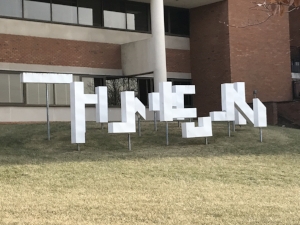


Viewing the installation from the side, it looked like random white blocks on sticks. But standing in front of the artwork, you could see the name of the school spelled out. I had to take a picture of it as the reminder for me at that moment was just as revealing as the blocks aligning into something recognizable.
Lately, I feel that I am viewing life as random white blocks on sticks: nothing seems to make sense, nothing is ordered and nothing is clear. It feels like I have been sucked into a vortex that doesn't allow me to see anything but the swirling chaos around me. I know that what I see is not the entire truth and the reality of my life. It just is hard to step out of that sucking tunnel.
But, step out I must. I know that I must make the effort to move my location and change my perspective. If not, I will become washed out, useless and bitter about my situation. "How come my white blocks don't spell anything?" I'll be stuck in my disjointed views and never see the way life can actually be.
I need to keep perspective by looking at the situation and my life in a different way:
- Perhaps I need to remove myself from where I am standing? Literally. I need to get out and take a walk or visit a new location.
- I might need to remove myself from a relationship or activity that holds me to a certain perspective. It might be a position that is expected from all the parties involved, or it is a position that has become comfortable and therefore provides no challenges and produces inertia.
- Or I need to help someone else see his/her white blocks aligned. Through that process, I might see a connection to my own situation and thereby help me to get my own blocks aligned.
What about you? Do you ever feel that you are stuck at looking at your life from one direction? How do you get out of that rut? Do you think you even need to get out of a rut? Is there anything wrong with ruts or one perspective?
Yesterday afternoon, I got out from my normal routine. I had a leisurely lunch with a friend who provided me with a new perspective on my situation. What was new and refreshing about this get together, was that neither one of us was rushed to a next thing. We were able to dive a little deeper with our discussions and let the conversation twist and turn through a wide variety of topics. I came home refreshed, encouraged and renewed. She helped me align those random blocks into seeing some words.
When you look at your life, do you see white blocks on sticks or do you see a word?
*(Lately our two have been awful in the lack-of-wanting-to-walk department. Must be because it is cold. They absolutely loath their jackets and many times our walks become more of a "drag" than a walk.)
One Hand
This week I committed the cardinal sin of kitchens. I placed a sharp cutting knife in the soapy dishwater and forgot about it. Only when I was washing the dishes did I come upon it- by slicing the tip of my left-hand, middle finger.
Yikes. Talk about blood. God love my "faint upon seeing blood" husband. (He now has a sticker in his medical chart. He must lie down with his feet preventively above his head when he gets labs drawn. Too many times when he passed out giving a small vial to check his hemoglobin,etc.)
Once I got the bleeding somewhat under control, he helped me put a butterfly bandage on it. He always amazes me. He knows just what to do and does it. Part of it comes from his first aid training in Boy Scouts. In fact, he was the one who taught the class at Boy Scout camp. I always wondered how did that work? Didn't he faint as he taught the class? "Purely theoretical", he replies. (It is after the crisis is over, will he have to lie down and let the color return to his face.)
I now have 2 butterfly bandages on my finger, plus a flexible fabric bandage to contain the antibiotic ointment and another knuckle bandage over top of it all. It really extends my middle finger so that when I move my hand, I look like I am perpetually ticked off at everyone. (which some days describes my mood)
The thing is, having limited use of my left hand is a big annoyance. It is just a small appendage, but I have to rethink what I am doing. I don't want to get that hand wet because the soggy bandages have to be continually changed. I don't want to use it when I garden because I don't want dirt in my cut. So many things I do, require that I use both hands and for the time being I can't.
"Two hands are better than one". That is certainly an apropos adage. Two hands can provide strength, support, and symmetry. For us as individuals we need to have the balance of both sides.
It makes me thing that in the global sense, we need two hands; we need the balance of both sides. We need the strength, support and symmetry that comes when there is more than just one idea, one way of doing something, or one solution.
With my one handedness, I have to ask my husband to help. I find that it is quite a bother because I am, as I have mentioned before, an independent cuss. It is humbling to have someone else button a button or fix a clasp.
But isn't that what we are asked to do? Help others? Give support? Provide strength? Be humble?
Just like we need two hands, we need one another.
What about you? Ever have trouble with your appendages? Temporarily or permanently? What did you learn with that experience?
In this Day and Age
This past week I heard another story on the radio about women and the difficulty of their lives. The thought came to mind that in this day and age it is still unbelievable that we have racism, sexism, and poor treatment of others. For all our accomplishments as humans, we still hear story upon story of age-old problems: hunger, disease, warfare, hatred, discrimination, and domination. As a species, have we learned anything?
But then I thought, why does it have to be the negative? Why cannot we say, "in this day and age.." of things that are positive? In this day and age, can you believe that we can talk to someone across the world? In this day and age, can you believe that surgeons can stop a heart and replace it with another? In this day and age, can you believe we can open a metal box and find something to eat? For the general population we no longer have to spend most of our days hunting, foraging, sowing and harvesting. For many of us we do not have to worry about shelter, food and our immediate survival.
If we have advanced beyond the basics, are we improving the lives of others? Are we moving beyond a day to day existence to something more?
I am reminded of the Biblical story of Esther. She was the only one in a position to save the lives of her people. As her uncle reminds her, she was born for such a time as this. The question becomes in this day and age and in this time and place, am I helping to improve the lives of others?
I think all of us are born for such a time as this. For whatever reason, and it is partly our responsibility to figure out our purpose, we are born into our set of circumstances: family, time, place, temperament, gifts and graces. I am living in this day and age. The next question becomes, how am I living it? For the improvement of myself and others or as a repetition of the same old human condition?
What about you? Have you ever felt that you were born for such a time as this? Or do you feel that you are a pawn in the game of life and that you don't have much say in the matter? I believe while we cannot change some of the basic facts of our place and time of birth, we can choose to embrace and improve the situations we find ourselves.
In this day and age we can choose to focus on the positive and the improvement of the day and age.
Burnt
This past weekend we watched the 2015 movie Burnt starring Bradley Cooper and Sienna Miller. We had wanted to watch it for a while and so finally did. I guess with so many things the anticipation is greater than the actuality. While I enjoyed it, it wasn't quite what I expected. The story line was predictable and kind of slow yet it had some good points.
It is the comeback story of Chef Adam Jones. A chef who had it all but lost it due to his own choices. It is a redemption story yet lacks the how, why and what of the cause for loss and reason for the turn around. But through it all there runs the theme of going it alone versus team work. The bottom line, in life It is all about the team, or the family, or the business -whatever you want to call your collective- cooperatively working together.
I think that is one of those truths we know but we truly do not grasp. I know that I am stubbornly independent which it not good at times. I have a tendency to be like the little red hen that if no one is going to help or help in the way I want, I will just do it myself. The fable of the little red hen is just that- a fable. But I think it speaks to how many of us feel. We say to ourselves: Fine, we will just do it ourselves. We don't need anyone else. I can just pull myself up by my own bootstraps. If I just work harder and smarter than anyone else I will achieve what I want. No one else will do it the way it needs to be done, so I need to do it...
Yesterday the sermon at church talked about our gifts and how we are called to use them for God's glory and to benefit others. The thing is, we are called to use and "give" our gifts to others but we also need to receive the gifts of others. No one can do everything. Even if we had all the resources in our personalities, abilities and lives, if we try to do it all we will get burnt out. We know that we don't have it all. We need each other to fill in and complete that what is lacking in ourselves. It is through the collective that we are truly whole.
What about you? Do you try to do it all? Do you suffer from the little red hen syndrome? How are you at sharing your gifts and talents? How are you at receiving from others? Do you feel burnt? What would it take to heal? Do you have a redemption story?
Poverty Inc.
Last week my husband and I attended a showing of the movie, Poverty, Inc. which also included a panel discussion afterwards. The movie was educational, inspirational, and thought-providing. It also was convicting. The main premise is that the way we (wealthy, "developed", western world, whichever word you choose) have "dealt" with poverty and those who are struggling is not sustainable, nor healthy. In some respects those who are trying to help are really hurting and keeping people in poverty. The title Poverty, Inc. suggests that there is a huge business in the multitude of NGOs (non-government organizations) and in the system we have created, all in the name of helping.
One of the biggest hurdles is that those who help never ask the ones who they are helping what they want. How do they (the impoverished) see themselves and what would be the best plan to get out of the situation? For many, many years the people who are to be helped were never themselves factored into the equation. They were just told to do certain things in a certain way or they were given things without any idea of how to get those items on one's own all in the name of "aid". It was a very paternalistic approach which on so many levels doesn't work. Not only does the poverty perpetuate but the self-esteem of the one who is being helped is chipped away.
It got me thinking. The crux of this larger global problem is no different than helping a family member or a person in one's community, or coaching a client; each individual has the right to self-determination. Each person knows what they want to achieve or has some inkling that needs to be unearthed. Of course, some might not have the tools in their toolbox to do so, but that would be part of the overall plan- discovering what is needed to learn in order to achieve the goals. And a plan includes steps to achieving goals. Many times even if if the person has determined that they need such and such, if there is not an overall reason for getting those needed things, it is not a plan.
Most people are compassionate, generous and have big hearts. We want to help others. We may in the name of love try helping by providing "aid"; money, food, help, etc. but if the one who needs assistance doesn't ask for it or hasn't determined what he/she wants, the assistance won't be sustainable. As it was pointed out in the movie, sometimes the seemingly generous logical task, i.e. donating used clothes to countries in Africa, unintentionally causes harm- cotton growers and textile manufacturers in Kenya have gone defunct. People say why should I buy clothing when I can get if free? And so an entire industry and livelihood is gone.
The new buzz word is partnership. Those projects that work the best are those that the nationals have determined would be best for themselves and their community. They shared a beautiful antidote of a company in Haiti that is using the local community to make beads and necklaces that are being sold to various stores in the United States. They use low-tech technology to produce the beads and have sold enough to continue employing people. From starting with just one or two employees, currently they are up to a couple hundred. This provides the adults in this community to have a wage and to care for their children. There was a story of a woman who had turned up to the orphanage to hand over her child for whom she couldn't care. (Apparently this is a big problem- parents are "sacrificing" one of their children to an orphanage, knowing that the child will be educated, cared for with food and medicine and may have an opportunity to live a better life with another family. The child has parents but they are at a loss of what to do since there are minimal jobs.) Someone asked her, if you could work would you keep your child? Of course was the reply. The bead group took her in, she learned to make beads and she set small goals for herself. i.e. If I make so many necklaces in the next couple of months, I can buy a small 2 room house where I can live with my children. Powerful. And it wasn't some complicated economical formula. It all started because someone asked her what did she want.
I think that there is a lesson for all of us. What do you want and how do you see yourself going about doing that? What is the overall plan? No matter what our income, we all can feel at times that others are determining our lives and that we have no say in the matter. We need to stop and ask of ourselves and those whom we are helping- what do you really want? How do we want to go about achieving it? We are called to give dignity to everyone and many times that starts with a simple dialogue of listening to their needs. The antithesis for Poverty, Inc. comes down to the golden rule: do unto others as you would want done unto you.