Sick Day/Snow Day/ Sabbath

Three weeks ago I woke up with a head cold. You know the type: eyes are sore and feel heavy, headache, congestion with intermittent nasal drainage followed by trickling-down the back of the throat, guaranteed to cause fits of eye-watering coughing in which you think you will cough out part of your brain and lungs. Wasn’t the flu and it wasn’t covid. Just the old-fashioned head cold.

So, I cancelled/postponed any in-person meetings/events, drank lots of fluids, and rested. I had to take a sick day (actually a bunch of sick days until I was reasonably “normal”.)

While I find being under the weather incredibly annoying, secretly it was kind of nice to have an excuse to not be so busy. Dare I say, it reminded me a little of the pandemic and those open-ended days.

Of course, during the pandemic, I was feeling healthy and so, feeling a little cooped up. For most of the cold week, I wasn’t feeling like doing anything: didn’t want to read, or watch any movies, or even sleep.

The tree outside our front windows.

On Monday, we had a doozy of a blizzard in my neck of the woods. The governor banned all travel on Monday and Tuesday. Our street had one lane plowed (we are the emergency route) but all other streets around us have not been plowed as of this writing. Fortunately we have power and so it is another type of rest day.

But this feeling of having a “sick or snow day” intrigues me. Many years ago, in the employment parlance, they talked of a “mental health day”. Not sure if that is the correct term nowadays.

There is something to be said about having a mental health day- a day to clear one’s mind and to reset the pace of our living.

Of course, the Creator of the Universe- which includes the creation of each one of us- knew that we needed a regular “mental health day” which God called the Sabbath. Of course, Sabbath is different from just taking a day off, in that there is a spiritual element to it. The fact that we become, “short-changed” each week of a productive day is one of faith: We rely on God’s time not our own. Just like God’s economy of money, in God’s economy of time, when we give to God first, miraculously, all our needs, demands and responsibilities are met.

According to the Mayo Clinic, everyone would do well to have a mental health day, before any burnout or “sickness” really occurs. It is a day to recharge but not necessarily to just do nothing- or to sit or lie in bed all day (though, I imagine for some, having a day or part of a day like that would be a luxury and well received.) The Mayo Clinic suggests the following: *

  • Unplug social media

  • Review Goals

  • Be creative

  • Get physical

  • Spend time outdoors

What about you? Have you ever taken a mental health day? If so, what was happening for you to do so? Or, do you keep going until something, like a cold knocks you out? Do you regularly practice a Sabbath? What does that look like for you?

During this Lenten time, some people take on a practice. I have been sending out daily words for us to contemplate. In addition, I would encourage us to practice a Sabbath on our Sundays: to take some time outdoors-noticing the beauty of the created world, to do something other than our routine on “normal” days and to look at our surroundings with a heart posture of gratitude.

*https://www.mayoclinichealthsystem.org/hometown-health/speaking-of-health/recharge-with-planned-mental-health-day.

Lent

Today is the beginning of Lent- the forty days prior to Easter, not including Sundays. Not growing up with a liturgical background, Lent really didn’t have any specific meaning to me. I remember my neighborhood playmate who, being Catholic, “gave up” something for Lent. Usually chocolate, sugar or something of that nature. It baffled me, “You mean you can’t have this cookie?” I would ask Kathy. I was grateful for being Protestant and therefore, didn’t have to do that.

In more recent years, I have become more interested in the liturgical calendar and the rationale behind the design. I see the symbolism, the mystical beauty and comfort of the liturgical rhythm. I see how it all fits together and is such a great teaching tool especially for those who are different types of learners.

Just yesterday, I received an email newsletter from a pastor that I sometimes read. She suggested that for Lent, instead of giving up an item, think about giving up an attitude, namely to give up despair or discouragement. She is encouraging people to notice the good around each one of us. And while social media may be a contributing factor towards our despair, she is encouraging others to use social media to spread goodness.

The idea is to notice something good every day during Lent and to share that positivity through social media.

One of my absolute favorite quotes.

Her only criteria is that it has to be something that you personally witnessed. It cannot be something that was reported on a social media page. For instance, she would not comment on the walk for peace monks because she has not personally seen them. But she would report on a positive conversation she had with her neighbor.

I like her idea and was thinking our little community could join in with this conversation or just encourage each other.

What I am proposing:

  • Each day in Lent I will post a picture with a word of encouragement. (If my technological skills work, the picture and word will be on: the blog-wellofencouragement.com, facebook.com/virginiaruth.author, instagram.com/virginiaruth010-@virginiaruth010)

  • I would encourage you to ponder that word and keep your eyes open for examples of it during the day.

  • Journal about the experience.

  • Write a comment, take a picture, share an anecdote about that word.

  • Share your thoughts either on the comment section here or on one of the other social media sites: facebook or instagram- include the hashtags: #40DaysLentenEncouragement, #40DaysofGoodShit. (I apologize for the language but that is the link for the pastor.)

  • If the word doesn’t speak to you that day, ponder Goerthe’s words:

“Every day one should at least hear one little song, read one good poem, see one fine painting and -- if at all possible -- speak a few sensible words.” ― Johann Wolfgang von Goethe.

As we journey these 40 days together, may we experience Lent in a new and eye-opening way this year.

Adaptation

This year as it has in the past 25 years, the town of Mt. Olive, NC dropped a pickle from the Mt. Olive Fire Department Tower 23 to mark the ringing in of the new year. 2026 will mark the centennial of the Mt. Olive Pickle company which sponsors the drop.

The company was originally started when an immigrant from a nearby town noticed that the surplus of local cucumbers were going to waste. He and another friend came up with the idea of brining the cucumbers and then selling them to other pickling firms. While that plan did not take off, a group of local people saw potential in the idea and decided to start their own pickle company. Thirty-seven business men put in the capital for the company. They called it a “community proposition”. The two gentlemen who originally came up with the idea became the factory superintendent and the company salesman, respectively. 100 years later, the company is still privately owned and has become the #1 pickle brand in the US.

Making lemonade out of lemons. Or, pickles out of excess cucumbers.

I love to hear stories of imagination, adaptation, and finding another solution. Finding repurpose.

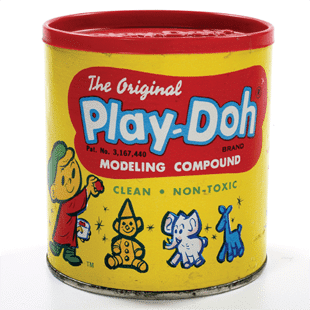
Such was the case for Play-Doh. Originally, it was a putty-like substance for cleaning wallpaper. In the days before WWII, wallpaper would attract dirt and soot from coal and wood stoves/heaters. The cleaning compound which was made by a soap company, could be rubbed over the walls to clean the soot. After the war, new, easier to clean vinyl-type wall paper was introduced. Simultaneously there was a move from coal stoves to oil and natural gas, which reduced interior soot. There wasn’t a need for the compound and the company almost went out of business. The nephew of the inventor of the cleaning substance was hired to help keep the business from bankruptcy. The nephew’s sister-in-law was a nursery school teacher who had read an article that the wallpaper substance provided good modeling clay for students. And so, the nephew pivoted the company into making a child’s toy with the sister-in-law’s inspiration for the use and new name, Play-Doh.

For those of you who grew up with the ubiquitous childhood modeling clay, remember the scent? Apparently the scent is so distinctive, in 2018 Hasbro (the toy company who now owns it) trademark registered the scent with the USPTO. It is described as “"combination of a sweet, slightly musky, vanilla-like fragrance, with slight overtones of cherry, and the natural smell of a salted, wheat-based dough.” Originally, it only came in an off-white color but shortly after marketing it to children, it was offered in blue, red and yellow. I remember upon first receiving Play-Doh for Christmas, (maybe I only received it once, but it seems to me it was always a stocking stuffer) keeping the colors separate for a little bit of time, but eventually I would have a massive ball of multicolor flecks and odd shades. There always seemed to be crusty dry pieces attached to the outside that never quite reintegrated with the rest of the mass.

Turns out, another childhood stocking stuffer was also a repurposed product- Silly Putty. Silly Putty was originally made to be an experimental rubber replacement. During WWII, America couldn’t access the rubber plants needed for tires, equipment, etc. Scientists were tasked with finding a replacement. While Silly Putty has a lot of rubber properties, it wasn’t quite the rubber replacement that was needed. Instead, it became marketed as a child’s toy, especially when it was advertised during the Howdy Dowdy Show.

It seems as if I have been lately hearing these types of stories of items that on first blush, appeared to be potential failures. For whatever reason, circumstances changed and the item wasn’t needed. Those people who invested in the items (not only financially, but time and resource-wise) could have given up. They could have decided that their past was wasted and that there was no hope for the future.

But someone was able to see the potential and adapt to the new reality.

It makes me wonder how adaptable am I? All of us at times either get ourselves into situations or have situations thrown at us that requires some adaptation. Situations that make what we are currently doing obsolete, irrelevant or not fully meeting new demands.

What about you? How adaptable are you to changes? Either in your life or in the world around you? Go with the flow? Dig your heels in? Find a new marketing strategy, like PlayDoh and Silly Putty? Turn an excess into a benefit, like Mt. Olive Pickles? When life gives you lemons, do you readily make lemonade? Or do you find yourself holding a rotting mess?

I would love to think that I make lemonade out of disappointment, hurt, or failures. That I have the hutzpah to keep going even when the going gets tough. But that can be quite hard. Especially when life throws us curves and difficulties. If we live long enough and with intentional empathy, we learn that no one goes through life without difficulties. Some people can adapt easily and others struggle.

According to various psychology articles, one can take that which we’ve negatively experienced and transform it into a positive future through what is called cognitive reappraisal. It is more than revisionist history. It is taking reality- based information and purposefully reframing the explanation of what happened in the past. It is in the reframing that we can find purpose for the past situation and can then, face the future.

According to Psychology Today, “Cognitive reappraisal—generating a positive, even absurdly incongruous, reinterpretation of a negative event— often underlies benign humor. And in fact, researchers find that the use of benign humor—pointing out the bright side of adversities—is good at both down-regulating negative emotion and amplifying positive emotion.

Below are some questions to think about when we are trying to repurpose our past and make cucumbers into pickles. Experts identify several questions you can ask yourself to stimulate a positive reappraisal for negative situations:

  • Are you engaging in some form of cognitive distortion, such as catastrophizing?

  • What is the evidence supporting your automatic appraisal of the situation?

  • Are any positive outcomes possible from the situation?

  • Are you grateful for any aspect of the situation?

  • In what ways are you better off than before the situation occurred?

  • What did you learn from the experience?

I don’t know about you, but I know so many people who are feeling discouraged- that their lives have not turned out the way they planned and/or thought. They are discouraged in the macro (world) and micro (individual) nature of life. For me, I am grateful for the Sovereign God who controls both the macro and micro in the world. I look at the questions of cognitive reappraisal and also ask, “What is True, what is Good, what is Honorable, what is Pure, what is Lovely? What in this situation do I know is of God? What is God teaching me in the situation?

If anyone is in the repurpose/adaptation business, it is God. God can take any of our problems, excesses, outdated, unused or worn situations and make them new.