
Au Revoir

Au revoir. French, meaning “goodbye until we meet again…”
Recently a pillar from our church died. He was a larger than life character who loved God, his family and sharing God’s love with others. While he had a long and successful life, he will be missed by all. One of our dear friends shared a story about him: Many years earlier our friend was introducing this gentleman to her son, “Here was one of Granddad’s dearest friends.” (Her father, the boy’s grandfather had passed away years earlier.) To which the gentleman corrected her (in his recognizable booming “outside” voice), “NO. Not WAS. Our friendship isn’t over. I am just waiting until I see him again.”
As our dear friend shared, that comment has always stayed with her. I, too like that comment. It helps keep in perspective the long view that we should have of our lives. Yes, we have a beginning when God formed us but we don’t have a finite ending as long as we believe in our future with Christ. Our physical bodies may end in this temporal world but we have the choice to live in a future that has no end. To be reconciled with the Creator of all and to live in harmony as El intended. We will meet again, all who have come before us and all who come after.
Once again life is a paradox: we can only know what we are experiencing in the current moment yet we need to see life in its expansive longview. While we may only know this current experience, we do not have to be limited by that experience. Life is so much more and so much longer than we can imagine. How we view our lives (read individual, limited lives) can be scaled up to how we live our LIVES- (read universal, more eternal timeframe).
Just as mindfulness is to experience each moment (minute and hour) without worry of the past or concern for future planning, in a “cosmic” mindfulness we need to live intentionally each day and be aware of our lives here on earth- what transpires between the dashes of birth and death. To make the most of the time we are given.
Yet we need also to be aware that there is life after death and that those who have gone are not gone forever, just out of our immediate lives for now. While we do not know what the post-death future looks like, we can believe that there is something for us.
On Sunday, the Blessing at the end of the church service reminded me of these two tensions: living our daily lives to the fullest yet trusting in our eternity:
Life is short and we have too little time to gladden the hearts of those who travel the way with us. So, be swift to love and make haste to be kind, and may the blessing of God Almighty, Father, Son and Holy Spirt be with you now and remain with you forever. Amen.
Au revoir. What a great expression to remember that we WILL meet our loved ones again someday.
Enough

Enough. Sufficient. Adequate.
What is enough? For you? For your family? For society?
Ever since our water situation (see June 7, 2023 post) when there wasn’t enough (or any) water coming into our home, I’ve been thinking about resources and what constitutes “enough”. What would be sufficient or adequate for the quality and quantity of resources or items in my life? What is enough?
It also begs the question- what would/should I do with those resources or items that are plenty? Share with others? Many of the world wars have been fought over one country’s desire to have more than enough than its neighbors- more resources, more people under rule, more revenue, and just plainly, more power.
The thing is- there is always enough when one shares. It is part of God’s economics. Plenty of Proverbs in the Old Testament call for the Hebrews to be generous and share: One person gives freely, yet gains even more; another withholds unduly, but comes to poverty. A generous person will prosper; whoever refreshes others will be refreshed. (Proverbs 11:24-25.) I think of Abram giving his nephew Lot “first dibs” in choosing land for their respective, growing households.
But it is more than allowing someone to pick the choicest morsel. It’s the miracle of loaves and fishes. The bounty of nature. The unexplainable economics of tithing.
I am always amazed at the quantity of seeds/flowers/fruit/vegetables that a single plant can produce. While plants are designed to produce a lot in order that the species survives, some plants provide much more than that. Their abundance is not necessarily for their own survival but for those insects/birds/animals surrounding them. And then there are those plants that provide just beauty. I think of the abundance of my hydrangeas at our previous home. Some years, the blooms were prolific. Heavenly. The thing that I learned, it was best to cut them and enjoy the blooms. That way, I could prune/shape the bushes as I enjoyed the flowers and be guaranteed that I wouldn’t inadvertently cut the next year’s set blooms (which can happen if I tried pruning in the spring before the season began). Of course, the hydrangeas being so prolific, I had to share them with others. There was no room in the house otherwise.
A gardening task that is necessary for perennial plants to grow and thrive is to divide them every three to five years. Dividing is a natural sharing. It underscores the health benefits for sharing in general: physical/mental/emotional health as well as community building. The dividends can be placed in other parts of the garden or given to others. The remaining plant has room to grow deeper roots, allows more sunlight and air into the plant and in general will allow it to become even healthier.
If you had any doubt about sharing and/or plants producing enough- look to zucchini. Is there any other plant that keeps on growing and giving like the zucchini? What to do when you the gardener has enough? Give to neighbors, friends, colleagues, etc. (There is an old adage that you cannot out give God but I think the zucchini plant could give Him a run for His money. Or perhaps zucchini is a divine plant?)
When I was a teenager there was a gentleman in our church who shared a home movie about a relative who tried a tithing experiment in the 1940’s: The relative planted wheat and gave a tenth of the yield to the church and then replanted the remaining 90%. He continued this practice for six years, resting on the seventh. He started with 1 cubic inch of wheat kernels- about 360 kernels that were planted in a four by eight feet area. The final crop, six years later, grew in an area of over 2,000 acres. The amount of yield he received with the planted 90% exceeded the expectation of what the amount should’ve yielded. (Click here to see the 1944 Life Magazine article about the tithing experiment.)
It seems to me that the underlying question of enough and sharing is all about control and fear. Think about little kids who have trouble sharing. “Mine” they say. They do not want to relinquish their ____ (fill in the blank- toy, food, blanket, etc.) Or they do not want a portion of what they have to be shared (half a cookie, piece of candy, etc.) Some of the rationale is the fear that the item will not be returned, or that it will get lost or broken. Or what is left will not be enough to satisfy them. If they hold on to item and not share it, they can control what happens to it.
There is really no difference with adults. Can you let go of something and trust that all will be well? That what you have left will be enough? Or that what is shared will be returned, perhaps even in unimaginable ways? Or just be satisfied with what you have? No more? No less?
And we have trouble sharing not just physical items, but what about the intangible- sharing information, ideas, or guidance. Helping the colleague which may give them the leg up for the promotion? Allowing another to take “credit” for your idea? Does the recognition matter as long as the activity/solution/idea comes to fruition? Fear that someone will “get ahead” of us? That we will be left with “nothing”?
What about you? Do you have enough? More than enough? Of what types of items? Tangible? Intangible? How are you with sharing?
I love the idea that King Solomon writes in Proverbs that he (or she) who refreshes others will be refreshed. To be refreshed- I pray that would be enough for me.
Summer Reading

What are you reading this summer? Is it just me and my romantic notion of books but why is it that each season brings its own image of reading: fall- struggling under the weight of “required reading” for school, with the anticipation of all that “knowledge” being uncovered; winter-snuggling in a deep armchair, the glow of a fire behind me and a warm drink beside me; spring- enjoying the warmth of the sun kissing my face as I sit on the newly uncovered deck chairs or summer- sitting under the shade of an umbrella, head bowed over a book with toes/feet mindlessly swirling patterns in the sand?
This past week I was visiting our one son. We enjoy hiking, visiting historic places and museums and checking out book stores. While I am at home with the sights, smells and (hushed) sounds of libraries and support our local library as much as possible (first thing my husband and I did after signing the papers to our new home was to get our local library card), I so enjoy entering a book store, either selling new or used books.
I love a brightly-lit bookstore with books arranged on tables inviting the reader to take a peek in thoughtfully arranged comfy chairs to peruse the soon-to-be purchased material. Many of the independent book stores that I love are the ones in which the proprietor knows his/her stock. They can give you great recommendations verbally, or the ones that I find amusing are the book stores whose staff has written little notes or descriptive signs by various books or genres. There is a (in)famous book store on Cape Cod while semi-organized, it always seems as if one has hit the jackpot if, sorting through the piles and piles of books, one finds the book on one’s list. (That bookstore was used as the setting for the film: The Storied Life of AJ Fikry- a quirky, heart-warming, enjoyable tale.)
One of the book stores we entered had a summer reading challenge- try and read five books over the summer. Rather than provide titles, they gave a list of categories. I thought that was a neat idea since most of the categories are not beach reads- (unless you actually read them on the beach.). If five seems daunting, try just to read one or two books this summer.
Here are some of the categories they suggested:
a memoir written after 2020
a local (to your area) author
attend an author event in your area
a banned or challenged book in 2023
a short story collection
a book in translation
an essay collection
a debut author
a Pulitzer winner from the last 5 years
an author of Caribbean heritage (or another nationality not your own)
about a musician/music
a mystery written by a woman (might I suggest- Louise Penny and her Inspector Gamache series? I love retreating into the world she has created.)
a young adult or middle grade book
a book written by multiple authors
a poetry collection (I just purchased a collection by Mary Oliver)
a novella
a family saga
a disabled lead/protagonist
a fantasy or romance book published in 2023
In moving to our new location, I have joined two book clubs- one is run by our local librarian and the other is a neighborhood one. What I love about both groups is that I will be “forced” to read books that I do not normally read which is a good thing. Also, I have met so many interesting individuals in these groups. Discussing books (and ideas) is a good way to get to know another person under the auspices of discussing a “non-personal” topic. In some ways it allows you to see the authentic person. A friend of mine is part of a family bookclub: the different women in the family, nieces, moms, aunts, meet to discuss books via zoom. What a great way to get to know your family- outside of our respective roles.
If you have trouble finding books to read or even finishing a book, consider joining a book club. Click here for information about bookclubs- finding, starting one, discussions, recommendations, etc.
Happy Summer Reading. Don’t worry- there is no test or written essay “What I read this summer.” Just enjoy the world’s you will explore.
"...Nor Any Drop to Drink."

Thus is the sentence ending of the line “Water, water everywhere…” from The Rime of the Ancient Mariner by Samuel Taylor Coleridge.
For a week, such was our lives. We had to have our water turned off due to a leak in our main pipes which required a water main line change. Of course, the leak would occur right before the Memorial Day weekend and the water company had a typical bureaucratic response. While it was most inconvenient, our neighbors were extremely kind to let us use their outdoor spigots to water our newly installed flower garden and fill containers so we could flush toilets.
It was interesting my thought process during this “home drought.” I was saying to one of the neighbors, “Well. This is a first world problem.” Then I stopped and thought. “No. Actually this is a third world problem that many people live with all the time.” I thought of those who never had running water, those who have lost water due to drought and war torn places, and those refugees who are struggling to find food and water. The rationing water made me think of the time I spent visiting my sister in Africa. She had limited electricity (rationed throughout the day) as well as limited running water. I remember filtering our kitchen water and learning to take cold showers.
I was also reading The Nightingale, by Kristin Hannah (highly recommend). Set in Occupied France during WWII, The Nightingale tells the story of two sisters as they navigate the war. The account of the deprivation/starvation/rationing of the people was fascinating, made all the more real since we were rationing our water.
In some ways it is amazing how quickly I forget basic survival skills. It just takes some planning and thinking. I can survive without water flowing from the tap. I just have to fill buckets and think of what water I will need through out the day. Of course, the beauty of consistently running water is that you do not have to think about it. And that can make us too compliant and wasteful.
For instance, how long does it take for running hot water to get hot? According to This Old House, if you ran your shower for 10 seconds you could collect between 1 1/3 and 1 2/3 gallons of water or 8-10 gallons per minute. All that water down the drain while you wait. (Of course, being on the public water system, the waste water is recycled to some extent.) But having had to lug gallon jugs of water from our neighbor to do the washing up in the kitchen, the number of gallons per minute, even for a quick shower seems obscene.
(In the past I have used pitchers or old milk bottles to collect the water as it warm and then use that water to water my plants. Reading about the number of gallons per minute, I am rethinking my plan and how best to collect and “save” all that water.)
As the pipe was being replaced I spoke with the water inspector. One of the things that I did not know was that our water flows due to gravitational force. To me that is unbelievable. How can we (or any of the other 60,000 town residents) get any water pressure at all. But we do.
While earlier civilizations in Egypt and India had aqueducts, it was the Romans who perfected the system: using gravitational force- through building pipes, tunnels, canals, bridges and the natural structure of the land. And that type of system (with some moderations, no lead pipes) is still being used today. What an engineering marvel.
I think of all the other type of “modern” conveniences that I take for granted: electricity, transportation, communication, refrigeration, heating, cooling- many inventions that came during the industrial and post industrial age. I very rarely give any of those services/utilities a thought. And perhaps it is a good thing that I do not spend too much time worrying about the day-to-day existence.
Yet this water situation has me thinking about other resources that I use/abuse. Do I turn off the lights when I leave a room? Have things delivered when I could wait and pick up a grouping of items during an one-errand trip? While we generally have at least one meatless meal a week, I am committed to regularly plan for meatless meals. I also intend on using my bicycle for local errands (fortunately there are two grocery stores nearby). I also want to find out more information about helping global communities obtaining drinkable water. Here is a start: Click here.
What about you? Have any water or electricity issues? What happened? Did you appreciate the service when it came back on? For how long?
I know that there are the skeptics who say that doing a little change in our behavior is a “drop in the bucket”. Yet, I firmly believe that if everyone did a little thing, it would add up to big change, because little things matter. You can find plenty of examples in the natural world: microscopic organisms (phytoplankton and the like) feeding the entire ocean food chain; millions of insects supporting the animal food chain as well as our agricultural system; 10^27 (billions of billions of billions) atoms making up one human body. If any of these organisms are depleted, lacking or harmed, the larger system suffers.
The older I get, the more I'm conscious of ways very small things can make a change in the world. Tiny little things, but the world is made up of tiny matters, isn't it? ~ Sandra Cisneros
Great things are done by a series of small things brought together. ~ Vincent Van Gogh
Firm Foundations*

Ahh. If only my sewing was this straight forward…
Recently I have been working outside in our back and side yards. While the previous owner had some gardens, it is not quite to my taste and so I am re-evaluating, making decisions about which plants to keep in place or move and “designing” (more like talking out loud to myself as I wander through the dirt) what I would like to plant.
One of the things I have uncovered is landscape fabric. It seems to have been used everywhere on the property. I have only used landscape fabric once in my gardening life. We put it under the sand in laying our brick patio at our previous home. As a tool for flower garden beds I must say that I am not a fan.
It makes it very difficult to dig into the dirt to either turn over the soil, mix in nutrients, remove plants or to put in new ones. I will have to remove all the material before I begin with any plans.
As I was removing the fabric and trying to augment the soil in the one side garden it had me think about foundations: what are our basic structures that we build upon? Physically, mentally, emotionally, spiritually? Are they foundations that hinder or help?
Foundations call to mind material. We need solid materials with which to work. Whether that is good soil, healthy plants, adequate nutrients as well as well-made and appropriate tools for the job.
Just recently I had to pick up some gardening gloves (Do other people go through gloves as quickly as I? I general get large holes in the fingertips of my fore and middle fingers.) As I was in a discount odd-lots type of place, I bought some gloves. When I got home I discovered two left hands. Sometimes you can reverse the gloves but in this case, the palm side had different fabric than the meshy back so as I quickly discovered one couldn’t do that. I had tried using them but got pricked and poked when I was cutting back a thorn bush.
I have also been doing some sewing- making curtains and pillows for the house. Turns out, the type and quality of the fabric matters as to the ease and correctness of the sewing. As is typical of me, I was trying to “use up” some leftover fabric from cut down curtains in our mudroom. The curtains were ones that I had picked up at a thrift store. I liked the pattern and they worked with the decor of the room. But I should’ve paid attention to the type of material. They were made of a non-natural material and so, continually frayed and almost dissolved under the cutting and sewing of it. A simple, easy project turned into one that was fraught with some blue air.
All of these incidences remind me of the adage that I have heard my whole life and do try to espouse: quality and good foundations are key to things lasting, saving time and money in the long run and in general, looking good. It is a principle that can be applied across the board. Think of food prep in cooking- fresh, quality ingredients, prepped and ready to go as well as using a quality kitchen tool (not necessarily the latest gadget) will produce a tasty quality meal. Certainly it applies to my sewing and gardening.
It can also apply to our physical and mental health. According the UK’s Mental Health Foundation the following are good foundational practices: (Click Here to view website.)
Get Closer to Nature. (Download here for a brochure describing interesting ideas)
Learn to Understand and Manage Your Feelings
Talk to Someone You Trust For Support
Be Aware of Using Drugs and/or Alcohol To Cope with Difficult Feelings
Try to Make the Most of your Money and Get out of Debt
Get More Sleep
Be Kind and Help Create a Better World
Keep Moving
Eat Healthy Foods
Be Curious and Open-Minded To New Experiences
Plan Things to Look Forward To
But more than the physical and mental, what about our spiritual foundations? I think of China and their official atheism. While they do allow some religious practice, according to the Council on Foreign Relations, the Communist party (of which there are more than ninety million party members) prohibits party members from holding religious beliefs and practicing in public. In 2017 the CCP paper warned members that putting faith in religion was “spiritual anesthesia”. What a shame because spiritual belief is a core foundational value for all societies. Without some type of belief system, society is traveling without a centerboard- skittering in one direction then another. We are designed for some type of belief system and if we choose to not have anything, it will be filled. We may think we have no system but nature abhors a vacuum. In some ways it is no surprise that with a vacuum of spiritual beliefs, the Communist Party has put that energy into power and material items (so much for their utopian idea of all people and monies distribution are equal). Things that will be destroyed and have no lasting value.
Since my life viewpoint is Christianity, for me spiritual foundations are key. But, when you think about it, all spiritual philosophies have these types of components (in parenthesis):
Praise and Worship God (attitude of gratitude)
Reading/studying of the Bible (reading inspirational words)
Prayer (communication)
Service to Others (get out of our heads)
There are more spiritual foundations, called spiritual disciplines that not only provide a foundation but also growth- solitude, tithing, fasting, to name a few. All are practices that develop spiritual character.
What about you? Do you have any foundational practices in your life? What are they? Have any changed over time? Have you ever had to “make do” with the wrong tool, material or process? What happened? Alternatively, ever have the right tool, the right material and process? How did that go?
As I am finding with my gardening, sewing and to some extent the house remodeling- firm foundations are important. Sometimes we have to re-evaluate those foundations- are they hindering more than allowing for growth? Are there any new practices that can be adopted?
We need to look for foundations that are solidly built and that have stood the test of time. It is through those strong, core practices that we can grow and thrive. Not only when times are difficult (which will come to all of us at some point) but when times are good.
*Firm Foundations makes me think of the old hymn:
How firm a foundation, ye saints of the Lord,
Is laid for your faith in His excellent word!
What more can He say than to you He hath said,
To you who for refuge to Jesus have fled?
“Fear not, I am with thee, O be not dismayed,
For I am thy God, and will still give thee aid;
I’ll strengthen thee, help thee, and cause thee to stand,
Upheld by My righteous, omnipotent hand.”
“When through the deep waters I call thee to go,
The rivers of sorrow shall not overflow;
For I will be with thee, thy troubles to bless,
And sanctify to thee thy deepest distress.”
“When through fiery trials thy pathway shall lie,
My grace, all sufficient, shall be thy supply;
The flame shall not hurt thee; I only design
Thy dross to consume, and thy gold to refine.”
“E’en down to old age all My people shall prove
My sovereign, eternal, unchangeable love;
And then, when grey hairs shall their temples adorn,
Like lambs they shall still in My bosom be borne.”
“The soul that on Jesus hath leaned for repose,
I will not, I will not desert to his foes;
That soul, though all hell should endeavor to shake,
I’ll never, no, never, no, never forsake!”
(1787- George Keith, R. Keen)
Happy Gardening
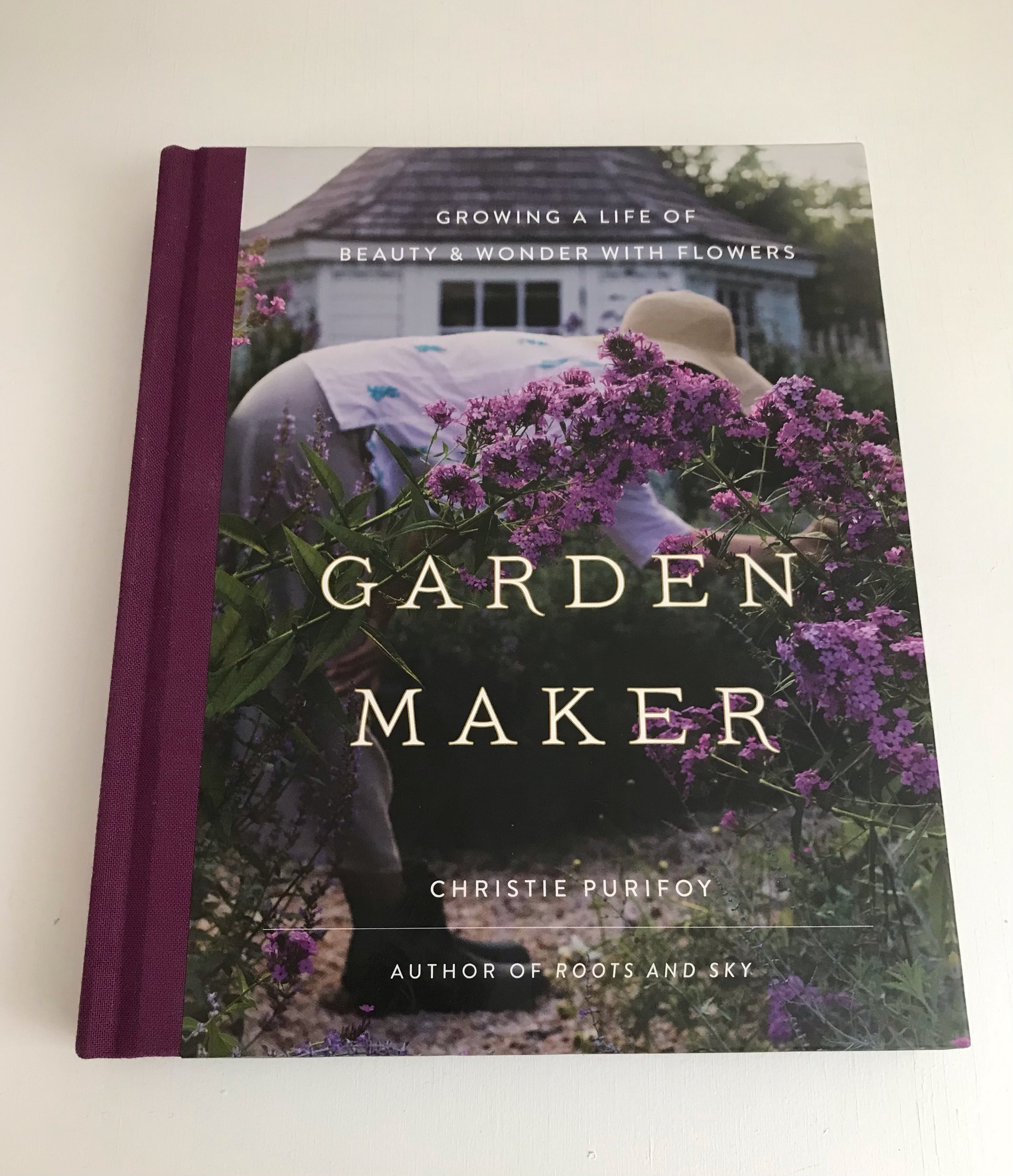
My dear friend gave me this book. I have been enjoying reading it- not only for the gardening advice but also for the life lessons.
Are you a gardener? Do you like to feel the warm earth in your hands? The smell of soil and mulch? Revel in the warmth of the sun on your shoulders and face?
While the contractors still have a punch list for finishing the house remodel, we have finally moved in most of our items, unpacked the boxes and have put away our things. It is now time to turn my attention to the outside of the house: the side and front yards. I have so many ideas in my head but I know that I need to edit them down. So, I’ve tried to make a list of what flowers I like, what flowers will do well in our location and what would look appropriate/in keeping with our older home. I also want to reduce as much of the grass/lawn as possible, add wildflowers for the pollinators and perhaps try my hand at vegetables.
Over the years I have read a plethora of gardening books, magazines and articles. There is nothing more satisfying than turning the glossy pages containing brightly colored, beautifully photographed lush gardens. I am a sucker for cottage gardens. Probably due to watching too many English murder/dramas in my youth, but I absolutely love the look of cut wild flowers overflowing in a ceramic jug- bringing that wildness indoors.
Regardless of the style, the “experts” recommend that one starts with a plan and a garden design. While I would love to have a plan, I am really a what-the-heck, just-plop it-in, type of gardener. When I have tried to design a garden, I start with the intention of beautifully drawn, recognizable plants, all set in an easy to follow garden plan but alas, I generally end up with a page of scribbles.
What I like about gardening is that there are so many life lessons. One learns how to: be patient, be creative, stop and witness wonder, share, nurture a living thing, stay optimistic, foster hope. In addition, there are so many physical and mental benefits of being outside and working “the land” even if that land is a small terracotta pot: reduce stress, improve immune system, lower blood pressure, improve mental clarity, among other things.
What about you? Any gardening plans this spring/summer? Have you ever designed a written plan? What are your favorite plants? Favorite style?
If you have never grown anything or think you cannot grow anything- give it a try. If I can grow plants, you can. Years ago my husband made a cold frame for me so that I could overwinter some plants and get a head start on the spring seeds. Our boys referred to it as “the death chamber”. Need I say more? Gardening produces persistence.
NEWS: Just received my copies of Guideposts, Angels On Earth, May/June 2023 containing my article-“The Fun Starts Now”.
Lead With Love
The other day I heard a story about a woman who wanted to do something for her friend who had cancer. Because of the ordeal of the treatment and illness, the sick woman didn’t have a chance to care for her house the way she liked it to be- well-tended gardens, clean and organized inside. Her husband was doing the best he could but it wasn’t just the way she liked it. And while the woman with cancer wouldn’t complain about the state of things, her friend knew that she would be pleased to have some help.
In a spontaneous gesture, while the sick woman was getting a long treatment, the friend called all the people she knew to come and do a blitzkrieg clean/spruce up event at the house. There were people in each room working as well as outside landscaping. When the sick woman drove up to the house she was just amazed and so pleased. The place looked wonderful and she was very appreciative of her friends. Turned out that was the last time that woman was outside her house looking at it because shortly thereafter she died in the house.
As the woman telling the story said, whenever you have a chance, take the opportunity to show love to others for you never know what is going to happen.

I’ve been thinking about that idea of taking the opportunity to love. Just recently we heard of another teen taking his life. Tragically in recent months we have had a number of friends and acquaintances whose family members have either attempted to end their lives or have succeeded.
In all these cases, I have no idea what was the prompting or the inner turmoil these young people experienced. It breaks my heart that they experienced such pain and hurt. Certainly the parents would give anything to turn back the hands of time.
It makes me realize that nothing else matters except love: we are made to give and receive love. Not that it is easy nor is love our emotional default, especially when we disagree with others or don’t really like them. But when tragedy occurs, it clarifies what is truly important.
But how do we express love? Our culture doesn’t do it very well. We either go overboard and “love” something superficial like an item of clothing or piece of cake or have complete apathy and disregard for things or people that don’t satisfy our desires or expectations.
A glance at the various psychological/well-being websites or blogs on the topic of love finds many similar definitions for “how to show love to others”: active listener; celebrate what makes the person unique; keep one’s promises; show trust; be interested in their interests; practice simple acts of kindness; anticipate the other’s needs; value their opinion; encourage the other; want the best for the other; have the other person’s back. As I read through the various lists, it struck me that once again, there is nothing new under the sun. The Apostle Paul shared a similar type list to the Corinthians.
What the Apostle Paul shared and what has been determined by current psychology: love is an action word. It requires us to do something, not just feel. It is not a feeling that focuses on ourselves and our desires. I like the way The Message describes Paul’s letter to the Corinthians:
“Love never gives up. Love cares more for others than for self. Love doesn’t want what it doesn’t have. Love doesn’t strut, doesn’t have a swelled head, doesn’t force itself on others, isn’t always ‘me first’, doesn’t fly off the handle, doesn’t keep score of the sins of others, doesn’t revel when others grovel, takes pleasure in the flowering of truth, puts up with anything, trusts God always, always looks for the best, never looks back, but keeps going to the end….
Trust steadily in God, hope unswervingly, love extravagantly. And the best of the three is love. Go after a life of love as if your life depended on it-because it does.” (1 Corinthians 13, The Message)
Not only does your life depend on a life of love but also the others you come in contact with. As a people reconciled to God and to each other, we need to lead with love and speak (through voice and actions) the language of love to others. Can you imagine how families, neighborhoods, and communities would be if we practiced leading with love? If we showed love when we had the opportunity? If we loved extravagantly?
What about you? Have you ever spontaneously showed love to someone? What happened? What can you do today to lead with love, however great or small, to the people around you? What does that look like?
All of us have the need to belong and to be loved. And all of us have the wherewithal in us to make others feel that they belong and are loved. As is with much of God’s economy that doesn’t “make sense” and turns our logical world upside down, if we lead with love first, love comes back to us.
Season of Hope

A garden of hope: That brown, nondescript bulb planted in the fall becomes this glorious riot of color.
For a good portion of the United States, spring has sprung. While I am waiting for a little bit warmer nights to put out my spring plants, the air and light during the day is definitely different from the winter’s. The outside temperatures might be similar to a couple of weeks ago, yet the air seems warmer.
This week is Holy Week for those celebrating Easter and Passover for my Jewish friends. It is a time of remembrance and hope. As I have been thinking of the events of both Holy Week and Passover, I imagine what a rollercoaster of emotions during that time for those who witnessed it.
I think of the Israelites and how scared and perplexed they must have been during the plagues and with the final plague: applying blood over their doorways so the angel of death would “passover” the household and spare the inhabitants. They needed to be ready to leave their homes at a moment’s notice and travel to only God knew where. Their only experience with God was through oral stories of the "God of Abraham, Isaac, and Jacob”. They would have heard of the stories of Joseph, his brothers and their moving to Egypt. At that time, there was no law or guidelines of a belief system. It was down to individual trust and faith.
For those followers of Jesus, what a week for them: to see their leader triumphantly riding a donkey on Sunday hailed as a King, by mid-week having the sentiment turn with Him being treated worse than a criminal and receiving the worst possible death-crucifixion. Yet by the following Sunday- the most life-altering event happened in history. No more would humans have to be separated from God. The creation is restored back to the Creator. For those followers of Christ, it came down to trust and faith too.
The ups and downs of emotions and experiences. But after all, isn’t that life? Don’t we all have weeks or seasons of life like that? We can experience the most heart-wrenching sorrow and the most profound joy at the same time. I know that I have. On one hand there is hope for a new day and excitement over dawning possibilities but on the other, there is the loss of what might have been, the people we mourn and miss, the dreams put on hold or ended.
Many of whom I know and love are having tough times: anxiety, profound grief, hurting, despair, major concerns, brokenness, or health issues, to name a few.
In our family we have suffered a recent loss. A week that started out with promise has become profoundly sad. Holy Week and Passover remind me of God’s provision and hope for the future even and most especially, during a time of loss. Both people groups in Old and New Testament experienced loss: for the Israelites, loss of their known home and for the Christ followers the loss of their leader. While their experiences and journeys were hard, God provided for them and led them to a place of joy: for the Israelites the promised land and for Christ’s followers, His resurrection.
While questions abound, “Why God? Why do people have to suffer?” it comes down to trust and faith. Trusting that God, the creator, knows the best for His creation and faith that He will act on that best for those we love. Even though life is a roller coaster, the end is the ultimate Promised Land- communion, community and life with the Creator of all things.
What about you? Have your ever experienced joy and grief in a short amount of time? How did you respond?
For me it is comforting to know that my human experience is not unusual- I am not alone in what life throws my way. Nor are you. For me, this season of spring is a season of hope- while I may not understand sorrows and difficulties, I have hope and faith in the One who does understand. Happy Easter.
Trust
How are you in the waiting game? Having to wait for something is in some ways about delayed gratification, something I wonder if I am lacking? When I was a kid, my neighborhood playmate Kathy and I would receive cookies from her mom which we would share equally. It was always a game as to who could make her cookies last. Kathy always won. I would be so frustrated that I never won. What was wrong with me? Only later did I realize that she would hide her last cookie.
Waiting always makes me think of the marshmallow study done over 50 years ago by psychologist Walter Mischel. While the findings and conclusions have been reassessed over the years, I still find the videos of the children and their antics/strategies to not eat the marshmallow before the allotted time and thus, receive an additional one in the end, adorable. When I get frustrated waiting, this makes me laugh: Click here to watch.

How I feel most days as I wait for the remodeling to finish…
Once again, we have had a delay in our remodeling project. I must say, I am really beginning to lose patience over the delays. In all fairness, most of the delays are really out of anyone’s control. Yet it seems, once the wheels fall off the wagon, the whole thing falls apart: one error can cause a whole litany of other problems to happen. I get it. Sometimes that is just the way things occur. I remember when working with clients, inevitably there would be one client, that if one thing went wrong with the care and/or project, then sure enough, multiple things would also be off.
Yet, I also recognize that because of the issues and delays, the final outcomes have been better than if things went according to the original plan. For instance, the snafu with the cabinets caused a reassessment of the type of cabinet for the stove, which now is even a better arrangement and will provide more storage.
But, like the Psalmist I groan, “How long, O Lord…?”
I keep muttering to myself, “trust in God, trust in the process and trust the workmen.” At times I have been discouraged about the whole shebang- moving, remodeling, and the all encompassing energy that both things take. I start to doubt God and myself regarding the call to move.
Then I get an affirmation from the place where we live- the beauty of the surroundings or the friendliness of the neighbors. Reminders from God that we are exactly where He wants us to be at this time. I begin to remember God’s faithfulness in the past. Not just to me and my family but to my spiritual family and friends as well as the stories of the faithful in the Bible.
I have been reading about Joshua and Caleb- the only two spies who, after coming back from the reconnaissance in the Promised Land, were encouraged that through God, the Hebrews could overtake the area. All the other spies incited the people to reject what God promised and not trust that God would do what He said. Because of that, God decided that the whole generation would not enter the land. The Hebrew people would have to wait for the next generation to receive the Promised Land. Only Joshua and Caleb would be allowed to enter with the new generation because of their trust in God.
Only recently did it dawn on me, Joshua and Caleb had to wait forty years before the Promise came to fruition for them. They didn’t do anything wrong. In fact, they were doing everything right and yet they still had to wait. Even after entering the Promised Land it took some effort and time before things settled down and there was a period of peace.
What about you? Have you ever had to wait for some dream or plan to come to fruition? How did you handle the waiting time? Are you more like the marshmallow children, sneaking in a bite or two or more like the hound- waiting patiently for something to occur?
Interestingly that this week’s chapter in my Bible Study book was all about waiting. (Tish Harrison Warren, Liturgy of the Ordinary: Sacred Practices in Everyday Life) The author reminds us that waiting is active and purposeful like a fallow field. Even when a dirt field appears to be dormant, there are microorganisms, fungi, insects, wind and sun all readying the soil for planting.
When I am impatient, I need to remember: my past and God’s goodness as well as His goodness to others. It gives me hope and helps me to be patient and trust God.
Tertullian, an early (160 A.D.) Christian author from Carthage, states, “The singular mark of patience is not endurance or fortitude but hope. To be impatient…is to live without hope. Patience is grounded in the Resurrection. It is life oriended toward a future that is God’s doing, and its sign is longing, not so much to be released from the ills of the present, but in anticipation of the good to come.” (Robert Louis Wilken, The Spirit of Early Christian Thought: Seeking the Face of God.)
May we all look forward to the good that is to come.
Civility

You too can have your very own British bobby watching over your garden. Only $1,424.50 on Amazon.
Civility. According to my Webster’s, civility is defined: “deference or allegiance to the social order befitting a citizen. Civil government or polity. Solidarity of civil rights and obligations and civil justice in the civil order.” In some interpretations, it is being polite and showing good manners regardless of how you feel about the person.
Many years ago my husband and I watched a documentary about the British policeman, the “bobby”. It was narrated by David Niven. In it, he remarked that the bobby was trained with the golden thread of civility. It was his demeanor and his speech that was considered the bobbies greatest tool in policing.
In trying to find that documentary I found another one: “The History of the British Police Force”. (https://www.youtube.com/watch?v=9P48YT61zII). In that history, the founder of modern day policing, Sir Robert Peel (why British policemen are called “bobbies” or “peelers”) wanted a trained professional force. He felt the emphasis should be on crime prevention by having a police presence in the community through walking a “beat”. He had them wear uniforms that looked more like civilian clothing rather than the traditional military uniform. He felt that the attributes of the officer should be to remain calm, quiet, determined and at all times keep one’s temper. In the history of American policing, similar to our laws, some of the British attributes were incorporated.
Lately I have been thinking about the various police/civilian encounters that have been in the news, especially the ones that have led to loss of life. How did they go so wrong? Is policing a profession? Are we back to just a free for all, much like the wild west? How can officers keep the peace and remain calm, when sometimes those they are helping are violent and disruptive? How can the public remain calm when the police seem violent and disruptive? Is it too much to ask?
I cannot imagine what the police officer must go through. To think, everyday they have no idea what result will be with any encounter they have. Their actions or speech might lead to theirs or a civilian’s - death, dismissal, maiming, or being critically injured. Their experience must be similar to the adrenaline pumped war preparation that military personnel encounter. And for police officers it is every minute of every day that they are on duty.
But then, I think of those of us who encounter the police. Isn’t there some societal contract that we are entitled to dignity and respect from the officers? Shouldn’t there be some type of civility? Aren’t the police the “helpers”, trying to find the root of the problem? Displaying a calm, quiet, but determined demeanor?
I think of our contractor whose mother had a horrific encounter with the police. A physically disabled woman due to a stroke, she had traveled out of state to visit with a friend. On arriving in the town, she felt ill and was taken to the hospital. At the hospital they said she was okay and discharged her. Still not feeling well, she took a cab to another hospital in town who kept her overnight. In releasing her the next morning, she did not want to leave saying she still felt ill. The police were called and from that moment on, her life changed dramatically.
The body cam footage from the police was released and through it you can see the physical decline of the woman. Eventually she lost consciousness in the back of the police car, was taken back to the hospital, coded numerous times and was admitted to ICU. She never regained consciousness and died in the hospital. What is so appalling is the treatment she received from the police. The didn’t cause her death, per se, but they certainly didn’t help her.
I think it mostly comes down to lack of training of the police in handling a person with physical ailments and a basic civility of showing respect to her even if they are biased. It was if the police pre-judged the situation without really discovering the problem. They treated her as if she were homeless and therefore less than human. I believe if one of the officers just asked her, “Is there anyone we can call for you?” they might’ve held off a horrific situation.
And while there are a multitude of police encounters with the public every day that go according to procedure with no incidence, when they go awry, it is heartbreaking. For the individuals involved and for all of us as humanity. It becomes a chipping away at the common decency that we should try to uphold: treating others as we would like to be treated. All of us can chip away at common decency through our uncivil actions, but when the actions come from a position of authority, it is more of an erosion.
Yet, I need not be too quick to point any fingers. As the adage goes, pointing a finger at someone, creates three fingers pointed back at yourself. I think of my thought processes when I see someone on the street or someone in distress or even witnessing those encountering police. Do I see them as someone’s child? Parent? Sibling? Do I pre-judge before I even encounter them? Do I not want to be bothered to step out of my routine to help another? Had I witnessed what our contractor’s mother experienced, would I have spoken up in the middle of an encounter seemingly going wrong? Do I take time to discover someone’s story?
What about you? How are you with all the news stories of police encounters? Outraged? Troubled? Numbed? Apathetic?
What can we, the public do about this? Demand reform? Ask for more training? Think it is someone else’s problem? While I am focusing on the police’s response, there are many questions throughout this whole incidence that poses questions about responsibility: What about the hospital? What about the family? What about the assisted living facility that released her? What about the airport and the policies to assist those who need it? What about the individual herself?
In the alumni magazine for my husband’s alma mater, there was an article highlighting a woman who is using her acting and theatric training to help the police train and roll play the type of situation that our contractor’s mother was in. http://www.twopenny.org/home.html. While it is just a drop in the bucket of a complicated problem, it is a start.
Our contractor has said to us that they just want to see processes and procedures change. I get it. Sometimes we cannot do anything about the current situation- as another adage goes, “it is what it is.” But we can try and make changes so that someone else does not have to go through the same heartbreak- willing to look past our own pain to insist on change for the sake of others and the social order. Perhaps that should also be part of the definition of civility.
Just Right Moments

Am I the only one who feels like she is treading water? Bicycling my legs and pushing myself up through the water for a brief gulp of air only to find myself sinking down and needing to continue the process. The demands of schedule and responsibilities feel like water rising above my head- the moments fraught with anxiety and fears of expending a lot of energy.
The last couple of days, I feel that I have no wiggle room in my life- room for large crisis or small interruptions. Without that wiggle room I am edgy and annoyed. My usual pleasant demeanor becomes morphed into a state of irritability. Not how I want to live my life.
Do most people live with margins in their lives? You know, the type of buffers that allow for a day to go smoothly: running a timed errand but able to chat with the elderly neighbor, a functioning car, relatively healthy family members, no pay-check-to-pay-check worries. Or are they so stressed that there is no down time or any time in case something in their tightly woven lives becomes unravelled.
I am not talking about the circumstances that happen regardless of preparation or planning- circumstances, accidents, situations that pull the rug under our feet and are generally controlled by other people and totally out of our control.
I am talking about how we spend and plan our days, how we can control for some “disasters” and how we can give ourselves some breathing room.
Not only have I not felt any breathing room lately but I have noticed it among our workmen. Pretty much, every one of the workmen who has come to our house has had some type of story, tragedy, recklessness, life change, or day-to-day problem occur. While the issues get resolved, it does impact their completion of work. And while it is also understanding that “this is life”, I wonder how many of us are living without any wiggle room or margins in our lives which then in turn impacts our day to day functioning? How much do I give myself for wiggle room?
At the library book club we are reading Julia Alvarez- In the Time of Butterflies. I had read it years ago when it first came out. At that time I had trouble getting into it and so I cannot remember the thrust of the story line. But this time I have been moving along with it and have enjoyed it. There is one scene in the beginning where an American reporter is making plans to speak with the surviving sister of the tragedy (which enfolds throughout the book). The American asks for a specific time for the meeting. The interviewee who is living in Dominican Republic thinks, “Oh yes. The gringos need a time. But there isn’t a clock time for this kind of just-right moment.”
While I am too much a product of time, schedules, planning, etc, I do see the value in not being so beholden to the clock. To allow for the “just-right moments”. Our dear friend Jim lived in
”just-right moments”. He seemed to balance spending time with others and getting things accomplished. When one was with him, one never felt rushed in the conversation or that Jim had something else to do. The time spent was important.
I was reminded of this type of balance at our last small group meeting. One of our members was explaining the encounter he had with some folks he knew but not well. He had to deliver an item to them and planned to spend some time talking with them if need be. He said that he had a lovely long visit and really got to know them better. Of course, he added, he has the luxury of time now that he is retired.
Made me think- do we really have to wait until we are retired to plan our days and time so that we do not feel rushed? I know that when I feel rushed- and mostly it is a self-imposed deadline- I feel frustrated when I get “held up” with unforeseen circumstances. I feel agitated at others who are “in my way”. It is in the rushing that I feel like I am treading water.
What about you? Do you have margin in your life? With your schedule? In your finances? With your emotional bandwidth?
I have realized that for me, having an organized, relatively clutter-free surrounding provides some margins: I am not spending time retracing my steps for keys, tools for a project, or any other type of object. As the physical items are “under control”, I am able to handle other types of situations and not feel pushed to the edge. It is a daily process, yet I am trying to live into those “just right moments”.
Exciting News- Just received my copy of Signs & Wonders.


Funda

Would you describe learning as fun? Recently I heard of a storytelling program that is called Funda-using the Swahili word for learning. The founder explained that it is through storytelling that our earliest ancestors learned about their surroundings, backgrounds and beliefs. She likes the word because “fun” is a part of its spelling. And shouldn’t learning be fun?
I was one of those kids who enjoyed school and learning new things. Still do. For me, learning something new is part of an ideal day. But learning takes many shapes and experiences, not all having to be in a formalized school setting. Once, in one of my snippy teenage quips to my mother, I told her, “I am not going to school today. School is getting in the way of my education.” I cringe now when I think how I spoke to my mother but my sentiment was that, at the time, the competition in my high school was driving me crazy and I needed a mental health day (not that I knew what that was at the time.)
There is knowledge from reading. From watching. From hearing. From questioning. From experiments. We learn from experience, we learn from others and we learn from “being taught” in the traditional school model.
It is hard to get back in the learning mode once one has left the “formal” school model yet we all can be and should be life-long learners. We have dear friends who are the epitome of life-long learners. For years, their travels involved learning all they could about the visiting destination even the most obscure detail. Their thorough preparation increased the enjoyment of their experiences.
Sadly, when our son tried that method with me, it did not go well. On our trip to Austria, our son, who had studied there, had very kindly printed out a history of the Hapsburgs. It was a large tome, neatly clipped in a binder all ready for reading. He gave it to me with plenty of time to read before the trip, but with one arrangement or another, I did not have time to look at it. I thought I could peruse it during the flight over, but I pretty much slept during the trip and quite frankly, the info was dry as toast. Upon arriving and visiting some of the historic sites, I asked a question. “Didn’t you read the book?” my son asked. He was quite exasperated. “I didn’t know we were having a quiz!” was my response.
For me, reading has always been one of the ways I learn new things. However I am finding that lately I engage in short bursts of information- whether that is written or through video. I wonder if my shortened attention span has become learned behavior due to social media? Losing focus as I age? Or just out of practice and habit?
What about you? When was the last time you had fun learning? Ever? Have you ever wanted to learn something just for the learning process? What would you like to know? How can you go about it?
Many years ago I read a book in which the author would describe, “creative excursions”: little trips that expand our minds. Perhaps like my life-long learner friends, we all should practice going on creative excursions: daily informational sessions that help us grow. Perhaps we should have our daily “funda”.
Here are some ideas for learning:
Local art museums- many times they offer free lectures (on site) or videos through their websites.
Enroll in Masterclass ($) (masterclass.com) or other “masterclass” type paid video content.
youtube offers a plethora of informational videos: TedTalks; language videos; how-to videos; most college/university have uploaded some courses.
Recently I discovered: jeanneoliver.com (creative collective- free and $ classes).
Local community colleges, recreational centers- offer various courses (in-person and online).
Local library- besides books, many offer classes or workshops.
Trade a skill with a friend- do you know how to do something? Your friend knows something else? Teach each other.
Ask questions: If you see someone doing something that is interesting or know that the individual has a specific skill or knowledge- ask them questions about it.
Engage a friend to join you on your learning quest.
Smile
The other morning I was painting some molding for our basement remodel and was listening to some music. The song, “Smile” came on and perhaps for the first time in all the years that I have heard it, I listened to the words.
In some ways, it has a universal truth: smile even when you do not feel like it. Of course, that doesn’t mean to submerge your feelings. When we are at rock bottom- whatever the cause- we might not be physically, emotionally or spiritually able. But, I would contend that some times we are just being ornery- we want what we want and we want to be annoyed, angry or upset. We just like living in that pit.
I know that I sometimes feel that I just want to stay annoyed and mad at the world, and so I go about my day with a scowl on my face. I get so caught up in my own concerns, ruminating over the seemingly unfairness of life that I forget to smile.
In our old location, it was easy to go about with a scowl on one’s face. It seemed that many people I passed did. When I would smile and say hello, most generally I would not receive any response. Just a head down and a quick walk away. After receiving that type of response, it was easier to not even try.
These last couple of years with our masks and face coverings have brought home to me one of the many things that we lacked due to Covid: smiling and responding in kind. Sure, you can see the crinkly eyes above the mask, but it is not the same as seeing the upward curvature of lips, white teeth and perhaps a dimple or two. It is a joy to see a whole person. In person.
In our new place, I have yet to find too many taciturn New Englanders. Most are ready with a smile and hello. Not all. There is a curmudgeonly receptionist at one of the building centers with whom I have had to interact. Not exactly unpleasant. But not pleasant. Of course, this isn’t a scientific study with controlled variables. Since moving up here I am practicing smiling and greeting with most everyone I meet. And I usually receive a response back. Sometimes it is a lovely little chat or some interesting information about the area. Almost every encounter makes me feel good.
I think smiling makes us approachable. It draws one another into community. I think people notice people who smile, which in turn gives the smiler confidence. It also gives the one who receives the smile, confidence: both individuals are noticed. Isn’t that the beginning of community- seeing each other. Of course, the skeptics could say by smiling at all sorts of people, one can attract all sorts of people and maybe not the type one wants? But I think it is worth the risk.
The other day I was coming out of a store and an older looking Asian gentleman was walking in. I smiled and said hello. He stopped. Smiled. Proceeded on his way and then turned, in halting English and said, “Miss (that word alone was worth the smile!), do you know where Alton Avenue is?” And so I engaged with him, trying to find the address on my phone and to give him directions via words and gesticulations.
Of course, I will never know what happened after he left the parking lot. Hopefully he got to his destination. Still, those encounters are the filaments that connect each of us. It may seem small and insignificant like a single embroidery thread, but when we interweave our threads, we have a stronger community tie and a much richer tapestry.
What about you? Are you a smiler? Do you speak to people when you are out? To the grocery checker? The waitstaff? The neighbor you pass on the street? The homeless person sitting at the corner? Your family member or roommate?
I am going to try a 30 Day Challenge: To smile at those I pass during my day to day activities and invite you to do the same. It will be interesting to see what is the reaction and how the smiling changes or doesn’t change the outcomes of our day.
Benefits of smiling:
Live longer
Relieves stress
Elevates mood
Is contagious
Boosts immune system
May lower blood pressure
Reduces pain
Makes you attractive
Suggests success- confident
Helps you stay positive
https://online.uwa.edu/news/benefits-of-smiling-and-laughter/
https://www.hopkinsallchildrens.org/Patients-Families/Health-Library/HealthDocNew/Good-Reasons-to-Smile
https://www.hopkinsallchildrens.org/Patients-Families/Health-Library/HealthDocNew/Good-Reasons-to-Smile
Happy Accident

When our family gets together we have odd discussions. Although, the more I live, the more I realize that every family has odd discussions in their own way. It’s a slight different variation of Tolstoy’s idea of happy and unhappy families, yet the point is that the way families interact are sometimes similar.
Over the holidays we were all enjoying a delicious cheesecake made by our son. As we ate, we started wondering-what exactly is cream cheese? Which then led to a discussion of how does one make any type of cheese? Which generated a discussion of rennet and what the heck was that? [Rennet: curdled milk from the stomach of an unweaned cow. It contains multiple enzymes which aid in the process of curdling the casein (main protein) in milk.]
As we all remarked and wondered- how did this first happen? Who “discovered” the process and more perplexing- who was brave enough to eat it? Perhaps many, many years ago in slaughtering a young cow, it was noticed that part of its stomach (there are four stomachs and this “rennet” is found in the third chamber) had a “curdled” type of milk? Or did some of the contents accidentally drop into a bucket of milk and then it was noticed that the consistency changed? Was it just by accident that the curdling and rennet were discovered? Certainly that discovery has changed the way people eat.
So many processes, inventions or ideas that were happy “accidents”: fluky things that happened which totally changed an outcome. Or what was originally planned was not the final outcome. New ideas developing from planned ideas not going quite as planned. It reminds me to not hold too tightly my plans, ideas or schedules.
A new year always brings about a demarcation: time to think of what went on in the past year and what ideas or plans for the future one. New Year’s is a time to reflect on those things: what to discard or to keep and what ideas or thoughts to investigate in the coming year. Many people like the one word idea of “resolutions”: one word to describe either how they will behave, think or react in the new year. The cream cheese makes me think of two words: happy accident.
I am reminded that if we look for it, we can discover new possibilities. I know that it is so easy for me to be so focused on what I have planned and ensuring that things go according to plan that I can miss seeing the beauty of something new and different.
Certainly with this ongoing house remodeling I have been a witness to many a happy accident. Much of the project has not gone according to plan. But, when all is said and done (and we hope that will occur before next new year!) what will be accomplished is more (and better) than we originally planned. I am always reminded of a dear friend who said many times the projects that she was involved in would have some type of snafu. But, the remodeled-change-in plans was almost always better than what was imagined.
What about you? Have you ever stumbled upon something that was better than originally planned? Or you discovered something completely unintentionally?
So for this coming year, I am re-thinking the planning mode in my new year’s goal. Trying to be a little less anxious over controlling outcomes and more present and aware of each day as it unfolds. Whatever will happen, will happen and to let it be.
For who knows what happy accident is just around the corner?
400 Hundred Years of Waiting

Merry
Christmas
Blessings and Peace to You and Yours,
Virginia Ruth
I have a confession to make: I am an extremely impatient person. When I get an idea, thought or project in my head, I am like a dog with a bone- holding on to that idea until I can do something with it. As a friend once said to me, “you don’t let grass grow under your feet.” Some of that “get it done” mentality was learned during my years nursing. In caring for others, if I thought of something to do and had the time, then I had do it because that time would not come around again. For me, once I have an idea I am ready to work on it and then finish that idea, thought or project in order to move on to something else.
Lately, the problem I am having is that I have had to wait on others, namely the workmen to complete their work, in order for me to begin my various home projects. But in waiting for others to do something, I really cannot have that impatient “just do it, darn it” mentality towards them or at least to expect them to have my similar mentality. I need to have a little more grace and patience.
And so I am finding myself trying to patiently wait. And that is really difficult. I find myself struggling each day to not massively complain. The disarray of our home continues and if possible, has become even more jumbled. Just when we thought we had some type of organizational “system”, some new problem has been discovered or items, like the kitchen cabinets will arrive and we have to push more things aside and on top of each other. In the words of the Christmas story, “there is no room in the inn.”
In the preparation and waiting time that is called Advent, I have been thinking about the Israelites and the waiting that they had to do over the many, many years. In fact, there is about four hundred years between the Old and New Testament when nothing is recorded. Four hundred years of silence and seemingly inaction from God. Talk about waiting!
You wonder-how did they handle the wait? Tell stories of the past? Plan out scenarios for the future? Massively complain? Where are You, God? How long are we to wait until we hear from you? How long before the Messiah comes?
God is the maker of sound and silence. As noted in Ecclesiastes (3:7): there is time to keep silent and a time to speak. In the past, God had spoken to His people through multiple prophets about returning back to communion with Him, yet the people remained stubborn in their own ways. It was now time to keep silent. Similarly, there are times when we can say only so much to our family, friends and loved ones. We may have cajoled, threatened, bargained or pleaded but eventually we just need to keep silent and let the consequences or things happen as they do.
All we can do during that interim waiting period is pray, hope and love.
I guess during my waiting time- which is by far NOT at all 400 years or at least I hope it won’t be!- I need to learn the lessons of patience. I am trying to be understanding when unforeseen things happen to either our workmen and their families. To pray for them and for their safety. To know when to be silent and when to speak.
It is good practice for me to hand over control of these uncontrollable situations. As I am learning more and more, we really have no control in life. The only thing we can control is how we handle the situations- our responses and attitudes. For me, I am struggling to handle my present situation through prayer, hope and love. I know that the more I practice these types of responses, the better I will be in handling future uncontrollable situations for myself and for family.
The thing is- the waiting time will end. For the Israelites, God did not remain silent. Nor does He remain silent to us. When Jesus was born, He fulfilled hundreds of years of prophecy. His birth, life, death and resurrection were all part of God’s rescue story for both His “people”- the Israelites, and also for us.
The beauty of Christmas is that is a yearly reminder, lest we have forgotten, that God IS with us- Emmanuel. The waiting time is over. God has spoken. We can look forward to the new life (and new projects) that God has in store for us. Merry Christmas.
While I was shopping for some holiday decor, I noticed the following display on the wall:

Oh the irony. Made me laugh but also made me think based on our Christmas consumerism (just seeing the long lines in the store) that we do believe that Christmas is what we can purchase.
It always amazes me that every year there are more and more items for sale for Christmas and those items are offered earlier and earlier. Seems to me, what most of the commercial items are representing are memories: you too can have the smiley, polished, beautiful family gathering if you give this game or toy to your children or surprise your loved one with some jewelry or decorate your house as if it were a Hollywood set design and gather around a holiday-themed groaning board of a table.
We all long for nostalgia of some sort. But some people have no history to recall or one that they would want to repeat. More than that, I think Christmas epitomizes our need to belong. I am aware of news stories, comments from people on the street or even looking at advertisements- people want to be recognized, to be heard and to feel part of the group.
I know that I feel that way in our new situation. It is nice to be seen and known. I was gobsmacked when walking on a different street from where we live, our letter carrier called me by name shortly after we had moved in. I had only met him once and I would’ve thought that seeing me out of context, my name would’ve been out of his mind. I had a similar experience when the town librarian called me by name after only meeting her once. (Maybe remembering people’s names is not as unusual as I think. Maybe it is only I who has a brain sieve for name recall?)
I find it interesting that many various psychological studies and articles speak about our basic need to belong: to feel connected to others and to be known. Part of the sense of belonging is feeling that one is connected to a group or ideal bigger than oneself. In doing so, we receive the sense that we are not alone in this journey called life, that we have some purpose and a sense of unity and values with others.
It is no surprise then that the need to connect drives behavior which is something smartphone technology (and advertising) has exploited. Phones, apps and social media are compelling to the individual because they allow one to be seen, heard and considered by others. The problem is that the individual does so in a vacuum. One can tap and send off any harsh or critical epistle thinking that others will react (which they might) but overall there is a lack of graciousness and consideration in this type of belonging. Even in the technology of the “old days”, one could hang up the telephone on another. It was just a voice on the other end and therefore one didn’t really see the others’ reaction.
There is something about being together and face to face in our interactions that gives us (or should give us) pause. Looking into another’s eyes when delivering difficult news or even a disagreement softens our words and helps us extend grace towards one another. In real life, (not the feigned, drama riddled reality television or the “perfect” instagram lives) we have lost the ability to have true conversation: agreeing to disagree or sharing an alternative point of view in a safe, loving environment. When we feel that we belong and that we are accepted, we are able to do so.
This past weekend we visited and spent some time with our small group from Maryland. Our small group has been together for a long time and has shared a lot of living. One of the purposes of the group is to journey through life together: encouraging one another, learning more about God together, holding each other accountable and sharing our joys and sorrows. One of the most fascinating phenomena to me is how a group of seemingly dissimilar individuals can form a bond of belonging. These are “my people”. In some ways we don’t look like we go together: different ages, life experiences, political beliefs, lifestyle beliefs but we are all bonded through our love of God. While I knew this to be true it wasn’t until we were driving back home, I realized that the group is truly family: a safe place where we only want the absolute God’s best for each other. It is the briefest glimpse of heaven on earth- the time when humankind is reconciled to God and to each other.
One of my dearest friends gave me a book for my birthday, “Start with Hello”, by Shannon Martin. I am looking forward to reading it.
From the back excerpt: A simple path to a more deeply connected life. You want more. You want to belong to a community that looks out for each other. You believe in your bones we don’t have to live detached, distracted and divided. The question is, How? Shannon Martin invites you into deeper connection through simple resets.
While some of the suggestions are familiar, the book will be helpful to me in meeting people in our new situation. In some ways, it is easier for us to greet and meet people- we have the excuse of just arriving in our neighborhood. It would be rather awkward when one is established to go back and reintroduce oneself. “Excuse me, I have lived next to you for twenty years and I still do not know your name.” (which, sadly would be my case if we were still in our old neighborhood.)
May this Advent season be a time when we practice our “hellos”. May we cultivate a sense of belonging with the people we meet: to let others know that they are not alone, that we hear each them and that we want God’s best for them. And that doesn’t come from any store.
Turkey Day

While this is not our deck, apparently the poop deck must be a common occurrence! Found a bunch of pictures of turkeys on a deck fence in the photo resources that I use.
While you might think Turkey Day aka Thanksgiving is on the fourth Thursday of November, in our household turkey day seems to be everyday.
In the last couple of years, the wild turkeys in our area of Cape Cod have increased like crazy. While it is fascinating to watch them waddle across the road with the “kids” in tow, recently they have become a nuisance to our home. *
Our little home is situated on Oak Street- aptly named due to the numerous oak trees throughout. We have quite a lot of them on our property. Apparently, turkeys LOVE acorns. They provide much needed nutrients for them. Unfortunately, all this eating has certain biological consequences.
The turkeys are very civilized. Not only do they like to eat and graze like normal foraging animals, but they seemingly also like to congregate, sit down and share a meal together as evident by the biological consequences on our deck! Not only did they mess the deck, but left evidence of their presence on every chair and table. With all the nautical themes on the Cape, we officially have a poop deck.
When we first discovered the detritus from their meal, we had arrived at our cottage for the weekend. Needless to say we were not planning on spending the entire time cleaning and disinfecting the deck. Once cleaned, we researched online for ways to discourage them and prevent from happening again, so we set up a very noisy distraction- a line tied with ribbons and clanging aluminum lids. It certainly would be a distraction for us humans as loud as it was.
Alas, on returning the following weekend to our cottage it appeared that the turkey preventer system did not work. In fact, it looked like it might have even attracted more of a crowd! As I grumbled and complained about the mess the birds had made, I looked up to see if there was anything else we could do. “Shoot them” our one son jokingly advised.
It appears that turkeys have a voracious appetite for ticks. So, while I am not a fan of their using our deck for their acorn orgies, I am grateful for their clearing the yard of ticks. I also like the way they aerate the lawn during their foraging sessions.
They have been a reminder to me that problems and life are not so binary- yes/no; on/off; black/white but rather a yes/and. Most times in life, one doesn’t experience absolute problems or absolute solutions. Rather, problems can be seen as yes, the birds have caused a major problem on our deck and furniture and they also remove the ticks from our yard. Many times situations in life are like that- there is some type of benefit even with a problem.
What about you? Have you ever had a situation that seemed to be the worst but discovering that it is not as bad as thought? What were the benefits, if any?
The apostle Paul reminds us to give thanks in everything. (1 Thessalonians 5:18) Sometimes we do not want to- there is too much poop on the deck to find the blessing. But there is something good out of our turkey visits- a decrease in ticks. I was reading a commentary on the 1 Thessalonians verse. Interestingly that the verse uses the little word, “in” as “in everything give thanks”. It doesn’t say “for” everything.
I am sure you would agree it would be very difficult to say, thank you for cancer. That would be too Pollyanna-ish. Rather we can give thanks that while we are in a difficult situation, God is with us in the middle and the muck. We can view the situation and find things for which to be grateful even if the solution of the situation seems unattainable. I do believe God works for good it is just that we might not see it- yet.
So, yes, we have a poop deck and we have a tick-free lawn.
Fun-facts: A group of turkeys are called rafter, crop, dole, gang, posse, raffle. Adolescents are called jakes, the tender young (under 4 weeks) are called poults, females called hens and males, toms.
Debridement

Tools of the Pruning Trade…
Debridement: the removal of damaged tissue or foreign objects from a wound. There are four types of debridement that can occur: surgical, biological, enzymatic, autolytic. While there are different methods, the idea is the same: remove the damage in order to foster growth of healthy tissue.
I like to say the basement debridement for our home remodeling has begun.
Actually it is a demolition but it feels like to me a debridement of a house wound.

One wall- cemented and dry lok (ed-verb?)
While the house is solid and firm (So says our contractor- repeatedly to reassure me, I think. Hope he is not protesting too much) there are some issues that need to be addressed: termites (Yikes! But they have been killed and treated.), some cracks in the foundation (good ole sealing hydraulic cement), old wood, wiring and leaky plumbing (removed and fixed). Almost all of the problems were not and could not be seen on inspection- tucked behind old walls and ceilings. Issues that, giving the previous owners the benefit of doubt, were unforeseen to them as well.
As our contractor began removing the old walls and ceiling and discovering the problem, it reminded me of treating infected wounds: remove the bandage, assess the problem, clean out the infection and then provide optimal healing with treatment and medication. Once conditions are optimal- the new cells form and skin looks good as new. It is amazing. Miraculous in fact that our body heals the way it does. However, if a wound remains untreated and infected, irreversible damage may occur- loss of limb, permanent bodily disfunction and even death.
Our home is undergoing the removal of conditions that over time would eventually harm it if left as is. If we did not do anything now, in a decade or so (maybe sooner?), we could see sagging floors, water damage, mold, mildew, to eventually a house collapse. Our contractor is providing optimal conditions (removing and repairing) in order to install new items (wiring, plumbing, walls) for practical usage of the space. Once he has gotten things “cleaned out”, we will be undertaking the fun project of designing what we want down there: our plan is a guest suite (bath, bedroom, sitting area) in addition to our work area.
I have been thinking about how our lives can be like that: we carry on for years, decades even with non-optimal conditions, many times completely unaware. We engage in physical, emotional, or spiritual behaviors that are working against the structure and foundation of our beings. We need to pull off the bandage (as it were), assess, debride, and engage in fostering renewal. We need to remove and clean out so that the basic foundation is solid and ready for new growth, new experiences, or new health.
Of course, we can think of the “diseased” conditions that definitely need debridement: drug, alcohol, or sex addictions. Conditions that will lead to death. But we may also need debridement in other areas. Just because we ate or drank the same things decades ago, doesn’t mean that they are good for us now. Similarly, activities that we once did may no longer be beneficial to us. Even spiritual practices need some reassessment: a new way to pray or a new look at Scriptures.
Jesus loved to give examples and stories in His teaching. Many times He used the agricultural culture in which He lived as an example. In John 15, He talks about the pruning of a plant to help in its growth. The vinedresser (the expert gardener in a vineyard) knows what parts of the vine to cut away so that good fruit is produced. Similarly, Jesus prunes us- removes the things which are sucking our growth- in order that we may spiritually grow healthy and strong.
But Jesus doesn’t just leave us as a hacked up plant (at least that is what my plants look like when I attempt to prune). He knows exactly what needs to be removed for our benefit. But He doesn’t just leave us there. He provides the nutrients and resources that we need. We only have to ask and to let Him.
In going forward, we only need to continue the relationship (abide with Him). Part of the relationship is allowing to be transformed by the renewal of our minds: to think on those things that are lovely, good, pure, true, and noble which help us build healthy “tissue”.
What about you? Undertaking any projects lately? For you home or self? Physical, emotional or spiritual? How did it begin? Do you have a “wound” that needs to be “debrided and cleaned”? Have you taken an assessment of life lately? Inspect behind the walls and ceilings? Do you need a life contractor or situational pruning?
Sometimes it takes someone else to help us assess what is going on in our lives. You might want to take some time to think about how life is going for you- do you feel anxious, tired, upset? Maybe talk to a trusted friend or family member. Below are different resources I found online that have different questions to ponder:
Spiritual Inventory:
https://influencemagazine.com/en/Practice/Taking-Spiritual-Inventory
https://biblical-christianity.com/spiritual-inventory-checklist
https://www.thenivbible.com/blog/8-point-spiritual-growth-inventory/
Emotional Inventory:
https://abphd.com/wp-content/uploads/2018/05/Emotional-Recovery-Inventory-Form-2014-PDF.pdf
http://csefel.vanderbilt.edu/modules/module1/handout4.pdf (geared for students but could be applied to adults)
Physical Inventory:
Visit your Primary Care Physician for a physical, get your annual screenings, dental check-ups: whatever that might have been delayed from Covid.
The thing about debridement, demolition and pruning- it produces a clean, new area in which to grow and build. Definitely worth the process.
Swaying Palms

U.S. Navy photo by Jim Brooks public domain
Much has been written about palm trees and their symbol of resilience. Palms trees are quite flexible- bending to 40-50 degrees. When heavy winds blow, the palms just go with it. Recently it was reported that the palms in Fort Myers Florida survived Hurricane Ian. Not only did they survive but in some ways the winds helped them thrive, for the heavy winds prune and shape the palms by having blowing off many of its dead fronds.
One of the reasons palms can withstand the gales, is that they do not have branches which can get in the way with wind. I think of our New England oak trees and the branches that have been easily pulled down by heavy winds. Most times the main trunk of the oaks stand firm, but occasionally some of the heavier branches can easily fell the tree, causing a right old mess. But the oaks are quite strong, good for building.
Another attribute of the palms is that they do not have large-diameter singular roots, rather a many smaller-diameter dense root system which spreads out among the sandy soils. This helps the palms stay planted on the ground. In a sense, their roots are like a multi-four point cane rather than one-tipped cane.
In general I am not been a big fan of tropical botany. I like the wild cottage gardens of England and more northern climes. But in reading about the resiliency of the palm tree and the way various tropical plants have developed to withstand the onslaught of extreme weather (monsoons, hurricanes, typhoons, to name a few) I am once again in awe of God’s design.
God made just the right tree to be in that tropical situation. Just like the oak is suited for our climate. It reminds me that there is such beauty and diversity in God’s creation, for each created thing has its special design. Sure, there are similarities among species and even natural design. Why wouldn’t God, in a sense, “reuse” a pattern or process. Apparently the palm is really more related to grasses than to trees (Another reason it can withstand the winds- the cross section of a trunk looks more like a collection of wires instead of rings. Makes me think of the pencil analogy that I wrote about the other week.)
Once again, God’s ways are a paradox: we are each uniquely created by Him and known individually by Him, yet there are many similarities and commonalities among us. We are both similar and different to one another. Perhaps that dichotomy is part of God’s design. By sharing our differences with each other, it helps us learn to adapt and be resilient. Just like the lessons learned from the palm tree:
1) Learn to bend and be flexible. Not only is that a good principle for our physical beings but it is important for our mental health as well. In psychology they call it cognitive flexibility- the brains ability to adapt to new, changing or unplanned events. It makes sense that those who can adapt to those unforeseen circumstances can manage the change better. I think of the first time that I attempted to ski- I was so tense and trying to control every movement down the slope that I ended up falling most of the time and had a horrible day. It was when I finally traversed back and forth down the slope, going along with the ride, not tensing if I seemed to be “slipping” that I finally skied down the mountain and actually enjoyed it.
2) Don’t hold on to branches. One thing that helps the tall palms withstand the wind onslaught is that they do not have spindly branches that can “catch” the wind and so cause them to topple. Because we have had to move all our possessions recently, I have been thinking and doing a bit of reorganizing, removing and ridding ourselves of all this “stuff”. There are a couple of items that as I unpack I think to myself, “Really? You had them move that?” I feel I should apologize to a long ago friend who, when a group of us moved him to a new place, had us move his recycling. There were some of us who grumbled about that. Now finding paper products, such as coffee cups and plates amidst our boxes made me think that I was not too far away from this friend’s mentality- although in my defense, our paper products were unused.
3) Shed those things that are finished. When conditions aren’t good for the palm, it will shed its branches. They are the botanical Goldilocks: too much water- brown fronds, too little water- brown fronds. Just enough- green, healthy fronds. Once a frond turns brown it is dead and is not providing any nutrients to the plant. The best thing to do is to remove them. Hurricanes and high winds are good for the palms as it naturally pulls off the unhealthy parts. I have been thinking about activities and my time. What things that I am currently doing that are not serving me in what I need to accomplish? Are there activities that, while once fine for my situation, are no longer necessary? Do I need to prune them out of my day?
What about you? How are you with bending and swaying when life is swirling around you? Are you holding on to something that is most likely going to break off? What have you learned from others? From nature? From adversity? From others’ adversity? Can you “go with the flow”? Sway along with the storm?
As I am writing this post, our contractor is starting the demoing of our basement. While we know the house is over 100 years old and have expected to find unforeseen problems, the discovery of wet, rotted wood and consequently termites has thrown me for a loop. I have had to remind myself of the swaying palms!
3 Strands
Now that we are ensconced at our new home, I’ve been wrestling with empty cardboard moving boxes. I’ll empty a couple of boxes a day, but it seems as if the boxes multiply. Once I get the empty ones under control, I’ll look at the broken down discarded boxes ready to be recycled and think, “Oh good. I’m making progress.” Then I return to where we have our stacked full boxes and feel an incredible let-down since there are seemingly just as many filled boxes as before.
Breaking down the boxes so that they can be recycled takes some time. The wardrobe boxes and some of the dish/plate ones are quite thick cardboard and difficult to fold. In time, if they get wet they are a little easier to manage but there is no way I can fold into a compact bundle. They are just too thick.
As I am wrestling to try and fold the cardboard, it makes me think of Ecclesiastes 4: 12, “though one may be overpowered, two can defend themselves. A cord of three strands is not quickly broken.” The multi-layers of cardboard are difficult to maneuver and manipulate.
I remember some type of kids’ science experiment about taking a pencil in hand. You can break one pencil in half. It is not too difficult. But if you have a bundle of pencils and tried to break that bundle in one go it is very difficult. Either the bundle needs to be separated into single sticks or you need something more powerful like a saw.
It makes me think of community. A community that is bound together is difficult to defeat. I am amazed at the sheer courage, resilience and hutzpah of the Ukrainians. They are bound together in a common cause of sovereignty.
I think of the communities formed through the openness and honesty of addiction support groups. The bonds among those in attendance are strong.
We need people around us to keep us together: to support one another when there are situations or problems that can seem to break us, to encourage us when we are despondent, to celebrate with us when we are euphoric and to hold us accountable to a higher standard as we journey along in life. Contrary to some beliefs, we do become better people when we live in community. We are healthier and happier.
Studies have concluded that we can live longer (our mortality rate can be cut in half), can double our chance of recovery from depression and even might help us fight the common cold (4.2 times less likely to succumb) when we have a network of friends. Retired evolutionary psychologist, Dr. Dunbar of Oxford University discovered that the biggest predictor of a primate’s brain size was the magnitude of its social interaction.
While I may lean more to the introverted side, I do recognize my need for friendship and community. The dear ladies of my Tuesday night Bible study encourage me each week. Just their presence encourages me to be a better person. I complete my study because I don’t want to let them down. I hear how they live their lives and learn how to adapt some of their principles, strategies and actions to similar situations that I may face. By the sharing of their experiences, I am blessed.
When I think of them, I think of the accountability created by seeing them. Not so much as a scare tactic or negative peer pressure, but more of accountability partners: we are called to encourage one another to become more and more like Christ- to improve the way we live and respond on this life journey.
In the age of “unfriending” it is easy to dismiss a friend because of a difference of opinion. But when we hang on together, even through disagreements, we can be rewarded with longevity in our friendships. How blessed are we when we have life-long friends- people who have seen us “when”, who don’t judge (since we have seen them “when”) and still love us.
What about you? Are you in community? Are they your friends? Do you have a multi-strand bundle of folks who keep you whole?
I think that the lessons learned in being a friend can help society in learning to be a community. For what is a community but a collection of people brought together- whether that is from ideology, geography, ethnicity, interests, beliefs. As all psychology has discovered, our relationships begin at home and venture out like ripples in a pond. I think when we develop friendships and stick with them, we learn that others can enrich our lives. So too, when we reach out beyond the individual friendships and develop bonds with those in our community our lives are enriched.