
Bouncing Back Like Bozo
I have been thinking a lot about the word resilience lately. I guess it is the natural reaction when you hear about all the tragedy and problems of this world- whether it occurs in another part of the country or in your own home. Resilience appears to be the key to moving forward in the face of difficulty, but what exactly is it?
According to the American Psychological Association, "Resilience is the process of adapting well in the face of adversity, trauma, tragedy, threats or significant sources of stress — such as family and relationship problems, serious health problems or workplace and financial stressors. It means "bouncing back" from difficult experiences."
It is not that we try to avoid or can avoid those difficult experiences because frankly we cannot. Change, adversity and stress are givens in our lives. It is not a question of if they will affect us but when? And when they affect us do we adapt or handle it well?
How to we prepare to handle these situations? How do we develop resiliency?
I think there are some basic foundational things we can do to be prepared and adapt to whatever possible stress will happen. I know that in my own life I can create additional stress by feeling disorganized, feeling that I have too much to do in too little time, or by being physically ill or tired.

I think a good way to prepare for stress is to have foundational elements in place in our lifestyle. Kind of like the old Bozo the Clown Bop Bags- those free standing inflatable bags that are weighted on the bottom. You can hit and punch it and it falls over but it always comes springing back to the upright position. Sure, we will have onslaughts in our lives but by practicing crucial lifestyle elements we can withstand the pummeling and bounce back to center.
The first is to be as healthy as you can be. That includes exercise, diet, sleep, balance of taking time for yourself and time for others. Years ago a work acquaintance shared that she had a brain tumor. It was benign but she had to go through surgeries and some follow up care nonetheless. She did quite well in her recovery and attributed it to being as healthy as she can be. "Who knows if I hadn't exercised or eaten well all these years what would've been discovered instead?"
I think too to my post op recovery for my surgery. I have been told that what I had done is one of the most painful procedures a person can experience but I was able to get through it. My healing has been pretty fast. I don't think that it is because I have any special healing super powers but because I am pretty healthy and am used to regular exercise and a good diet. Of course, these last couple of weeks I haven't been able to pursue the exercise as much but the foundations were there. In a sense, I have been pummeled but have been able to come back to center.
If you feel that you are not overall healthy, why not? Has something prevented you in the past? Can you start making small changes?
Start by looking at your current practices: Do you exercise? How much soda and sugar laden beverages or food do you ingest? Do you eat out a lot? How many fruits and veggies to you take in each day? How much sleep do you get? Do you feel drained caring for others? When was the last time you did something for yourself? What brings you joy? Do you volunteer or help others on a regular basis? Does that bring you joy?
As we have talked about before, making changes in our routine can be difficult. Start out small. Plan to incorporate one or two ideas each week. Remember that your goal is to be as healthy as you can.
- Exercise: Walk around your block before dinner, use steps instead of the elevator, do arm exercises, sit ups or march in place during commercial breaks while watching television, do one errand without using the car (bike, walk or run to do it).
- Food: Buy some clementines or apples and leave in a bowl on your counter- reminder to eat healthy snacks. Or any other fresh fruit or veggie. Swap out white flour products for whole wheat. Prepare for the afternoon munchies by having pre-measured cut up carrots and humus, nuts or popcorn as a work snack. Put away the candy dish and give away the extra Halloween candy. If the break room at work is too tempting this time of year, avoid going in. Plan to not bring into your home anything sugary or prepared with more than five ingredients. Drink a glass of water before snacking.
- Sleep: Try to get an extra 1/2 hour of sleep each night. If you cannot commit to that for seven days in a row, try getting some extra winks three nights/week.
- Balance: Figure out what brings you joy and what you love to do. Write in your calendar specific times when you can practice that activity. Look around your family, community, and work for opportunities to help others. It might be writing encouraging notes, driving an elderly person to the store, volunteering at a school, listening and keeping in touch with many friends or a myriad of other opportunities. Helping others is only limited by our imaginations. Schedule these times on your calendar too. A good rule of thumb- make sure that you have just as many outings for yourself as you do for others.
What about you? Do you bounce back like Bozo? Have you developed some basic healthy practices to help? What works for you?
Thinking Outside The Trash Can
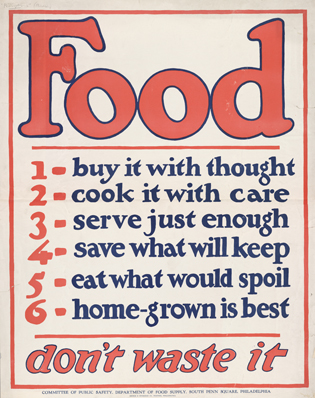
WWII poster encouraging civilians to do their part. Source: http://www.usda.gov/oce/foodwaste/resources/consumers.htm
I guess because it is the holiday season, food has been on my mind. In going to the grocery store these last couple of weeks I am reminded of the blessings of the many many food choices and the quantity of items in everyone's (my own included) carts. There was an interesting article in the November issue of Reader's Digest about ordinary people who are concerned with how we use our food resources and how best not to waste it. These individuals have thought of different ways to either help with the distribution of food or highlight the problem of food waste.
According to the US Department of Agriculture the US wastes between 30-40% of food. Food that is/was perfectly edible gets thrown into the land fills. The USDA notes that in 2010, that equated to 133 billion pounds of food and $161 billion worth of food that was wasted. It is more than a problem of edible food wasted- there is an impact on our environment. As stated on their website, "the land, water, labor, energy and other inputs used in producing, processing, transporting, preparing, storing, and disposing of discarded food are pulled away from uses that may have been more beneficial to society". Food waste is the single largest component going into our landfills causing landfills to be the third largest source of methane production.
On top of all that, there is the problem that people could have benefited from the food. As a country we are blessed with seemingly unlimited food resources, yet there are those among us who do no have enough to eat or enough healthy food to eat. When you think that there are people who go to bed hungry it seems a sin. It is not a question of our country not having the resources, but more of an equitable distribution of the food.
There is a woman from California who has designed an app for restaurants or businesses who have excess food to alert those in need- non-profits, food kitchens, etc. of edible food that won't become food waste. By using the technology of an app, those with excess food can alert those who can distribute it before the food becomes perishable. Her program operates in over 40 cities in Northern California. Hopefully in building an infrastructure in other areas the program can be replicated beyond the California region. Click here to download her app
On the East Coast, a group is demonstrating the problem of food waste by offering dinner in a dumpster. "One man's trash in another man's 6-course meal." They are highlighting the problem by using "imperfect" food in their creative meal plans. e.g. Office Coffee Butter & Recycled Rice Bread -Fresh butter whipped with an end-of-the-day office coffee reduction. Served on freshly baked bread with yesterday's rice or Broccoli Stalk Slaw - Shaved stalk of broccoli and blanched organic carrot peel with a soy-ginger drizzle, topped with black sesame.
They serve the meal in a (sanitized) dumpster. As is only in New York City, it is a big hit. One needs reservations and there is a waiting list. It certainly engages people in a conversation and raises their awareness of food purchasing and food preparation that decreases waste. "Salvage Supperclub exists to create inspiring food experiences with a purpose. We recognize how essential food is to all of us, but believe that the power of a shared meal can (and should) go beyond our base needs. It should not only nourish us but also delight and empower us. We don't just make great food. We put great food at the center of a dialogue about a more sustainable food system. We hope you'll join us." Click here to see their website and pictures of their meals.
The last story was about a former NFL football player who gave up his materialistic life to be a farmer who shares his bounty with others less fortunate. Jason Brown played for the St. Louis Rams but felt a calling to not just use his money to buy food and donate it but to actually be part of the solution. As he says, "I had to be out there doing the work and leading the way." His produce is given to local food pantries, churches and food banks in Eastern North Carolina. His ministry is called First Fruits Farms. Click here to see his website
I have heard of other similar food distribution programs: Campus Kitchen (college campuses give their excess to the local food bank) or Society of St. Andrew (an after harvest, gleaning-the-extra program to gather fresh produce) to name two. On the USDA website there are many other national programs. Click here to see a list of national food recovery programs
What I love about these stories and these programs is that they are comprised of ordinary people. People like you and me who have decided to act on an issue that was laid on their heart. They used their interests, talents and resources to create something bigger than themselves. And, they came up with ideas "outside the box"- looking at a problem in a different light.
What about you? Have you ever had an idea about a social situation? Did it seem impossible to you? Are there others who feel the same way? How can you take steps to try it out? Or can you partner with someone who is already doing something similar?
How are you and your family with food waste? Do you find mystery items in your fridge that need to be thrown out? Do you end up scraping half of your meal into the trash? Would you say that 30-40% of the food coming into your household is wasted? Higher? Lower? Are your "eyes bigger than your stomach" at restaurants?
EPA's Suggestions for Reducing Food Waste:
- Shop your refrigerator first! Cook or eat what you already have at home before buying more.
- Plan your menu before you go shopping and buy only those things on your menu.
- Buy only what you realistically need and will use. Buying in bulk only saves money if you are able to use the food before it spoils.
- Be creative! If safe and healthy, use the edible parts of food that you normally do not eat. For example, stale bread can be used to make croutons and beet tops can be sautèed for a delicious side dish.
- Freeze, preserve, or can surplus fruits and vegetables - especially abundant seasonal produce.
- At restaurants, order only what you can finish by asking about portion sizes and be aware of side dishes included with entrees. Take home the leftovers and keep them for your next meal.
- At all-you-can-eat buffets, take only what you can eat.
Incredible Edible Food
Over the Thanksgiving holiday, our sons were home for a visit. Our one son introduced me to some of his favorite podcasts. One was about a town and its fruits and veggies program. "Incredible Edible Todmorden". It is such an incredible project. What started as a germ of an idea (no pun intended) has been replicated in other communities on almost every continent.

https://www.incredible-edible-todmorden.co.uk/home
According to their website, Incredible Edible Todmorden is "A movement made up of passionate people working together for a world where all share responsibility for the future wellbeing of our planet and ourselves. We aim to provide access to good local food for all, through working together; learning – from field to classroom to kitchen; supporting local business"
It started as such a simple idea. Why don't we plan edible food gardens, open to all, around town? There was usable space in front of the rail station, the police station and the health clinic. And so, a group of volunteers planted raised beds of fruits, veggies and herbs. The results- anyone can pick and benefit from the food. Once they started planting, the question then became- who knows about growing food? The older citizens of course. So, they became engaged. As the community saw how food was grown, the residents became more supportive of local farmers and businesses. In seeing how the community appreciated the food, there was a concern that the local students needed to have agriculture classes and so curriculum was changed and developed for the local schools. There are all sorts of learning going on- from landscape designing, planting, tending, harvesting to cooking and enjoying the fruits of their labors. That simple idea has a multitude of benefits:
- Brings communities together- food is there to share
- Reduces vandalism and crime- people have respect for community spaces
- Engages all walks of life and all ages- their motto, "If you eat, you are in."
- Increases local businesses- the have a food tourisms in their town, people from all over want to see how the incredible edible process works
- Involves all civic entities, like retirement homes and schools - educational programs have been developed for the young people
- Replicated in other towns and jurisdictions- over 120 towns in UK and over 700 globally
What an exciting project. I especially like that the people who became involved had said enough of waiting for the government to do something. They realized that there was a responsibility that we all share with the environment, food and with one another. They didn't wait for permission or grants. They just did it. As one of the founding members, Pam Warhurst, says about the benefit of the process, "once we start the power of small actions, we start to believe in ourselves."
Click here to listen to the TED talk from Pam.
You will be inspired and encouraged. You may not be in a position to have an edible garden or live in a community that does. However, their story might inspire you that by doing small actions you can create change. It will give you faith and hope in a broken world.
Welfare Challenge
This week I decided that my husband and I would try the welfare food challenge (see post Up For A Challenge? February 25, 2016). Our challenge was to eat $57 (allotted $4/person/day) of food for the week. This was our grocery list: ground beef (1 pound); 1 dozen eggs; 2 lbs bags of whole grain pasta; butternut squash; potatoes; onion; celery; strawberries; grapefruit; apples; grapes; red peppers; grape tomatoes; black olives; yogurt; oatmeal; milk; cream; homemade bread; frozen green beans; peas; tea; coffee (using a gift bag); spaghetti sauce; mayo; butter; olive oil.
Our menus consisted of breakfast: yogurt + fruit or stovetop old-fashioned oatmeal or poached eggs, toast, grapefruit. lunch: egg salad sandwiches, any dinner leftovers + grapes or apples dinner: homemade butternut squash soup; spaghetti with meat sauce; pasta with sautéed vegetables (using up any vegetables from the fridge). Some of the staples we already had in the pantry- olive oil, mayo, butter, etc. Actually, I had most of the food already in the fridge- was using up what we had in a different way- I ball parked the cost of the different foods to try and keep under the $ amount.
Of course as we conduct this challenge I am aware that we have a safety net. There is food in our pantry, money in the bank and time to plan our meals. Many of those on welfare have none of those extras. I also know how to cook especially making things from scratch.
This week we also had a few unexpected and un-budgeted expenses. One such occurred while I I was doing my spring cleaning, I broke a glass shade in our kitchen. I can replace it but not everyone has the money for the "extras". Those who are on a tight welfare budget most likely would have to make choices between eating, household repairs, medical expenses, car repairs, etc. Even though food was the only part of the challenge, the extra expenses this week made me mindful of how tight some budgets may be.
It is difficult to eat healthy meals with a limited budget. This time of year we don't have the advantage of farmers' markets or growing our own food. Even if it was harvest season, it takes time and money (purchasing the equipment) to can or freeze food for the future. One can see why some of the working poor have unhealthy eating habits. In order to stretch the budget, sometimes people choose the calorie dense, nutritionally poor choice.
I am glad that we tried the challenge. I would like to practice it again. It provides a tangible reminder of those less fortunate around us. It also is good to assess our eating habits, bills and grocery lists.
Interestingly that this week I came across an article about The Food Project organization. What a great organization- they combine youth, food and community. "Since 1991, The Food Project has built a national model of engaging young people in personal and social change through sustainable agriculture." Young people from a variety of backgrounds come together to learn about sustainable agriculture and the practicalities of farming, harvesting, and selling their produce. Part of the food grown is given to food pantries. The program, through the education of agriculture, is bringing people together while giving them information and skills to practice a healthy, simple, relatively inexpensive lifestyle. The program, through the education of agriculture, serves and builds a greater community. What better way to get to know others, especially those who are different from ourselves, through the working together to provide and share basic resources with one another.